6: Quasi-Experimental Designs
 Call Kai
 Learn
Learn Practice Test
 Spaced Repetition
 Match
Match Flashcards
 Knowt Play
1/10

There's no tags or description
Looks like no tags are added yet.
Name | Mastery | Learn | Test | Matching | Spaced | Call with Kai | Chat |
|---|
No analytics yet
Send a link to your students to track their progress
11 Terms
quasi-experiment has a ______ setting and ____ control
natural, low
things that make a true experiment
manipulation of independent variable (creation of groups/ conditions
random assignment to experimental groups (counterbalancing for conditions)
quasi-experiments
manipulation of (sometimes naturally occurring) IV (existence of groups/conditions) but lack random assignment
NO random assignments to groups (between-subjects)
groups are pre-exiting or participants self-select into groups
NO random assignment to counterbalancing conditions (within-subjects)
less control compared to experiments
more threats to research validity (particularly internal validity)
types of quasi-experimental designs
nonequivalent control groups designs (between-subjects)
nonequivalent groups pretest-posttest
delayed control group designs
designs without control groups (within-subjects)
one-group pretest-posttest
interrupted time-series designs
repeated treatment designs
nonequivalent control group designs (mixed)
(some) mixed factorial designs
multiple time-series designs
nonequivalent groups pretest-posttest designs
allocation to group 1 and 2: any nonrandom method
ceiling effects and floor effects may render results uninterpretable
delayed control group designs
testing of one group is deferred
two groups are tested sequentially with an appreciable time interval between them
one-group pretest-posttest designs
pretest, treatment, and posttest applied to group 1
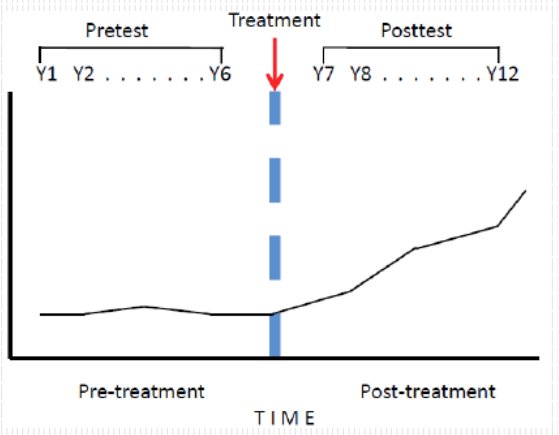
interrupted time-series design
same group is compared over time
consider the trend of the data before and after the treatment
repeated treatment designs
compare participant responses before and after repeated treatments
mixed factorial designs
at least one between-subjects variable and one within-subjects variable
multiple time-series designs
interrupted time-series design with a nonequivalent control group