Physics chapter 8
 Call Kai
 Learn
Learn Practice Test
 Spaced Repetition
 Match
Match Flashcards
 Knowt Play
1/42

There's no tags or description
Looks like no tags are added yet.
Name | Mastery | Learn | Test | Matching | Spaced | Call with Kai | Chat |
|---|
No analytics yet
Send a link to your students to track their progress
43 Terms
other names for toque
angular force
rotational force
Torque, T
the tendency of a force to rotate an object about some axis
torque formula
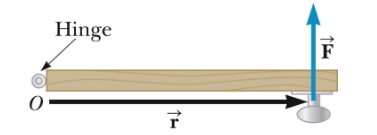
T = r F
T = torque
r = length of the position vector/lever arm/moment arm
F = force
r is the distance axis of rotation to F
SI unit for torque
Newton x meter (Nm)
Force vs torque
forces cause accelerations
torques cause angular accelerations
force and torque are related
torque is a ___ quantity
vector
direction is perpendicular to the plane determined by the position vector and the force
If the turning tendency of the force is counterclockwise, the torque will be
positive
If the turning tendency is clockwise, the torque will be
negative
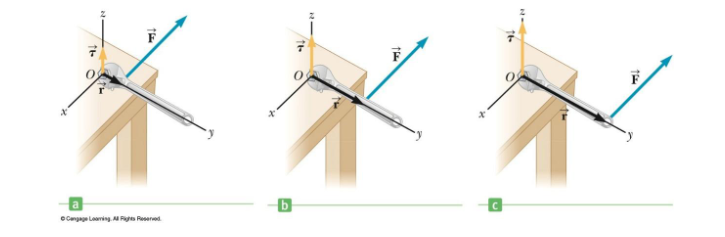
Right Hand Rule
• Point the fingers in the direction of the position vector
• Curl the fingers toward the force vector
• The thumb points in the direction of the torque
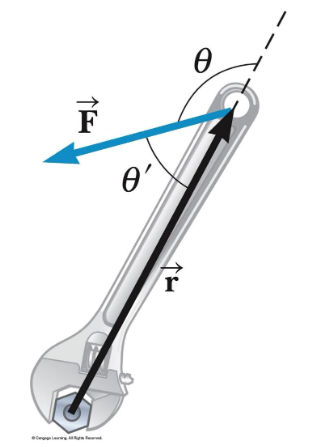
What affects Torque?
• The wrench is free to rotate about an axis through O
• There are three factors that determine the effectiveness of the force in opening the door:
• The magnitude of the force
• The position of the application of the force
• The angle at which the force is applied
changing r affects torque value
In torque, the applied force is not always
perpendicular to the position vector
The component of the force perpendicular to the object will cause it to rotate
W = fdcosΘ
T = rFsinΘ
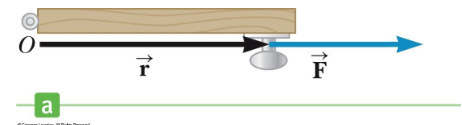
When the force is parallel to the position vector,
no rotation occurs
When the force is at some angle, the perpendicular component causes
the rotation
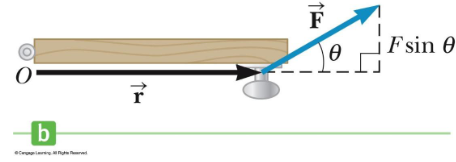
Taking the angle into account leads to a more general definition of torque:
T = r F sin Θ (given on exam)
Θ = the angle between the force and the position vector
Net Torque
When two or more torques are acting on an object, the torques are added
as vectors
If the net torque is zero, the object’s rate of rotation
doesn’t change
The net torque is the sum of
all the torques produced by all the forces
Counterclockwise torques are
positive
Clockwise torques are
negative
first condition of equilibrium
The net external force must be zero
This is a statement of translational (linear) equilibrium

The Second Condition of Equilibrium states
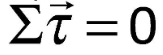
The net external torque must be zero
This is a statement of rotational equilibrium
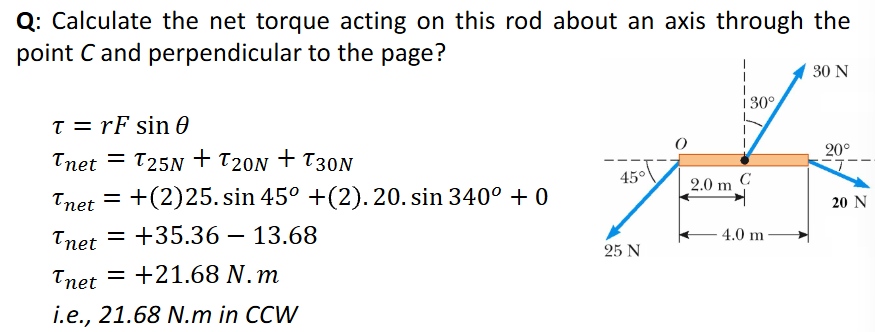
torque math example
Moment of Inertia (aka Rotational Mass)
The angular acceleration is inversely proportional to the analogy of the mass in a
rotating system
This mass analog is called the moment of inertia, I, of the object
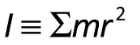
Si units for moment of inertia
kg m2
Moment of Inertia is also known as
rotational inertia or angular mass
difference between moment of inertia and mass
the moment of inertia depends on the quantity of matter and its distribution in the rigid object
The moment of inertia also depends upon
the location of the axis of rotation
A majorette twirling a baton: Moment of Inertia,

The moment of Inertia of a system depends on,
how the mass is distributed and on the location of the axis of rotation
Moment of Inertia of a Uniform Ring
• Imagine the hoop is divided into a number of small segments, m1 ...
• These segments are equidistant from the axis
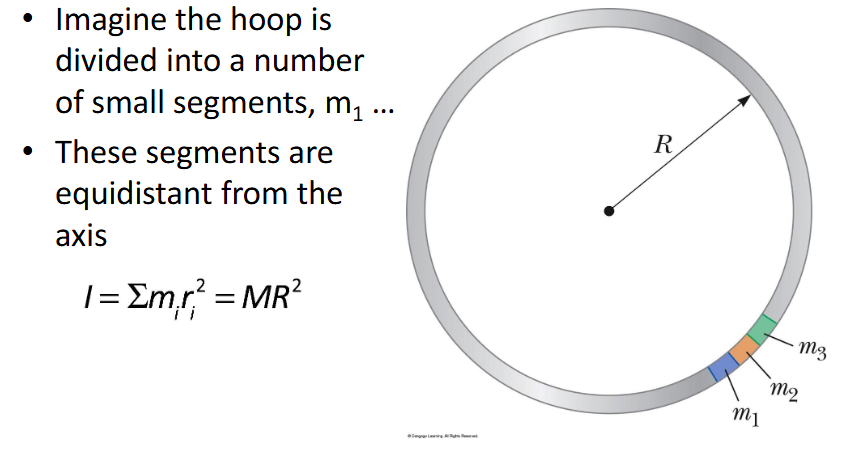
moment of inertia example for rotating object
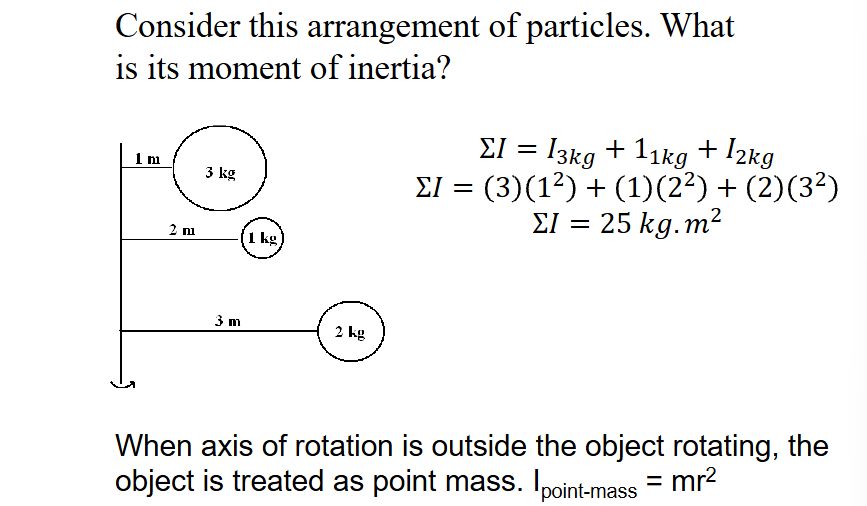
When axis of rotation is outside the object rotating, the object is treated as
point mass
point mass formula
Ipoint-mass = mr2
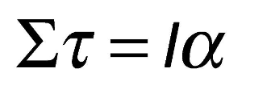
Newton’s Second Law for a Rotating Object
• The angular acceleration is directly proportional to the net torque
• The angular acceleration is inversely proportional to the moment of inertia of the object
like F = ma
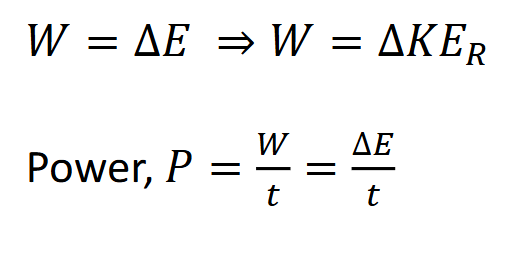
Work done in rotational motion is
W = T 𝜃
T = angular force
𝜃 = angular displacement
SI unit for work done in rotational motion
Joules (J)
Rotational Kinetic Energy
KE = ½ mv2
(since vt = rω)
KE = ½ mr2ω2 = ½ Iω2
• An object rotating about some axis with an angular speed ω, has rotational kinetic energy KEr = ½Iω2
• Energy concepts can be useful for simplifying the analysis of rotational motion
Work – Energy Theorem and Power in rotational motion
Angular Momentum
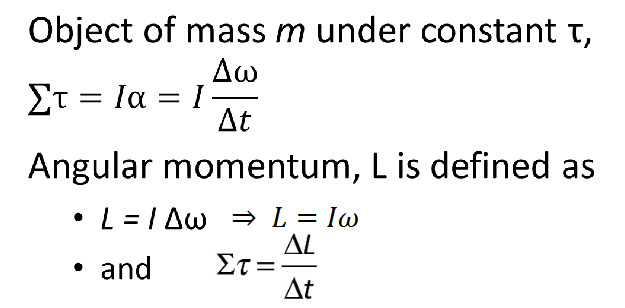
Conservation of Law of Angular Momentum (LCAM)
Applies to macroscopic objects as well as atoms and molecules

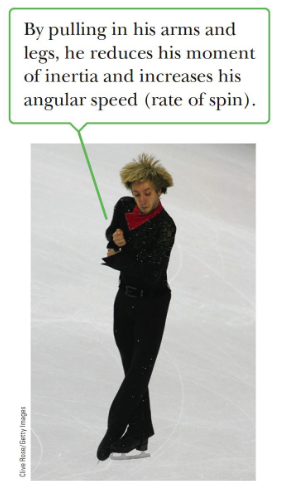
Law of Conservation of Angular Momentum, Example
With hands and feet drawn closer to the body, the skater’s angular speed increases
• L is conserved, I (=1/2mr2) decreases, w increases
𝐿 = 𝐼𝜔
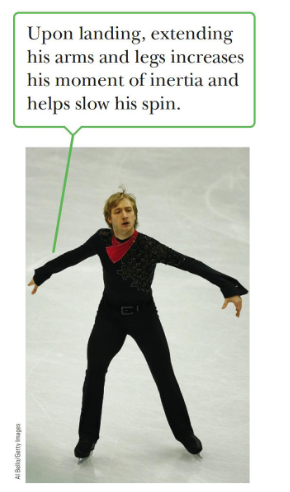
Law of Conservation of Angular Momentum, Example, cont.
Coming out of the spin, arms and legs are extended and rotation is slowed
• L is conserved, I (=1/2mr2) increases, w decreases
𝐿 = 𝐼𝜔
in L = I w, if I increases
w decreases (and vice versa)
in skating example, spreading hands out increases I which decreases w