PROTEINS - chapters 3-6 Lehninger principles of biochemistry
 Call Kai
 Learn
Learn Practice Test
 Spaced Repetition
 Match
Match Flashcards
 Knowt Play
1/47

There's no tags or description
Looks like no tags are added yet.
Name | Mastery | Learn | Test | Matching | Spaced | Call with Kai | Chat |
|---|
No analytics yet
Send a link to your students to track their progress
48 Terms
In the alpha helix the hydrogen bonds:
are roughly parallel to the axis of the helix
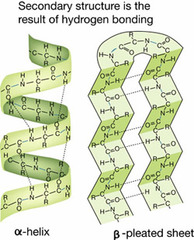
In an alpha helix, the R groups on the amino acid residues:
are found on the outside of the helix spiral.
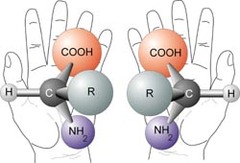
The chirality of an amino acid results from the fact that its alpha carbon:
is bonded to four different chemical groups
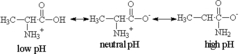
How are the amino acid structure at different ph?
Of the 20 standard amino acids, only ___________ is not optically active. The reason is that its side chain ___________.
glycine; is a hydrogen atom
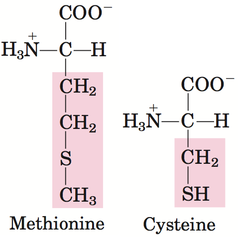
Two amino acids of the standard 20 contain sulfur atoms. They are
methionine and cysteine
All of the amino acids that are found in proteins, except for proline, contain
amino group
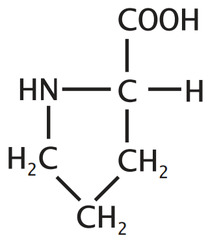
A D-amino acid would interrupt an alpha helix made of L-amino acids. Another naturally occurring hindrance to the formation of an alpha helix is the presence of:
a Pro residue.
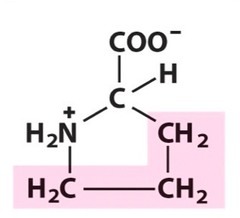
Thr and/or Leu residues tend to disrupt an alpha helix when they occur next to each other in a protein because:
steric hindrance occurs between the bulky Thr side chains.
An alpha helix would be destabilized most by:
the presence of two Lys residues near the amino terminus of the alpha helix.
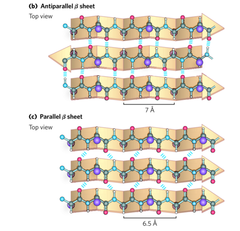
The major reason that antiparallel beta-stranded protein structures are more stable than parallel beta-stranded structures is that the latter
have weaker hydrogen bonds laterally between adjacent strands (since they're bent).
Amino acid residues commonly found in the middle of beta turn are
Pro and Gly.
A sequence of amino acids in a certain protein is found to be -Ser-Gly-Pro-Gly-. The sequence is most probably part of a(n)
beta turn (Pro-Gly in the middle!)
Why are glycine and proline often found within a beta turn?
A beta turn results in a tight 180° reversal in the direction of the polypeptide chain. Glycine is the smallest and thus most flexible amino acid, and proline can readily assume the cis configuration, which facilitates a tight turn
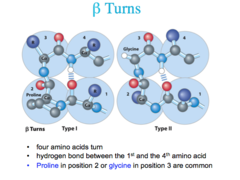
The three-dimensional conformation of a protein may be strongly influenced by amino acid residues that are very far apart in sequence. This relationship is in contrast to secondary structure, where the amino acid residues are:
generally near each other in sequence
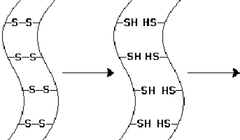
The alpha-keratin chains indicated by the diagram below have undergone one chemical step. To alter the shape of the alpha-keratin chains—as in hair waving—what subsequent steps are required?
Shape remodeling and then chemical oxidation
Which of the following statements is false?
A) Collagen is a protein in which the polypeptides are mainly in the alpha-helix conformation.
B) Disulfide linkages are important for keratin structure.
C) Gly residues are particularly abundant in collagen.
D) Silk fibroin is a protein in which the polypeptide is almost entirely in the beta conformation.
E) alpha-keratin is a protein in which the polypeptides are mainly in the alpha-helix conformation
A) Collagen is a protein in which the polypeptides are mainly in the alpha-helix conformation.
Collagen is a fibrous structural protein, and its polypeptide chains are primarily in the triple helix (of elongated fibril) conformation, not the alpha-helix conformation. Therefore, option A is false.
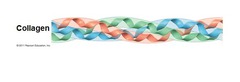
In superhelical proteins, such as collagen, several polypeptide helices are intertwined. What is the function of this superhelical twisting?
The superhelical twisting of multiple polypeptide helices makes the overall structure more compact and increases its overall strength
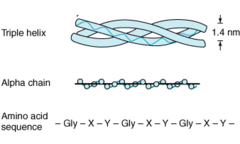
Most abundant amino acid in collagen
Glycine
Kendrew's studies of the globular myoglobin structure demonstrated that:
he structure was very compact, with virtually no internal space available for water.
What is typically found in the interior of a water-soluble globular protein?
The interior of a water-soluble globular protein typically contains hydrophobic amino acid residues. Hydrophilic or polar amino acid residues, on the other hand, are often found on the surface of the protein, where they can interact with water molecules. These surface residues can form hydrogen bonds with water, enhancing the solubility of the protein in an aqueous environment.
Determining the precise spacing of atoms within a large protein is possible only through the use of:
x-ray diffraction.
Proteins often have regions that show specific, coherent patterns of folding or function. These regions are called:
domains
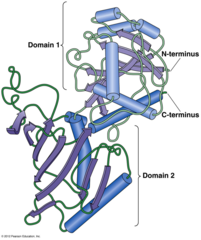
Which of the following statements concerning protein domains is true?
They may retain their correct shape even when separated from the rest of the protein.
The structural classification of proteins (based on motifs) is based primarily on their:
secondary structure content and arrangement
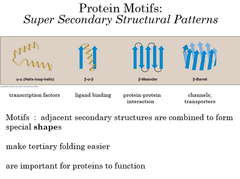
Explain what is meant by motifs in protein structure
A motif or fold is a recognizable folding pattern involving two or more elements of secondary structure and the connection between them.
Ex) Beta-alpha-beta loop
or the more complex beta barrel
Proteins are classified within families or superfamilies based on similarities in:
structure and/or function
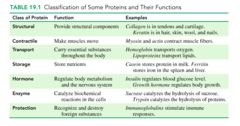
Which of the following statements about oligomeric proteins is false?
A) A subunit may be similar to other proteins.
B) All subunits must be identical.
C) Many have regulatory roles.
D) Some oligomeric proteins can further associate into large fibers.
E) Some subunits may have nonprotein prosthetic groups.
B) All subunits must be identical.
(oligomeric - composed of multiple subunits - at least two are identical... if not, it's just a multimeric)
Ex: Hemoglobin is tetrameric
A repeating structural unit in a multimeric/oligomeric protein is known as a(n):
Protomer - the identical units
Hemoglobin, for example, can be considered either a tetramer of four polypeptide subunits or a dimer of protomers.
Which of the following statements concerning rotational symmetry in proteins is false?
A) It involves rotation of proteins inside the cell.
B) It is frequently seen in the subunits of oligomeric proteins.
C) It is frequently seen in viruses.
D) It may involve rotation about one or more axes.
E) It results in closed, packed structures.
A) It involves rotation of proteins inside the cell.
An average protein will not be denatured by:
A) a detergent such as sodium dodecyl sulfate.
B) heating to 90°C.
C) iodoacetic acid.
D) pH 10.
E) urea.
C) iodoacetic acid.
Which of the following is least likely to result in protein denaturation?
A) Altering net charge by changing pH
B) Changing the salt concentration
C) Disruption of weak interactions by boiling
D) Exposure to detergents
E) Mixing with organic solvents such as acetone
B) Changing the salt concentration
Which of the following statements concerning the process of spontaneous folding of proteins is false?
A) It may be an essentially random process.
B) It may be defective in some human diseases.
C) It may involve a gradually decreasing range of conformational species.
D) It may involve initial formation of a highly compact state.
E) It may involve initial formation of local secondary structure
A) It may be an essentially random process.
instead, protein folding is a highly regulated and intricate process guided by the protein's amino acid sequence and the interactions between its constituent amino acids. The folding process follows specific pathways to achieve the native and functional three-dimensional structure of the protein.
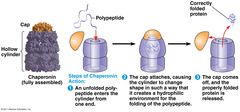
Which of the following is not known to be involved in the process of assisted folding of proteins?
A) Chaperonins
B) Disulfide interchange
C) Heat shock proteins
D) Peptide bond hydrolysis
E) Peptide bond isomerization
D) Peptide bond hydrolysis (breakdown of a compound due to the reaction with water)
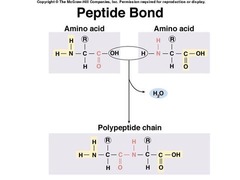
peptide bond
The chemical bond that forms between the carboxyl group of one amino acid and the amino group of another amino acid
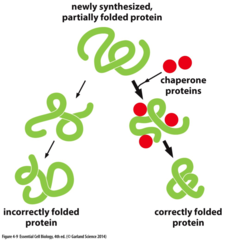
Protein S will fold into its native conformation only when protein Q is also present in the solution. However, protein Q can fold into its native conformation without protein S. Protein Q, therefore, may function as _________ a for protein S.
molecular chaperone
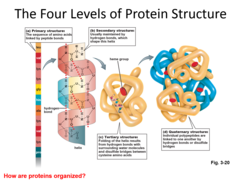
Proteins structures and differences between them
Primary structure - linear sequence of amino acids bonded with peptide bonds
secondary structure- creates a repetitive structure which are either alpha helixes or beta sheets, stabilized by hydrogen bonds. There are also beta turns and loops.
Tertiary structure - a 3d structure of the protein, folding due to disulfide bonding.
Quaternary structure - has more than one subunits made of different or the same polypeptide chains
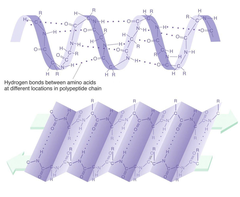
alpha helix vs beta pleated sheet
Alpha Helix:
Shape: Spiral or coil.
Stabilization: Hydrogen bonds formed between the carbonyl oxygen and amide hydrogen of amino acids, about three residues apart.
Geometry: Approximately 3.6 amino acid residues per turn.
Flexibility: Relatively rigid structure.
Beta Pleated Sheet:
Shape: Flat sheet-like structure.
Stabilization: Hydrogen bonds formed between adjacent strands, running perpendicular to the polypeptide chain.
Geometry: Strands can be parallel or antiparallel.
Flexibility: More flexible compared to the alpha helix.
Similarities:
- Both structures are stabilized by hydrogen bonding.
- Both are secondary structures found in proteins, made from amino acid building blocks.
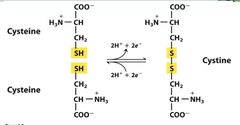
disulfide bridge/bond
A strong covalent bond formed when the sulfur of one cysteine monomer bonds to the sulfur of another cysteine monomer. important in tertiary structure of proteins
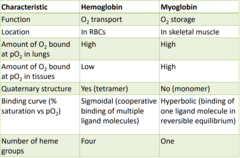
myoglobin vs hemoglobin
Myoglobin:
- has higher O2 affinity
- stores O2, but isn't a great transporter
- Consists of a single polypeptide chain
- Tertiary structure consists mainly of alpha helices
Hemoglobin:
- Primary role is to transport oxygen from the lungs to tissues and organs and to carry carbon dioxide, a waste product, from the tissues back to the lungs for exhalation.
-Consists of four polypeptide chains: two α chains and two β chains.
- Each chain has a heme group, making a total of four heme groups.
- Tertiary structure is also predominantly alpha helical.
- Exhibits a quaternary structure due to the association of multiple subunits.
- Hemoglobin undergoes cooperative binding, where the binding of one oxygen molecule enhances the binding of subsequent molecules. This allows efficient oxygen transport.
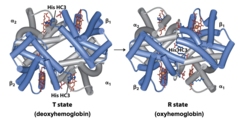
conformations of hemoglobin
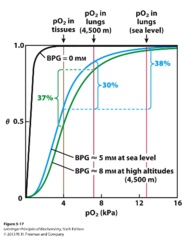
There are two confirmation of hemoglobin T state (Tense) which is the low affinity, it has low po2 and has a large cavity inside of the hemoglobin and R state (relaxed) which is high affinity, it has a high po2 and no cavity because it's fill with oxygen
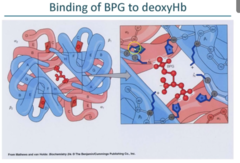
How does 2,3-BPG regulate O2 binding?
- it is a negative heterotrophic regulator of Hb function (meaning it reduces affinity of O2)
- This small negatively charged molecule binds to the positively charged central cavity of Hb "closing it off" and blocking oxygen from binding
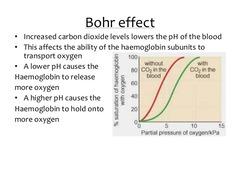
Bohr Effect
Oxygen release is favored where lower pH is (which corresponds to the portion of the organism where metabolic process is active, since we are releasing CO2—therefore lowering pH). Note that the Bohr effect shifts the oxy-hemolobin saturation curve to the right.
How does 2,3-BPG change in response to high altitude?
At higher altitudes, air pressure decreases, and so does the lung pressure (so not enough O2 gets released)
- Exposure to high altitudes stimulates increased production of 2,3-BPG, an adaptive response that helps improve oxygen release from hemoglobin and enhances the delivery of oxygen to tissues in environments where oxygen availability is reduced
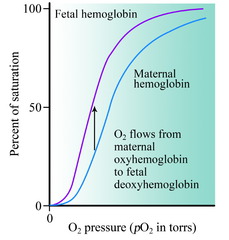
Difference between Hba and HbF (adult vs fetal hemoglobin)
The fetal hemoglobin needs to have a higher affinity for oxygen to acquire oxygen from the mother, so the hemoglobin can bind to the oxygen at the lower partial pressure.
Structure wise: Fetal hemoglobin has 2 gamma (instead of beta) subunits. The replacement of histidine with serine at position 143 in the gamma globin chain of fetal hemoglobin decreases its affinity for 2,3-BPG, leading to increased oxygen affinity
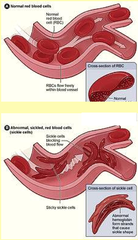
sickle cell anemia
Sickle cell anemia is a genetic disease caused by a single amino acid substitution (Glu to Val in position 6) in each beta chain of hemoglobin.
When oxygen is bound, both Hemoglobin A (normal) and Hemoglobin S are soluble, but in the deoxygenated form
Hemoglobin S (but not Hemoglobin A) becomes very insoluble, due to exposure of the hydrophobic
valine residue. This exposed "patch" causes aggregation of deoxy-Hemoglobin S into long insoluble fibrous aggregates, resulting in distorted shapes of the red blood cells (and leading to the symptoms of the disease).
Heterozygous individuals, however, have no health problems and exhibit a resistance to MALARIA
Proteostasis
The maintenance of a cellular steady-state collection of proteins that are required for cell functions under a given set of conditions.
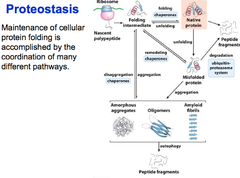
Chaperonins
a protein complex that assists in the proper folding of other proteins