Muscle Physiology and Motor Control: Nerve-Muscle Interaction, Reflexes, and Proprioception
 Call Kai
 Learn
Learn Practice Test
 Spaced Repetition
 Match
Match Flashcards
 Knowt Play
1/29

There's no tags or description
Looks like no tags are added yet.
Name | Mastery | Learn | Test | Matching | Spaced | Call with Kai | Chat |
|---|
No analytics yet
Send a link to your students to track their progress
30 Terms
What is the main function of excitation-contraction coupling?
Links excitation of muscles by the nervous system to their mechanical contraction.
What is the neuromuscular junction?
Where α-motor neuron communicates with muscle fibres; site of neuron-to-muscle communication.
What does the length-tension relationship describe?
Relates the strength of an isometric contraction to the length of the muscle at which the contraction occurs.
Where does maximum power occur in the force-velocity relationship?
Maximum power occurs at about 1/3 of maximum shortening velocity.
What is Henneman's size principle?
Smallest motor units are recruited first, typically Type 1 muscle fibre motor units.
What are voluntary movements?
Movements accompanied by conscious awareness of what we are doing and why.
What are involuntary movements?
Unconscious, automatic or reflex actions.
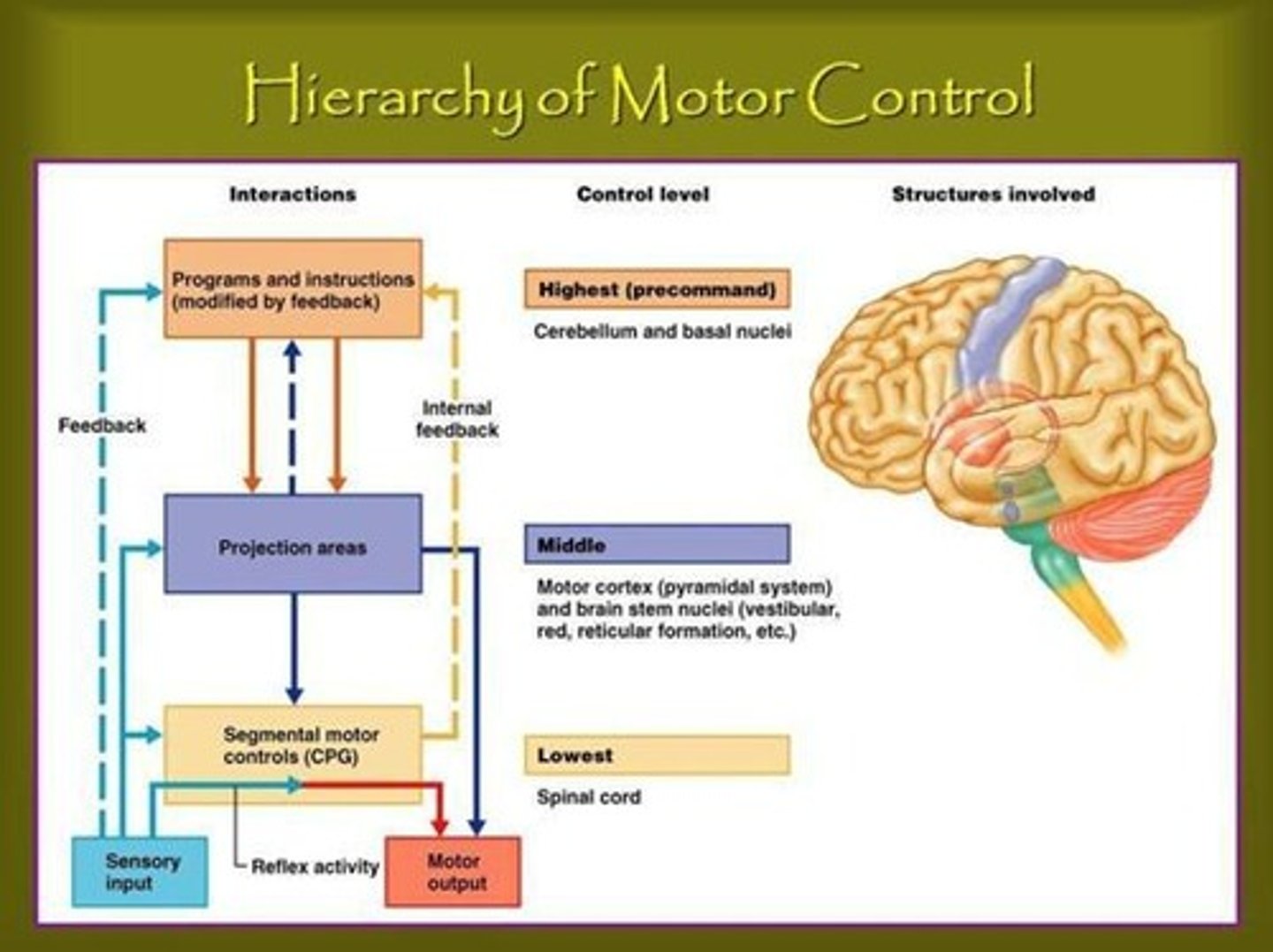
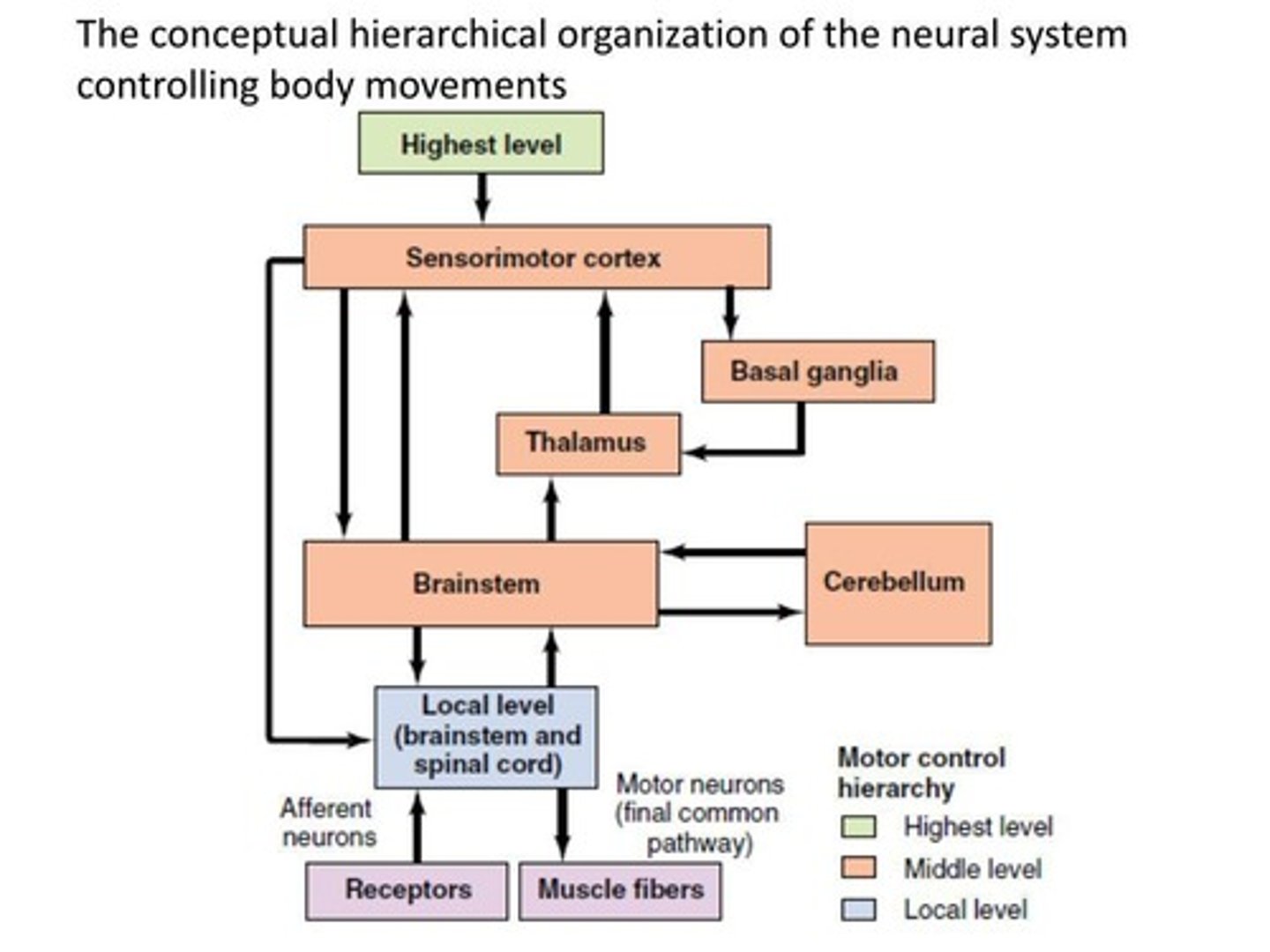
What is the highest level of the motor control hierarchy responsible for?
Forming complex plans according to intention and communicating with the middle level via command neurons.
What does the middle level of the motor control hierarchy do?
Converts plans from higher centres into smaller motor programmes.
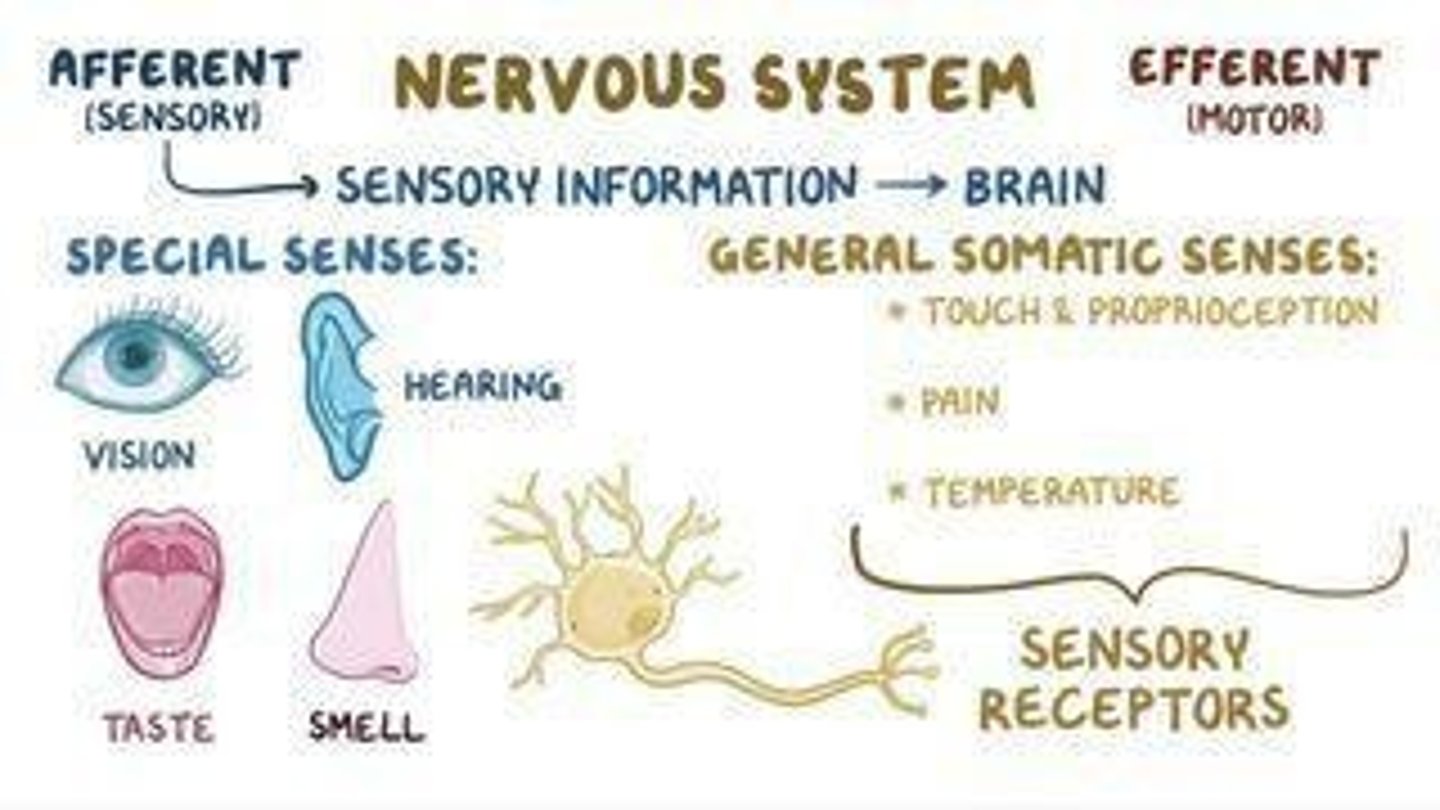
What information does the middle level of the motor control hierarchy use?
Afferent information from muscles, joints, tendons, skin, eyes, and the vestibular apparatus.
What is the local level of the motor control hierarchy responsible for?
Specifying tension of specific muscles and angle of specific joints at specific times necessary to carry out the motor programme.
What is a reflex activity?
A rapid, unconscious means of reacting to stimuli.
What is a motor reflex?
An instant, preprogrammed response to a given stimulus that occurs before conscious awareness.
What is the role of the interneuron in motor control?
Transmits information between different neurons and is important for deciding which muscles should be activated and when.
What is proprioception?
The sense of limb position and movement, monitored by proprioceptors.
What do muscle spindles respond to?
Changes in muscle length.
What is the function of the Golgi tendon organ?
Monitors tension developed in muscle and prevents muscle damage during excessive force generation.
What is muscle tone?
Resistance of skeletal muscles to stretch, even when relaxed, due to passive elastic properties.
What is the purpose of the muscle spindle?
To detect stretch and initiate a reflex contraction.
What is the adjustment of the motor programme?
The motor programme is continually adjusted at the middle level during the course of most movements.
What happens if there is a discrepancy between intended and actual movement?
Corrections are determined and relayed to the local level.
What is the stretch reflex?
A protective mechanism against injury due to excessive stretch.
What is the significance of frequent repetition of complex movement?
It leads to motor learning and skilled movement.
What is the function of afferent information in motor control?
It allows the local level to adjust motor unit activity in response to unexpected obstacles or painful stimuli.
What is the relationship between muscle spindle and alpha motor neurons?
Gamma motor neurons stimulate intrafusal fibres to contract with extrafusal fibres by alpha motor neurons.
What is the role of inhibitory neurons in the Golgi tendon organ?
They send inhibitory postsynaptic potential to muscle fibres to prevent excessive force generation.
What is the purpose of the cardiovascular system?
To circulate blood and supply oxygen and nutrients to tissues.
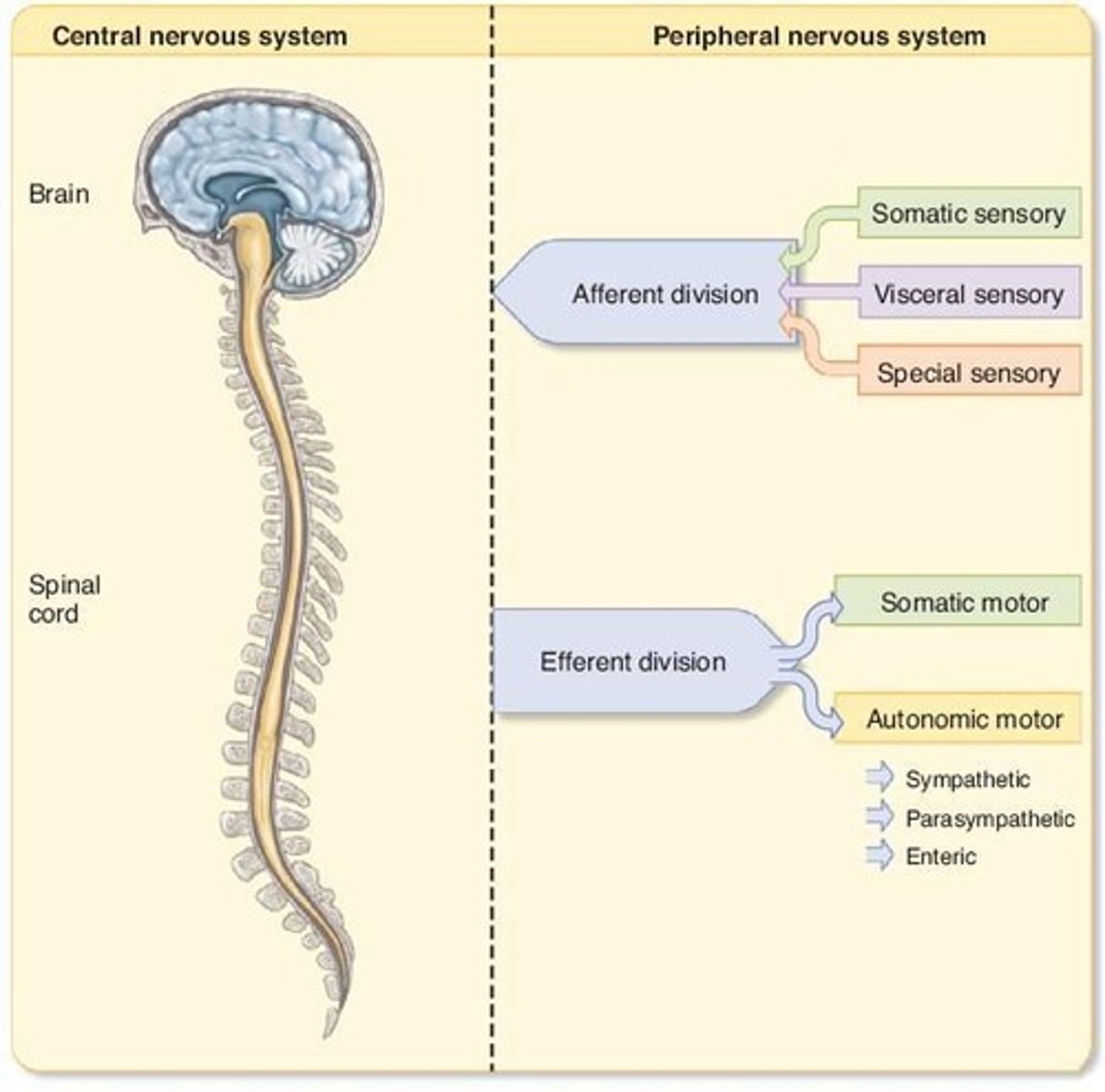
What is the purpose of the nervous system?
To control and coordinate body activities and responses.
What is the sliding filament mechanism?
The process of muscle contraction where actin and myosin filaments slide past each other.
What is the purpose of a motor control programme in sports?
To outline the sequence of movements required for a specific sporting action.