Media Unit 2 AOS 3
 Studied by 7 people
 Call Kai
 Learn
Learn Practice Test
 Spaced Repetition
 Match
Match Flashcards
 Knowt Play
1/7

There's no tags or description
Looks like no tags are added yet.
Name | Mastery | Learn | Test | Matching | Spaced |
|---|
No study sessions yet.
8 Terms
Old and New Media Technologies?
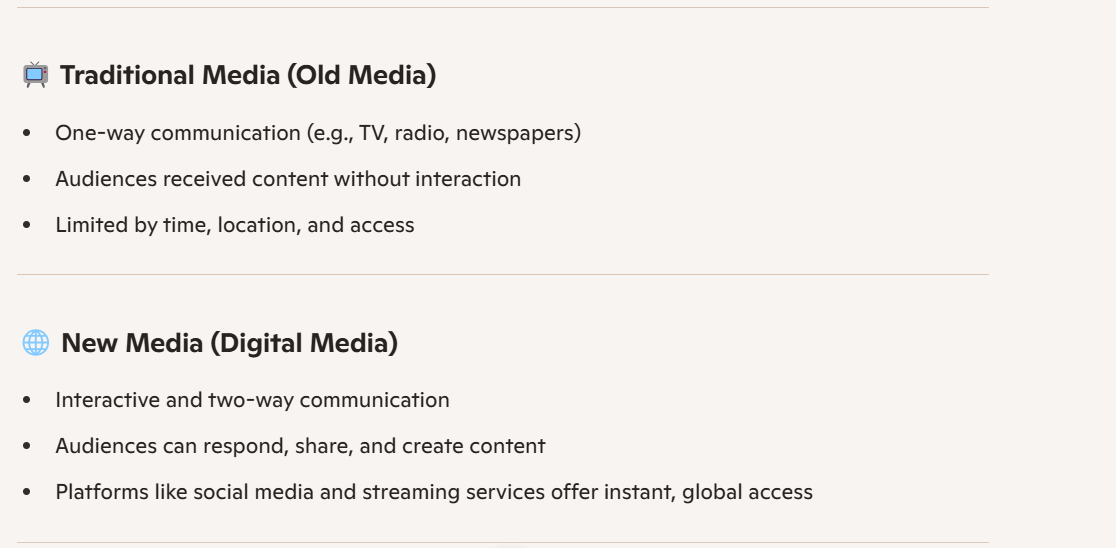
📰 Old Media Technologies (Traditional Media)
Examples: Newspapers, books, radio, television, DVDs
Format: Physical and broadcast
Communication: One-way (audience receives but doesn’t interact)
Access: Limited by time, location, and resources
Distribution: Physical formats with slower, restricted reach
🌐 New Media Technologies (Digital Media)
Examples: Internet, social media, websites, streaming services, podcasts
Format: Digital and interactive
Communication: Two-way (audiences can respond and create content)
Access: Instant, global, and affordable for anyone with a device
Distribution: Online, fast, and accessible anytime, anywhere
New media empowers users to be both consumers and creators, breaking down barriers and transforming how we share, interact with, and consume content.
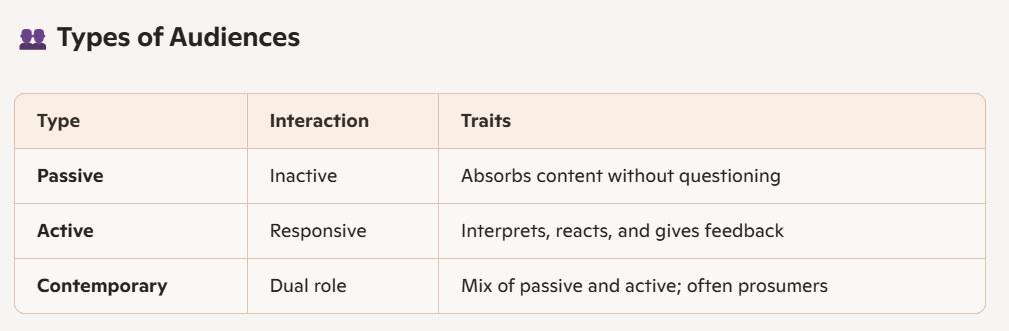
Types of Audiences:
👥 Passive Audience
Simply absorbs media without questioning it
One-way communication, typical of traditional media
Focuses on surface-level content like visuals
💬 Active Audience
Engages with and interprets media
Gives feedback and challenges ideas
Common in today’s interactive digital platforms
🎯 Intended Audience
The group media producers aim to reach
Creators tailor content based on their expectations
But audiences may interpret it differently due to changing social contexts
🌐 Contemporary Audience
Mix of passive and active traits
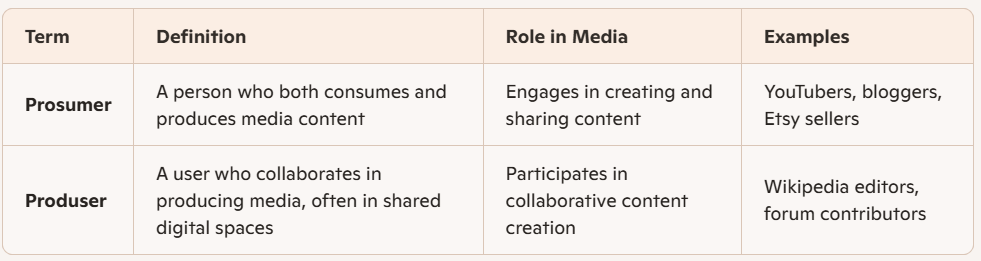
Often acts as both consumer and creator (prosumer/produser)
Uses platforms like YouTube, blogs, and Etsy to share and engage
Modern audiences are more involved, shaping and responding to media in dynamic ways.
Audience Interactions with Media
(n, o, a, r)
🛠 Prosumer/Producer Role
Users are both consumers and creators
Examples: bloggers, YouTubers, Etsy sellers
⚡ Changes in Consumption
No time or location limits
On-demand access via streaming and social platforms
Audiences influence media decisions (e.g., saving cancelled shows)
Risks include doomscrolling and exposure to harmful online behavior
Development in:
Production (m,p,d)
Distribution (m,s,m)
Consumption (a,p,a)
AI (a, i,t)
🎬 Production
Media creation is now accessible to anyone with a computer.
Physical tools like CDs and floppy disks are no longer needed.
Digital platforms and software have made content creation easier and cheaper.
🌍 Distribution
Media is shared instantly online, removing time and location limits.
Streaming services, social media, and gaming platforms now handle most distribution.
It's more affordable for both big companies and independent creators.
📱 Consumption
Audiences can access media anytime, anywhere.
People now actively engage with content, giving feedback and sharing.
Algorithms personalize feeds but can lead to overconsumption and mental health issues like doomscrolling and exposure to hate comments.
🤖 Artificial Intelligence (AI)
AI and CGI have transformed visual content creation.
Industries like entertainment and gaming use AI for realistic effects and immersive experiences.
Tools like Photoshop’s AI Generative Fill allow easy, lifelike image editing.
Digital media has reshaped how we create, share, and interact with content—making it faster, more personal, and more powerful than ever.
The impact on the audience because of these developments
🔄 Shift in Audience Role
Audiences have moved from passive viewers to active participants and content creators.
Many now act as prosumers—both consuming and producing media (e.g., YouTubers, bloggers).
📣 Audience Influence
Viewers shape media by giving feedback and rallying online to save or revive shows.
Social media campaigns show how powerful audience voices can be.
📱 Media Access and Consumption
Content is now available instantly, anytime, anywhere.
Streaming services offer on-demand viewing, removing time and location limits.
The internet allows fast sharing and wider access to media.
🧠 Social and Mental Health Effects
Constant access can lead to stress, doomscrolling, and exposure to harmful comments.
Social media affects real-life bonding and weakens face-to-face communication.
People often focus more on screens than those around them.
🔐 Privacy and Control Concerns
Algorithms personalize feeds but can trap users in echo chambers.
Platforms collect detailed user data for targeted ads, raising privacy and manipulation concerns.
Data breaches highlight risks to personal information.
Digital media has empowered audiences but also introduced new challenges in mental health, privacy, and social connection.
Link to Social Media, Streaming and Web 2.0
🔗 Shared Features
All three use digital tools to share and consume content.
They promote interactive communication, letting users respond and engage.
📱 Social Media & Streaming
Social Media (e.g., Facebook, Instagram) enables instant sharing and connection.
Streaming Services (e.g., Netflix, YouTube) offer on-demand access to movies, music, and shows.
Both rely on digital distribution across multiple devices.
🤝 Web 2.0 Principles
Encourages user-generated content and collaboration.
Users become prosumers—both consuming and creating media (e.g., bloggers, YouTubers).
Platforms use algorithms to personalize content and keep users engaged.
📣 Audience Impact
Audiences are now active participants, giving feedback and shaping media.
Content is accessible anytime, anywhere, enhancing engagement and personalization.
Together, these technologies have transformed how we communicate, create, and consume media in the digital age.
Prosumer/Producer?
Linking Case Studies to Audience:
🧠 Mental Health & Industry Pressure
Celebrities often face stress when their private lives are exposed by the media and public.
Britney Spears lost control over her life during her conservatorship, while fans unknowingly supported the system.
Kanye West’s bipolar disorder shows why mental health support is important in high-pressure jobs.
Amanda Bynes’ early fame shows how young stars can be affected emotionally by fame and public attention.
⚖ Defamation & Legal Issues
Celebrities care a lot about their public image and may take legal action to protect it.
The Blake Lively vs. Justin Baldoni case shows how far stars might go to control how the public sees them.
📱 Cyberbullying & Online Ethics
Social media can be harmful when people use it to bully or harass others.
Dolly Everett’s story shows how online bullying can deeply hurt young people.
The #doitfordolly campaign encourages kindness online and reminds people to speak up before it’s too late.