Ionic, Covalent, Metallic Bonding
 Call Kai
 Learn
Learn Practice Test
 Spaced Repetition
 Match
Match Flashcards
 Knowt Play
1/72

Earn XP
Description and Tags
C4.1.1 Intro and PKR: Metals C4.1.2 Ionic Bonding C4.1.3 Properties of Ionic Substances C4.1.4 Covalent Bonding C4.1.5 Properties of Covalent Substances C4.1.6 Diamond C4.1.7 Graphite C4.1.8 Graphene, Fullerenes and Nanotubes,,,,, \metallic bonding do nanotubes & nanoparticles
Name | Mastery | Learn | Test | Matching | Spaced | Call with Kai | Chat |
|---|
No analytics yet
Send a link to your students to track their progress
73 Terms
Atoms are very small and have a radius of about…
1x10⁻¹⁰m.
State the definition of an element
A pure substance made up of only one type of atom.
Atomic Number
The number of protons in an atom
Mass Number
The number of protons and neutrons in the nucleus of an atom
What did Niels Bohr do?
developed the Bohr model of the atom: electrons orbit the nucleus in the energy levels
ions
Atoms that have gained or lost electrons
What type of elements form negative ions?
Non-metals
What type of elements form positive ions?
Metals
Explain why atoms are considered electrically neutral.
Atoms have equal numbers of protons, which are positively charged and electrons, which are negatively charged. This means that the charges cancel each other out.
Explain what it means for an atom to be stable.
It has a full outer shell.
Where does ionic bonding occur?
in compounds formed from metals combined with non-metals.
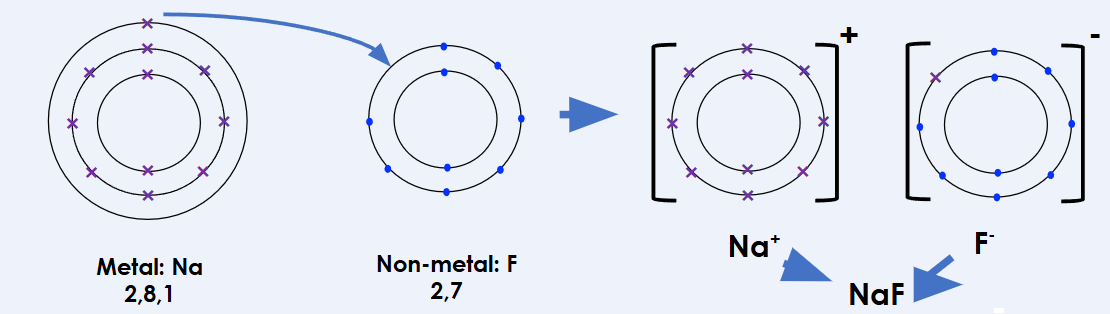
Describe
The sodium atom transfers an electron to the fluorine atom
This forms a sodium ion and a fluoride ion
These oppositely charged ions have a strong electrostatic force of attraction called ionic bonding
valence electrons
electrons in outer shell
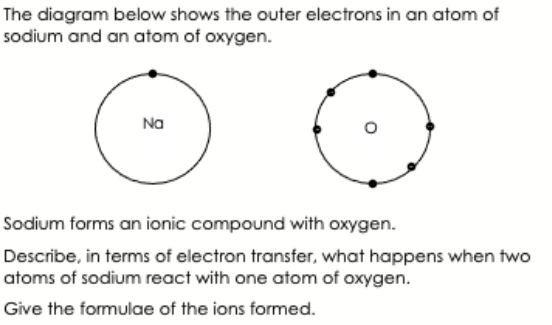
Each sodium loses 1 electron
Oxygen needs 2 electrons for a stable configuration
Oxygen gains 1 electron from each sodium
It forms the ionic compound Na2O, sodium oxide.
What is sodium oxide used for?
ceramics and eye glasses.
What hazards are associated with sodium oxide?
Sodium oxide is corrosive, and it reacts violently with water.
Properties of ionic substances
They conduct electricity when molten or in solution.
They are hard solids,
They have high melting and boiling points.
They have crystalline structures
The structure of ionic substances
have a giant lattice structure, also called an ionic lattice
have a regular, repeating pattern of oppositely charged ions
are held together by strong electrostatic forces of attraction (also called ionic bonds)
Why do ionic substances have high melting and boiling points?
due to strong electrostatic forces of attraction between oppositely charged ions. These require large amounts of energy to overcome.
Why can’t ionic substances conduct electricity as solids?
their ions are held in a fixed, rigid crystal lattice and are not free to move
Why can ionic substances conduct electricity when molten or dissolved in solution?
because the ions are free to move and carry the charge
Why can ionic substances form hard, crystalline structures
because the ions are tightly packed in a regular, repeating structure called an ionic lattice
What is ethanol used for?
the manufacture of plastics, fertilisers, alcoholic drinks and cosmetics.
What are ionic bonds caused by?
the electrostatic forces of attraction between oppositely charged ions.
compound
two or more elements combined together chemically.
Covalent bonding
where two or more non-metal atoms share pairs of electrons in order to achieve a stable electronic configuration
How is a single covalent bond represented?
A single covalent bond is represented by a single line, for e.g. H-H
How is a double covalent bond represented?
A double covalent bond is represented by a double line, for e.g. O=O
How is a triple covalent bond represented?
A triple covalent bond is represented by a triple line, for e.g. N≡N
What is a double covalent bond?
A double covalent bond is 2 shared pairs of electrons
What is the formula for methane?
The formula for methane is CH4
percentage by mass equation
% by mass = mass of element
———————— x100
mass of compound
concentration equation
concentration = mass divided by volume
Properties of simple covalent substances & explanations
low melting and boiling points - are liquid or gas at room temperature: they have weak intermolecular forces of attraction between the molecules. These require little energy to overcome and melt or boil the substance.
cannot conduct electricity: because the molecules are neutral (no charge), they do not have any free electrons or ions to carry a charge.
Properties of giant covalent substances
high melting and boiling points
are solid at room temperature
may conduct electricity
intermolecular forces
the forces that exist in between molecules
examples of simple covalent substances
water
methane
carbon dioxide
examples of giant covalent substances
diamond
graphite
graphene
As molecules increase in size, the intermolecular forces get…
bigger
Are covalent bonds weak or strong?
Strong
Describe the physical appearance of chlorine.
Chlorine is a green-yellow gas.
What type of bonding is present in chlorine gas?
Covalent bonding
appearance & smell of methane
colourless & odourless
diatomic molecule
a molecule made of two atoms
What word describes a substance that dissolves?
Soluble
What word describes a substance in which other substances are dissolved in?
Solvent
Write down the formula to calculate pressure.
Pressure = force ÷ area
What is diamond used for and why?
It is used for making jewellery, and for the tips of cutting tools like drills and saws, because it is a very hard and valuable substance.
The structure of diamond
1. Each carbon atom is joined to 4 other carbon atoms by covalent bonds ..so diamond has a high melting point ..because it takes lots of energy to overcome all of these strong covalent bonds
2. Many, many carbon atoms are joined up to create a giant lattice arrangement which is held together by strong covalent bonds. ..which means that diamond is a hard substance ..because the rigid network of carbon atoms, held together by strong covalent bonds, takes a lot of energy to break.
3. There are no delocalised (free) electrons ..which means that diamond does not conduct electricity ..because there are no delocalised electrons to carry an electrical charge
Properties & uses of graphite
Graphite is a giant covalent substance.
Graphite is a soft substance.
It is used
in pencils, because it’s soft, and layers of graphite slide off as you rub it against a page, because the carbon atoms in graphite are arranged in layers, with only weak forces holding those layers together.
as a lubricant in machinery because it’s soft and slippery, and layers of graphite slide off easily, because the carbon atoms in graphite are arranged in layers, with only weak forces holding those layers together.
to make electrodes because graphite conducts electricity, because it contains delocalised electrons that carry charge through the structure.
The structure of graphite
Each carbon atom is bonded to 3 other carbon atoms by strong covalent bonds: There is one delocalised electron for every carbon atom.
The carbon atoms are arranged in layers; these layers are held together by weak intermolecular forces. This means that each layer can slide off easily.
Allotropy
a property shown by some elements that can exist in different forms, e.g. allotropes of carbon include diamond, graphite, graphene, fullerene, and carbon nanotubes
Compare the structure of diamond and graphite.
Both diamond and graphite are giant covalent structures made of carbon atoms
Both diamond and graphite contain strong covalent bonds.
In diamond, a rigid network of carbon atoms is held together by strong covalent bonds, whereas in graphite, the carbon atoms are arranged in layers, with only weak intermolecular forces holding these layers together.
In diamond each carbon atom makes 4 bonds with other carbon atoms, whereas in graphite, each carbon atom only makes 3 bonds with other atoms
The structure of graphene
Graphene is made of carbon atoms
Each carbon atom is bonded to 3 other carbon atoms by strong covalent bonds
There is one delocalised electron for every carbon atom
Uses of graphene & why
Graphene is used in construction materials because graphene is strong because it is a giant lattice structure containing many strong covalent bonds which require a lot of energy to be broken.
Graphene is used in electronics because graphene conducts electricity because it contains delocalised electrons that carry charge through the structure.
How many atoms thick is graphene?
The graphene is 1 atom thick.
Fullerenes
Fullerenes are molecules of carbon atoms with hollow shapes.
Each structure is made up of hexagonal rings of carbon atoms.
The first fullerene to be discovered was buckminsterfullerene.
Buckminsterfullerene has the formula C60.
What type of bonding is there
between the atoms that make up the molecule
in between molecules of fullerene?
Strong covalent bonds
Weak intermolecular forces
Carbon Nanotubes
examples of fullerenes: they have a cylindrical shape, with a high length to diameter ratio.
structure of carbon nanotubes (just like graphene) & properties as a result
carbon nanotubes are made of carbon atoms
there are strong covalent bonds between the carbon atoms: have a high tensile strength
each carbon atom has a delocalised electron: conduct electricity
are slippery (high length to diameter ratio)
Who discovered the electron?
J.J. Thompson
What is a silver alloy?
a mixture of silver and another element.
What are some properties of pure silver?
Pure silver is very soft and reacts with air
Metallic bonding
the force of attraction between the positive metal ions and the ‘sea’ of delocalised electrons forming a giant metallic structure
Why do most metals have high melting and boiling points?
strong metallic bonds
alloy
a mixture of chemical elements where at least one is a metal
Alloys uses
such as in construction and for dental braces
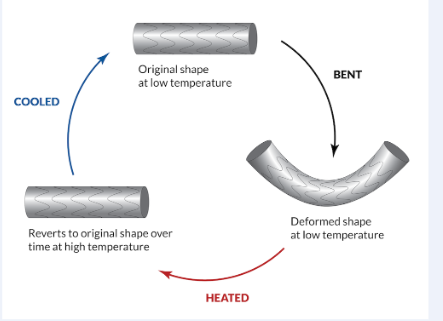
Shape memory alloys uses
for spectacles
Shape Memory Alloys transformation process
Pure metals are … and … than alloys
softer and weaker
The structure of metals
Metals have a giant structure
Particles are in a regular arrangement
Particles are arranged in layers, which can slide over each other, allowing metals to be bent and shaped easily
The structure of alloys
Alloys have a giant structure
Particles are in an irregular arrangement because atoms are different sizes
Particles are not arranged in layers, so alloys cannot easily be bent and shaped
Which material would be a better electrical conductor, pure copper or a copper alloy?
Pure copper. This is because it is easy for electrons to flow through the regular layers carrying a charge.
In the alloy, the layers are disrupted/distorted. This makes it harder for the electrons to flow through the material.