Exam/Practical 1 - Shoulder pt. 1
 Call Kai
 Learn
Learn Practice Test
 Spaced Repetition
 Match
Match Flashcards
 Knowt Play
1/50

There's no tags or description
Looks like no tags are added yet.
Name | Mastery | Learn | Test | Matching | Spaced | Call with Kai | Chat |
|---|
No analytics yet
Send a link to your students to track their progress
51 Terms
what does this stand for: A-C
acromial-clavicular
what does this stand for: G-H
gleno-humeral
what does this stand for: S-T
scapulo-thoracic
what does this stand for: St-Cl
sternal-clavicular
what does this stand for: St-Co
sterno-costal
what are some things to look for during visualization of the shoulder
scapula distance from spine
scapular winging
squared off
step defect
sulcus sign
how should a normal shoulder appear
smooth, rounded, clavicles same height
how far should the scapula be from the spine
3 of the patient's fingers
a step defect is associated with what
A-C separation (Clavicle separates from scapula but humerus stays in place)
Squared off sign is associated with what
anterior shoulder dislocation (head of humerus is almost into chest cavity area/very midline from where it should be)
what is the most common position for an anterior G-H dislocation? What are the other positions
subcoracoid
subglenoid, subclavicular
sulcus sign is associated with what
G-H I (shoulder simply pulled down from joint)
where do patients feel pain for scapula
subscapularis at the anterior aspect
after visualization and static palpation, where do you move next
ROM - active then passive
what are the different movements to perform to assess ROM
flexion
extension
abduction
adduction
internal rotation
external rotation
apley's scratch
what is the average scapulo-humeral ration? what does this mean?
2:1 (humerus to scap)
- humerus moves roughly 120 degrees of abduction
- scapula moves the other 60 degrees
the first 90-120 degrees of abduction comes from the ___
G-H joint
if the scapula begins moving in after 30 degrees of abduction, how does the ration change
1:1 (humerus has lost some function)
if we noted a 4:1 S-H Ratio, what does this mean
the scapula has lost function
dysfunction of which joints may lead to decreased scapular function
S-T
St-Cl
A-C
what are the different orthopedic tests you can use for the shoulder
Apley's Scratch
Apprehension
Dawburn's
Drop Arm
Dugas
Yergason's
during Apley's, when does adduction/flexion occur
reaching in front of neck to reach behind the back
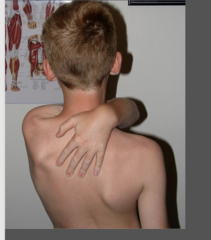
during Apley's, when does external rotation, abduction, and flexion occur
reaching over the head to touch opposite scapula
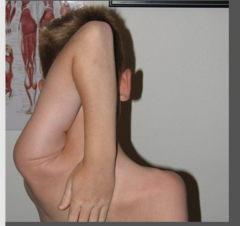
during Apley's, when does internal rotation and extension occur
reaching behind back to touch opposite scap
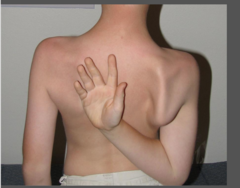
if the external rotation part of Apley's is decreased, what could this mean
G-H I (humerus has gone inferior)
if the internal rotation part of Apley's is decreased what could this mean
S-T L (scapula is lateral)
G-H P (humerus is posterior)
how do you perform apprehension test
place patient shoulder into 90 degrees of abduction and external rotation, push P-A on the posterior humerus
what is Dawburn's used to test
subacromial bursitis
how do you test Dawbunrs
press into subacromial space, lift arm into abduction and slight flexion
what does a positive dugas test indicate
anterior shoulder dislocation
what does a positive yergason's test indicate
transverse humeral ligament laxity or bicipital tendonitis
during the drop arm test, if part 1 is positive it means there is a grade ___ tear. If part 2 is positive, there is a grade __ tear. If part 3 is positive, there is a grade ___ tear. If it is positive on the first few degrees of abduction, there is a ___ tear
3, 2, 1
supraspinatus
what is part one of the drop arm test
patient raises arm against gravity
what is part 2 of drop arm test
patient slowly lowers arm against resistance
what is part 3 of drop arm test
patient holds arm against object to set up reflex with rotator cuff muscles
what muscle test is used for St-Cl and St-Co joints
pectoralis
- patient supine, arm perpendicular to floor with thumb towards feet
what is the direction of movement for the muscle test of a St-Cl joint
towards the clavicle (45 degree angle)
what is the direction of movement for the muscle test of a St-Co joint
towards the sternum (horizontal across body)
if the pec major test is weak at the sternal attachment, what could the listings be
st-co I or St-Co S
if the pec major test is weak at the clavicular attachment, what could the listing be
st-cl S
what muscle test is used for a G-H I
anterior deltoid
- supine, arm parallel to floor with palm down
what muscle test is used for G-H P
teres major
- supine, hand under low back, elbow parallel to floor
what muscle test is used for A-C joint
coracobrachialis
- arm flexed with hand by ear, doctor pulls bicep
if the coracobrachialis muscle test is weak AND the clavicle moves DOWNWARD, then the muscle is intact and there is a possible listing of ____
A-C PS
if the coracobrachialis muscle test is weak AND the clavicle does NOT move downward, then there is a ___ of the A-C joint
tear
how do you assess fluid motion of the St-Cl joint
1. in front of patient
2. fingertips at st-cl joint
3. patient shrugs shoulders
4. patient shrugs, moves shoulders back, and puts them down
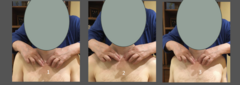
how do you assess fluid motion of the A-C joint
1. behind patient
2. have patient lean into your hand right below humeral head
3. stabilize scapula and press down on clavicle
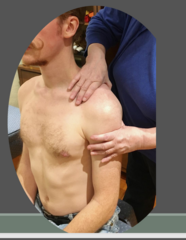
how do you assess fluid motion of the G-H joint
1. behind patient
2. stablize scapula and clavicle
3. hand on elbow, slightly push up
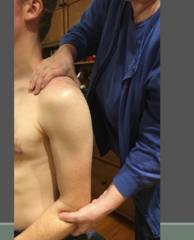
how do you assess fluid motion of the S-T Lateral joint
1. side of patient
2. press shoulder down
3. push into the inferior lateral aspect of scapula
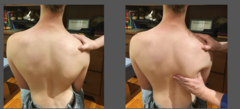
how do you assess fluid motion of the S-T Medial joint
1. side of patient
2. pull shoulder up
3. push into the inferior medial aspect of scapula
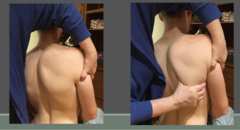
how do you assess fluid motion of the St-Co joint
1. in front of patient
2. fingertips in the intercostal space
3. take deep breath in and out