nominal vs real interest rates
 Call Kai
 Learn
Learn Practice Test
 Spaced Repetition
 Match
Match Flashcards
 Knowt Play
1/10

There's no tags or description
Looks like no tags are added yet.
Name | Mastery | Learn | Test | Matching | Spaced | Call with Kai | Chat |
|---|
No analytics yet
Send a link to your students to track their progress
11 Terms
nominal vs real value of money
nominal: the amount we have
real: its purchasing power (the amount it can buy)
nominal vs real intersticio rates
nominal: compares amount of money we have
real: compares purchasing powers
which is more commonly used for interest rates
nominal
give an example using coke of how the growth of your money can be illustrated using nominal and real interest rates
one can costs £1 today
i have £2
so I can buy 2
one can costs £1.05 next year
i have £2.20 after growing my money at a 10% nominal interest rate
so I can buy 2.095 cans
so my 2 pounds has grown by 10% (nominal interest rate)
but my purchasing power has only grown by 4.76% (real interest rate)
notation for purchasing power today and purchasing power after one period
PP0 for today
PP1 for after one period
so then what is the formula for real interest rates, using purchasing powers
so this is like when I divided the 2.095 cans by 2 cans which gave me 1.0476 in the last question, meaning that real interest rate is 4.76%

what notation do we often use for inflation
pi, but it can be set to equal a different value (eg. pi = 5)
give a different equation for 1 + real interest rates, that involves r and pi, using the Coca Cola example to derive it
might take u a minute but it does make sense eventually i promise

so therefore what is the fisher equation
as pictured
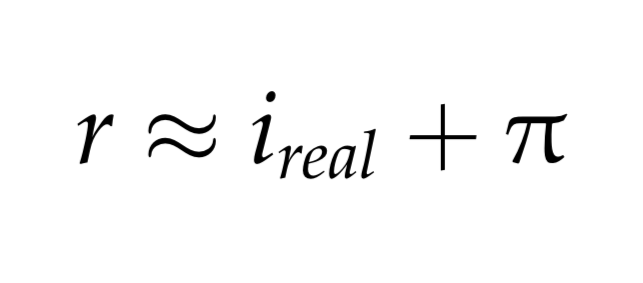
r = nominal interest rate
ireal = real interest rate
pi = expected inflation rate

when you expand the fisher equation, what do you get
since both inflation and real interest rates will be low, them multiplied together can be approximated to zero
so by the time you’ve expanded brackets and simplified it will look as pictured
only an ESTIMATE
if we use this estimation to work out ireal first, what do we apply that to in order to solve a question
multiply it by the NUMBER OF ITEMS so you can see the increase in PURCHASING POWER
so like in this question you would multiply it by the initial 20 cans you could buy, to get 21.6 cans (only an estimate tho - the method u would more naturally use will actually give u the accurate answer of 21.43 cans)
