ERS 4-6
 Call Kai
 Learn
Learn Practice Test
 Spaced Repetition
 Match
Match Flashcards
 Knowt Play
1/24

There's no tags or description
Looks like no tags are added yet.
Name | Mastery | Learn | Test | Matching | Spaced | Call with Kai | Chat |
|---|
No analytics yet
Send a link to your students to track their progress
25 Terms
4
4
What is Taxonomy in Autonomy and Ethical Robot?
Structured way of classifying robots according to properties like autonomy and moral agency
Levels of Autonomy (Taxonomy)
Level 1. The human does everything, the system does not help.
Levels 2-4. Suggest all or one action.
Levels 5-9. From “Executes with approval” to “Informs if it decides to”.
Level 10. Full autonomy.
Levels of Moral Agents
No moral agents
(only does what it was programmed to do and does not think about right or wrong)Ethical impact agents
(does not reason morally; affect people through things like safety, privacy, or social effects)Implicit ethical agents
(rules or limits that prevent dangerous or unethical behavior)Explicit ethical agents
(programmed ethical rules or principles to decide what to do)Fully moral agents
(understand, choose, and justify ethical actions in a human-like way)
Top-down development and +-
Choosing an ethical theory first and then systematically turning it into rules, code and robot behavior
+ Clear, structured and consistent
- Rules can conflict, less flexible, harder to adapt
Bottom-up development and +-
Robot learns ethical behavior gradually from experience and feedback instead of following fixed ethical rules from the start
+ Adaptive, improves over time, closer to human-like moral
- Lack of clarity
Example of application of deontology rulebook
A deontological autonomous vehicle follows a predefined rulebook and, in an unavoidable crash situation, stays in its lane rather than swerving into another lane and causing an accident it would be at fault for
Example of application of ethics of risk
In ethics of risk, an autonomous vehicle samples several possible trajectories and chooses the one that keeps risk below defined thresholds while distributing risk more ethically, for example by reducing risk for vulnerable road users instead of following a selfish trajectory
5
5
Elements of Moral Competence
Moral vocabulary
(language used to describe moral ideas like fairness, blame, and forgiveness)System of moral norms
(set of shared rules about what is allowed, required, or forbidde)Moral cognition and affect
(ability to judge moral situations, including intentions, responsibility, and emotional significance)Moral decision making and action
(choosing and performing behavior that follows moral goals)Moral communication
(expressing moral judgments, rejecting wrong orders, and explaining actions)
Multi Agent Systems
System where multiple agents interact with each other and with an environment to pursue goals and produce behavior together
Reinforcement Learning
Learning what to do by trying actions and getting rewards
Markov Decision Process (MDP)
mathematical model for decision-making with states, actions, transitions, and rewards
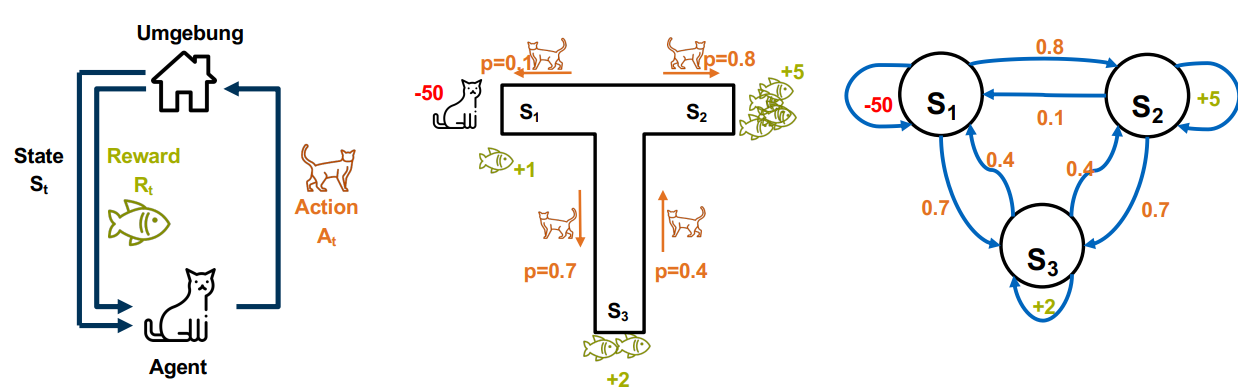
Q-Learning with Example
Reinforcement learning method where an agent learns, by trial and error, which action is best in each state by updating Q-values for state-action pairs
Example: robots or agents can learn ethical behavior by using Q-Learning with moral reward functions
Inverse Reinforcement Learning with Example
Example: shows how a system can learn socially correct behavior by observing human behavior and inferring the reward function behind it.
6
6
What is Embodied AI?
AI that learns and acts through a body in an environment, using perception, reasoning, and action in a continuous interaction loop, while adapting from experience like humans do
Foundational model of Embodied AI
Perception
(AI senses and interprets the environment through sensors)Language understanding
(AI understands natural language and maps it to meaning and context)Reasoning
(AI infers, predicts, and makes decisions based on goals and the current context)Planning to action
(AI plans a sequence of actions and carries them out in the real world)Manipulation
(AI physically interacts with objects in the environment to achieve goals)
Opportunities of Embodied AI (compared with dataset-based AI)
Enhanced learning
(learns through interaction with its environment, which leads to more robust and adaptive behavior than purely dataset-based AI)
Enhanced adaptability
(Can generalize from experience and perform better in dynamic or unpredictable situations)
Cost and efficiency benefits
(Simulators allow a lot of testing and training in controlled environments, which reduces costs, risks, and the need for real-world trials)
Real-world problem solving
(Can handle complex real-world tasks, especially ones that are dangerous, repetitive, or require high precision)
Challenges of Embodied AI (compared with dataset-based AI)
Sensory realism
(It is difficult to build sensors that match human-like perception, including depth recognition and tactile feedback)
Real-world navigation
(Must deal with changing environments, including weather conditions and obstacles)
Complexity vs. scalability
(Can become very complex, so it is hard to scale them efficiently and cost-effectively)
Energy efficiency
(Must balance strong performance with limited energy use)
Safety
(Safe operation is essential, including avoiding harm and respecting privacy)
Opportunities of Ethics and Embodied Ai
High-bandwidth interactions
(Rich sensor input lets embodied AI interact with noisy real/virtual environments, helping it learn more human-like ethical behavior)
Simulation and real-world transfer
(High-fidelity simulations allow safe testing of ethical decisions without real-world consequences, before transferring them to actual robots)
Human-in-the-loop systems
(Humans can give feedback or intervene, which helps keep the AI aligned with human ethical standards)
Teleoperation / empathy-related interaction
(Direct human-robot interaction, such as teleoperation, can support ethical guidance and improve how robots respond to human needs and values)
How to create Embodied Ai?
Build an agent in an environment
Model perception with sensors
Use world models
Train through interactive learning
Define goals and tasks
Use modern large models
Develop and test in simulation frameworks
Embodied AI Tasks and Goals
Visual Exploration
Visual Navigation
Audio-Visual Navigation
Question Answering
(The agent answers questions based on what it perceives in the environment)
Navigation Instruction Following
Rearrangement
(The agent organizes or moves objects in the environment)
Common sense principles
Safety
Predictability
Reasonableness
Uniformity
(Similar situations should be handled in a consistent way)
Explainability
(The robot should be able to make its behavior understandable to humans)
Practical Common Sense Tests
Test common sense scenarios
(Focus on everyday situations, not only on ethic dilemmas)Use low-stakes scenarios
(Test frequent, small-impact situations, because they occur much more often)Acknowledge limited information
(Perfect information is usually unrealistic)Acknowledge uncertainty
(Outcomes are not always predictable and that multiple possibilities may exist)Work with trade-offs
(Not all goals can be maximized at once)Rank principles rather than outcomes
(Prioritize general principles such as safety or liability instead of judging only isolated outcomes in single scenarios)