Pathogen virulence factors and evolution
 Call Kai
 Learn
Learn Practice Test
 Spaced Repetition
 Match
Match Flashcards
 Knowt Play
1/43

There's no tags or description
Looks like no tags are added yet.
Name | Mastery | Learn | Test | Matching | Spaced | Call with Kai | Chat |
|---|
No analytics yet
Send a link to your students to track their progress
44 Terms
How do pathogens enter the body?
cutaneously through skin/wound or a vector
mucosal
What are the mucosal routes of pathogen entry into the body?
ocular
respiratory
oral
urogenital/rectal
What is the first line of defense against pathogens and some examples?
stops pathogen entry and adhesion
physical - skin, hair, eyelashes, urination, mucus membranes
chemical - low pH, Iga, lysozynes
biological - microbiome in gut
What is the second line of defense against pathogens?
inside of body after pathogen enters
prevents pathogen establishment/infection
innate and adpative immune system
What is the innate immune system?
2nd line of defense
white blood cells
engulf pathogens, lysozymes, etc
release cytokines
What is the adaptive immune system?
2nd line of defense
B and T cells
remember pathogens
produce antibodies
How does the body respond to viruses vs bacteria?
respond differently
different complement factors and cytokines released
What is unique about viruses?
only DNA or RNA, not both
no organelles or ribosomes
no cell wall
no flagella
need a host to reproduce
What are some diseases caused by viruses?
flu
measles
HIV
What is a bacteriophage?
viruses that infect bacteria/archaea
What are the actions of virulence factors?
adhesion
invasion
colonization/infection
immune evasion
persistence/replication
want to attach or evade host immune defense
causes toxicity/harm to cells
What is a virulence factor?
something that makes an organism pathogenic and gives it a survival edge in the host

What are some possible outcomes of viral replication to a host’s cells?
cell death
persistence/latency (ex. HIV)
cell proliferation
malignant transformation (cancer)

What are some diseases caused by bacteria?
typhoid
tuberculosis
strep throat
What virulence strategies do bacteria use?
release exotoxins
release endotoxins
fimbriae for adherence
cytoxin
antibiotic resistance from plasmids from other bacteria/virus
What is an exotoxin?
toxic protein secreted by a bacterium
ex. cytotoxin, enterotoxin (diarrhea)
Why are fungal infections hard to treat?
fungi are more similar to humans, so medication may impact human cells as well
What are some diseases caused by fungi?
histoplasmosis
valley fever
athletes foot
ringworm
What unique strategies do fungi use for dispersal?
hyphae and spores when in mold state
Describe fungi at a broad level
eukaryotes
unicellular/multicellular
DNA and RNA
ribosomes
What virulence strategies do fungi use?
morphological transition between yeast, hyphae, and spores depending on what survives best in host vs environment
thermotolerance - survive hotter temps in host
adhesion
secrete exoenzymes that digest human tissue
secrete toxins
immune evasion
cell wall for robustness
What are some diseases caused by protozoans?
malaria
chagas disease
giardiasis
Describe protozoans at a broad level
eukaryotes
unicellular
DNA and RNA
organelles
some have complex lifestyles and life stages
What are virulence strategies of protozoans?
surface proteins to evade host immune system
adhesive factors to attach to host cells
proteins/enzymes to prevent death (ex. destroy machrophages)
What are challenges infectious agents face when jumping to a new type of host (spillover)?
must contact novel host
must successfully infect - needs new virulence factors for host cell receptor binding, entering cells, replicating, escaping host immune response, etc.
sufficien transmission
Why do infectious agents develop virulence factors?
to persist and replicate in host
How can symptoms be involved in pathogen transmission?
can help spread disease; ex. sneezing and coughing
What limits pathogen transmission rates?
host mortality
pathogen replication and spread speed
host immunity
How can viruses evolve?
mix with an established virus in a bridge host
multiple viruses from different sources mix in a bridge host
What is an endotoxin?
found in membrane of gram-neg bacteria
causes fever
What is an enterotoxin?
exotoxin that causes vomiting/diarrhea
Why is adhesion important for pathogens?
prevents pathogen from being physically removed from host cell
helps pathogen colonize host tissue
What are fimbriae?
bacterial structures that help bacteria adhere to host cells

What is recombination?
when gene fragments from parental viruses recomnbine and form a hybrid virus
small changes occur


What is reassortment?
when entire gene segments from parental viruses are exchanged to form a hybrid virus
causes big changes, potentially antigenic shift
only in segmented viruses like influenza

How can bacteria evolve?
mutations
modification of a gene function
acquisition of new genes (horizontal gene transfer) via transformation, transduction, or conjugation
What are the types of horizontal gene transfer bacteria can undergo?
transformation
transduction
conjugation

Describe transformation
when bacteria pick up bacterial DNA fragments
can be from dead bacteria or membrane-bound DNA bud cells from a living cell
occurs between similar species of bacteria

Describe transduction
when bacteriophage transfer DNA between bacteria
DNA then incorporated into bacterial genome
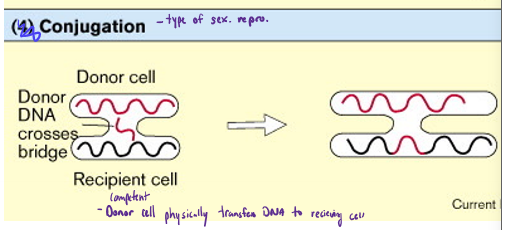
Describe conjugation
when competent Donor bacteria physically trasnfers DNA to recipient cell
type of sexual reproduction
transfers plasmid

What is a plasmid?
small, circular piece of DNA separate from a bacterium’s main chromosome
often carries useful genes, like antibiotic-resistance genes.
Why is bacterial horizontal gene transfer medically significant
transduction can carry dangerous genes between bacteria in the same family
conjugation is a common method of acquiring antiobiotic resistance
Which horizontal gene-transfer method uses free DNA?
transformation
Which horizontal gene-transfer uses a bacteriophage?
transduction