y5 bio: cluster 1 (proteins)
 Call Kai
 Learn
Learn Practice Test
 Spaced Repetition
 Match
Match Flashcards
 Knowt Play
1/45

There's no tags or description
Looks like no tags are added yet.
Name | Mastery | Learn | Test | Matching | Spaced | Call with Kai | Chat |
|---|
No analytics yet
Send a link to your students to track their progress
46 Terms
generalised structure of proteins
hydrogen group (H+) [at top]
amine group (NH2) [at left/right side]
carboxyl group (COOH) [at right/left side]
R-group [at bottom]
![<ol><li><p>hydrogen group (H+) [at top] </p></li><li><p>amine group (NH2) [at left/right side] </p></li><li><p>carboxyl group (COOH) [at right/left side] </p></li><li><p>R-group [at bottom]</p></li></ol><p></p>](https://assets.knowt.com/user-attachments/3de3c841-fe4c-433b-811b-40148df23dee.jpg)
how many different amino acids and their differentiating factor?
20 amino acids, R-group as differentiating factor
what are short chain of amino acids (up to 10) called?
oligopeptides
what is condensation reaction?
when 2 amino acids react to form dipeptide and water, and peptide bonds forms between carboxyl and amine group

what are the terminals in the dipeptide called?
n-terminals and c-terminals
what are essential amino acids (+ example)?
they cannot be synthesised by the body and can only be obtained by food. e.g. phenylalanine
how many essential amino acids in humans?
9
what are non essential amino acids (+ example)?
they can be synthesised by the body and are made from other amino acids. e.g. tyrosine, made from phenylalanine
animal proteins vs plant proteins (in amino acid aspect)
animal proteins have a complete amino acid profile, but plant proteins may lack specific amino acids
how many amino acids in a short peptide chain?
5 to 10
how many amino acids in a medium peptide chain?
100 to 200
how many amino acids in a very long peptide chain?
thousands…
how to calculate possibilities for a chain of X amino acids
20^X (number of amino acids available to you, to the power of the number of amino acids in one chain)
how do proteins get denatured?
heat or extreme pH, that break intramolecular bonds and changes protein’s shape, structure and function
R-groups can be categorised EQUALLY into 2 groups
hydrophobic and hydrophilic
hydrophobic R-groups can be further split into 3 groups
basic (accepts protons, positively charged), acidic (donates electrons, negatively charged), polar (forms hydrogen bonds)
which amino acid contains SH group?
cystenine contains disulphide bonds
which amino acid contains sulfur?
methionine
smallest and largest amino acid?
glycine smallest, tryptophan largest
2 main types of secondary structure of proteins
alpha helix and beta pleated sheet
how do hydrogen bonds form in both alpha helix and beta pleated sheet?
N-H and C=O groups interact
how does alpha helix look like, and where are the hydrogen bonds located?
right handed spiral, hydrogen bonds between adjacent turns
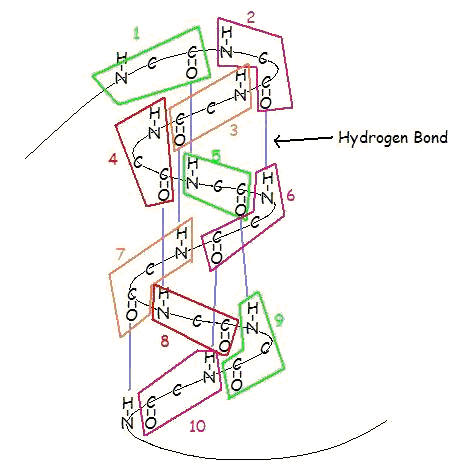
beta pleated sheets can be further categorised into
parallel and anti-parallel
how does beta pleated sheets look like, and where are the hydrogen bonds located?
parallel/anti-parallel polypeptide sections, hydrogen bonds between chains

4 types of bonds in tertiary structure
1.hydrogen bonds
2. ionic bonds
3. disulfide bonds
4. hydrophobic interactions
hydrogen bonds form between?
amino acids with polar R-groups
ionic bonds form between?
amino acids with charged R-groups
disulfide bonds form between?
cysteine amino acids
hydrophobic interactions form between?
amino acids with non-polar R-groups
out of the 4 types of bonds in tertiary structure, rank the strongest to weakest?
disulfide bonds, ionic bonds, hydrogen bonds and hydrophobic interactions
how is protein embedded in the membrane?
amino acid determines its location, where polar amino acids interact with water and non-polar amino acids avoids water
how many polypeptides make quaternary structure?
2 or more POLYPEPTIDES linked tgt make quaternary protein
2 types of proteins (composition)
conjugated (polypeptides + non protein groups) and non-conjugated (ONLY polypeptides chains)
examples of conjugated VS non-conjugated
haemoglobin has 4 polypeptide chains and 4 heme groups (conjugated), insulin with 2 polypeptide chains (non-conjugated),
what structure of protein is collagen?
it is considered in the quaternary structure, as it has 3 polypeptides linked tgt and has a high tensile strength to resist stretching
2 types of proteins (shape)
globular and fibrous
polypeptides in globular VS fibrous proteins
folded (globular), unfolded (fibrous)
shape of globular VS fibrous protein
round and compact shape (globular), narrow and elongated (fibrous)
solubility of water in globular VS fibrous protein
water-soluble (globular), insoluble in water (fibrous)
amino acids sequences in globular VS fibrous protein
non-repetitive (globular), repetitive (fibrous)
roles in globular VS fibrous protein
regulatory roles (globular), structural roles (fibrous)
globular proteins functions
they have diverse functions, with antibodies having immune function, haemoglobin having transport function and enzymes having catalytic function
fibrous proteins function
to withstand tension forces and provide structural support
defintion of primary structure of proteins
amino acid sequence
definition of secondary structure of proteins
regular patterns stablised by hydrogen bonds
definition of quaternary structure of proteins
multiple polypeptides linked tgt