Chapter 3 - Protein Structure & Function
 Call Kai
 Learn
Learn Practice Test
 Spaced Repetition
 Match
Match Flashcards
 Knowt Play
1/26

There's no tags or description
Looks like no tags are added yet.
Name | Mastery | Learn | Test | Matching | Spaced | Call with Kai | Chat |
|---|
No analytics yet
Send a link to your students to track their progress
27 Terms
What is the monomer of a protein? How many of them are there?
amino acid; 20
What is the structure of an amino acid?
A hydrogen atom, NH2 as the AMINO functional group, COOH (carboxyl functional group), and a distinctive R-group (side chain)
In an amino acid, what is the central carbon also known as?
It is known as the alpha carbon, where all of the four bonds (that make up the structure of the amino acid) bond around.

Label the image from left to right with the black covers first, then answer the pink one last (be specific with that!)
Also, is this ionized or non-ionized?
Amino group, R-chain, Carboxyl Group, Alpha carbon.
This is NON-ionized!
What happens when an amino acid is put into water? (say why)
The amino acid will ionize. Since water has a pH of 7, the amino group (NH2) will act as a base, attracting a proton to form (NH3+). Additionally the carboxyl group will donate a proton, forming COO-
Why are the charges on the functional groups (name them and give their charge) of an amino acid so important? (two reasons)
amino group (positive since it gains a proton), carboxyl group (negative since it loses a proton).
It is so important that they have charges because they help amino acids STAY in an aqueous solution, where they can interact with one another and with other solutes. Additionally, the affect the amino acid’s reactivity to perform reactions.
What is the importance of the R-chain on an amino acid?
This r-chain is what characterizes a specific amino acid (remember there’s 20).
NOTE: YOU NEED to know whether they are polar, nonpolar, acidic, basic, which one forms a disulfide bond based on a picture of them!
Peptide bonds are between (what kind of macromolecule)? Are they stable or unstable AND WHY?
two amino acids. They are usually stable because the nitrogen can sporadically (it goes back and forth) donate its pair of unshared valence electrons to the carbon in the C-N bond, forming a C=N double bond. When this happens, a pair of electrons are pushed FROM the carbonyl (C=O) ot the oxygen atom, forming a single bond with an oxygen anion (C—O-). This gives the peptide bond flexibility!
TLDR; think of resonance because that’s the big picture here!
What is the directionality of an amino acid chain? (be relatively specific here)
It will usually start at the N-terminus (NH3+) and then end at the carboxyl group (COO-)
When you have many amino acids binded together, but fewer than 50, what is the chain called? What about one with more than 50?! And finally, why don’t we just called it a protein?
An oligopeptide (or simply a peptide lol). More than 50 is called a polypeptide!
We don’t just call it a protein because a protein refers to the complete, fully functional form of the molecule. They usualy contain multiple polypeptides!
What kind of R-groups would be willing to dissolve in water (or are considered hydro_____)? What about ones that don’t dissolve in water; what do they do instead?
hydrophilic;
The r-groups that fit this category are ones that are both polar and electrically charged.
The ones that don’t dissolve in water are non-polar and don’t have highly electronegative atoms capable of forming hydrogen bonds with water. Instead of dissolving, they usually group up with each other in an aqueous solution.
What amino acid is a really special one? Why?
The special one is methionine, because it does not have a negative charge, a positive charge, or an oxygen atom. It’s a nonpolar amino acid!
What is the primary structure of a protein characterized as?
The primary structure usually contains the unique SEQUENCE of amino acids. There’s over 10,000 billion variations!!!
Why is the order and type of amino acid so important in the primary structure of a protein?
It is because every R-group affects the overall protein’s size, shape, reactivity, and solubility. So if something is just slightly incorrect or flipped (like a different amino acid), then the entire protein could be messed up, like in the example of hemoglobin, where a change on the amino 6 group makes it sickle cell disease.
look at image
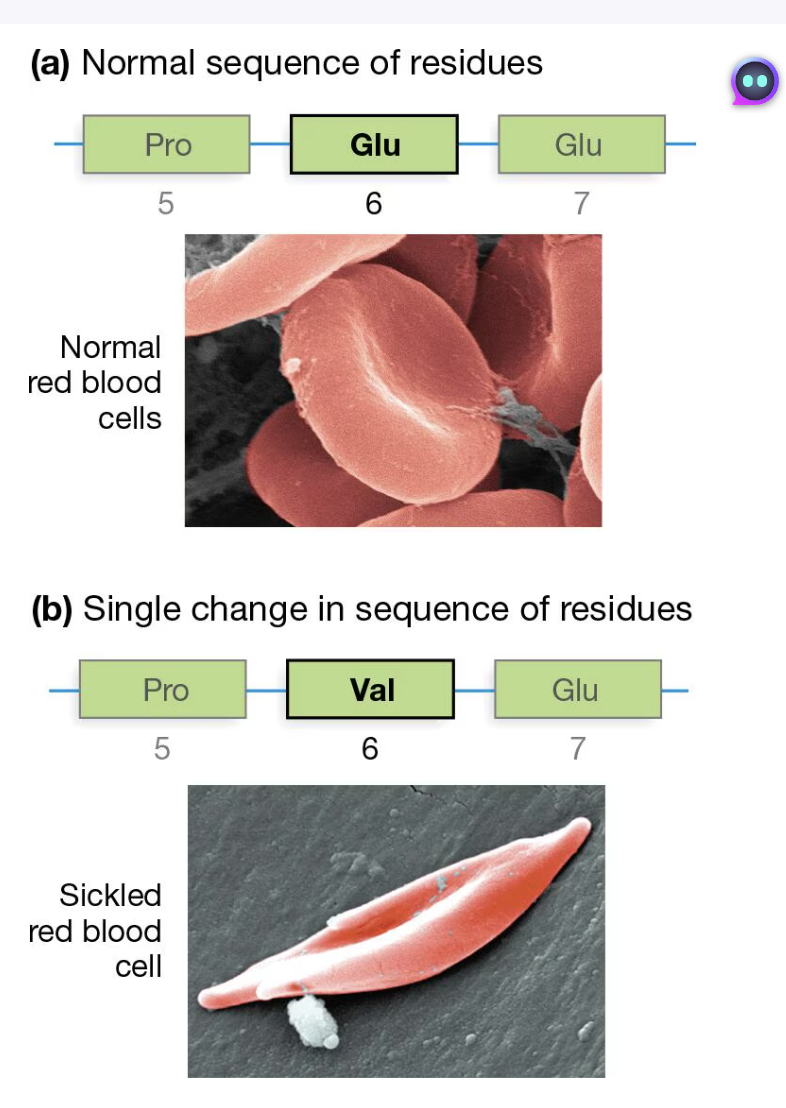
What is the second structure of a protein characterized by? (be specific on where hydrogen bonding occurs!)
ALSO, say what this results in?
The secondary structure contains the interactions between funtional groups in the peptide-bonded backbone. They are largely formed of hydrogen bonding that occurs between the oxygen on the carbonyl group of one amino acid and the hydrogen on the amino group of another.
This will result in either an alpha-helix or beta-plated sheet (look at image)

You don’t need to know the specifics, but how do we know whether an alpha-helix or beta-plated sheet will form?
We will usually know based on the molecule’s primary structure, specifically the amino acid sequence(s). Certain amino acids, like proline, are rarely found in alpha-helices because of its unusual R-group.
How is it that hydrogen bonds give shape to an alpha or beta shape of a protein (secondary structure) if the hydrogen bond is SO much weaker to a covalent bond?
It’s mainly because of the NUMBER of hydrogen bonds that occur on both the alpha and beta shape. As a result, they make the secondary structure really stable and define its shape.
What are the characteristics of the tertiary structure of a protein? (five specifics; this is the hardest flashcard)
The tertiary structure is characterized by its three-dimensional shape, which happens from the interactions between the R-groups OR between the R-groups and their backbone. There are five important interactions that build to this 3D shape:
hydrogen bonding - between the polar side chains and/or the backbone.
hydrophobic interactions - between water molecules interacting with the hydrophilic polar side of a polypeptide, forcing the hydrophobic ends to group together
Van der Waal interactions - when nonpolar chains are close to one another, they can bring each other together for a temporary amount of time
covalent bonding between the side chains of TWO CYSTEINES via disulfide bonds. This is a VERY strong linkage that gives to shape
Ionic bonding betwen groups tha thave full and opposite charges, like the ionized acidic and basic chains
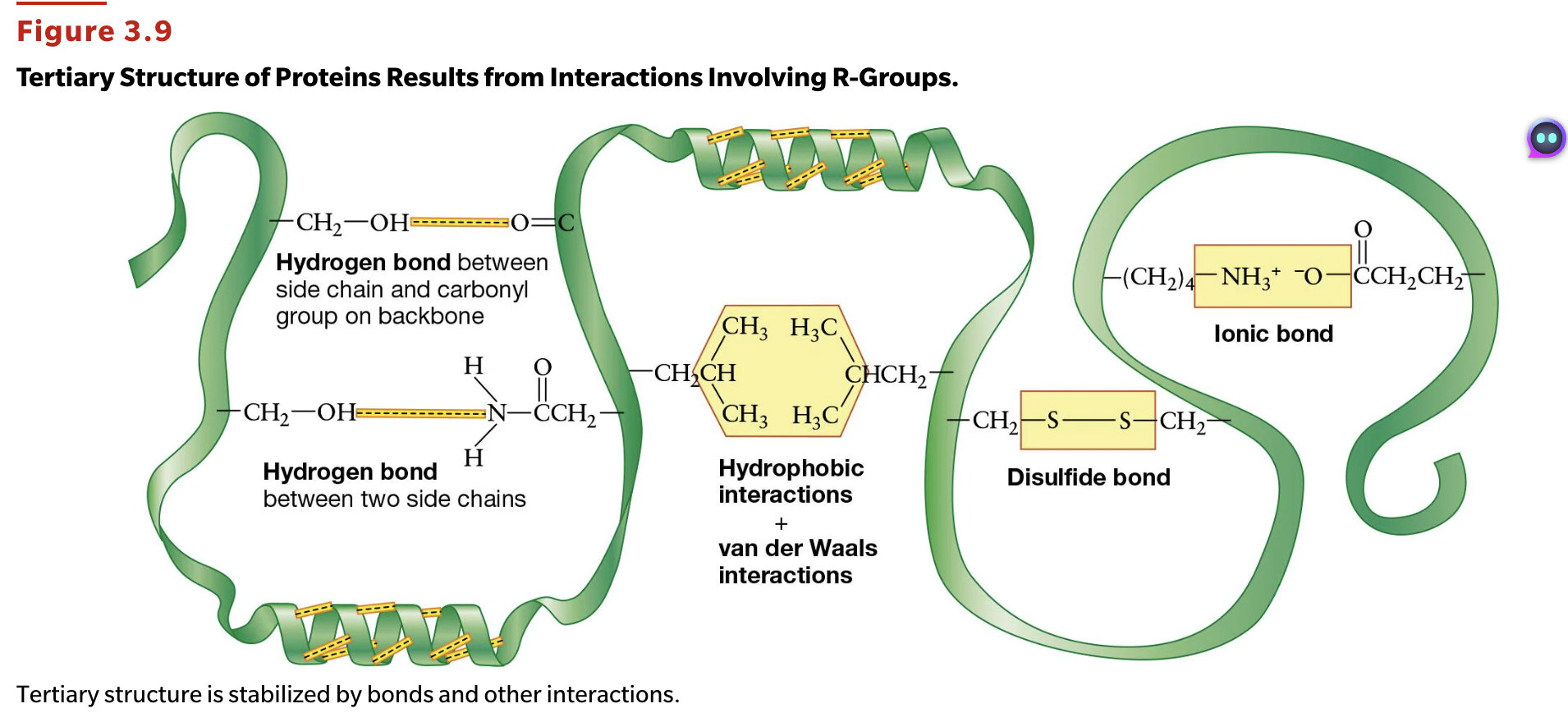
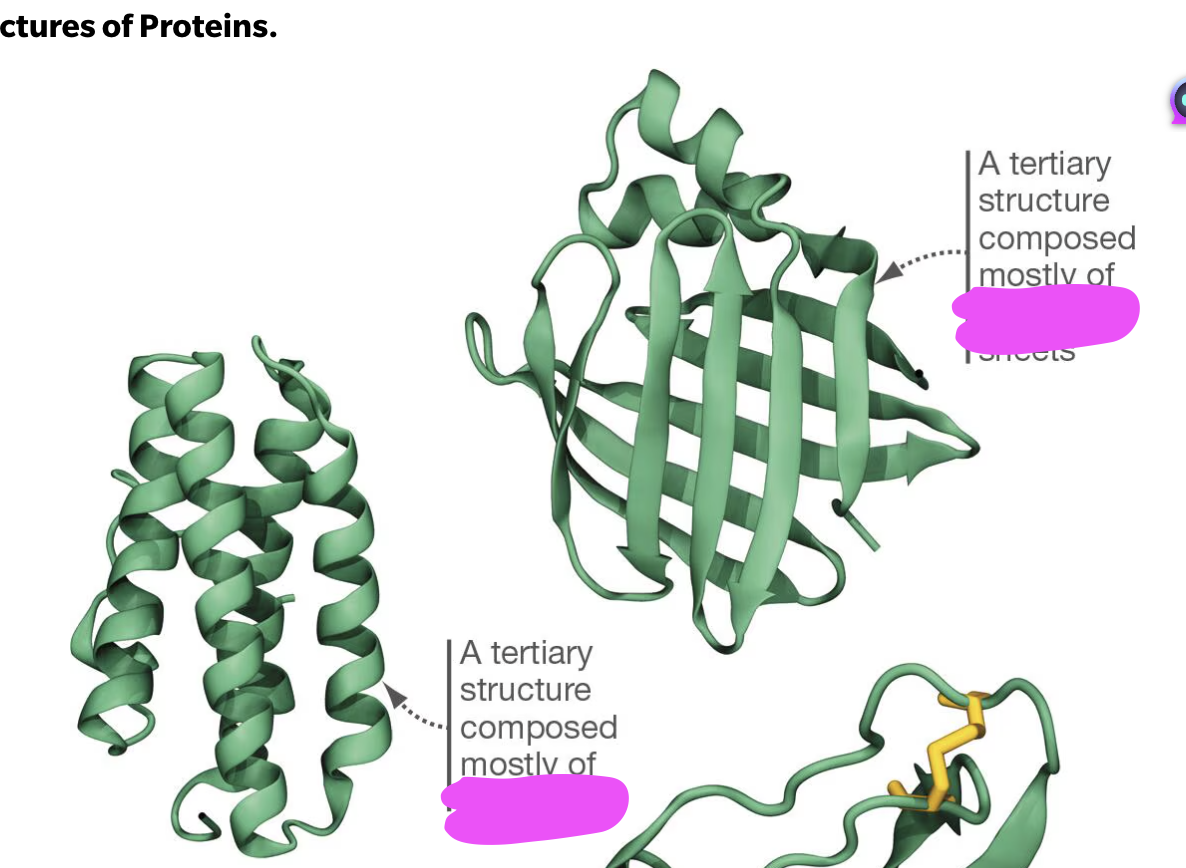
Go from left to right filling that in:
alpha-helices; beta-plated sheets
What are the characteristics of the quaternary structure?
This structure includes multiple polypeptides, which might be the same or different. When the two polypeptide subunits are identical, they are homodimers; heterodimers when they are non-identical.
You can also have a mix of homo/hetero dimers of the quaternary strucutre includes MULTIPLE polypeptides (e.g., 40).
Look at image
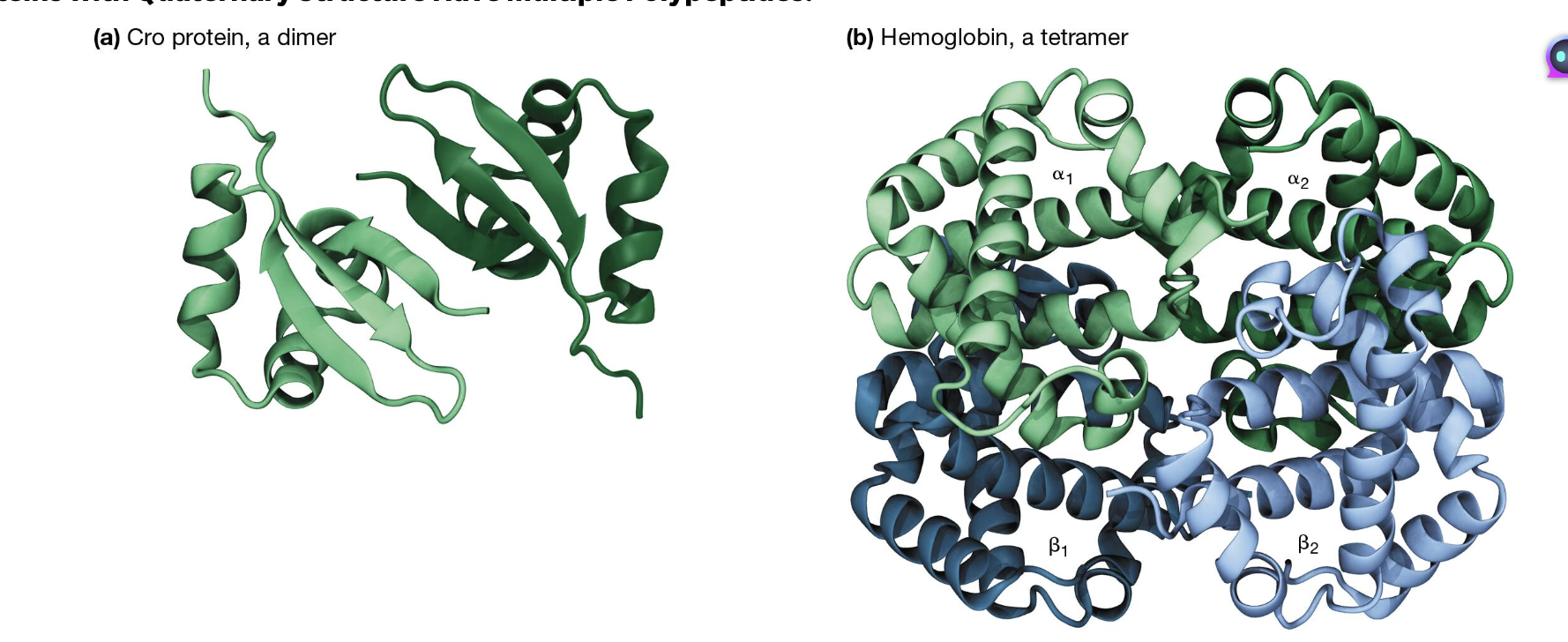
The first three stages of protein structure only involve _____?
SINGLE polypeptides
In a primary structure, what stablizes the polypeptide? What about in secondary? Tertiary? Quaternary?
Primary - Peptide bonds stablize it
Secondary - Hydrogen bonding between groups ALONG the peptided-bonded backbone
Tertiary - Bonds and other interactions (those 5) between R-groups or between R-groups and the peptide-bonded backbone
Quaternary - Bonds and other interactions between R-groups and between peptide backbones of DIFFERENT polypeptides.
Look at image (top to bottom like this card)

How might a protein be denatured? How might one guess if they’re denatured by simply looking at the protein?
A protein can be denatured if it is put into compounds that break the hydrogen bonds and disulfide bonds, which give the protein by default a unique condensed structure.
Them unfolding is a sign of denaturing!
What is the name of the special protein(s) that help proteins fold? How does this work?
They are called molecular chaperones. Essentially, they assist in the folding of a protein by attaching to the hydrophobic parts of the nonpolar side chain of polypeptides to prevent aggregates from forming, THEN, they will release them to fold properly.
look at image

Since protein folding can be so critical to its function, how is it regulated?
It is regulated by molecular chaperons and won’t fold UNLESS it binds to other molecules/ions during a signaling event (this is where molecular chaperons are apparent).
What is the reactant in a catalyzed reaction? Additionally, why are enzymes such effective catalysts?
The reactant in a catalyzed reaction is the substrate. Enzymes are so good because they can hold the subtrate in a precise orientation that allows them to react in reactions.
Where do substrates bind on the enzyme? And what happens?
They bind on the active site, which is very specific FOR that substrate. After binding, the active site will slightly shift to lock in that substrate called an induced fit.