PKP Kap. 4
 Call Kai
 Learn
Learn Practice Test
 Spaced Repetition
 Match
Match Flashcards
 Knowt Play
1/6

There's no tags or description
Looks like no tags are added yet.
Name | Mastery | Learn | Test | Matching | Spaced | Call with Kai | Chat |
|---|
No analytics yet
Send a link to your students to track their progress
7 Terms
How does psychodynamic personality assessment work, and what were Jim's results? Do these tests work?
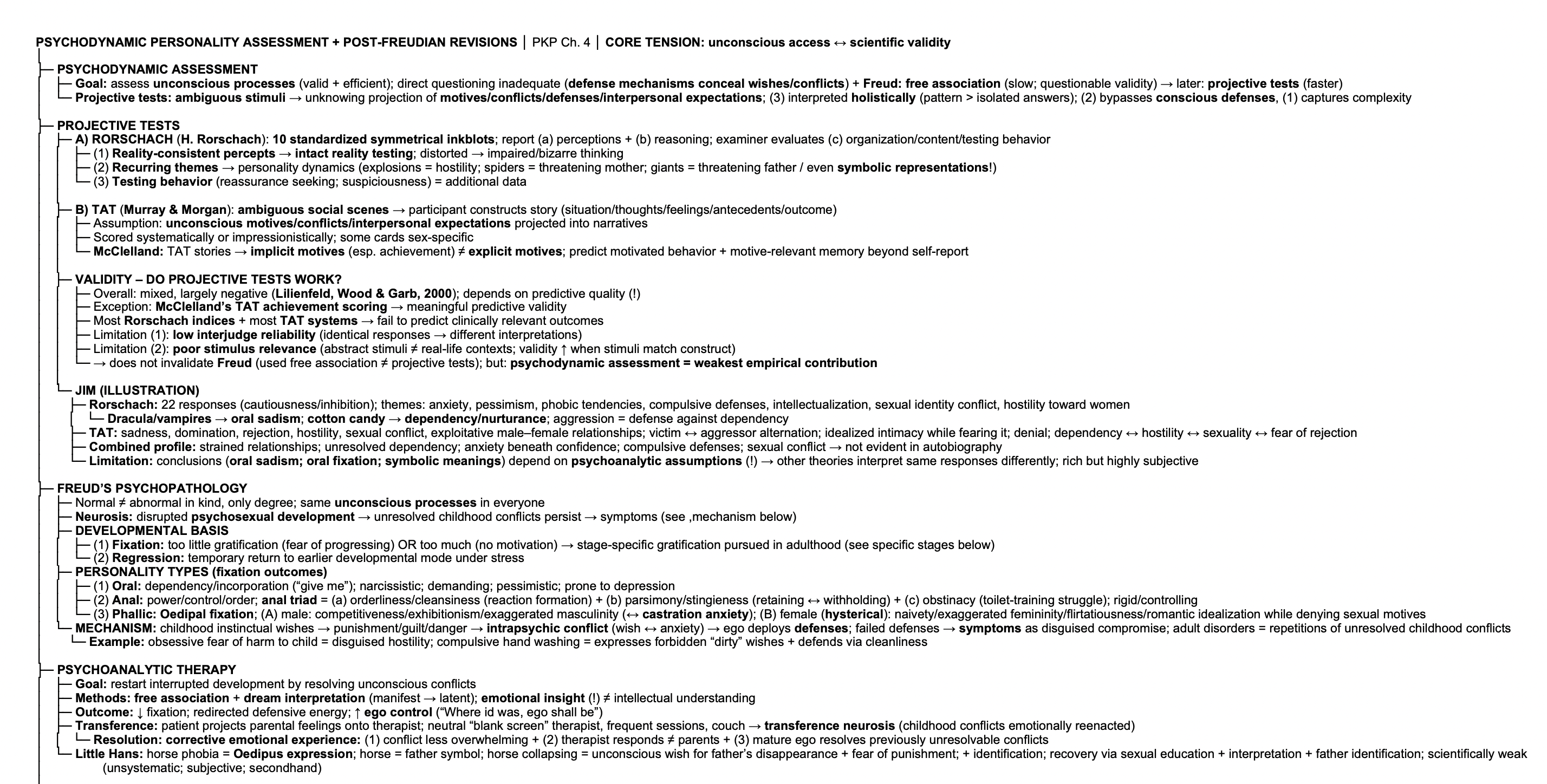
Psychodynamic personality assessment: Goal = assess unconscious personality processes (valid + efficient!); direct questioning inadequate (unconscious wishes/conflicts + defense mechanisms conceal them). Freud → free association (slow; questionable validity) → later psychodynamic psychologists developed projective tests (faster assessment).
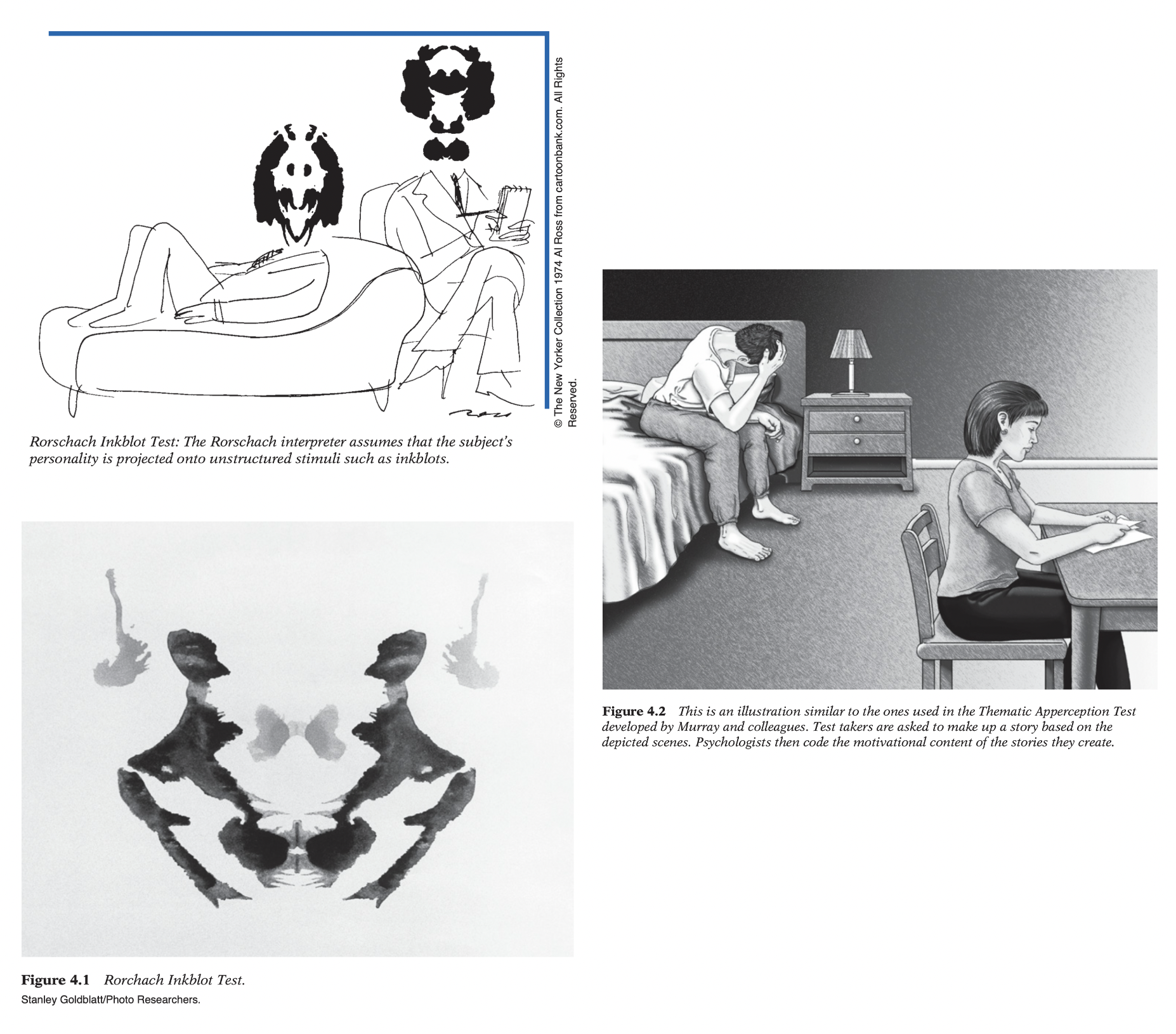
Projective tests: Use ambiguous stimuli (clarity deliberately minimized) → individuals unknowingly project motives, conflicts, defenses, interpersonal expectations, and characteristic cognitive organization onto stimuli; responses interpreted holistically ((3) overall response pattern > isolated answers); intended to capture personality (1) complexity and (2) bypass conscious defenses.
Rorschach Inkblot Test (H. Rorschach): 10 standardized symmetrical inkblots; participant reports perceptions + reasoning; examiner evaluates response organization, content, and testing behavior. (1) Reality-consistent percepts → intact reality testing; distorted percepts → impaired reality contact/bizarre thinking. (2) Recurring themes (aggression, dependency, hostility, humans vs. animals, symbolic images such as explosions = hostility; spiders = threatening mother; giants = threatening father) generate hypotheses about personality dynamics; (3) testing behavior (e.g., reassurance seeking, suspiciousness) also interpreted.
Thematic Apperception Test (TAT; Murray & Morgan): Ambiguous social scenes → participant constructs story (current situation; thoughts/feelings; antecedents; outcome). Assumption = projection of unconscious motives/conflicts/interpersonal expectations into narratives. Can be scored systematically or impressionistically; some cards sex-specific. Unlike the Rorschach, the TAT became important in motivation research: McClelland showed stories reveal implicit motives (esp. achievement), which differ from explicit motives and predict motivated behavior and memory for motive-relevant events beyond self-report.
→ Do projective tests work? Overall mixed (depends on prediction content!), but largely negative. Lilienfeld, Wood & Garb (2000): only a few procedures (especially McClelland’s TAT achievement scoring) showed meaningful predictive validity; most Rorschach indices and most TAT scoring systems failed to predict clinically relevant outcomes. Major limitations: (1) low interjudge reliability (different clinicians interpret identical responses differently) + (2) poor stimulus relevance (abstract stimuli poorly represent real-life contexts; better validity when stimuli directly match the construct, e.g., interpersonal scenes for interpersonal motives). → Does not directly invalidate Freud (he primarily used free association, not projective tests), but indicates that the psychodynamic tradition has produced relatively weak personality assessment methods, making assessment one of its weakest empirical contributions.
Jim (illustration of projective interpretation): (1) Rorschach: Only 22 responses (→ cautiousness; inhibition). Themes: anxiety, pessimism, phobic tendencies, compulsive defenses, intellectualization, sexual identity conflict, hostility toward women, interpersonal discomfort despite outward composure. Dracula/vampires → interpreted as oral sadism; later cotton candy → dependency/nurturance wishes → aggression interpreted as defense against dependency; (2) TAT: Stories consistently involved sadness, domination, rejection, hostility, sexual conflict, and exploitative male–female relationships. Jim alternated psychologically between victim and aggressor, idealized intimacy while fearing it, relied heavily on denial, and showed chronic conflict among dependency, hostility, sexuality, and fear of rejection.
→ Overall interpretation: Rorschach + TAT produced a coherent profile (strained relationships; hostility toward women; unresolved dependency needs; anxiety hidden beneath confidence; compulsive defenses; sexual conflict) not obvious in Jim’s autobiography → illustrates why psychodynamic clinicians valued projective tests for uncovering material beneath conscious self-description. Limitation: many conclusions (oral sadism, oral fixation—supported by his ulcer—symbolic meanings) depend heavily on psychoanalytic assumptions; other personality theories would interpret the same responses differently or regard many as insignificant → rich qualitative information, but highly subjective interpretation.
How did Freud describe e psychopathology? Give an example.
Freud’s psychopathology: Normal ≠ abnormal in kind, only degree; same unconscious processes operate in everyone. Neuroses arise when psychosexual development is disrupted → unresolved childhood conflicts persist into adulthood → symptoms.
Developmental basis:
Fixation (too little gratification → fear of progressing; too much gratification → no motivation to progress) → continued pursuit of stage-specific gratification in adulthood (e.g., oral fixation → overeating, smoking, drinking).
Regression = temporary return to earlier developmental mode under stress (see to which exactly below).
Personality types (fixation outcomes):
Oral: dependency, receiving, incorporation (“give me”); others valued for what they provide; narcissistic, demanding, dependent, jealous, pessimistic, prone to depression (empty, in need of nourishment).
Anal: power, control, order (“I control”); anal triad = (a) orderliness/cleanliness (reaction formation), (b) parsimony/stinginess (retaining possessions ↔ retaining feces), (c) obstinacy (toilet-training struggles); rigid, controlling, rule- and possession-oriented.
Phallic: fixation during Oedipal period; (A) male: competitiveness, exhibitionism, exaggerated masculinity → defense against castration anxiety; (B) female (hysterical personality): naive (!), exaggerated femininity, flirtatiousness, seductiveness, romantic idealization while denying sexual motives.
Psychopathology mechanism: Childhood instinctual wishes persist → associated with punishment, guilt, or danger → intrapsychic conflict (wish ↔ anxiety). Ego reduces anxiety through defense mechanisms (denial, projection, displacement, etc.); successful defenses keep wishes unconscious, failed defenses produce symptoms as disguised compromises between unconscious wishes and defenses. Adult disorders therefore represent repetitions of unresolved childhood conflicts, not entirely new problems.
Examples: Mother’s obsessive fear that harm will come to her child may disguise unconscious hostility toward the child; compulsive hand washing simultaneously expresses forbidden “dirty” wishes while defending against them through excessive cleanliness.
Psychological change (psychoanalysis): Goal = restart interrupted development by resolving unconscious conflicts. Free association + dream interpretation uncover unconscious material (manifest → latent content). Cure requires emotional insight, not merely intellectual understanding (!). Therapy reduces fixation, redirects defensive energy toward mature functioning, and strengthens ego control (”Where id was, ego shall be”).
Transference: Patients project feelings originally directed toward parents onto the therapist; analytic setting (neutral therapist/“blank screen”, couch, frequent sessions) strengthens this → transference neurosis, where childhood conflicts are emotionally reenacted. Resolution occurs through the corrective emotional experience: (1) conflict is less overwhelming, (2) therapist responds differently than parents, and (3) the mature adult ego can resolve previously unresolved childhood conflicts.
Example – Little Hans: Horse phobia interpreted as expression of the Oedipus complex. Early fascination with his penis (“widdler”) + mother’s threats of castration → castration anxiety (denial of sister not having as cope). Love for mother + rivalry with father → unconscious wish to replace father. Horse symbolized the father (large penis, physical resemblance, Hans pretending to be a horse); seeing a horse collapse triggered unconscious wishes that his father would similarly disappear (+ fear of punishment + identification with father). Dreams (e.g., large and crumpled giraffe) symbolically expressed Oedipal wishes. Recovery occurred through sexual education, psychoanalytic interpretation, and identification with the father, reducing hostility and castration anxiety. The case elegantly integrates Freud’s major concepts but is scientifically weak because observations were unsystematic, highly subjective, and largely based on second-hand reports.
What were the first major revision of Freud?
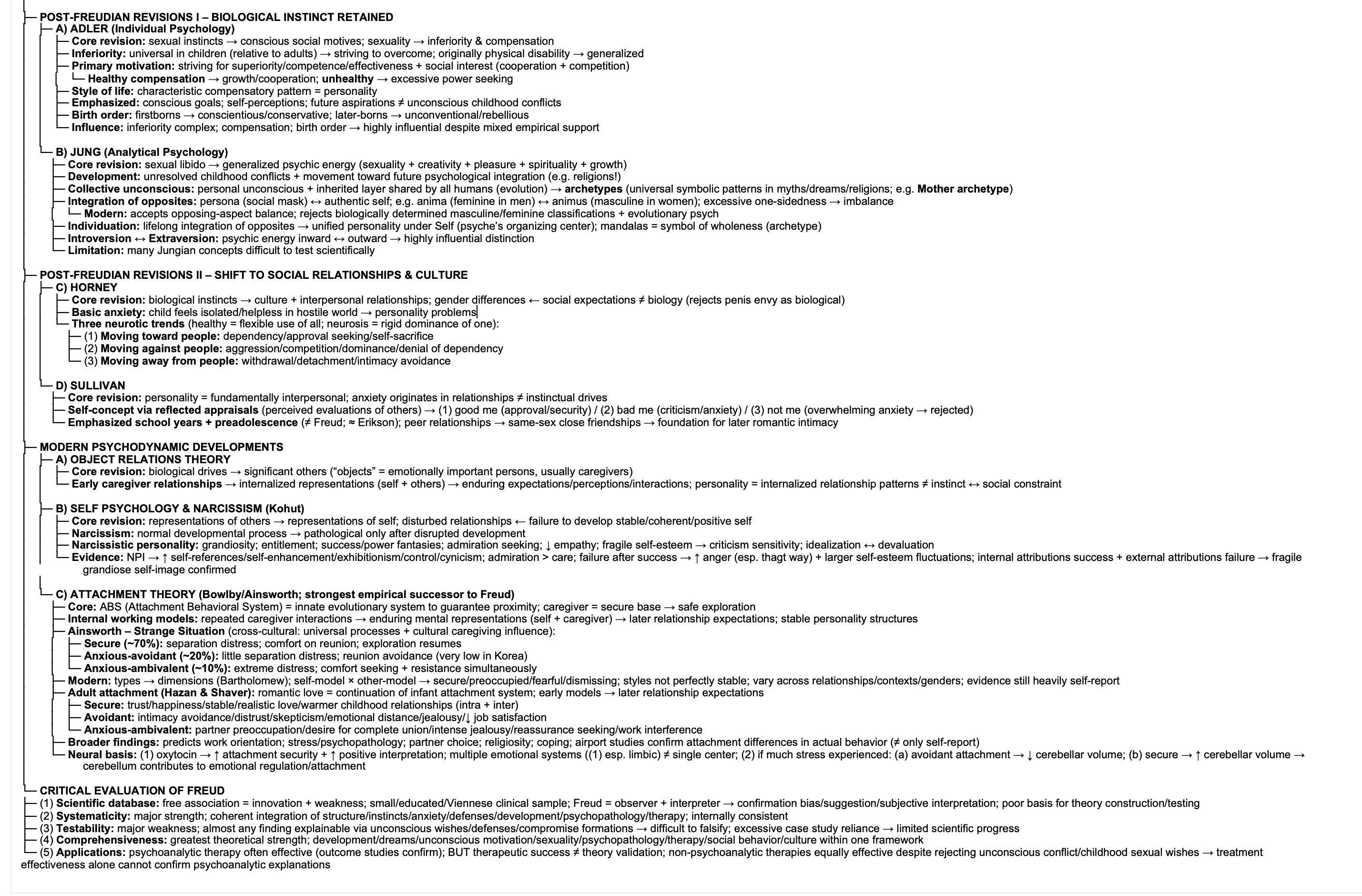
Biological instinct still:
Alfred Adler (Individual Psychology)
Core revision: (1) Unconscious sexual instincts → conscious social motives; (2) sexuality → inferiority & compensation.
Inferiority & compensation: All children experience inferiority relative to adults → universal striving to overcome inadequacy. Originally based on compensation for physical disabilities (e.g., stuttering → excellent public speaker), then generalized to all personality development.
Primary motivation: Striving for superiority, competence, effectiveness, and social interest (innate tendency toward cooperation as well as competition) // Healthy compensation → growth, cooperation, social contribution; unhealthy compensation → excessive power seeking and domination.
Style of life: Personality develops through each person’s characteristic way of compensating for inferiority.
Other revisions: Emphasized (1) conscious goals, self-perceptions, and future aspirations rather than unconscious childhood conflicts. Proposed (2) birth order effects (first-borns → conscientious/conservative; later-borns → unconventional/rebellious). Concepts such as inferiority complex, compensation, and birth-order effects became highly influential despite mixed empirical support.
Carl G. Jung (Analytical Psychology); many Jungian concepts remain difficult to test scientifically
Core revision: Sexual libido → generalized psychic life energy (sexuality + creativity + pleasure + spirituality + personal growth). Personality develops not only from unresolved childhood conflicts but also through movement toward future psychological integration.
Collective unconscious: Accepted Freud’s personal unconscious but added the collective unconscious—an inherited psychological layer shared by all humans through evolution. It contains archetypes, universal symbolic patterns expressed across myths, dreams, religions, and cultures (e.g., Mother archetype).
Integration of opposites: Psychological health requires balancing opposing forces: persona (social mask) ↔ authentic self; e.g. anima (feminine aspect in men) ↔ animus (masculine aspect in women). Excessive identification with one side creates imbalance. Modern psychologists broadly accept balancing opposing aspects of personality but question Jung’s biologically determined masculine/feminine classifications (+ evolutionbary psych).
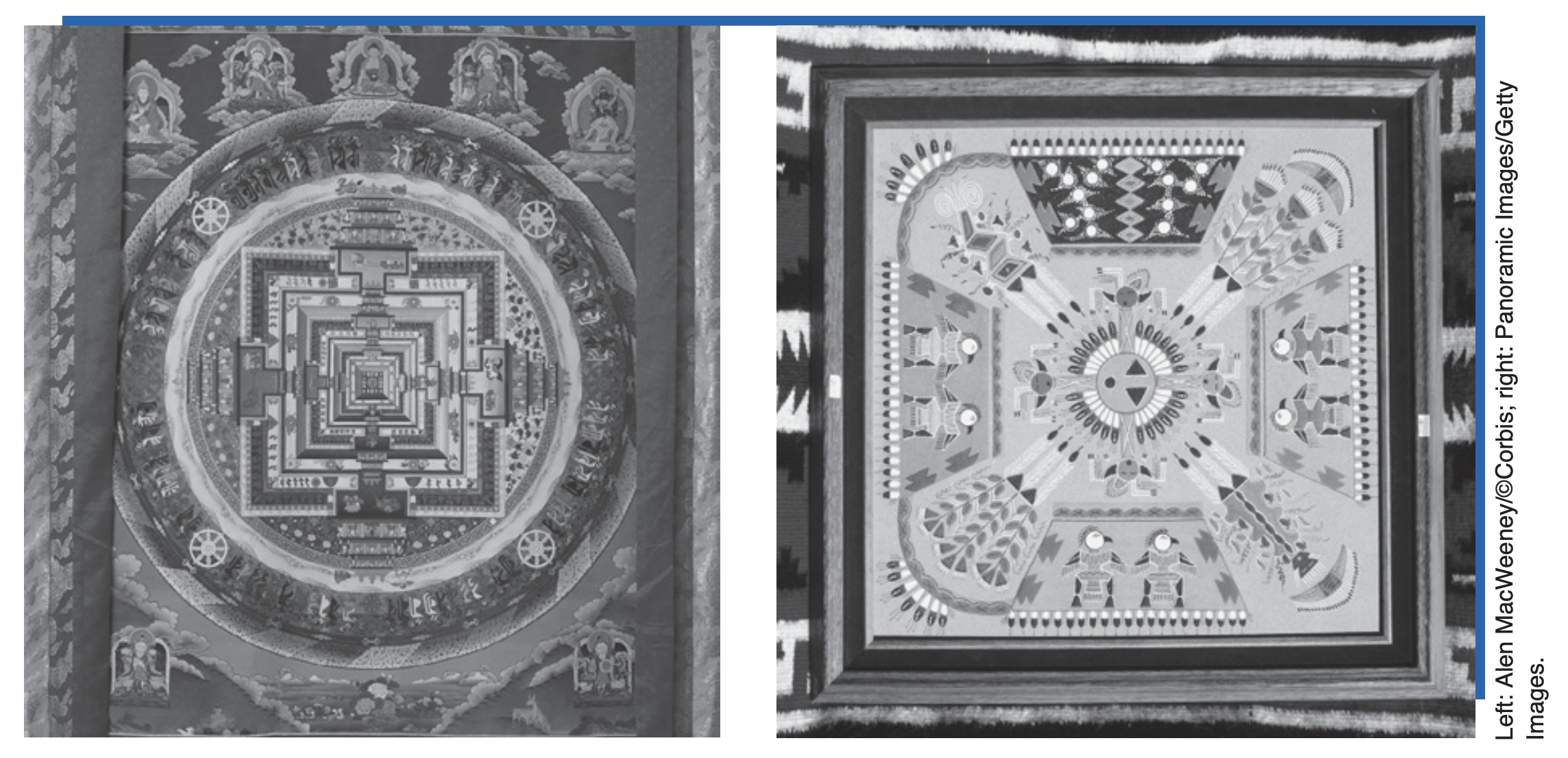
Individuation: Highest developmental goal = lifelong integration of opposing forces into a unified personality under guidance of the Self, the psyche’s organizing center. Mandalas symbolize this universal striving for wholeness (also an archetype).
Introversion–Extraversion: Introduced the influential distinction between introverts (psychic energy directed inward) and extraverts (energy directed outward); became quite influential
Shift to social relationships & culture:
Karen Horney
Core revision: Biological instincts → culture & interpersonal relationships. Rejected Freud’s view that femininity or concepts such as penis envy are biologically determined; argued that many gender differences arise from social expectations and cultural environments.
Basic anxiety: Personality problems originate from the child’s feeling of being isolated and helpless in a potentially hostile world; Three neurotic trends (Healthy people flexibly use all three; neurosis develops when one orientation becomes rigidly dominant. Horney therefore replaced Freud’s instinct theory with a more optimistic interpersonal theory emphasizing disturbed social relationships):
(1) Moving toward people: dependency, approval seeking, self-sacrifice.
(2) Moving against people: aggression, competition, dominance, denial of dependency.
(3) Moving away from people: withdrawal, detachment, avoidance of intimacy.
Harry Stack Sullivan
Core revision: Personality is fundamentally interpersonal. Emotional experiences—including anxiety—originate in relationships rather than instinctual drives.
Development of the self: Self-concept develops through reflected appraisals (how individuals believe others perceive them). Experiences create:
Good me: approval, security.
Bad me: criticism, anxiety.
Not me: overwhelming anxiety → rejected part of the self.
Development beyond childhood: Unlike Freud (and similar to Erikson), Sullivan emphasized the importance of school years and preadolescence. Peer relationships become increasingly important, and close same-sex friendships provide the foundation for later romantic intimacy.
What are modern psychodynamic developments?
Object Relations Theory
Core revision: Biological drives → significant others (“objects”); object = emotionally important person (usually caregiver).
Core idea: Early caregiver relationships → internalized mental representations (self + others) → enduring expectations, perceptions, interactions; personality explained by internalized relationship patterns, not instinct ↔ social constraint conflicts.
Self Psychology (within psychoanalythic tradition) & Narcissism
Core revision: Representations of others → representations of the self; disturbed relationships ← failure to develop stable, coherent, positive self.
(1) Narcissism (Kohut): Psychological energy invested in self; normal developmental process → pathological only after disrupted development. vs. (2) Narcissistic personality: Grandiosity; entitlement; fantasies of unlimited success/power; admiration seeking; reduced empathy (self-preoccupation); fragile self-esteem → criticism sensitivity; idealization ↔ devaluation of others.
Research: (1) NPI (self-reports) → more self-references; self-enhancement; mirror/video viewing; preference for admiring > caring partners; exhibitionistic, assertive, controlling, critical. Also self-aggrandizing attributions; simple self-concepts; cynical mistrust of others + (2) Experimental evidence: Manipulated success/failure → greater anger (esp. failure after success); larger self-esteem/happiness fluctuations; internal attributions for success; external attributions for failure → supports fragile grandiose self-image.
Attachment Theory (= strongest empirical successor to Freud; among the most empirically productive psychodynamic developments despite limitations)
Core revision: Attachment Behavioral System (ABS; Bowlby) = innate evolutionary system maintaining infant–caregiver proximity; caregiver = secure base → safe exploration + Internal working models: Repeated caregiver interactions → enduring mental representations of self + caregiver → later relationship expectations; stable personality structures.
Ainsworth – Strange Situation (Cross-cultural evidence: Universal attachment processes + cultural caregiving influence):
Secure (~70%) → separation distress; comfort on reunion; exploration resumes.
Anxious-avoidant (~20%) → little separation distress; reunion avoidance (very low rates in Korea).
Anxious-ambivalent (~10%) → extreme distress; simultaneous comfort seeking + resistance.
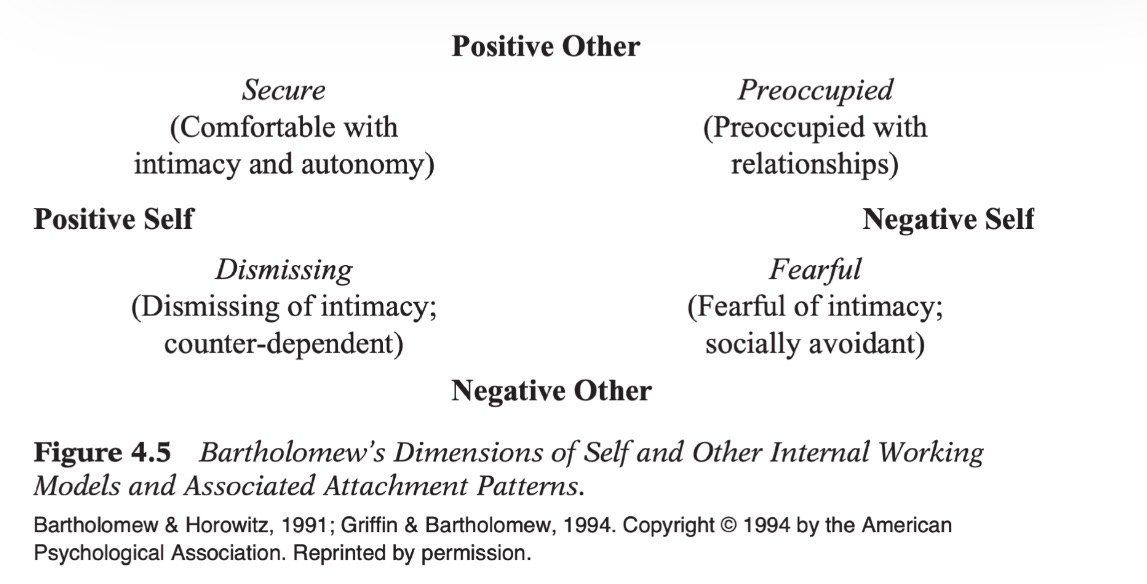
“Types → dimensions” (modern view); attachment better represented continuously than categorically; Bartholomew: Internal working model of self × internal working model of others → secure; preoccupied; fearful; dismissing BUUUT Current limitations: Attachment styles not perfectly stable; vary across relationships, contexts, genders; evidence still heavily self-report.
Attachment in Adulthood (Hazan & Shaver: Adult romantic love = continuation of infant attachment system; early internal working models → later relationship expectations/behavior)
Secure: trust; happiness; friendship; stable (but fluctuating / realistic) love; warmer childhood parental relationships (inter and intra).
Avoidant: intimacy avoidance; distrust; skepticism about lasting love; emotional distance/work → avoid dependence; jealousy; emotional highs/lows; lower job satisfaction.
Anxious-ambivalent: partner preoccupation; desire for complete union; intense jealousy/emotions/sexual attraction; reassurance seeking; relationship concerns interfere with work.
+ Broader findings: Predicts work orientation; stress psychopathology; interpersonal functioning; partner choice; religiosity; coping. Naturalistic airport studies confirmed attachment differences in actual behavior (not only self-report): avoidant women ↓ contact seeking/support during separations but warmer behavior without separation threat → infant attachment dynamics generalize to adult relationships.
Personality and the Brain
(1) Oxytocin: ↑ attachment security; ↑ positive interpretation of attachment-related situations, (2.1) Neural basis: Multiple emotional systems (esp. limbic system), not single attachment center; (2.2) Cerebellum: Traditionally movement → also attachment. After interpersonal loss: avoidant attachment → reduced cerebellar volume; more secure attachment → greater cerebellar volume → emotional regulation systems contribute to attachment.
Give a critical evaluation of Freud's theory.
Scientific observation (database): Free association = major innovation + major weakness; database = small, educated Viennese clinical sample; limited diversity/objectivity; Freud = observer + interpreter → confirmation bias, suggestion, subjective interpretation; poor scientific database for theory construction/testing.
Systematicity: Major strength; highly coherent integration of personality structure (id/ego/superego), instincts, anxiety, defense mechanisms, development, psychopathology, therapy; one of the most internally consistentpersonality theories.
Testability: Major weakness; almost any finding explainable via unconscious wishes, defenses, compromise formations→ difficult to falsify; highly flexible explanations, few genuinely testable predictions; excessive reliance on case studieslimited scientific progress.
Comprehensiveness: Greatest theoretical strength; attempts to explain development, dreams, unconscious motivation, sexuality, psychopathology, psychotherapy, social behavior, culture within one framework; exceptionally broad scope.
Applications: Psychoanalytic therapy often effective; outcome studies support clinical benefit. BUT: therapeutic success ≠ validation of Freud’s theory; many non-psychoanalytic therapies equally effective despite rejecting unconscious conflict/childhood sexual wishes → treatment effectiveness alone cannot confirm psychoanalytic explanations.
Tree (PKP. Kap. 4) 1/2
Tree (PKP. Kap. 4) 2/2