PSYC 102 - Ch. 8: Thought, Language, Intelligence
 Call Kai
 Learn
Learn Practice Test
 Spaced Repetition
 Match
Match Flashcards
 Knowt Play
1/87

There's no tags or description
Looks like no tags are added yet.
Name | Mastery | Learn | Test | Matching | Spaced | Call with Kai |
|---|
No analytics yet
Send a link to your students to track their progress
88 Terms
replication crisis
The discovery that many psychological studies cannot be successfully repeated (replicated), raising concerns about the reliability of findings.
paradigm shift
A major change in the model or framework scientists use to study something.
Why is psychology in a paradigm shift right now?
Because the field is reforming how research is done to improve replicability.
What study became the “canary in the coal mine” for the replication crisis?
Daryl Bem’s 2011 “Feeling the Future” study.
What did Bem (2011) claim?
That participants could predict future erotic images at above-chance levels (53% - statistically significant!!)
Why was Bem’s study controversial?
Because many later studies failed to replicate it.
What percentage of 100 major psychology studies successfully replicated?
Only 39%
Why did Bem’s results seem shocking?
They appeared to support precognition (paranormal ability).
Why were Bem’s studies important to the replication crisis?
Because if impossible claims (like feeling the future) could get published in top journals, it suggested a bigger systematic problem in psychological science.
What did Bem’s work reveal about scientific literature?
That statistically significant findings are not always true findings.
What was the goal of Simmons (2011) study?
Relatively common, unreported scientific research practices can create/find evidence for effects known to be false.
false-positive psychology
Finding statistically significant results for effects that are actually false.
The area of psychology called _______ proves that we can ______ ____ conclusions
false-positive psychology; “simulate”, false
Who conducted the false-positive psychology studies?
Joseph Simmons in 2011
“Hot Potato” study
Participants listened to the song “Hot Potato” and then reported feeling older.
“When I’m 64” study
Participants listened to the song and were supposedly “1.5 years younger.”
What does “chronological rejuvenation” mean for Simmons study?
The absurd false claim that music made people literally younger.
Did Simmons actually believe music changed age?
No—the study was designed to expose flaws in research practices.
Why was Simmons’ study important to the replication crisis?
It demonstrated the mechanism by which false claims can gain empirical support.
What mechanism did Simmons reveal?
Flexible analyses and questionable research practices (p-hacking).
Mechanism 1
“Filtering Published Research”
Criteria used to evaluate research for Mechanism 1
Finding answers important question
Finding has high internal validity
Finding is novel or surprising
Finding is statistically significant,p < .05
Pressures for publication for Mechanism 1
Significant & novel effects are published, even if...
Non-significant go to the ‘file drawer”, even if....
Mechanism 2
“Filtering Researchers”
Filters for scientists (Mechanism 2)
Publish to get a PhD
Publish to get a post-doc
Publish to become a prof
Publish to get grant funding
Publish to get tenure
Science is a ___ ____ and relies on ____ ______!
social process; human decisions
Social indicators (Mechanism 2)
Social indicator 1: Is the result statistically significant?
Social indicator 2: Did you, scientist, publish?
Indicator 2 outlines…
In your career have you engaged in any of the following practices:
Not reporting all outcome variables: 66.5%
Collecting more data if not significant: 58.0%
Reporting only studies that ‘work’: 50.0%
Not reporting all conditions: 27.4%
Stopping data collection early: 22.5%•
Rounding”p-values: 23.3%
Falsifying data: 1.7%
Biases in research design
effectiveness study
side-effect study
__ ____ differ for effectiveness vs. side-effect studies, displaying what?
Rx doses; biases in research design
effectiveness study
use big doses
side-effect study
use small doses
What is p-hacking?
Manipulating data collection or analysis until p < .05 is found.
What is the file drawer problem?
Non-significant results are often not published.
Why is publication bias a problem?
It makes effects look stronger or more reliable than they actually are.
What percentage of researchers admitted to collecting more data after non-significant results?
58%
What percentage admitted to not reporting all outcome variables?
66.5%
Solutions to Replication Crisis
Preregistering hypotheses, data collection, and data analysis plans
Publishing null results (p > .05) and replications
Increasing sample sizes
Publishing raw data, methods, & analysis scripts
Embracing ‘messy’ data
Even (bravely) critiquing own work
preregistration
Publicly stating hypotheses, methods, and analyses before collecting data.
Why publish null results?
To reduce publication bias.
Why do larger sample sizes help?
They make findings more reliable.
Why publish raw data?
So others can verify analyses.
How did David Wechsler define intelligence?
The global capacity to act purposefully, think rationally, and deal effectively with the environment.
What is the difference between aptitude and achievement tests?
Aptitude = future ability; Achievement = what you already learned.
What do intelligence tests measure?
Broad, overall capability across many domains.
3 Approaches to Intelligence
Psychometric Approach
Multiple Intelligences
Information Processing Approach
What is the psychometric approach?
Children seem to have different potentials → assume existence of intelligence construct, then measure intelligence through standardized testing.
Who developed early intelligence testing?
Alfred Binet and Théodore Simon
Binet-Simon Natural Intelligence Test
The first widely accepted practical intelligence test. It was designed to identify schoolchildren needing academic support, laying the groundwork for modern IQ testing.
what did the Binet-Simon Natural Intelligence Test assess?
Instead of testing acquired knowledge like specific math or reading skills, the Binet-Simon scale focused on assessing:
Memory
Attention
Abstract reasoning
Problem-solving abilities
the tests were tailored to specific age levels based on developmental norms
Who proposed the two-factor theory?
Charles Spearman
Spearman’s 1904 General Ability/Intelligence Approach
A person's ultimate performance on any task is determined by their overarching general intelligence (g) combined with the specific ability (s) required for that exact task.
Factor 1 (g)
General ability — overall mental ability; single, foundational mental capacity that drives all of our cognitive performance
Factor 2 (s)
Specific abilities — strengths in particular areas.
akin to aptitudes
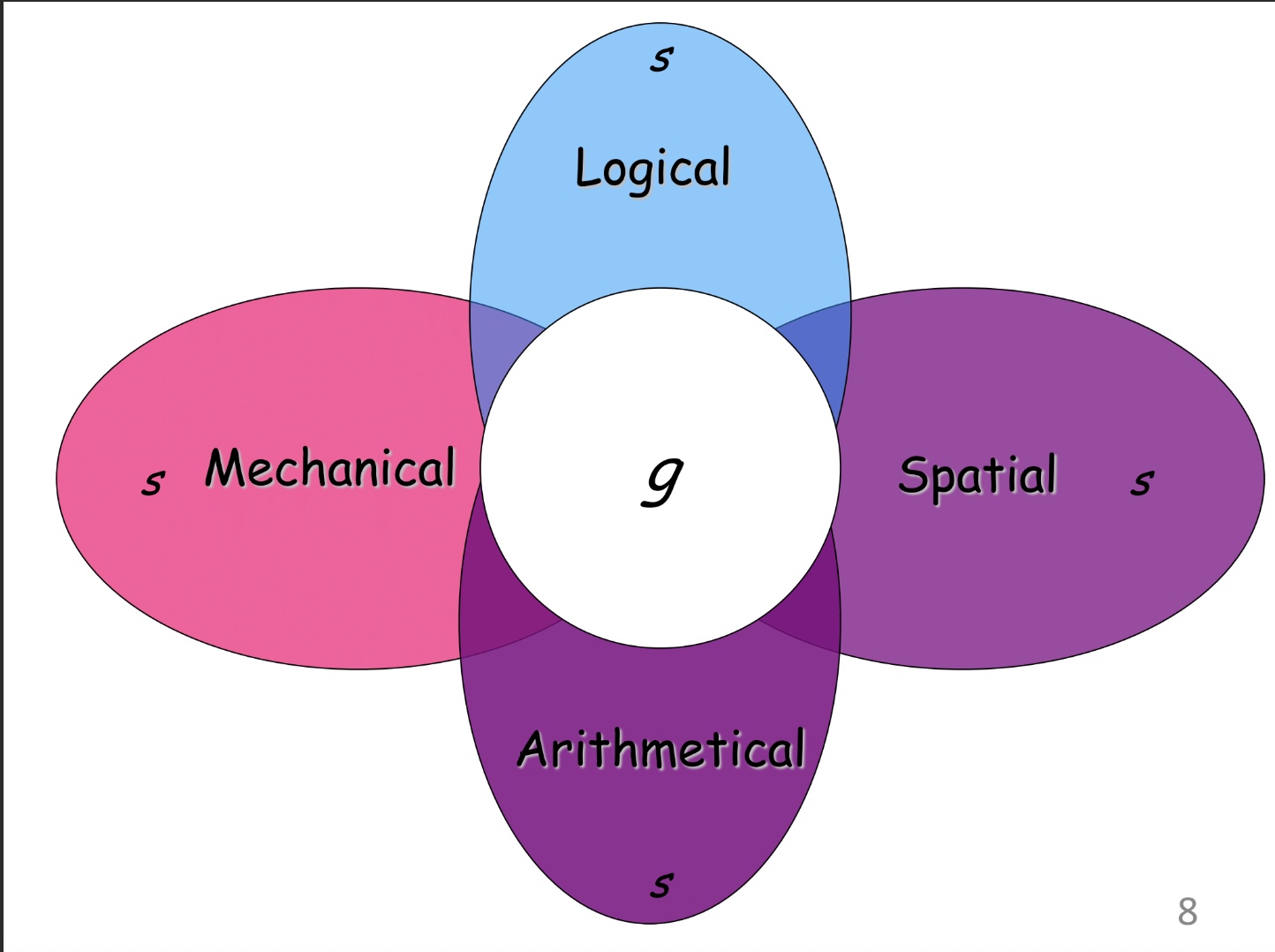
Logical, Mechanical, Spatial, Arithmetical
Two-factor theory, Spearman’s Approach
predictive validity
A test’s ability to predict future performance.
What does g predict?
School performance and academic success.
What does Mechanical s predict?
Video game expertise (15%)
what is the Multiple Intelligences Approach?
Intelligence is the product of many communicating systems
Intelligence exists in many independent forms.
supporting evidence of Multiple Intelligences Theory
Brain damage often impacts a specific ability, but not other abilities
Development of systems happens at different ages
‘Gifted’ individuals may possess strong ability in one domain, but not another
Gardner’s 7 (or 8) Intelligences
Logical/mathematical***
Verbal***
Visual-Spatial
Intra-personal
Social (interpersonal)
Body/kinesthetic
Musical
Naturalistic
Limitations to Multiple Intelligences Theory
Multiple intelligences are strongly correlated with each other - should be unique, implies existence of g
Multiple intelligences strongly correlate with g!!
Subjective theory - different researchers could defend entirely different sets of intelligences
Low predictive validity - 10% of elementary grades (vs. 49%)
Components of ‘g’
processing speed
fluid intelligence
crystallized intelligence (knowledge base)
general memory & learning
broad visual perception
broad auditory perception
broad retrieval ability
broad cognitive speediness
Why is Gardner’s theory criticized as subjective?
Different researchers could define different intelligences.
What does Information Processing Approach study?
The basic mental processes supporting intelligence.
what are the basic mental processes supporting intelligence?
Processing speed
Acquiring new mental processes/habits
Inhibiting previously learned mental processes
Knowledge base or crystallized intelligence
processing speed
How quickly you perform mental tasks.
fluid intelligence
sequential reasoning
induction
quantitative reasoning
crystallized intelligence
Knowledge you’ve built up over time.
general memory & learning
memory span
associative memory
broad visual perception
visualization
spatial relations
closure speed
broad auditory perception
speech sound discrimination
general sound discrimination
broad retrieval ability
creativity
ideational fluency
naming facility
broad cognitive speediness
rate of test-taking
numerical facility
perceptual speed
What factor has the strongest support from evidence in the Info Processing Approach?
Working memory.
What does the other evidence point to in the Info Processing Approach?
3 Factor Model
Updating
Shifting
Inibition
What IQ test is considered the “winner”?
Wechsler Adult Intelligence Scale (WAIS)
What four areas does WAIS-IV measure?
Verbal comprehension (g)
Perceptual reasoning (g)
Working memory (info-processing)
Processing speed (info-processing)
What makes a good intelligence test?
Reliability and validity.
reliability
Consistency over time.
validity
Measuring what it claims to measure.
How reliable is WAIS?
Very high (r = .96).
What does WAIS predict besides other IQ tests?
job performance
When does IQ predict job performance best?
In complex jobs requiring decision-making.
What is the key difference between Bem and Simmons in relation to the replication crisis?
Bem = shows the problem (false/impossible findings can enter the literature).
Simmons = shows the mechanism (how researchers can accidentally create false findings).
Why are Bem’s and Simmons’s studies often taught together?
Together they explain both what went wrong in psychology and how it happened.
Why was Bem’s study a canary in the coal mine?
It was an early warning sign that the scientific system could publish impossible findings, revealing deeper issues in replicability.
What did Simmons prove?
That common but hidden research practices can produce statistically significant results for things known to be false.