Cells (3a)
 Call Kai
 Learn
Learn Practice Test
 Spaced Repetition
 Match
Match Flashcards
 Knowt Play
1/66

There's no tags or description
Looks like no tags are added yet.
Name | Mastery | Learn | Test | Matching | Spaced | Call with Kai | Chat |
|---|
No analytics yet
Send a link to your students to track their progress
67 Terms
What are the main ideas of cell theory?
A cell is the structural and functional unit of life; the body's function depends on the activities of its cells; cell structure and function are related; and cells come only from preexisting cells.
Why are there so many different types of human cells?
Humans have over 250 cell types that differ in size, shape, and subcellular structures, allowing them to perform different functions.
What are the three basic parts of a generalized human cell?
Plasma membrane = flexible outer boundary; cytoplasm = intracellular fluid containing organelles; nucleus = DNA-containing control center.
What are extracellular materials?
Substances outside cells, including extracellular fluids, cellular secretions, and extracellular matrix.
What are examples of extracellular fluids?
Interstitial fluid surrounds/bathes cells; blood plasma is the fluid portion of blood; cerebrospinal fluid surrounds nervous system organs.
What is the extracellular matrix?
Material outside cells that acts like glue to help hold cells together.
What is the main function of the plasma membrane?
It forms an active barrier between intracellular fluid (ICF) and extracellular fluid (ECF) and controls what enters and leaves the cell.
What is the fluid mosaic model?
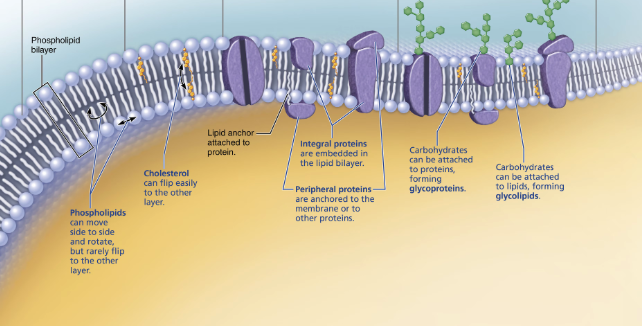
The plasma membrane is a moving phospholipi

d bilayer containing cholesterol and proteins that float within the membrane, creating a constantly changing pattern.
What are the major lipids in the plasma membrane?
About 75% phospholipids, 20% cholesterol, and 5% glycolipids according to the slides. (where glycolipids are carbohydrates attatched to lipids)
What are the two parts of a phospholipid?
A polar, hydrophilic phosphate head that likes water and nonpolar, hydrophobic fatty acid tails that avoid water.

How are phospholipids arranged in the membrane?
Hydrophilic heads face the watery fluid inside and outside the cell, while hydrophobic tails point inward toward each other and form the membrane's center.

What is the interior of the phospholipid bilayer like?
It is nonpolar and hydrophobic because it is formed by the fatty acid tails.
What do glycolipids do?
They are lipids with sugar groups on the outer membrane surface and contribute to the cell's glycocalyx.
What does cholesterol do in the plasma membrane?
It increases membrane stability and helps reduce excessive membrane fluidity.
What are the two major types of membrane proteins?
Integral proteins and peripheral proteins.
What are integral membrane proteins?
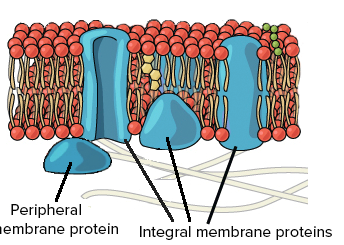
Proteins firmly inserted into the membrane; most span the entire membrane and contain both hydrophobic and hydrophilic regions.
What are the main functions of integral proteins?
They can act as transport proteins such as channels or carriers, enzymes, and receptors.
What are peripheral membrane proteins?
Proteins loosely attached to integral proteins or the inner membrane surface; they help support the membrane and can function as enzymes, motor proteins, and cell-to-cell connections.

What are the major functions of membrane proteins?
Transport, receptors for signaling, enzymatic activity, cell recognition, attachment to the cytoskeleton/ECM, and joining cells together.
What is the glycocalyx?
A carbohydrate-rich "sugar coating" on the outside of the cell made from sugars attached to proteins and lipids.
What is the function of the glycocalyx?
It acts as a biological identification marker, helping cells recognize one another and helping the immune system distinguish self from nonself.
What are the three main types of cell junctions?
Tight junctions, desmosomes, and gap junctions.

What is a tight junction?
A sealed junction where proteins of adjacent cells fuse together and prevent fluids and most molecules from passing between the cells.
What is a desmosome?
A strong, rivet-like junction that anchors neighboring cells together and allows some give, reducing tearing when tissues are under tension.
Why are desmosomes useful in areas under mechanical stress?
They provide strong anchoring between cells while still allowing some flexibility, which helps keep cells from pulling apart.
What is a gap junction?
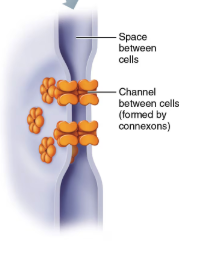
A junction made of protein channels called connexons that create tunnels between neighboring cells.
What is the function of gap junctions?
They allow ions and other small molecules to pass directly between cells and allow electrical signals to travel quickly from cell to cell.
Where are gap junctions especially important?
Cardiac muscle and smooth muscle cells.
What does selectively permeable mean?
The plasma membrane allows some substances to cross easily while preventing or limiting others from crossing.
What is the difference between passive and active transport?
Passive transport requires no cellular energy; active transport requires energy, usually ATP.
What are the three types of passive transport in these slides?
Simple diffusion, facilitated diffusion, and osmosis.
What is diffusion?
The natural net movement of molecules from an area of higher concentration to an area of lower concentration.
What does moving down a concentration gradient mean?
Moving from where there are more molecules to where there are fewer molecules.
Why does diffusion occur?
Molecules are constantly moving randomly because of kinetic energy and collide with one another, causing them to spread from crowded areas toward less crowded areas.
What three factors affect the speed of diffusion?
Concentration difference, molecular size, and temperature.
How does concentration difference affect diffusion?
The greater the difference in concentration between two areas, the faster diffusion occurs.
How do molecular size and temperature affect diffusion?
Smaller molecules diffuse faster; higher temperatures increase molecular movement and therefore increase diffusion rate.
What is equilibrium in diffusion?
A state where concentrations are balanced so there is no NET movement of molecules in one direction, although molecules are still moving randomly.
What is simple diffusion?
Movement directly through the phospholipid bilayer from high to low concentration without using energy or a transport protein.
What substances can move by simple diffusion?
Nonpolar, lipid-soluble substances such as oxygen, carbon dioxide, steroid hormones, and fatty acids; very small amounts of water can also pass.
What is facilitated diffusion?
Passive movement of substances down their concentration gradient with the help of membrane transport proteins.
Why is facilitated diffusion needed?
Larger, polar, or non-lipid-soluble substances cannot easily pass through the hydrophobic membrane and therefore need carriers or channels.
What are the two types of facilitated diffusion?
Carrier-mediated facilitated diffusion and channel-mediated facilitated diffusion.
How does carrier-mediated facilitated diffusion work?
A specific molecule binds to a transmembrane carrier protein, causing the carrier to change shape and move the molecule across the membrane.

What kinds of substances use carrier-mediated facilitated diffusion?
Polar molecules such as sugars and amino acids that are too large to pass through membrane channels.
What does carrier saturation mean?
All available carrier proteins are occupied and transporting molecules, so the transport rate cannot increase unless more carriers are available.
How does channel-mediated facilitated diffusion work?
Substances move down their concentration gradients through water-filled protein channels in the membrane.
What substances commonly move through membrane channels?
Ions and water; water channels are called aquaporins.
What is the difference between leakage and gated channels?
Leakage channels are always open; gated channels open or close in response to chemical or electrical signals.
What is osmosis?
The movement of water across a selectively permeable membrane.
How can water cross the plasma membrane?
Small amounts can pass directly through the lipid bilayer, but much water moves through special channels called aquaporins.
What is osmolarity?
A measure of the total concentration of solute particles in a solution, expressed in osmoles per liter.
How does solute concentration relate to water concentration?
More solute means less water concentration; less solute means more water concentration.
Which direction does water move during osmosis?
From an area of LOW solute/high water concentration toward an area of HIGH solute/low water concentration.
What happens if a membrane is permeable to both solute and water?
Both solutes and water move down their gradients until equilibrium is reached and concentrations become equal on both sides.
What happens if a membrane is permeable only to water?
Only water moves by osmosis toward the side with higher solute concentration until osmotic equilibrium is reached.
What is hydrostatic pressure?
The outward "back pressure" produced when water enters a cell and increases its volume.
What is osmotic pressure?
The inward pull of water toward an area with higher osmolarity; more solute creates a greater tendency for water to enter.
When does net water movement stop?
When hydrostatic pressure pushing water out balances osmotic pressure pulling water in.
Why are animal cells more vulnerable to excessive osmosis than plant cells?
Animal cells lack strong cell walls, so excessive water entry can cause them to swell and burst.
What is tonicity?
The ability of a solution to change a cell's shape or volume by changing how much water is inside the cell.
What happens to a cell in an isotonic solution?
The solution has the same osmolarity as the cell, so there is no net water movement and the cell maintains its normal volume.
What happens to a cell in a hypertonic solution?
The solution has a higher osmolarity than the cell, so water moves OUT and the cell shrinks. shrinking can be referred to as crenation
What is crenation?
The shrinking of an animal cell caused by water leaving the cell in a hypertonic solution.
What happens to a cell in a hypotonic solution?
The solution has a lower osmolarity than the cell, so water moves INTO the cell and the cell swells.
What is lysis?
Bursting of a cell after excessive water enters it, which can occur in a strongly hypotonic solution.
How can you quickly remember isotonic, hypertonic, and hypotonic?
Isotonic = same, cell stays the same. Hypertonic = water exits, cell shrinks. Hypotonic = water enters, cell swells.