Structural Timber Design - Chapter 1
 Call Kai
 Learn
Learn Practice Test
 Spaced Repetition
 Match
Match Flashcards
 Knowt Play
1/89

Earn XP
Description and Tags
Comprehensive vocabulary terms and definitions covering the introduction to structural timber design, including material properties, wood anatomy, defects, grading, and design concepts.
Name | Mastery | Learn | Test | Matching | Spaced | Call with Kai | Chat |
|---|
No analytics yet
Send a link to your students to track their progress
90 Terms
Wood
A cellular organic material made principally of cellulose and lignin, forming the hard fibrous substance beneath the bark of trees and shrubs.
Wood
the substance that trees are made out of. Hard, fibrous structural tissue that is commonly found in the stems and roots of the trees. Also, the material we obtain from trees.
Timber (Physical state)
Wood that is still attached to the ground or still has its bark on; it requires processing for construction use.
Timber (Sawn size)
Square or nearly square sawn lumber that is not less than 125mm wide.
Lumber
Wood processed and cut into various sizes; it can be classified as rough (raw material) or finished (processed).
Cells / Wood Cell
Basic structural element of wood. They are approximately rectangular in cross section with unsymmetrical tapered ends that overlap (in staggered position) with the cells above and below.
Cellulose and Lignin
Cell walls consist of ____ and ______.
Cellulose
The structural units of wood and the load-carrying material that provides its strength.
Lignin
The "glue" that cements and stiffens wood fibers together, filling the spaces between them.
Hardwoods and Softwoods or Conifers
Species of trees are divided into two classes:
Hardwoods
Species of trees categorized by having broad leaves, often deciduous, belonging to trees like oak.
Softwoods (Conifers)
Species of trees categorized by having needle-like or scale-like leaves and cones, such as pine.
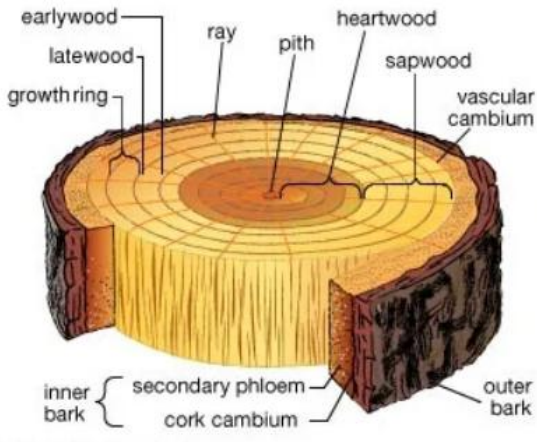
Parts of Wood
Sapwood
The outer layer of wood containing living cells, typically light-colored and located just beneath the bark.
Heartwood
The inner zone of wood, generally darker in color and more resistant to decay fungi than sapwood.
Pith
The center point of a wood log's cross-section.
Earlywood (Springwood)
Portions of new wood created during springtime with relatively large cell openings and thin walls.
Latewood (Summerwood)
Portions of wood created later in the year with smaller cavities and thicker walls; it is 15× stronger than earlywood.
Annual Growth Ring
An annual increment of growth consisting of an earlywood and a latewood band.
Medullary Rays
Ribbonlike bundles of cells arranged in a radial direction perpendicular to the annual rings, running from the pith toward the bark.
Cambium
The layer that produces new wood cells by cell division, increasing the diameter of the tree. At the same time, adds new cells to the inner bark.
Pores
Thin-walled, large-diameter structures made up of individual cells in hardwoods whose only function is to carry water.
Moisture Content (MC)
The weight of water contained in wood, expressed as a percentage of the weight of the oven-dry wood. As wood loses moisture, the water in the cell cavity is evaporated first.
Equilibrium Moisture Content (EMC)
The moisture content at the point where wood attains a balance relative to the surrounding atmospheric temperature and humidity.
knots, slope of grain, compression wood, and shakes
Wood contains certain natural growth characteristics such as _____, ____, _____, and _____. Structural grading rules take into account the effects of these growth characteristics on the strength of wood in establishing working stress values for stress-graded lumber and glued laminated timber
Orthotropic
Wood is non-isotropic. The nature of wood having physical and mechanical properties that differ in three mutually perpendicular directions: longitudinal, radial, and tangential.
• Compressive strength parallel to the grain
• Modulus of elasticity parallel to the grain
• Tensile strength parallel to the grain
• Compressive strength perpendicular to the grain
• Modulus of rupture (bending strength)
• Longitudinal shear strength (horizontal shear)
• Shear modulus (modulus of rigidity)
Wood Mechanical Properties, which are of most interest in structural design (7 Enumeration)
• Crushing
• Grooming
• Shearing
• Splitting
• Wedge split
• Combined shearing and splitting
Types of Failure under Compression Parallel to Grain
• Species
• Moisture content
• Specific gravity (indicator of cellulose amount)
• Duration of loading
• Size and shape of the wood member
• Nature, size, and location of defects (strengthreducing characteristics)
Factors affecting the strength and stiffness of wood (6 Enumeration)
Strength-reducing defects in Timber
are imperfections or irregularities in wood that compromise its structural integrity, making it less capable of bearing loads and resisting forces. These defects can occur naturally or result from improper handling, storage, or processing.
Shakes
Separations between the annual growth rings, extending along the grain or between rings.
Bow
A warp along the length of wood where it bends in a single plane, forming a curve on the face.
Twist
A helical distortion occurring when wood rotates around its longitudinal axis.
Checks
Cracks that occur along the wood grain, typically resulting from drying.
Splits
Cracks along the wood grain that extend through the entire thickness of the timber.
Knotholes
occur when a knot, which is the base of a branch or limb embedded in the wood, falls out or is removed, leaving a hole or void in the wood
Wane
The presence of bark or the lack of wood along the edge or corner of a piece of timber.
Cup
A concave or convex curvature across the width of a board.
Crook
A type of warp where wood bends along its length in the direction of its edge.
Seasoning
The controlled drying of timber to reduce moisture content to a level close to the equilibrium MC.
Air Drying/ Seasoning
is the method in which the timber is stacked and layered with air-space in open sided sheds to promote natural drying. This method is relatively inexpensive with very little loss in the quality of timber if carried out correctly.
Kiln Drying/ Seasoning
is the method in which timber is dried out in a heated, ventilated, and humidified oven. This requires special equipment and is more expensive in terms of energy input. The temperatures used are sufficient enough to kill any decay-causing organisms present in the wood.
Grading
is the process of classifying lumber according to quality for a particular use. Structural designers are interested in strength and stiffness, so stress grading rules were developed. In stress grading, qualities that affect various strength properties and stiffness are evaluated.
Visual Strength Grading
A subjective grading method based on physical observation of strength-reducing defects and the judgment of the grader.
Machine Strength Grading
A grading method where timber is subjected to bending tests to measure the force required for deflection to determine the Modulus of Elasticity (E).
Yard Lumber
Lumber of all sizes and patterns intended for general building purposes.
Strips
Yard lumber less than 50mm (2") thick and less than 200mm (8") wide.
Boards
Yard lumber less than 50mm (2") thick and 200mm (8") or wider.
Dimension Lumber
Surfaced lumber of 50mm (2") through 100mm (4") nominal thickness used for framing members like studs and joists.
Factory/ Shop Lumber
comprise of factory plank graded for doors, window frames, moldings, furniture, sash, and other cuttings 25mm (1") to l00mm (4") thick and 125mm (5") or wider, intended for general millwork and other industrial commodities.
Structural Lumber
a lumber intended for use where working stresses are required, may be classified as: Beams and Stringers (B&S), Joists and Planks (J&P), and Posts and Timbers (P&T)
Beams and Stringers (B&S)
Lumber of rectangular cross-section 250mm (10") or more in width, with depth more than 50mm (2") greater than the width.
Joists and Planks (J&P).
Lumber of rectangular cross-section with 50mm (2") to 250mm (5") width, and 100mm (4")' or more in depth. These are graded with respect to its strength in bending when loaded on the narrow face as a joist or on the wide face as a plank.
Posts and Timbers (P&T)
Lumber of square or nearly square cross-section measuring 250mm×250mm (10"×10") or more, with depth not more than 50mm greater than width.
Finishes Designations
The _______ of lumber are based on the roughness or smoothness of its surfaces.
Sides and Edges
Other combinations are defined by symbols S for___ and E for ____.
S4S (surfaced on four sides).
Most lumber used in building design is surfaced on both faces and on both edges and is referred to as _______.
surfaced on two sides and one edge
S2S IE
surfaced on two sides only
S2S
S1 S2E
surfaced on one side and two edges
Nominal Size
The commercial size designation of width and depth, usually referring to rough lumber.
Rough Lumber
lumber that has been sawed but has not had its four longitudinal surfaces finished. Saw marks show on each surface.
Actual Size (Dressed Size)
The net dimension of timber after it has been planed smooth (dressed).
Dressed Lumber
Lumber whose surfaces have been finished. May be S1S, S2S, S1E, or S4S, according to which faces have been finished (surfaced).
Worked Lumber
Lumber that has been dressed and has also been matched or patterned. Matched lumber has a groove on one longitudinal edge and a corresponding tongue on the other. Pattern lumber fastens together side by side with something fancier than a plain tongue and groove.
6 mm (1/4 inch)
NSCP PROVISIONS/REQUIREMENTS on DIMENSION/ SIZE REDUCTION: The reduction in face dimensions of dressed lumber shall not be more than ____ of the nominal size
Allowable Stress (Safe Working Stress)
The stress determined by tests and experiments representing the safe limit for a material.
Actual Stress
is the stress induced by the applied loads on the structural member which has to be computed by the designer.
Board Foot (fbm)
The amount of wood present in a piece one foot long with an end area of 12sq. in.; calculated using nominal sizes.
Factor/ Margin of Safety
It is a factor that is being included in the design of structural members to ascertain a high degree of probability that failure will not likely to happen. By definition a factor or margin of safety is a statistical concept.
• Uncertainty of the material properties
• Uncertainty of the applied loading in any given circumstance.
• Uncertainty of the calculated shears, moments, axial loads, and stresses.
• Uncertainty of the quality of the workmanship of skilled workers
The following are some of the reasons why a factor or margin of safety is required:
Allowable Stress Design
Load Resistance Factor Design (LRFD) or Load Factor Design (LFD)
Limit State Design
Three Design Philosophies
Allowable Stress Design (ASD)
In this method the factor of safety is introduced by considering the structural behavior of the member under working or service loads conditions and comparing the induced stresses to the allowable stress values. The allowable values are obtained by dividing the failure stress by an appropriate factor of safety.
LOAD RESISTANCE FACTOR DESIGN (LRFD) OR LOAD FACTOR DESIGN (LFD)
In this method, safety is evaluated under collapse conditions by comparing ultimate section capacities (based on yield strength) against design load effects. Ultimate loads are calculated by multiplying service/working loads by a factor of safety.
LIMIT STATE DESIGN
In this method, safety factors are applied at collapse conditions by comparing ultimate section capacities against design load effects. Ultimate capacities are calculated by dividing failure stresses by a partial safety factor, while ultimate loads are calculated by multiplying service loads by a partial safety factor.
Dead Loads
Loads due to the weight of the structural member itself plus all permanent construction.
Live Loads (Imposed Loads)
Loads due to the weight of movable bodies such as people, furniture, equipment, or traffic.
Wind Loads
are derived from wind pressure and environmental conditions, and because their dynamic effects are typically minimal, static analysis can be used by considering key factors such as location, topography, altitude, building geometry, wind speed direction, and the wind gust peak factor.
Seismic Loads
are loads based on the location (______ zone map of the Philippines) and on the environmental situation. The Philippines has two seismic zone classifications, the zone 2 having a _____ zone factor of Z=0.2, and zone 4 having a _____ zone factor of Z=0.4. Generally, ______ loads were derived from the ground motion due to earthquakes and from the mass of the structure.
• Bending (flexure) Stress, fb, parallel to grain
(a) compressive flexural stress, fc, and
(b) tensile flexural stress, ft
• Tensile Stress, ft, parallel to grain
• Compressive Stress, fc, parallel to grain
• Compressive Stress, fc, perpendicular to grain
• Shear Stress, fy, parallel to grain (horizontal shear)
• Modulus of Elasticity, E
• Modulus of Rigidity, G
Common Types of Stresses for Wooden Structural Members:
Compressive stress
Tensile stress
Shearing stress
Basic Kind of Stress
Compressive stress
results from a force that tends to compress or crush a member.
Tensile stress
is the stress that results from a force that tends to stretch or elongate a member. The lower chord and certain web members of trusses and trussed rafters are in tension
Shearing stress
results from the tendency of two equal and parallel forces, acting in opposite directions, to cause adjoining surfaces of a member to slide one on the other.
Deformation
Whenever a body is subjected to a force, there is a change in its size or shape; this change is called ____. Regardless of the magnitude of the force, some _____ always takes place, although often it is so small that measurement is difficult, even with the most sensitive instruments.
Elastic Limit (Proportional Limit)
The unit stress at which deformation begins to increase at a faster rate than the increments of applied load.
Elasticity
is the property of a material that enables it to return to its original size and shape when the load to which it has been subjected is removed. This occurs, however, only when the unit stress does not exceed the elastic limit.
Permanent Set
Beyond the elastic limit a permanent deformation, called a _____, remains in the member.
Modulus of Elasticity (E)
The ratio between unit stress and unit deformation; it serves as a measure of a material's stiffness.
Ultimate Strength
defined as the unit stress that occurs at or just before rupture. Some structural materials possess considerable reserve strength between the elastic limit and the ultimate strength, but this "inelastic" strength is not taken into account directly under the elastic theory of structural design.