Cardiac Tachyarrhythmias
 Call Kai
 Learn
Learn Practice Test
 Spaced Repetition
 Match
Match Flashcards
 Knowt Play
1/44

Earn XP
Description and Tags
Classification and definitions of different tachyarrhythmias, investigations, and management - excluding atrial fibrillation!
Name | Mastery | Learn | Test | Matching | Spaced | Call with Kai | Chat |
|---|
No analytics yet
Send a link to your students to track their progress
45 Terms
Tachycardia
A faster heart rate than normal - usually defined as a resting HR > 100 bpm in adults.
Are all tachyarrhythmias a threat to the patient’s health?
No, this depends on the type and the cause. They can range from benign to life threatening.
Name the two broad categories that tachyarrhythmias are grouped by?
Supraventricular tachycardia
Ventricular Tachyarrhythmias
What is supraventricular tachycardia (SVT)?
A rapid heart rate originating from within or above the AVN. There are many different types of SVT, but they are (mostly!) all narrow complex (signalling they originate above the ventricles).
What are the two different classifications of SVTs?
Focal Tachycardias
Re-entry Tachycardias
What are Focal Tachycardias?
SVTs originating from a single point in the atrium or AVN. There is therefore organised atrial contraction, so a wave similar to a P wave will appear before the QRS complex.
What are the different types of focal tachycardias?
Sinus tachycardia
Focal atrial tachycardia
Multifocal atrial tachycardia
Junctional rhythms
What are Re-entry tachycardias?
SVTs where there are abnormal electrical conduction pathways through the heart where the impulse gets stuck in a loop, causing tachycardia. The P waves will be abnormal as conduction of the impulse is not very organised.
What are the re-entry tachycardias called?
Atrial Flutter
Atrial Fibrillation
AV node re-entrant tachycardia (AVNRT)
AV re-entrant tachycardia (AVRT)
What is sinus tachycardia?
A focal SVT, where the focus is the SAN. It is therefore usually regular. This is a normal response to different triggers such as:
Exercise
Dehydration
Certain drugs (e.g. caffeine)
Anxiety
Illness (e.g. fever)
Sometimes there is no clear reason for the tachycardia, and this is labelled innapropriate.
What is focal atrial tachycardia?
A focus SVT where a different focus in the atrium takes over from the SAN, resulting in abnormal P waves.
Risk factors and conditions predisposing to focal atrial tachycardia
No pattern in relation to sex or ancestry, and occurs in all age groups.
Concomitant lung disease (e.g. COPD)
Heart disease
Previous MI
Electrolyte imbalances
Too much alcohol intake
Infection
Low oxygen levels
Toxic effects of digoxin (a medication)
Caffeine and other stimulants
Catecholamine excess
Congenital heart conditions
Idiopathic
What is multifocal atrial tachycardia?
A focal SVT very similar to atrial tachycardia where different focuses in the atrium takes over from the SAN for each heartbeat, resulting in abnormal P waves with varying morphologies.
Risk factors and conditions predisposing to multifocal tachycardia
Typically elderly patients with multimorbidity
Lung disease, especially COPD (most common risk factor)
Respiratory failure.
Infection.
Coronary artery disease.
Heart failure.
Low levels of potassium, magnesium or sodium.
Cancer.
Diabetes.
Major surgery.
Kidney failure.
Pulmonary embolism (rare).
Heart valve disease (rare).
What are junctional rhythms?
Focal SVTs where the AVN takes over from the SAN, so the atria and ventricles contract simultaneously.
Conditions predisposing to a junctional rhythm
Typically caused by SAN impairment, where the impulses are blocked or fall below the automaticity of the AVN. Tends to be seen more in elderly patients. Causes include:
Medications
Digoxin
Drugs causing sinus bradycardia (e.g. beta blockers etc.)
Structural and inflammatory causes:
Chest trauma
Heart diseases (Myocarditis, Pericarditis, IHD, previous MI etc.)
Iatrogenic (surgery and other treatments)
Other illnesses and disease (rheumatic fever, amyloidosis, Lyme disease etc.)
Conduction system disorders (e.g. sick sinus syndrome, heart block)
Neuromuscular conditions
Systemic conditions (e.g. hypothyroidism, sleep apnea, hypoxia)
Neurologic conditions (e.g. anorexia)
Autonomic and reflex causes
Electrolyte and metabolic disturbances (e.g. Hyperkalemia)
What is an atrial flutter?
A re-entry SVT where there is a large re-entry circuit (macro re-entry) around the atrium which triggers the AVN every time it goes around. The circuit is fixed, so the rate of atrial contraction is regular.
Typical vs atypical atrial flutter
Typical atrial flutters run anti-clockwise around the right atrium and across the cavotricuspid valve isthmus. This produces the sawtooth pattern seen on ECGs.
Atypical atrial flutters do not have this pattern and are therefore harder to identify. They can be found:
running clockwise in the right atrium
in the left atrium
around sites of previous surgery
What is the most common cardiac arrhythmia?
Atrial fibrillation, followed by atrial flutters.
Conditions predisposing to an atrial flutter
High blood pressure
Congenital heart disease
Ischaemic heart disease
Pericarditis
Cardiomyopathy
Cardiac surgery
Other disease of the heart
Over active thyroid valves
Chronic airways disease (e.g. COPD)
Pneumonia
Pulmonary embolism
Idiopathic
Risk factors for atrial flutter
Male
Increasing age
Excess alcohol
Family history of arrhythmias
What is atrioventricular node re-entrant tachycardia (AVNRT)?
A re-entrant SVT where the circuit loops in or around the AVN. This is because there are two pathways of varying speeds (one slower, one faster) in or around the AVN, and the impulse can travel backwards into the atria via one pathway (usually the fast one) from the other pathway (usually the slow one).
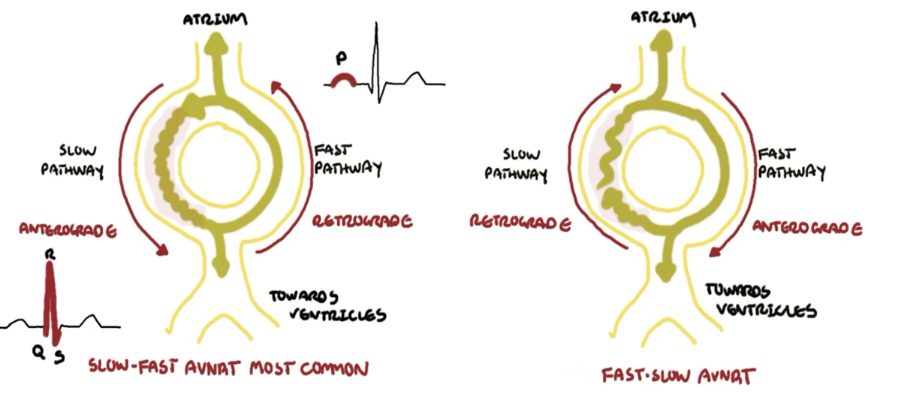
What are the predisposing conditions to AVNRT?
Coronary artery disease, heart valve disease and other heart diseases.
Heart failure.
Heart condition present at birth, called a congenital heart defect.
Previous heart, lung or throat surgery.
Obstructive sleep apnea.
Thyroid disease.
Lung diseases such as chronic obstructive pulmonary disease (COPD).
Diabetes that is not controlled.
Risk factors for AVNRT
Young women
Some medicines, including those used to treat asthma, allergies and colds.
Emotional stress.
Caffeine.
Excessive alcohol use.
Smoking and using nicotine.
Stimulant drugs, including cocaine and methamphetamine.
What is atrioventricular re-entrant tachycardia (AVRT)?
A re-entrant SVT where there is an accessory pathway (additional pathway) between the ventricles and atria through which a re-entry loop is created, causing tachycardia. There are two types:
Orthodromic - normal AVN conduction, then the impulse travels back up into the atria through the accessory pathway.
Antidromic - the impulse travels down the accessory pathway and then back up via the normal conduction pathway.

What are the predisposing conditions for AVRTs?
The accessory pathway is typically present from birth. The most common congenital heart condition associated with this is Wolff-Parkinson-White syndrome (not usually genetic).
What are ventricular tachyarrhythmias?
A wide complex tachyarrhythmia originating from the ventricles.
What are the two different types of ventricular tachyarrhythmias?
Ventricular tachycardia
Ventricular fibrillation
What is ventricular tachycardia?
A regularly irregular tachyarrhythmia originating in the ventricles. It can be focal, or re-entrant, however both are dangerous.
Focal ventricular tachycardia causes
It is caused by the ventricular pacemaker cells (usually too slow to take over from the SAN) becoming stressed or irritated. This makes them fire at a faster rate, taking over from the SAN. They can be irritated by:
Medications
Illicit drugs (stimulants - e.g. cocaine or methamphetamine)
Electrolyte imbalances
Myocardial Ischaemia or previous MI
Structural heart disease
Congenital heart conditions (e.g. Long QT syndrome)
What is more likely - focal or re-entrant ventricular tachycardia?
Re-entrant.
What causes re-entrant ventricular tachycardia?
Scarring / structural disease creating two pathways in the ventricular myocytes. If one pathway is slower than the other, then impulses can create a loop, triggering continual ventricular contractions. Causes of this include:
Ischaemic cardiomyopathy (main cause)
Dilated cardiomyopathy (2nd most common cause)
Other structural heart diseases and cardiomyopathies

What is ventricular fibrillation?
A very dangerous ventricular tachyarrhythmia where the contractions in the ventricles become completely disorganised and chaotic.
What causes ventricular fibrillation?
The cause is not always clear, but it is thought it is usually caused by the myocytes becoming stressed or damaged, and therefore structurally or electrically changed - tissue heterogeneity. This means the cells contract abnormally. Some causes of this include:
Medications
Illicit drugs (stimulants - e.g. cocaine or methamphetamine)
Electrolyte imbalances
Myocardial Ischaemia or previous MI
Are all SVTs narrow complex?
No, in some scenarios SVTs can be wide complex - typically AVRT associated with WPW syndrome is wide complex.
What are the general potential consequences of tachyarrhythmias?
It shortens diastole, reducing ventricular filling and coronary perfusion.
Loss of effective atrial contraction and synchrony can reduce cardiac output (particularly if the patient already has ventricular dysfunction of valve disease).
Rapid ventricular activation increases myocardial oxygen demand and may precipitate ischaemia.
Persistent tachycardia can cause a reversible tachycardia-induced cardiomyopathy.
VT and VF cause severe loss of effective output and can precipitate death.
VF is incompatible with a pulse.
Typical presentation of atrial tachycardia
Typically paroxysmal, but can be persistent
Tends to have abrupt onset and offset
Palpitations
Fatigue
Pre-syncope/syncope
Chest pain
Dyspnoea
Multifocal atrial tachycardia can be masked by other illness
Can be asymptomatic (in healthy young people, it can appear when they sleep)
Typical presentation of junctional rhythms
Can be persistent or paroxysmal
Can be abrupt or gradual onset
Can be symptomless
Anxiety
Chest pain
Dizziness
Fainting
Feeling fatigued or weak
Heart palpitations
Shortness of breath
What other arrhythmia is atrial flutter typically associated with?
Atrial fibrillation.
Typical presentation of atrial flutter
Can be paroxysmal or persistent
Abrupt onset and offset
Can be asymptomatic
Palpitations
Chest pain
Fainting or almost fainting
Shortness of breath
Feeling very tired
Typical presentation of AVNRT
Paroxysmal episodes that have abrupt onset and offset
Can be asymptomatic, but this is not as common
Heart palpitations — this is the most common symptom
Feeling like your heart is racing
Dizziness
Palpitations or discomfort in your neck
Producing more pee than usual (polyuria)
Shortness of breath
Typical presentation of AVRT
Typically paroxysmal with abrupt onset and offset
Often symptomatic
Heart palpitations
Chest pain
Lightheadedness
Dizziness
Shortness of breath
Fatigue
Typical presentation of ventricular tachycardia
Can be paroxysmal or sustained (>30 seconds)
Abrupt onset and offset
Can be asymptomatic
palpitations (a thumping or fluttering feeling in your chest)
chest pain or discomfort
difficulty breathing
feeling sick
sweating a lot
feeling light-headed or passing out (fainting)
Typical presentation of normal sinus tachycardia
Gradual onset
Paroxysmal with identifiable trigger
Faster heartbeat.
Palpitations.
Fainting.
Chest pain.
Lightheadedness.
Difficulty breathing.
Dizziness.
Managing sinus tachycardia
In most cases, sinus tachycardia is a normal response to environmental triggers, and requires no treatment.
If the sinus tachycardia has a clear cause and is troubling the patient, then the trigger should be avoided / managed (e.g. treating anxiety, avoiding caffeine etc.)
If the sinus tachycardia is inappropriate and interfering with the patients life then medications to slow the heart rate down may be used:
Beta blockers
Calcium channel blockers
Ivabradine
It is also important the patient stays active, as this can improve symptoms.