Pharm III Week 8 (Acute Pain and Anesthesia)
 Call Kai
 Learn
Learn Practice Test
 Spaced Repetition
 Match
Match Flashcards
 Knowt Play
1/133

There's no tags or description
Looks like no tags are added yet.
Name | Mastery | Learn | Test | Matching | Spaced | Call with Kai | Chat |
|---|
No analytics yet
Send a link to your students to track their progress
134 Terms
Preoperative evaluation
Anxiolytics
Antisialogogues
Antiemetics
Anesthetic Induction
IV Anesthetics
Opioids
Intraoperative Management
Inhaled Anesthetics
Neuromuscular Blockers
Local/Regional Anesthetics
Opioids
Recovery (PACU)
Reversal Agents
Antiemetics
Analgesics
Postoperative Pain Management
Non-opioid Analgesics
Opioids
Adjunctive Analgesics
Poorly controlled acute pain is associated with:
- Increased postoperative complications
- Delayed mobilization
- Longer hospital stays
- Higher risk of developing chronic postsurgical pain
Multimodal analgesia reduces ________ requirements while improving pain control and recovery
Multimodal analgesia reduces opioid requirements while improving pain control and recovery
An average surgical patient receives multiple medication classes in just a few hours
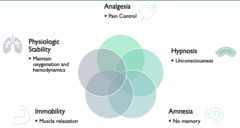
Goals of Anesthesia
• Analgesia: Pain Control
• Hypnosis: Unconsciousness
• Amnesia: No memory
• Immobility: Muscle relaxation
• Physiologic Stability: Maintain oxygenation and hemodynamics
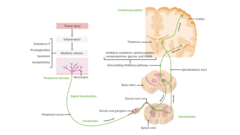
pain signaling pathway
Step 1: Tissue Injury (30 seconds)
med class blocks this inflammatory response? → NSAIDs
Step 2: Transduction --> nociceptors
Drugs: NSAIDs, APAP, Corticosteroids
Step 3: Transmission
Step 4: Modulation
Endogenous opioids, serotonin, Norepi
Step 5: Perception (signal reaches higher brain centers)
Multimodal Approach to Pain with Pain Pathway
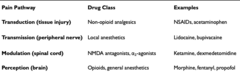
Multimodal analgesia
Combining medications with different mechanisms of action to improve pain control that target multiple points along the pain pathway while minimizing opioid-related adverse effects
Foundation Meds for Analgesia
Foundation (Almost Every Patient)
•Acetaminophen
•NSAIDs (if appropriate)

Procedure-Specific Meds for Analgesia
•Local anesthetic infiltration
•Peripheral nerve block
•Epidural/spinal anesthesia
Breakthrough or Moderate-Severe Pain
Opioids (morphine, hydromorphone, fentanyl, oxycodone)
Adjunct Agents / Specific Situations
•Ketamine
•Dexmedetomidine
•Gabapentinoids
Non-opioid Analgesics: First-line therapy - Acetaminophen
MOA *KNOW*
- Central analgesic and antipyretic
- Inhibits central prostaglandin synthesis (primarily COX activity within the CNS)
- Minimal peripheral anti-inflammatory activity
APAP Clinical Uses
*KNOW*
Mild to moderate acute pain
Fever reduction
Opioid-sparing agent
APAP Advantages
*KNOW*
Multiple formulations (PO, rectal, IV)
Minimal gastrointestinal irritation
No effect on platelet function
Safe in patients with bleeding risk or PUD
APAP Limitations & Adverse Effects
*KNOW*
Generally well tolerated at therapeutic doses
Hepatotoxicity with overdose or chronic excessive dosing
Use caution in (consider limiting dosage):
- Significant hepatic impairment
- Chronic alcohol use
- Malnutrition
Non-opioid Analgesics: First-line therapy
Nonsteroidal Anti-Inflammatory Drugs (NSAIDs) and MOA
Reversibly inhibit cyclooxygenase (COX-1 and/or COX-2)
↓ Prostaglandin synthesis
Produce analgesic, antipyretic, and anti-inflammatory effects
NSAIDs - COX-1
role? if inhibited?
*KNOW*
"Housekeeping" Enzyme
- Gastric protection
- Platelets
- Kidney perfusion
If Inhibited:
- GI Bleeding
- Bleeding Risk
- AKI
NSAIDs - COX-2
role? if inhibited?
*KNOW*
"Inflammation" Enzyme
- Triggers inflammation
- Creates pain
-Generates fever
If Inhibited:
- Analgesia
- Anti-inflammatory
- Antipyretic
Non-opioid Analgesics: First-line therapy
COMMONLY USED NSAIDS

NSAIDS - Avoid / Use Caution
*KNOW*
Active GI bleeding or peptic ulcer disease
Significant renal dysfunction or AKI
NSAID hypersensitivity/AERD
Late pregnancy
Severe heart failure
*Ketorolac monitor length of time (
NSAIDs Major Adverse Effects
GI ulceration and bleeding
Acute kidney injury
Platelet inhibition (nonselective NSAIDs)
Fluid retention and hypertension
Cardiovascular thrombotic risk (COX-2 selective agents)
NSAID Clinical Pearls
- Use lowest effective dose for shortest duration; avoid concurrent NSAIDs
- Ketorolac: limit to ≤5 days (GI/renal toxicity)
- Monitor renal function in high-risk patients
Non-opioid Analgesics (topicals)
Lidocaine, Diclofenac, Capsaicin
Lidocaine (Local anesthetic) use
- Localized or superficial pain
- Topical patch, cream, gel
- Useful for localized neuropathic pain
- Minimal systemic effects when used appropriately
Diclofenac (Topical NSAID) use
- Localized MSK/inflammatory pain
- Lower systemic exposure than oral NSAIDs
- Useful for minor injuries and osteoarthritis
- Still consider NSAID-related precautions
Capsaicin (TRPV1 agonist) use
- Primarily neuropathic pain
- More commonly used for chronic pain
- Initial burning/irritation is common
- Limited role in acute postoperative pain
Opioid Analgesics: Breakthrough or Mod-Severe Pain
Overview
• Significant risk of tolerance, dependence, and misuse
• No universal maximum analgesic dose ... No true analgesic ceiling! Higher doses can provide greater analgesia, but toxicity increases
•Dose should be individualized and titrated to effect
•Use the lowest effective dose for the shortest appropriate duration
Opioid Analgesics: Breakthrough or Mod-Severe Pain
Adverse effect profile: COMMON
Sedation / drowsiness
N/V
Constipation
Pruritus
Dizziness
Opioid Analgesics: Breakthrough or Mod-Severe Pain
Adverse effect profile: DOSE LIMITING/SERIOUS
- Respiratory depression
- Hypotension
- Bradycardia
- Urinary retention
- Delirium / altered mental status
- Chest wall rigidity (IV fentanyl)
Opioid Analgesics: Breakthrough or Mod-Severe Pain
Adverse effect profile: W/ REPEATED OR PROLONGED USE
- Tolerance
- Physical dependence
- Opioid-induced hyperalgesia
- Misuse / opioid use disorder
OPIOIDS - Risk increases with?
Risk increases with: higher doses, rapid IV administration, opioid-naïve patients, and concurrent CNS depressants (e.g., benzodiazepines, alcohol)
Opioid Analgesics: Breakthrough or Mod-Severe Pain
Managing Adverse Effects - Respiratory Depression
*KNOW*
First-Line Intervention: Decrease/hold opioid; support ventilation
Alternative / Adjunctive Intervention: Naloxone if clinically significant; possibly nalbuphine
Opioid Analgesics: Breakthrough or Mod-Severe Pain
Managing Adverse Effects - N/V
*KNOW*
First-Line Intervention: Antiemetic agent
Alternative / Adjunctive Intervention: Dose reduction/opioid rotation; motility agents such as metoclopramide in selected patients
Opioid Analgesics: Breakthrough or Mod-Severe Pain
Managing Adverse Effects - Constipation
*KNOW*
First-Line Intervention: Stimulant laxative ± stool softener
Alternative / Adjunctive Intervention: Osmotic laxative; opioid rotation
Opioid Analgesics: Breakthrough or Mod-Severe Pain
Managing Adverse Effects - Pruritus
*KNOW*
First-Line Intervention: Decrease dose or switch opioid
Alternative / Adjunctive Intervention: Antihistamine; low-dose naloxone/nalbuphine
Opioid Analgesics: Breakthrough or Mod-Severe Pain
Managing Adverse Effects - Hypotension
*KNOW*
First-Line Intervention: Decrease/hold opioid; supportive care
Alternative / Adjunctive Intervention: Fluid resuscitation/vasopressor if clinically indicated
Opioid Analgesics: Breakthrough or Mod-Severe Pain
Managing Adverse Effects - Tolerance
*KNOW*
First-Line Intervention: Reassess pain; optimize multimodal analgesia
Alternative / Adjunctive Intervention: Opioid rotation; non-opioid analgesic
Opioid Analgesics: Breakthrough or Mod-Severe Pain
Managing Adverse Effects - Withdrawal
*KNOW*
First-Line Intervention: Re-evaluate/slow weaning regimen
Alternative / Adjunctive Intervention: Rescue dosing, add another agent such as clonidine; longer-acting opioid when appropriate
Opioid Analgesics: Breakthrough or Mod-Severe Pain
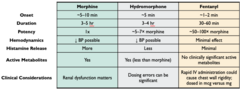
Common IV formulations: MORPHINE
Onset
Duration
Potency
Hemodynamics
Histamine Release
Active Metabolites
Clinical Considerations
*KNOW*
Morphine
onset ~5-10 min
duration 3-5 hr
potency 1x
↓ BP possible
More histamine release
Yes active metabolites
Renal dysfunction matters
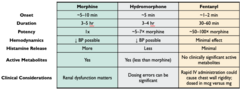
Opioid Analgesics: Breakthrough or Mod-Severe Pain
Common IV formulations: HYDROMORPHONE
Onset
Duration
Potency
Hemodynamics
Histamine Release
Active Metabolites
Clinical Considerations
*KNOW*
Hydromorphone
onset ~5 min
duration 3-4 hr
potency ~ 5-7 × morphine
↓ BP possible
Less histamine release
Yes active metabolites (less than morphine)
Dosing errors can be significant

Opioid Analgesics: Breakthrough or Mod-Severe Pain
Common IV formulations: FENTANYL
Onset
Duration
Potency
Hemodynamics
Histamine Release
Active Metabolites
Clinical Considerations
*KNOW*
Fentanyl
onset ~1-2 min (RAPID)
duration 30-60 min (SHORTEST)
potency ~ 50-100× morphine
Minimal effect on BP
Minimal histamine release
No clinically significant active metabolites
Rapid IV administration could cause chest wall rigidity; dosed in mcg versus mg
pearl for dosing for opioids
Start with intermittent opioid dosing (scheduled and/or PRN) and reassess frequently
for persistent or severe pain requiring frequent rescue doses, consider escalation to continuous infusion and/or PCA when appropriate
Opioid Analgesics: Breakthrough or Mod-Severe Pain
Common ORAL Options and Considerations
Oxycodone IR: common option for acute moderate-severe pain
Hydrocodone/APAP: frequently used for acute pain; monitor total APAP exposure
Morphine IR: option for moderate-severe pain; renal function matters
Hydromorphone IR: highly potent; typically reserved for more severe pain or when other opioids are unsuitable
Codeine: variable metabolism and analgesic response; generally not preferred
Why avoid ER opioids for routine acute pain?
do not use
Slow onset: poor fit for rapidly changing pain
Long duration: difficult to titrate
Accumulation: prolonged adverse effects
Higher risk: especially in opioid-naïve patients
Opioid Analgesics: Breakthrough or Mod-Severe Pain
Methadone
*KNOW*
Methadone (PO/IV)
- Selected perioperative use; long duration
- May be useful in opioid-tolerant patients
- Long, variable half-life → accumulation
- QT prolongation + significant drug interactions (CYP-mediated)
Opioid Analgesics: Breakthrough or Mod-Severe Pain
Tramadol
Tramadol (PO)
- Mild-moderate acute pain
- Variable analgesic response (CYP2D6)
- Seizures + serotonin syndrome
- Generally not preferred over conventional short-acting opioids when an opioid is indicated
Opioid Analgesics: Breakthrough or Mod-Severe Pain
Nalbuphine (IV/IM/SubQ)
*KNOW*
Nalbuphine (IV/IM/SubQ)
- Opioid-induced pruritus
- κ-agonist / μ-antagonist → may precipitate withdrawal or reduce analgesia
- Ceiling effect on respiratory depression (may have less severe respiratory depression)
Opioid Analgesics: Breakthrough or Mod-Severe Pain
Butorphanol (IV/IM/IN)
Butorphanol (IV/IM/IN)
- Alternative for acute moderate-severe pain
- κ-agonist / μ-partial agonist-antagonist
- Less commonly used than traditional full μ-agonists
- IN formulation: alternative/rescue therapy for migraine
- May precipitate withdrawal
Opioid Analgesics: Breakthrough or Mod-Severe Pain
Meperidine (IV/IM)
Meperidine (IV/IM)
- Limited role in acute pain
- More commonly encountered for postoperative shivering
- Normeperidine accumulation leading to neurotoxicity/seizures
Opioid Analgesics: Breakthrough or Mod-Severe Pain
Escalating therapy - intermittent dosing
Intermittent Dosing: Scheduled and/or PRN PO or IV opioids
- Reassess, Is pain adequately controlled? How often are rescue doses needed? Is the patient experiencing sedation or other toxicity? Is the current route appropriate? Is multimodal analgesia optimized?
Opioid Analgesics: Breakthrough or Mod-Severe Pain
Escalating therapy - When to escalate? Consider Alt delivery such as?
Escalate When:
- Frequent rescue doses are required
- Pain is persistent or predictable
- Intermittent dosing provides inadequate duration of relief
- Opioid requirements are high or difficult to predict
- Patient cannot reliably tolerate/use the PO route
Consider Alternative Delivery
- Continuous Infusion
- Patient-Controlled Analgesia
Opioid Analgesics: Breakthrough or Mod-Severe Pain
Patient Controlled Analgesia (PCA)
Patient can push a button and receive medication dose via IV
Can be useful in patients with post-op pain who are extubated; allows autonomy
Common medications: fentanyl, morphine, hydromorphone
Opioid Analgesics: Breakthrough or Mod-Severe Pain
CNCA = Caregiver/Nurse Controlled Analgesia
An authorized operator to administer pain medication to the patient
A nurse must generally complete education relating to CNCA utilization
Usage will be covered with the caregiver prior to initiation of CNCA
Consideration for use: patients who are developmentally, cognitively, or physically unable to understand or operate the pump
Opioid Analgesics: Breakthrough or Mod-Severe Pain - Parameters Included
Basal rate
Bolus amount
Lockout interval
4-hour maximum dose
Case #1
42-year-old patient is recovering in the PACU after an open abdominal surgery. Before surgery, the patient received scheduled acetaminophen and ketorolac as part of a multimodal analgesic regimen.
Thirty minutes after arrival in the PACU, the patient reports 8/10 incisional pain and says, "The pain is getting worse when I try to take a deep breath."
The patient has no history of chronic opioid use and has not received an opioid since surgery. Vitals stable.
What is the most appropriate next step?
A. Give another dose of acetaminophen
B. Administer an opioid for breakthrough pain
C. Administer midazolam for anxiety
D. Withhold analgesia because the patient is hemodynamically stable
B. Administer an opioid for breakthrough pain
Case #1
The provider is considering fentanyl vs. morphine for IV rescue analgesia.
Which characteristic would favor fentanyl in this PACU patient?
A.Longer duration of action
B.Greater oral bioavailability
C.Rapid onset of analgesia
D.Lack of respiratory depression
C.Rapid onset of analgesia
Adjunct Agents: select cases
Overview - When Might We Add An Adjunct?
*KNOW*
- Pain inadequately controlled with standard therapy
- Opioid-sparing is desirable
- High opioid requirements or opioid tolerance
- Specific pain mechanism (e.g., neuropathic pain)
- Need for additional analgesia without simply increasing opioid dose
Ketamine: MOA
NMDA receptor antagonist
Reduces central sensitization and nociceptive signaling
Produces analgesia at subanesthetic doses (higher dosing for anesthesia)
Ketamine
Role in Acute Pain (IV, IM, IN PO (off-label/compounded))
Opioid-sparing strategy
Moderate-severe acute pain, particularly when conventional analgesia is inadequate
May be useful in opioid-tolerant patients
Can reduce opioid requirements
IV administration allows titration in monitored settings
Ketamine: Key Adverse Effects *KNOW*
Increased HR / BP
Increased secretions
Sedation
Nausea/vomiting
Dysphoria, hallucinations, emergence reactions
Adjunct Agents
α₂-Adrenergic Agonists
dexmedetomidine
clonidine
α₂-Adrenergic Agonists MOA
Stimulate central α₂-adrenergic receptors
↓ norepinephrine release and ↓ sympathetic activity
Produces sedation and analgesic-sparing effects
α₂-Adrenergic Agonists Role in Acute Pain (IV, PO)
Opioid-sparing adjunct
Perioperative and procedural analgesia (where sedation is also desirable)
Can reduce opioid requirements
Dexmedetomidine: commonly used IV in monitored settings
Clonidine: enteral agent; may be used as an adjunct and can help manage opioid withdrawal symptoms
α₂-Adrenergic Agonists: Key Adverse Effects
Bradycardia
Hypotension
Sedation
Dry mouth
Possible rebound hypertension with abrupt clonidine discontinuation
Adjunct Agents: Gabapentinoids (GABAPENTIN, PREGABALIN)
MOA
Bind the α₂δ subunit of voltage-gated calcium channels
↓ excitatory neurotransmitter release
Reduce neuronal hyperexcitability
Gabapentinoids (GABAPENTIN, PREGABALIN)
Role in Acute Pain (PO)
Primarily useful when neuropathic pain is present
May be used as part of multimodal perioperative analgesia
Can reduce opioid requirements
Not typically first-line for routine acute nociceptive pain
Pregabalin > gabapentin in terms of predictable absorption and simpler dosing
Gabapentinoids (GABAPENTIN, PREGABALIN)
Key Adverse Effects
Sedation
Dizziness
Ataxia
Peripheral edema
Respiratory depression risk when combined with opioids/CNS depressants
Case 1: 42 y/o pt recovering in PACU after an open abd surgery. Before surgery, pt received acetaminophen and ketorolac as part of a multimodal analgesic regimen.
30 min after arrival in the PACU, pt reports 8/10 incisional pain and says, "The pain is getting worse when I try to take a deep breath." pt has no history of chronic opioid use and has not received an opioid since surgery.
After receiving IV fentanyl, the patient's pain decreases to 3/10. The provider wants to minimize additional opioid requirements.
Which strategy best represents multimodal analgesia?
A. Continue escalating the opioid until pain is completely eliminated
B. Use medications with different mechanisms to reduce opioid requirements
C. Avoid non-opioid analgesics once an opioid is started
D. Use a benzodiazepine to enhance opioid analgesia
B. Use medications with different mechanisms to reduce opioid requirements
CASE 1
Several hours later, the patient becomes increasingly somnolent. RR is 7/min, SpO₂ is 86%, and the patient is difficult to arouse.
What is the most appropriate initial priority?
A.Administer another dose of fentanyl
B.Administer flumazenil
C.Administer ketorolac
D.Support airway/ventilation and administer naloxone as appropriate
D. Support airway/ventilation and administer naloxone as appropriate
Stages of Anesthesia
Induction
•Initiate anesthesia → loss of consciousness
•Establish/protect airway
•Sedate before you paralyze (bc paralytics = NO analgesic effect)
Maintenance
•Maintain appropriate depth of anesthesia
•Balance hypnosis, analgesia & immobility
•Monitor/support vital functions
Recovery / Emergence
•Reduce/discontinue anesthetic agents
•Return of consciousness & protective reflexes
•Manage airway and pain
depth of anesthesia: too light vs too deep?
Too light: awareness, movement, physiologic response
Too deep: hypotension, respiratory depression, delayed emergence
Types of Anesthesia
General Anesthesia
Regional Anesthesia
Local Anesthesia
MAC / Sedation
general anesthesia
scope, consciousness, uses
Whole body / systemic
Unconscious
uses: Major abdominal surgery; thoracic surgery; intracranial surgery; procedures requiring airway control or complete immobility
regional anesthesia
scope, consciousness, uses
Large body region
Usually conscious
Cesarean delivery; total knee/hip arthroplasty; upper/lower extremity surgery; labor analgesia
local anesthesia
scope, consciousness, uses
Small, localized area
Conscious
Dental procedures; laceration repair; skin biopsy/excision; incision & drainage
Monitored Anesthesia Care/Sedation
scope, consciousness, uses
Varies
Sedation varies
Endoscopy/colonoscopy; bronchoscopy; cardiac catheterization; minor procedures requiring anxiolysis and/or sedation
LOCAL vs REGIONAL Anesthesia
Block the pain pathway before it reaches the brain
Local and regional anesthesia use the same local anesthetic drugs and mechanism; the difference is the site and extent of nerve blockade

Local and regional anesthesia use the same local anesthetic drugs and mechanism; the difference is the site and extent of nerve blockade
mechanism?
Peripheral nerve --> Na⁺ channel blockade --> No action potential --> No pain signal
Esters vs Amides
we like AMIDES!
esters
1) Plasma cholinesterase metabolism
2) PABA metabolite --> greater allergy potential
3) Less commonly used
examples of esters
•Procaine (not used anymore)
•Chloroprocaine
•Tetracaine
Amides
*KNOW*
1) Hepatic metabolism
2) Allergic reactions are rare
3) Most used
examples of amides
•Lidocaine ± epinephrine
•Mepivacaine
•Bupivacaine
•Articaine
Compare/Contrast Duration, Common Uses, and Considerations for these local and regional agents:
Lidocaine
Articaine
Bupivacaine
Ropivacaine
Mepivacaine

Anesthesia: Epinephrine Combined with Local Anesthetics
what does it do?
*KNOW*
•Vasoconstriction at injection site
•↓ systemic absorption
•↑ duration of local anesthesia
•↓ peak plasma concentration
•↓ local bleeding
Anesthesia: Epinephrine Combined with Local Anesthetics
Clinical Considerations
*KNOW*
1. Useful when prolonged anesthesia and/or hemostasis is desired
2. Consider injection site and patient factors
3. Use caution when significant vasoconstriction may be undesirable (ears, nose, fingers, toes - end arterial fields)
don't use with uncontrolled HTN, CHF
Anesthesia: Local Anesthetic Systemic Toxicity (LAST)
Cause
Excessive dose, rapid absorption, or inadvertent intravascular injection
Risk increases with highly potent/long-acting agents, particularly bupivacaine
Anesthesia: Local Anesthetic Systemic Toxicity (LAST)
CNS toxicity (early) results in
Perioral numbness/tingling
Metallic taste
Tinnitus
Dizziness/agitation
Seizures
Anesthesia: Local Anesthetic Systemic Toxicity (LAST)
CV toxicity (severe)
Hypotension
Conduction abnormalities
Ventricular arrhythmias
Cardiovascular collapse
Anesthesia: Local Anesthetic Systemic Toxicity (LAST)
Management
- Stop local anesthetic
- Support airway, breathing, circulation
- Treat seizures
- 20% lipid emulsion therapy for significant LAST (deactivates)
CASE #2: A 28 y/o otherwise healthy pt presents to the ED after sustaining a 5-cm laceration to the volar forearm from broken glass approximately 1 hour ago.
• The wound is irrigated and evaluated. There is no evidence of tendon, nerve, or vascular injury, and the patient has normal distal pulses and sensation.
• The patient is anxious but cooperative and reports 7/10 pain.
• The clinician plans to perform local infiltration before wound closure.
Which local anesthetic would be the most appropriate choice for this procedure?
A. Lidocaine
B. Bupivacaine
C. Tetracaine
D. Procaine
A. Lidocaine
CASE #2
The clinician is deciding between lidocaine and bupivacaine. The patient asks whether there is an option that would provide numbness for several hours after the procedure.
Which consideration would favor bupivacaine over lidocaine?
A. Faster onset
B. Longer duration of local anesthesia
C. Lower risk of cardiotoxicity
D. Greater effectiveness for short superficial procedures
B. Longer duration of local anesthesia
CASE #2
The clinician chooses lidocaine with epinephrine for the procedure. During the injection, the patient asks why epinephrine is being included.
Which effect of epinephrine best explains its use with a local anesthetic?
A. Directly increases the potency of the local anesthetic
B. Produces vasoconstriction, slowing systemic absorption of the local anesthetic
C. Prevents sodium-channel blockade
D. Provides additional local anesthesia through nicotinic receptor blockade
B. Produces vasoconstriction, slowing systemic absorption of the local anesthetic
Anesthesia Preoperative medications: Why do we give these?
•Reduce anxiety (benzos)
•Provide analgesia (opioids)
•Reduce airway secretions (anticholinergics/antisialogues)
•Prevent/treat post operative nausea and vomiting (antiemetics)
•Facilitate a smoother induction and recovery (Agent/Procedure Dependent)
Anesthesia Preoperative medications: Anxiolysis & Amnesia
agents?
LORAZEPAM
MIDAZOLAM (fav)
DIAZEPAM
MIDAZOLAM - more on why it is preferred compared to lorazepam and diazepam
*KNOW*
Rapid onset
Shorter duration than lorazepam/diazepam
- short half-life
- less prolonged postoperative sedation
No clinically relevant active metabolites
Predictable titration: IV doses can be given incrementally to achieve the desired effect
Anterograde amnesia: Useful before procedures
Multiple routes: IV, IM, oral, and intranasal formulations available
Reversible with flumazenil if clinically necessary