Biology A Level - Enzyme summary questions.
 Call Kai
 Learn
Learn Practice Test
 Spaced Repetition
 Match
Match Flashcards
 Knowt Play
1/9

There's no tags or description
Looks like no tags are added yet.
Name | Mastery | Learn | Test | Matching | Spaced | Call with Kai | Chat |
|---|
No analytics yet
Send a link to your students to track their progress
10 Terms
What are enzymes and why are they important?
Enzymes are globular proteins that act as biological catalysts - they speed up reactions in the body without being used or changed themselves. It works by lowering the activation energy of the reaction.
Enzymes are specific to a particular substrate as the active site has a specific tertiary structure that is complementary to the 3D structure of the substrate.
Outline the differences between intracellular and extracellular catalysis, providing examples.
Intracellular: enzymes that are produced and function within the cell. Example: Catalase, which converts hydrogen peroxide (a harmful by product of many metabolic reactions) into water and oxygen.
Extracellular: enzymes that are secreted by cells (exocytosis) and catalyse reactions occuring outside the cells. Example: Amylase, which is a digestive enzyme that hydrolyses starch into maltose and glucose. It acts in the mouth and the small intestine and is secreted by the salivary glands and pancreas.
Describe and explain the mechanism of enzyme action, comparing the two hypotheses.
In general, the complementary substrate enters the active site, forming and enzyme substrate complex. The reaction takes place and an enzyme-product complex forms, then the products leave the active site and the enzyme is free to bind with another substrate particle.
Lock and key - the shape of the active site it complementary to the substrate and the two fit together exactly on collision to form the ESC by forming weak temporary bonds. The bonds also put strain on the substrate, helping the reaction along.
Induced fit - the shape of the active site is not completely complementary to the substrate. When the two collide, the enzyme molecule changes shape slightly to fit around the substrate. Interactions between the molecules change the tertiary structure of the enzyme to form stronger bonds to the substrate. The bonds also put strain on the substrate, helping the reaction along. This hypothesis is believed to be more realistic.
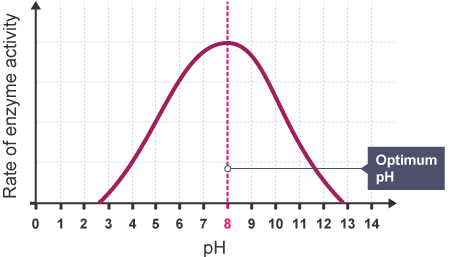
How does pH affect enzyme activity?
Hydrogen bonds and ionic bonds in the enzyme’s structure determine its 3D shape, and thus ability to bind to the substrate. Changing pH alters the H+ concentration, and extreme pH environments can alter the bonding in the enzymes and thus its 3D structure. More H+ (low pH) means less R groups can interact with each other. Less H+ (high pH) means more R groups can interact with each other. Every enzyme has an optimum pH at which its rate of activity is highest.
If pH change is extreme from optimum, the structure if an enzyme can be irreversibly changed, causing it to be denatured and unable to bind to the substrate.
If pH change is only minimal and then returns to optimum, an enzyme can be renatured and resume catalysing reactions.
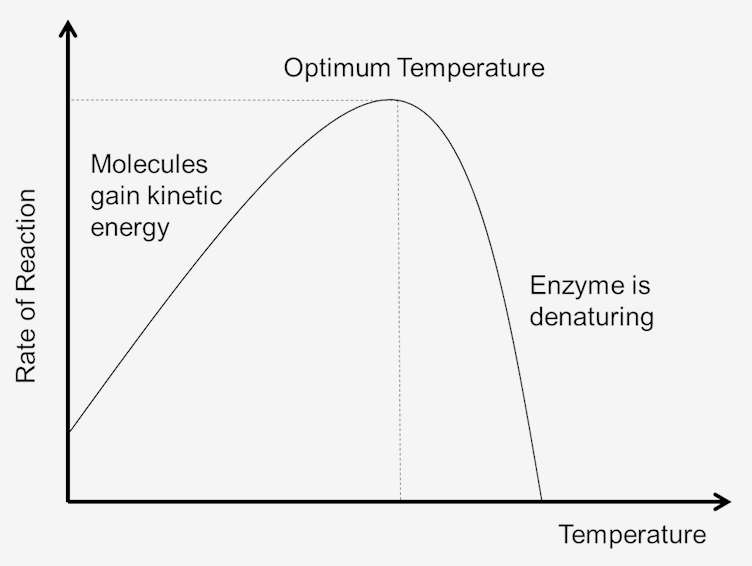
How does temperature affect enzyme activity?
Increasing the temperature increases the kinetic energy of particles, increasing the rate at which the enzymes collide with the substrate hence leading to more frequent successful collision and a higher rate of enzyme activity UNTIL THE OPTIMUM IS REACHED…
When temperatures exceed an enzyme’s optimum, enzyme activity begins to decrease as the high temperature begin to overcome bonds holding the enzymes tertiary structure in place as the particle vibrates more. As a result the enzymes active site changes shape and is denatured. Enzyme activity decreases as temperature increases as more enzymes denature until all enzymes denature and catalysis stops.
However, when temperature is decreased from the optimum, particles lose kinetic energy and enzyme activity slows down, but less rapidly as enzymes are not irreversibly denatured.
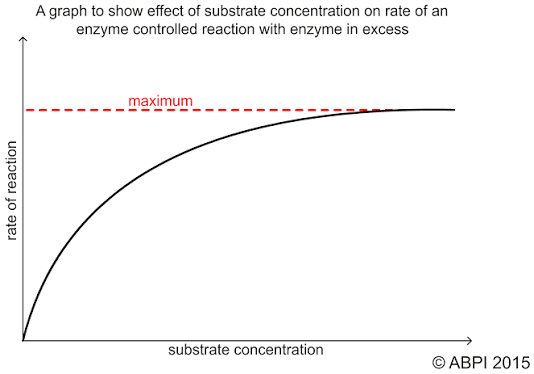
How do enzyme concentration and substrate concentration affect enzyme activity?
Enzyme concentration - Higher enzyme concentration increases the no. of available active sites allowing more ESC to form and more product to be produced. The rate of reaction increases until substrate concentration becomes the limiting factor as there isn’t enough substrate to fill all active sites. Activity plateaus.
Substrate concentration Higher substrate concentration increases the number of successful collision and hence more ESC are formed so the rate increases. However, when all the active site are occupied, enzyme concentration becomes the limiting factor and activity plateaus as Vmax is reached.
What are cofactors, coenzymes and prosthetic groups? How are they different and what are their roles? Provide examples of each.
Cofactors - inorganic ions that some enzymes require to function properly. May stabilise the structure or take part in the reaction at the active site. Example: Chloride ions act as a cofactor for amylase as it is necessary for the formation of a correctly shaped active site.
Coenzymes - organic molecules permanently or temporarily bound to or near the active site. Can be involved in carrying electrons or chemical groups between enzymes to aid catalysis. Example: Coenzyme A is required for the oxidation of pyruvate during respiration to link reactions.
Prosthetic groups - cofactors tightly bound to the structure of an enzyme that are necessary for enzyme activity. Example: Zn2+ in carbonic anhydrase, used to move carbon dioxide in and out of the blood.
Compare non-competitive and competitive enzyme inhibitors.
Competitive inhibitors - compete against substrate for the active site. If a competitive inhibitor binds to the active site, substrate cannot enter so enzyme cannot catalyse reaction and rate is reduced. However, if substrate concentration is increased enough, there will be more substrate than inhibitor.
Non-competitive inhibitors - Bind to an allosteric site on the enzyme that causes the tertiary structure of the active site to change so it is no longer complementary to the substrate. Increasing concentration of enzyme or substrate cannot overcome the inhibitor.
How do reversible and non-reversible inhibitors affect the rate of enzyme controlled reactions?
Reversible - enzyme activity is reduced or stopped temporarily. Can by competitive or non-competitive
Irreversible - form covalent bonds with enzymes to inhibit them permanently. Can be dangerous eg. cyanide and carbon monoxide
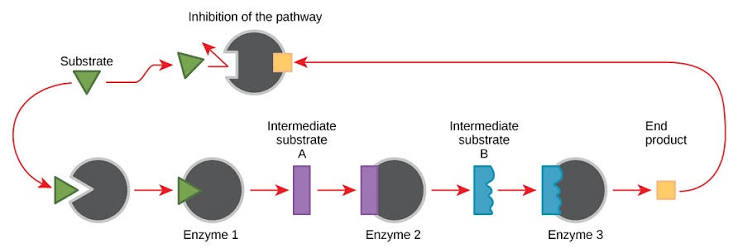
Outline how end-product inhibition works and why it is important.
Reversible inhibitors can act as regulars in metabolic pathways (sequences of metabolic reactions).
the enzyme will convert the substrate into a product, but as the end product of the pathway is produced, the enzyme is inhibited by it. This slows down and eventually stops the reaction pathway and prevents further product being formed.
The product will be a reversible inhibitor and detach from the enzyme as product levels fall. This allows more product to forms in a continuous feedback loop.