Chapter 8: Earthquakes and Geophysics (Interlude D)
 Call Kai
 Learn
Learn Practice Test
 Spaced Repetition
 Match
Match Flashcards
 Knowt Play
1/49

There's no tags or description
Looks like no tags are added yet.
Name | Mastery | Learn | Test | Matching | Spaced | Call with Kai | Chat |
|---|
No analytics yet
Send a link to your students to track their progress
50 Terms
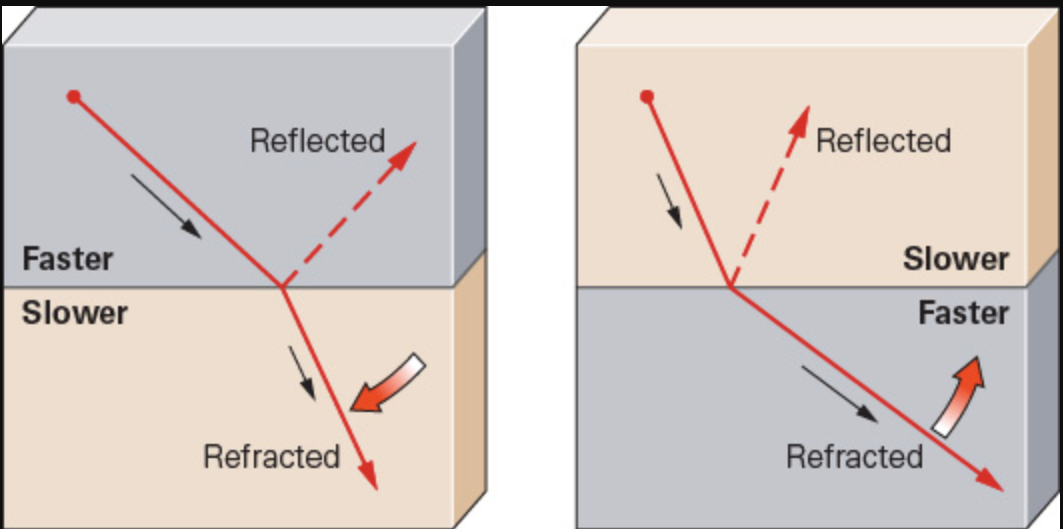
The image shows how rays are either reflected or refracted as they pass from one medium to another. The materials differ in the speed at which rays can travel. Which statement BEST describes the effect of material speed on the rays?
A ray that enters a faster medium will refract toward the boundary between the two materials.
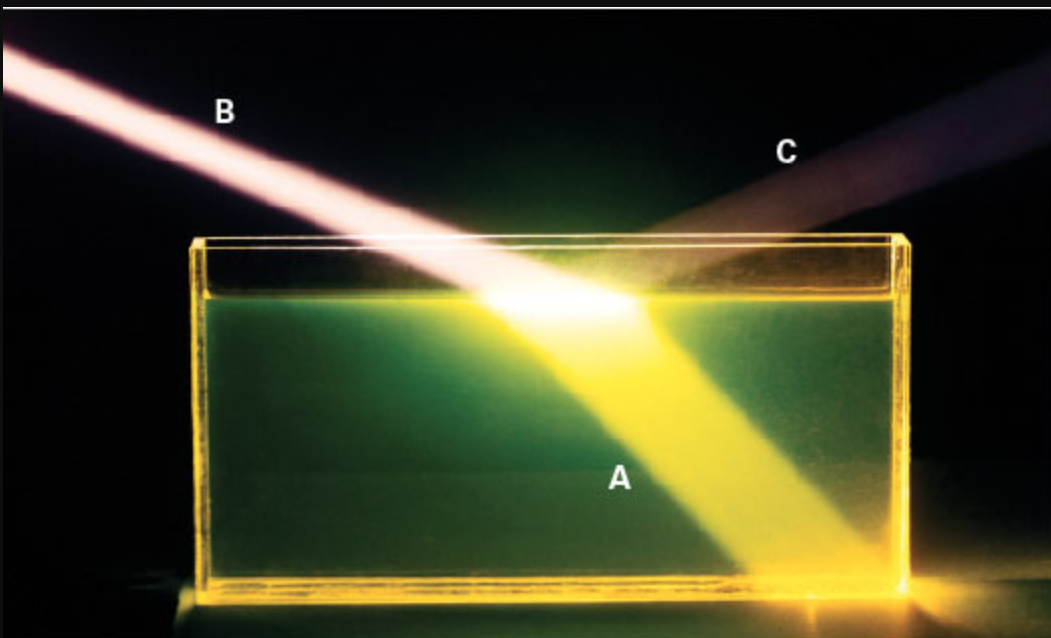
The image shows light entering standing water in a laboratory experiment. Which answer correctly matches the type of light with its location on the image?
A - refracted light, C - reflected light, B - incoming light
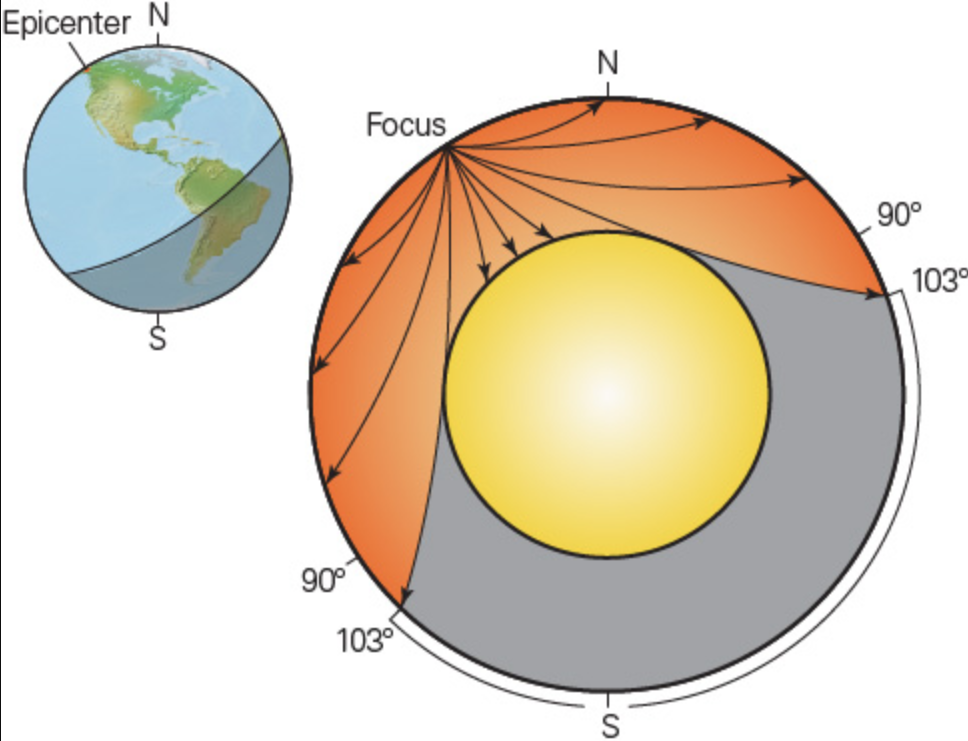
The image shows how a particular seismic wave will propagate through the Earth's interior. Using prior knowledge of seismic waves, how they travel, and the composition of the Earth's interior, what type of wave would produce the wave distribution shown below?
S-wave
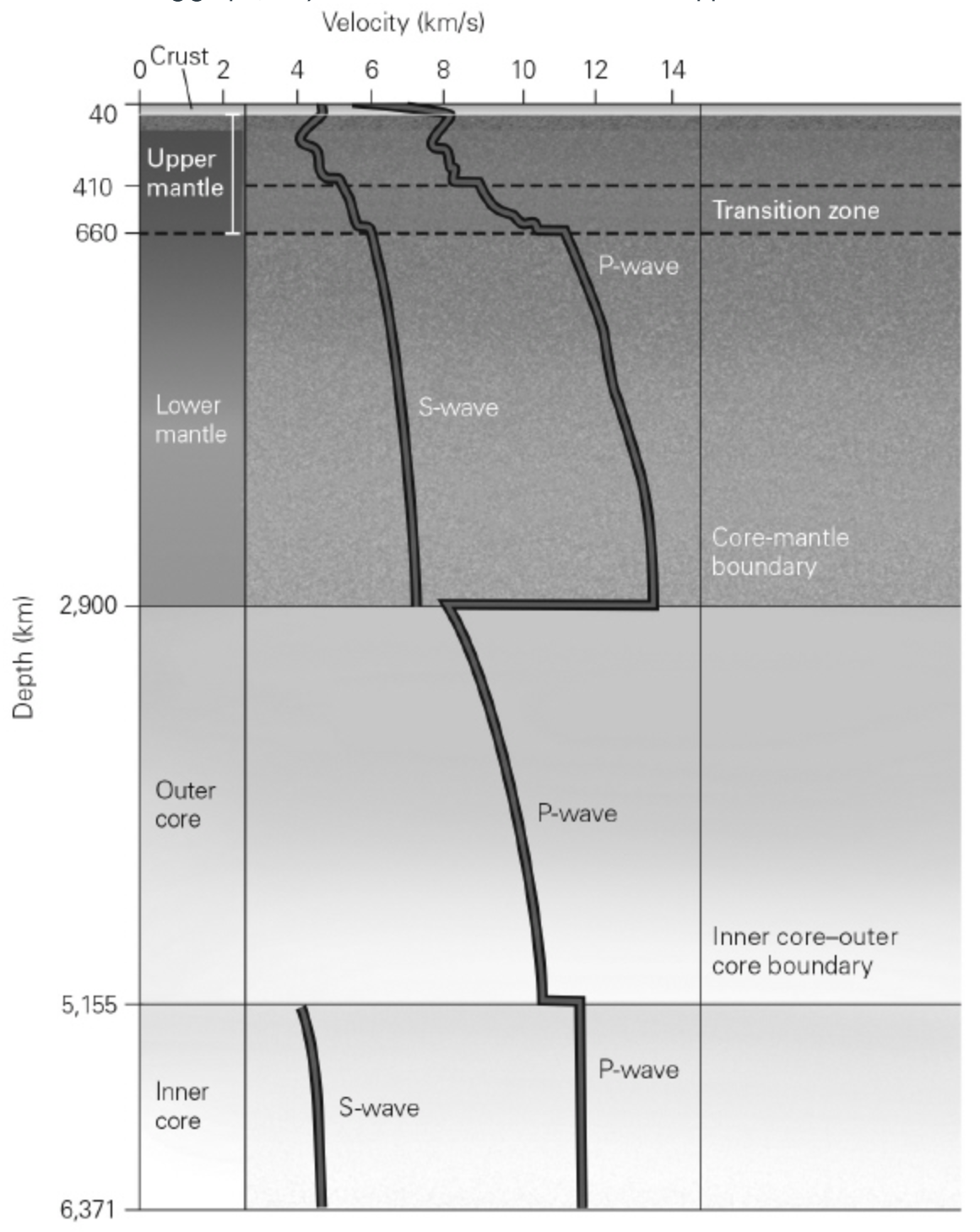
In the graph, why does the line for S-waves NOT appear in the outer core?
S-waves can’t travel through the outer core because it is liquid.
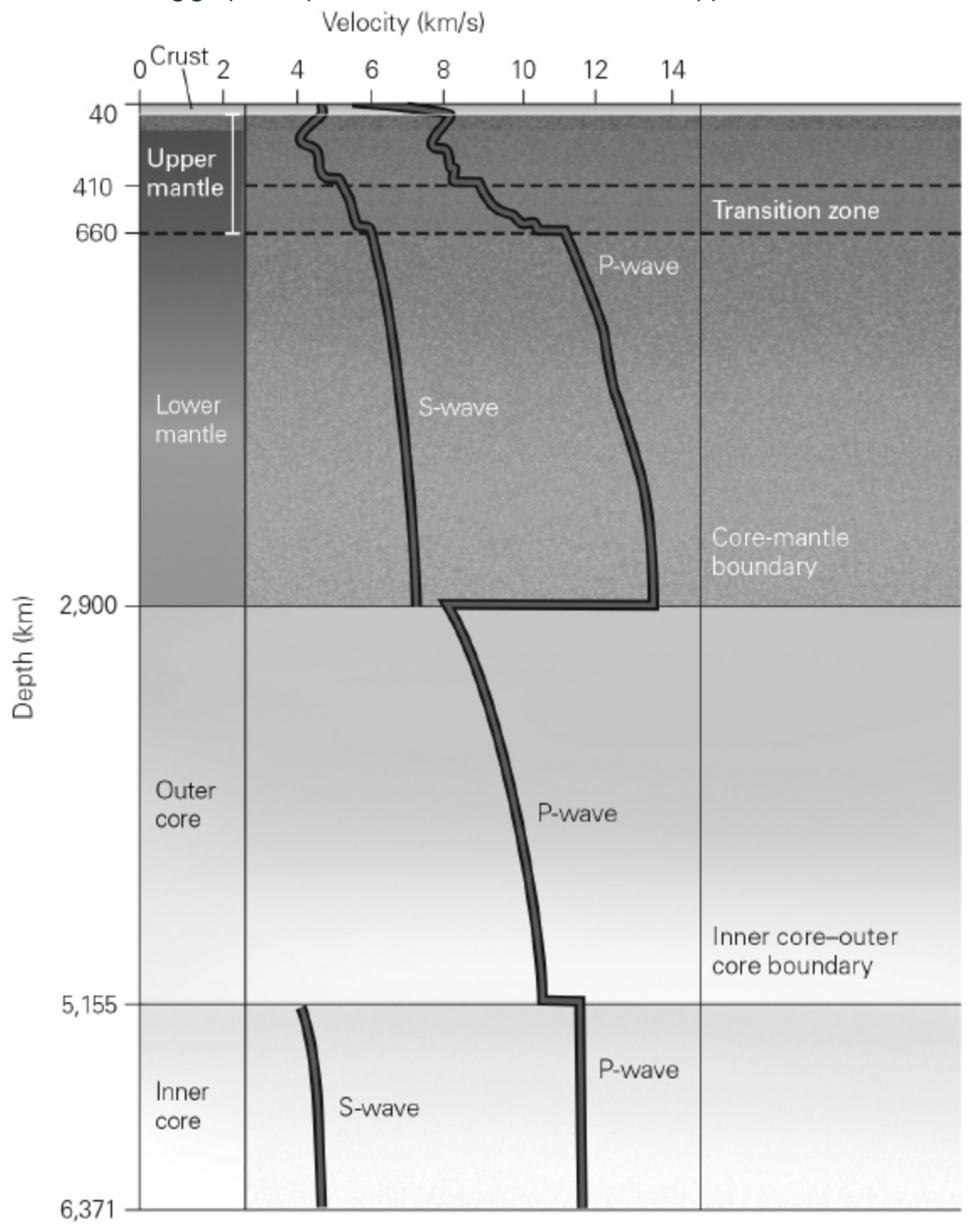
The graph shows the change in velocity of seismic waves with depth in the crust. Why does the velocity of the P-wave drop drastically at the core-mantle boundary?
Because the outer core is liquid and seismic waves travel slower in liquids
The core consists of two layers: a(n) ________ inner core and a(n) ________ outer core.
Solid; liquid
Which layer of the Earth has the highest density?
Core
What behavior will seismic waves exhibit when traveling from a lower-velocity material into a high-velocity material?
The direction the waves are traveling will bend toward the boundary
If an S-wave is traveling through rock when it encounters a molten magma chamber, what will happen to the velocity of the S-wave?
It will not travel through the magma.
If a P-wave is traveling through the Earth and encounters a molten magma chamber, what will happen to the velocity of the P-wave?
It will decrease.
Seismic waves travel ________ in solids than in liquids; however, unlike P-waves, S-waves ________ travel through liquids.
Faster; can’t
The subdiscipline of geology that investigates the Earth’s physical characteristics such seismic waves, gravity, and magnetism is termed _______.
Geophysics
Geologists who specifically study earthquakes are called
Seismologists.
Most earthquakes are a result of
Movement of rocks along faults.
The quantity of motion that occurs along a fault is termed
Displacement.
The energy that is released during an earthquake travels through the Earth as vibrations termed _______.
Seismic waves
Periods of intermittent sliding on a fault because of stress release during episodes of slip, followed by stress buildup to the point that the fault is reactivated, are termed
Stick-slip behavior.
The point within the Earth where an earthquake originates is termed the
Hypocenter (focus).
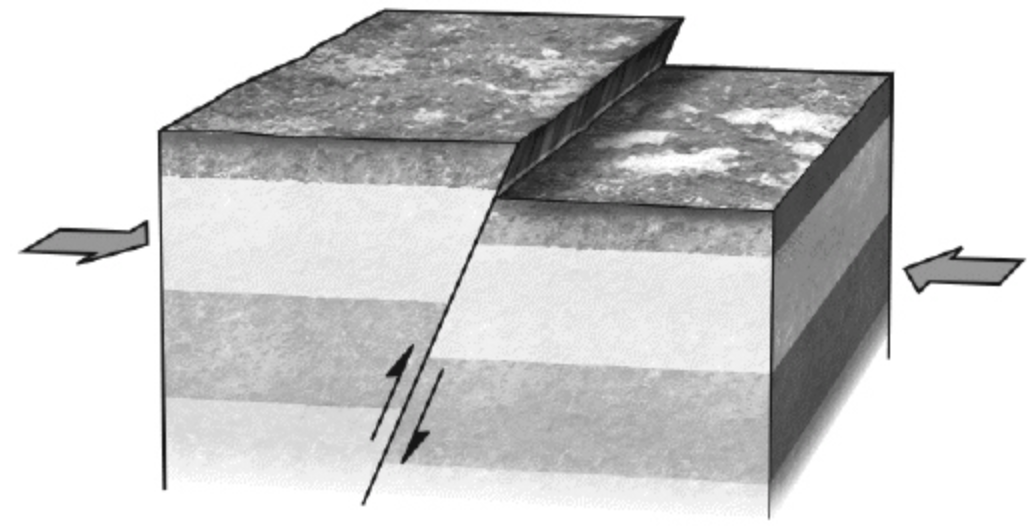
During an earthquake, if the hanging wall slides upward relative to the footwall, the fault is termed a ________ fault if the fault is steep (closer to vertical than horizontal). Refer to the figure for an example of such a feature.
Reverse
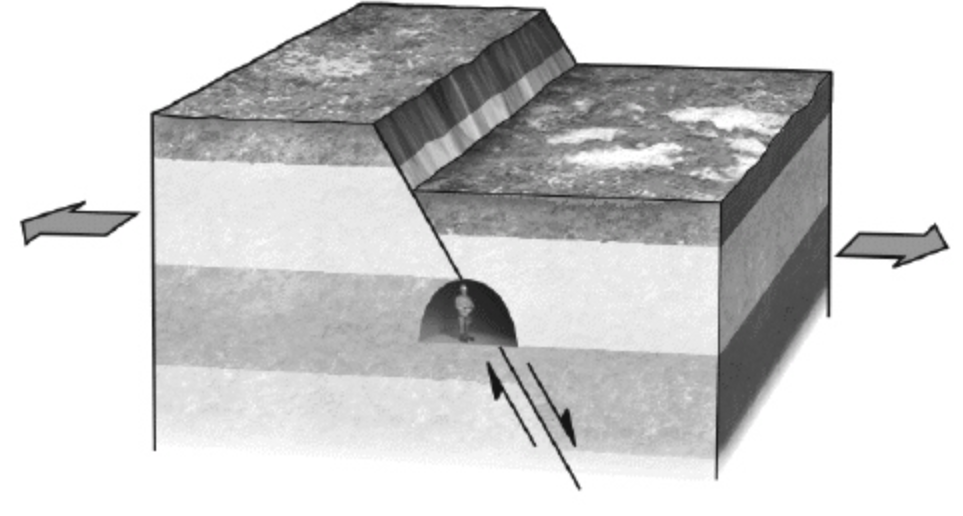
During an earthquake, if a hanging wall slides downward relative to a footwall, the fault is termed a ________ fault. Refer to the figure for an example of such a feature.
Normal
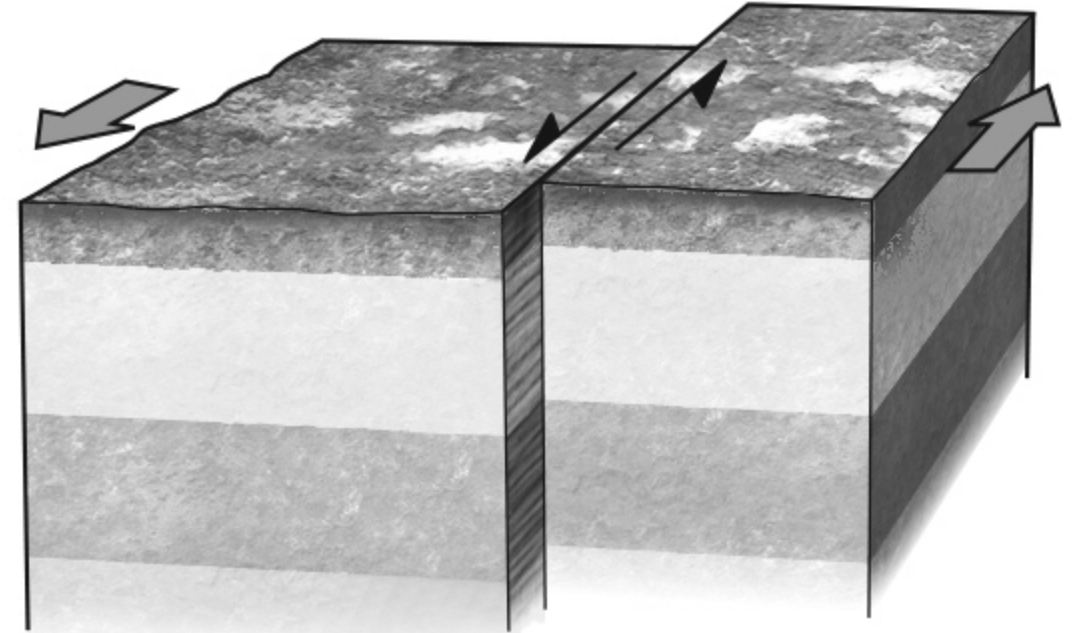
If a fault is nearly vertical in orientation and the two walls of rock on opposite sides slide past one another horizontally, the fault is termed a ________ fault. Refer to the figure below for an example of such a feature.
Strike-slip
Before an earthquake, rocks can respond to applied stress to a small degree by bending and warping without breaking. This is termed _________.
Elastic behavior
A ____________ is a scientific instrument used to record the ground motions produced by an earthquake.
Seismometer
Which type of seismic wave has the fastest velocity?
P-wave
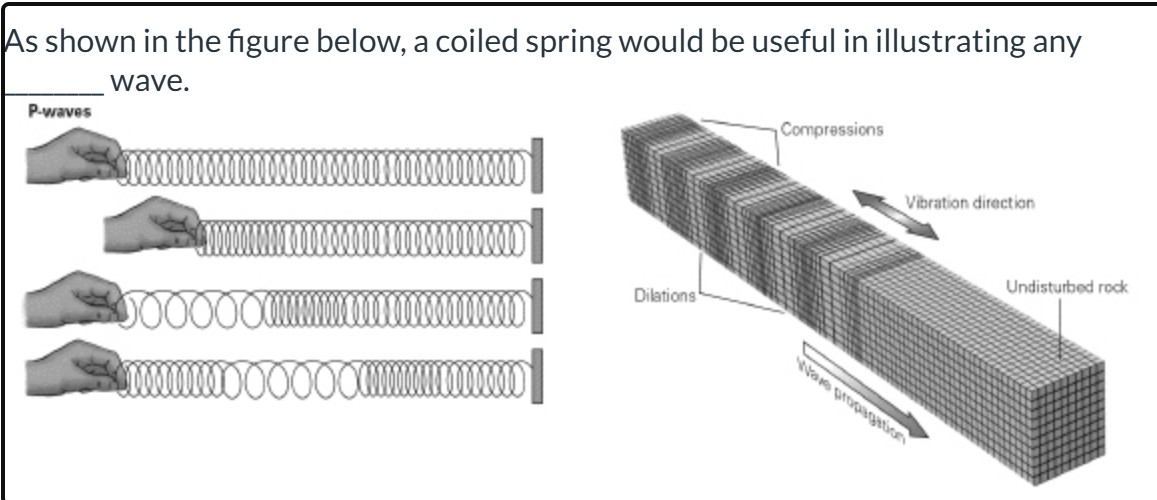
As shown in the figure, a coiled spring would be useful in illustrating any ________ wave.
Compressional
Body waves include
Both S- and P-waves.
Earthquake waves that pass through the Earth’s interior are termed
Body waves.
Earthquake waves that travel along the Earth’s surface are termed
Surface waves.
A long delay between the arrival of P-waves and S-waves at a seismometer means that
The seismometer is located far from the earthquake.
Which earthquake scale measures the amplitude of deflection of a seismograph pen, standardized to an idealized distance of 100 km between the epicenter and the seismograph?
The Richter scale
Which earthquake severity scale varies from locality to locality for a single earthquake?
The Mercalli scale
Which earthquake scale is used to assess the effects of an earthquake on humans and human-made structures?
Mercalli scale
The vast majority of earthquakes occur
Along any plate boundary.
Which geological setting is likely to experience the least amount of seismic activity?
The interior of a tectonic plate
Most medium- and deep-focus earthquakes occur at
Convergent-plate boundaries.
Wet and unconsolidated substrates are uniquely susceptible to ________ during an earthquake.
Liquefaction
A tsunami is
A seawave generated by an earthquake, landslide, or submarine volcanic eruption that may destroy coastal cities thousands of kilometers from its source.
Tsunamis are most commonly generated by sudden _________ movement of the seafloor during an earthquake.
Vertical
Short-term predictions of earthquake behavior have
Been largely unreliable.
The average length of time between earthquakes along a fault is termed the ______.
Recurrence interval
Earthquake early warning systems
Alert people when an earthquake has taken place, possibly giving them seconds to get to a safer place.
What kind of information is shown on a seismic hazard map?
The probability that different regions will experience a large earthquake
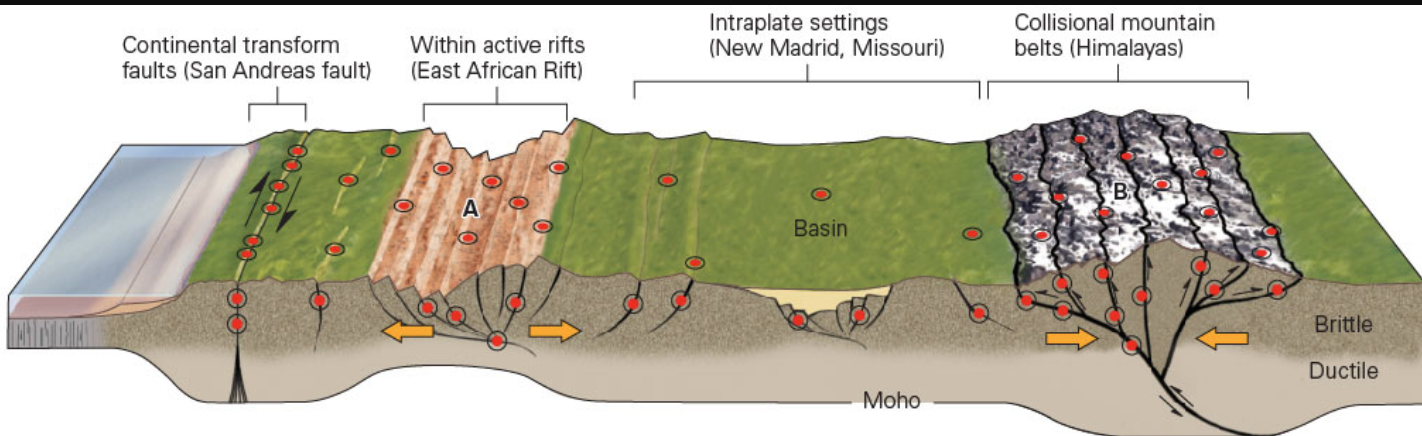
Faults with similar sense of motion are commonly found in specific geologic settings. Look at the figure below and determine which type of fault motion would dominate at each of the settings: the East African Rift vs. the Himalaya Mountains, respectively.
A - Normal, B - Reverse
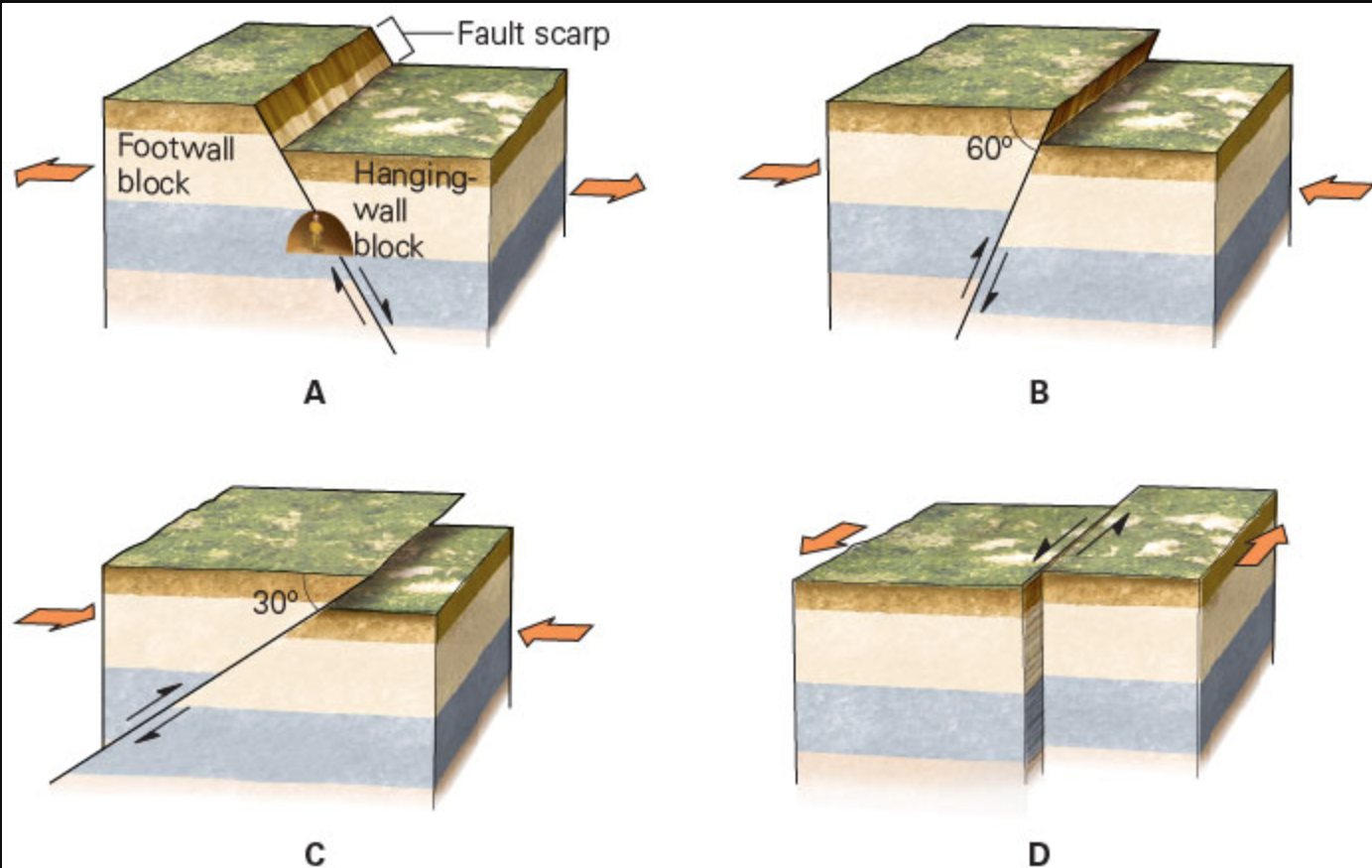
Geologists distinguish faults from one another based on the relative motion (sense of slip) of the hanging wall and footwall and the relative dip angle of the fault plane. Which of the images shows the motion of a normal fault?
A
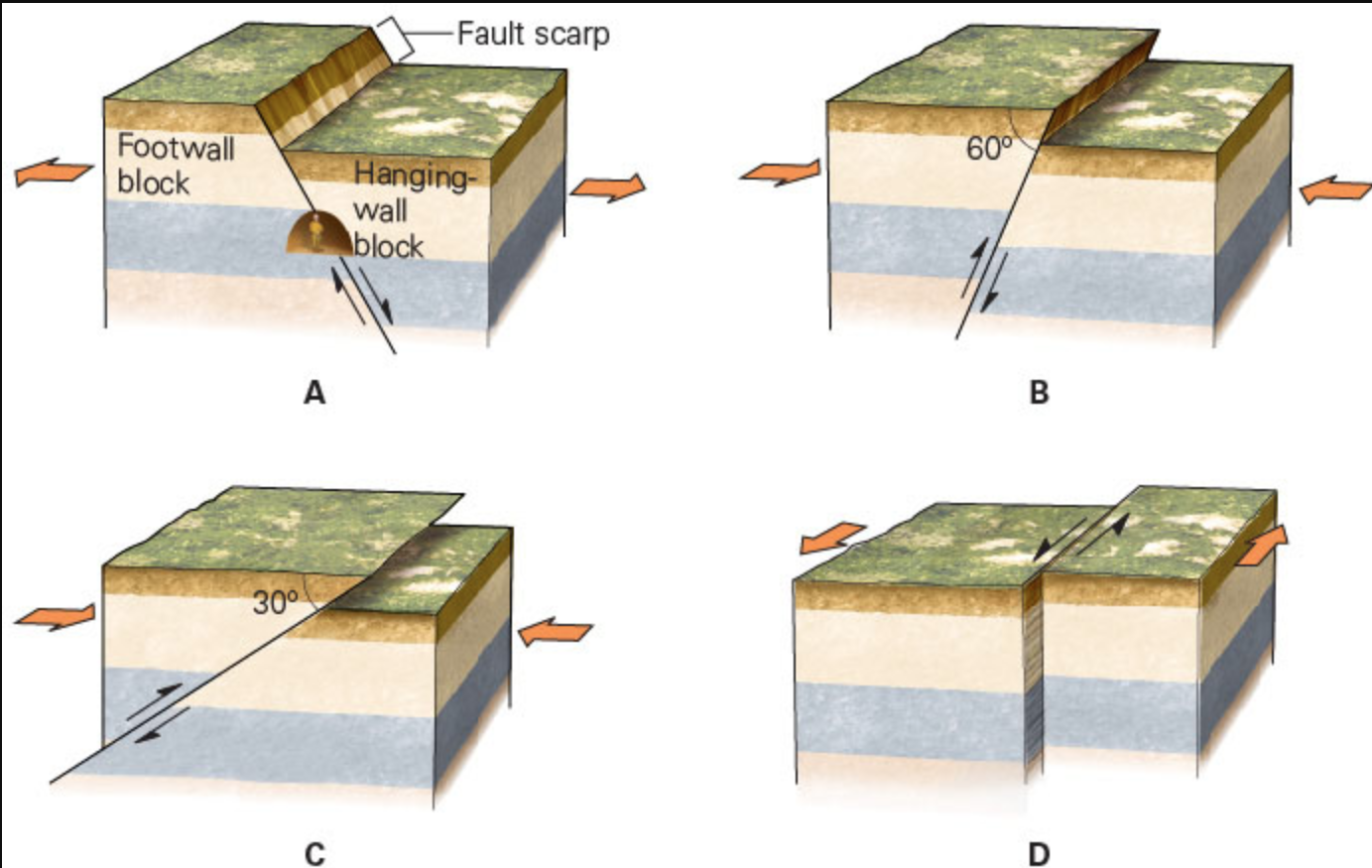
Geologists distinguish faults from one another based on the relative motion (sense of slip) of the hanging wall and footwall and the relative dip angle of the fault plane. Which of the images shows the motion of a reverse fault?
B
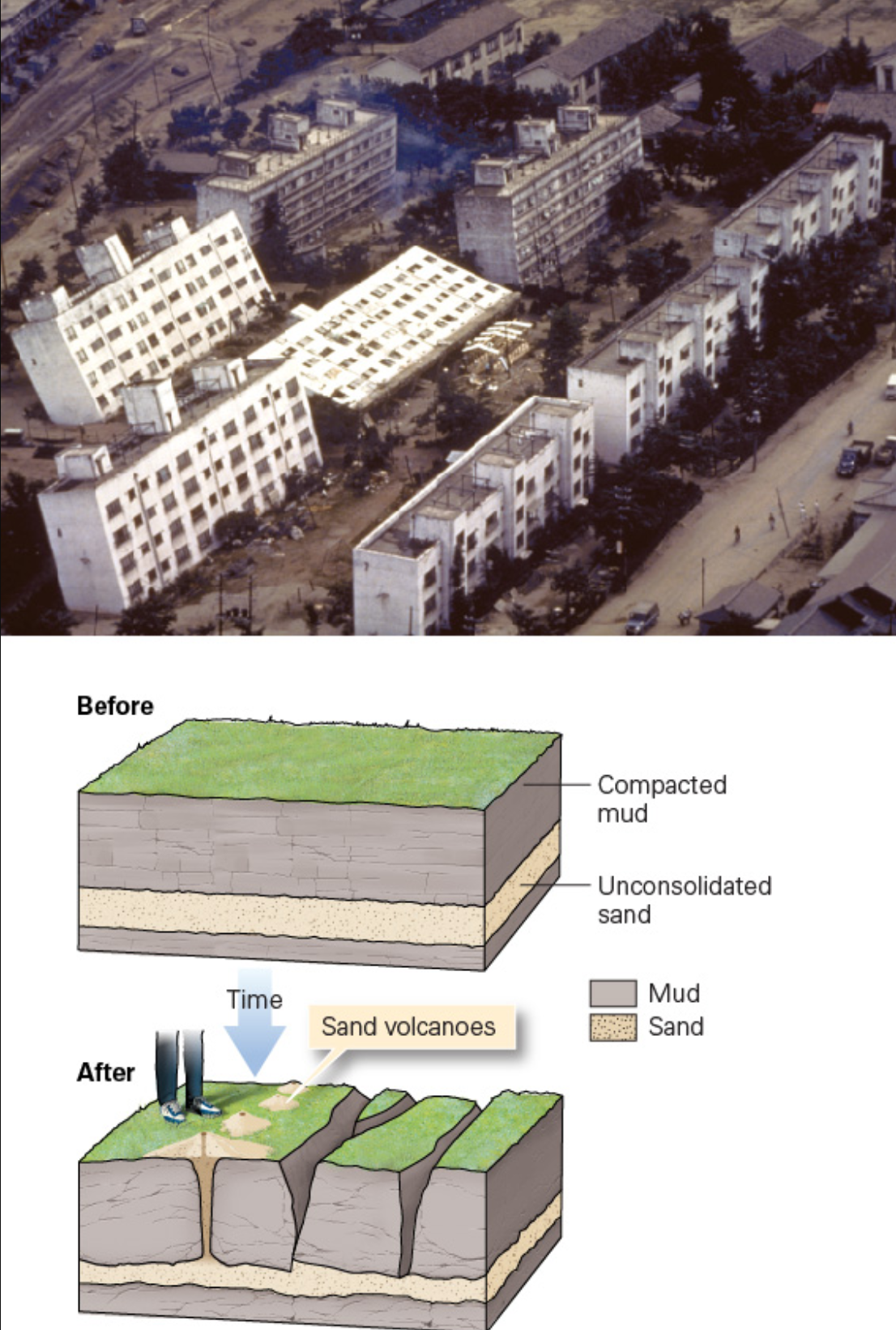
In addition to ground shaking, several peripheral hazards occasionally accompany earthquakes. In the top photo, the foundations of several large buildings sank into soft, soupy sediments. In the figure, a sinkhole full of wet sand opened up in a roadway. Which earthquake-related hazard caused these events?
Liquefaction
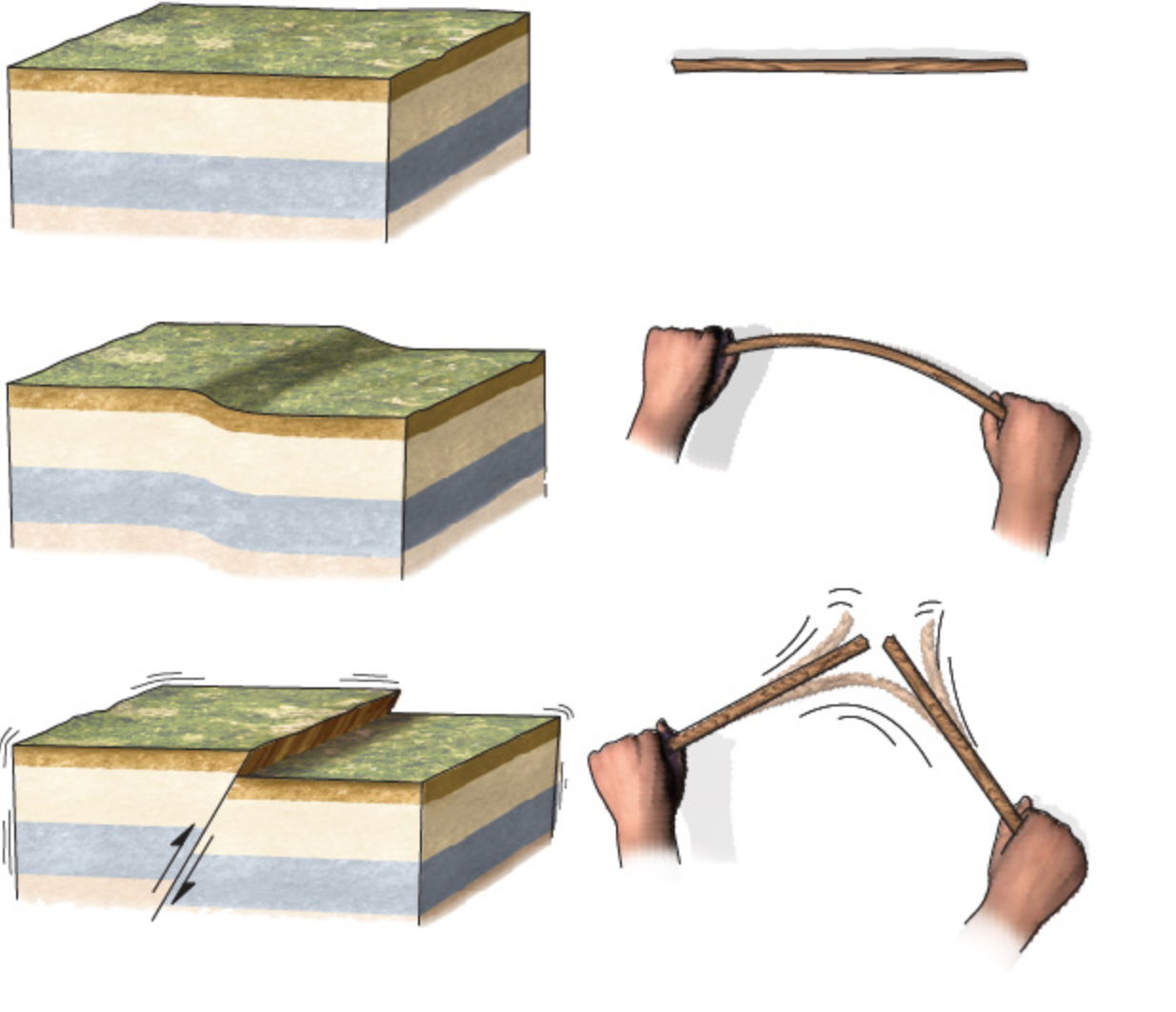
In the series of time-sequenced pictures, we can see a rock unit responding to the application of stress. What geologic hazard results from this stress accumulation?
An earthquake
The figure shows the generation of a tsunami, resulting from an earthquake. According to the figure, what kind of fault is responsible for this tsunami's generation?
Reverse fault

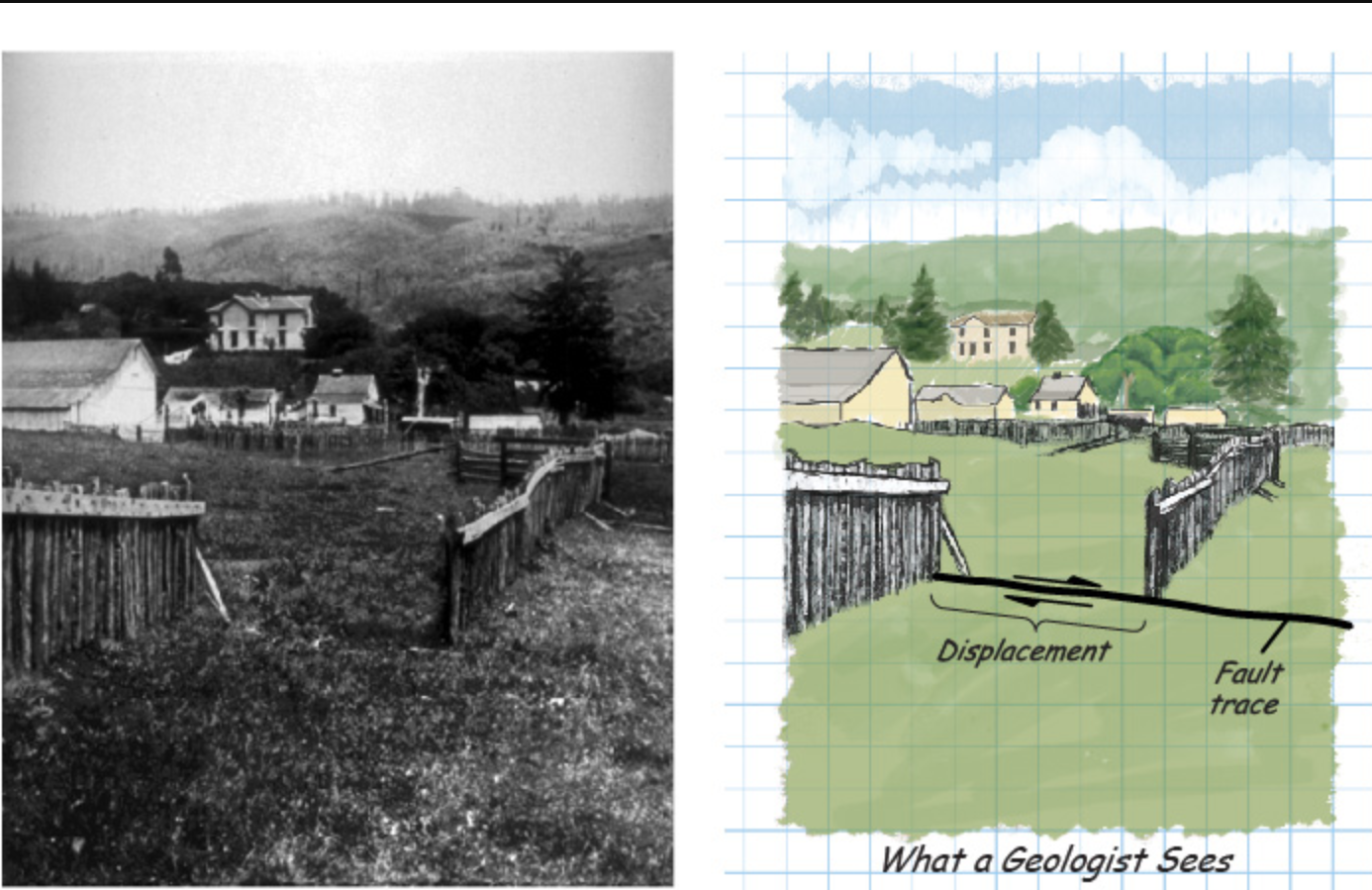
The picture and sketch show a result of the 1906 San Francisco earthquake. What kind of fault accommodated the motion seen in these pictures?
A strike-slip fault
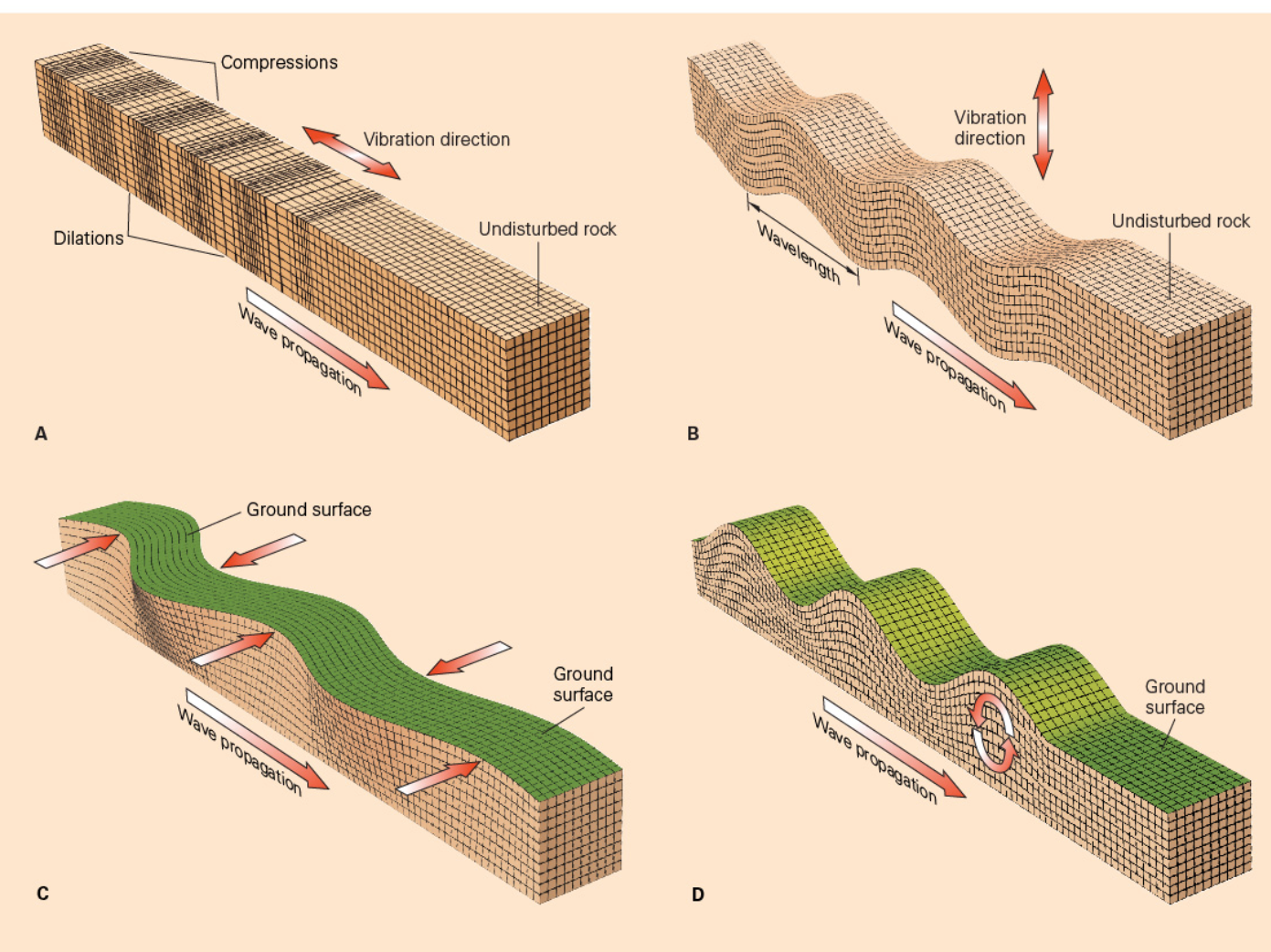
When earthquakes occur, they release energy in the form of seismic waves. The waves produced have different forms and motions. Of the four waveforms illustrated, which one illustrates the motion of an S-wave?
B