NIFE Aerodynamics Questions
 Call Kai
 Learn
Learn Practice Test
 Spaced Repetition
 Match
Match Flashcards
 Knowt Play
1/83

There's no tags or description
Looks like no tags are added yet.
Name | Mastery | Learn | Test | Matching | Spaced | Call with Kai | Chat |
|---|
No analytics yet
Send a link to your students to track their progress
84 Terms
What forces act on an aircraft in flight?
a) Lift and drag
b) Lift and thrust
c) Lift, drag and thrust
d) Lift, drag, weight and thrust
d) Lift, drag, weight, and thrust
Total pressure is comprised of what two elements?
a) Potential and dynamic
b) Potential and kinetic
c) Kinetic and dynamic
d) Dynamic and static
d) Dynamic and Static
What is the relationship between altitude and density?
a) Independent
b) Direct
c) Inverse
c) Inverse:
"The distance between individual air particles increases with altitude, resulting in fewer particles per unit volume. Therefore, air density decreases with an increase in altitude"
What force relationship must exist for an aircraft to maintain equilibrium flight?
a) The sum of all the forces and moments about the center of gravity must equal zero
b) Lift must equal weight
c) Thrust must equal weight
d) Thrust must equal drag
a) "Equilibrium flight exists when the sum of all forces and the sum of all moments around the center of gravity are equal to zero."
What would increase the density of air acting on an aircraft?
a) An increase in altitude
b) An increase in air temperature
c) A decrease in altitude
d) A decrease in static pressure where temperature is constant
c) Decrease in altitude:
"The distance between individual air particles increases with altitude, resulting in fewer particles per unit volume. Therefore, air density decreases with an increase in altitude"
What equation expresses the General Gas Law?
a) P = ρKT
b) ρ = P/RT
c) P = ρT
d) RP = ρT
b) Original equation is P = ρRT.
Roll is defined as the movement of the lateral axis about which axis.
a) Lateral
b) Longitudinal
c) Vertical
d) Horizon
b) Longitudinal:
"Movement of the lateral axis around the longitudinal axis is called roll."
The wingspan includes the area within the fuselage area?
a) True
b) False
a) True:
"Wingspan (b) is the length of a wing, measured from wingtip to wingtip."
The chordline is:
a) The wings center line
b) An infinitely long straight line drawn through the leading and trailing edges of an airfoil
c) A measure of the length of the wing
d) The average distance from the wing root to the wingtip
b) "Chordline of an airfoil is an infinitely long, straight line which passes through its leading and trailing edges."
According to the continuity equation for incompressible airflow, what is the relationship between area, airflow velocity and mass airflow for a streamtube?
a) Airflow velocity increases as stream tube area increases, to maintain a constant mass airflow
b) Airflow velocity increases as stream tube area decreases, to maintain a constant mass airflow
c) Airflow velocity remains constant as stream tube area decreases, to maintain a constant mass airflow
d) Airflow velocity decreases as stream tube area decreases, to maintain a constant mass airflow
b) Given A1V1 = A2V2, “If the cross sectional area decreases on one side of the equation, the velocity must increase on the same side so both sides remain equal.”
Since a streamtube is a closed-system, mass and/or energy must be held constant
When will the value of indicated airspeed equal the aircraft's true airspeed?
a) When the static pressure at aircraft altitude is less than static pressure at sea level
b) When the static pressure at aircraft altitude is greater than static pressure at sea level
c) When the static pressure at aircraft altitude is equal to static pressure at sea level
d) When air density at aircraft altitude is equal to air density at sea level, on a standard day
d) density at altitude = sea level density
"The pitot static system is calibrated for standard sea level density, so TAS will equal IAS only under standard day, sea level conditions.", or when ρ=ρo
What airspeed, when corrected for compressibility effects, results in equivalent airspeed?
a) Indicated airspeed
b) True airspeed
c) Ground airspeed
d) Calibrated airspeed
d) Calibrated Airspeed:
"Equivalent airspeed... is found by corrected calibrated airspeed for compressibility error."
What type of correction must you apply to indicated airspeed (IAS) to calculate true airspeed (TAS)?
a) Density correction
b) Temperature correction
c) Pressure correction
d) Viscosity correction
a) Density correction
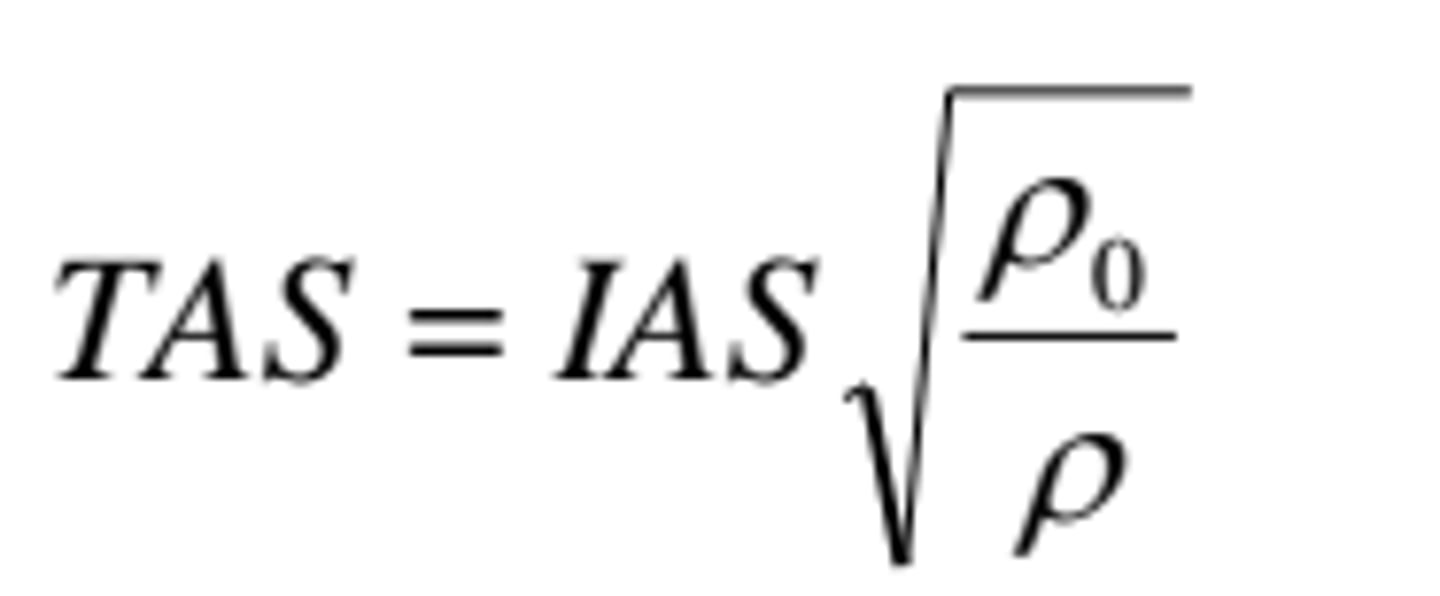
An aircraft is climbing at a constant 350 knots IAS. What change in TAS occurs as altitude increases?
a) True airspeed decreases
b) True airspeed increases
c) True airspeed remains constant
d) There is no such thing as true airspeed
b) True airspeed increases:
"If IAS remains constant while climbing from sea level to some higher altitude, TAS must increase"
What airfoil angle of attack setting is required to produce zero net lift on a positively cambered airfoil?
a) Negative angle of attack
b) Positive angle of attack
c) Zero angle of attack
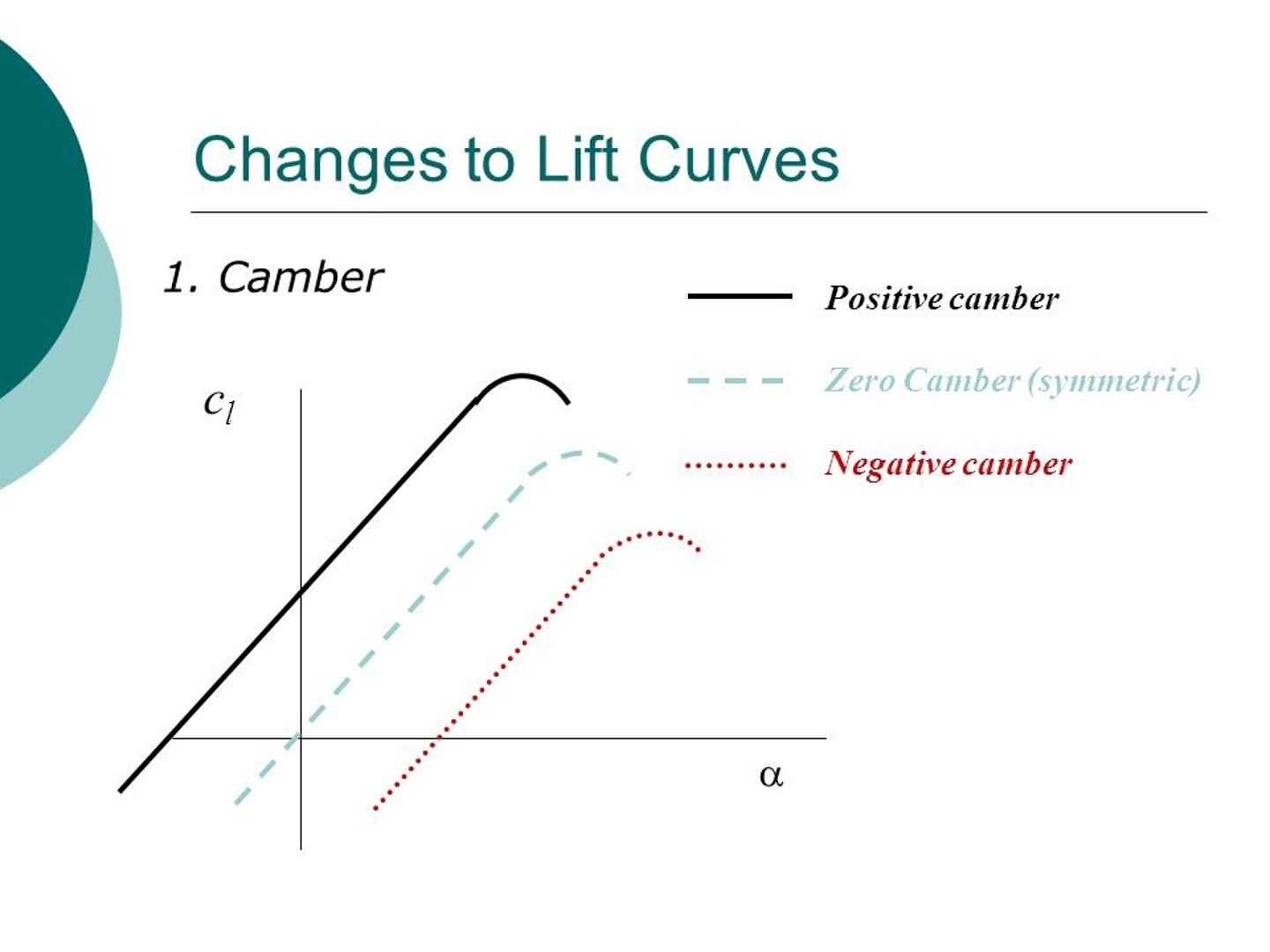
a) Negative AOA:
"The point where the curves cross the horizontal axis is the AOA where the airfoil produces no lift... the positive camber airfoil must be at a negative AOA."
What variables determine the amount of lift produced by an airfoil?
a) True airspeed (TAS), airfoil surface area (S) and total drag (DT)
b) True airspeed (TAS), airfoil surface area (S) and aircraft weight (w)
c) True airspeed (TAS), airfoil coefficient of lift (CL) and coefficient of total drag (DT)
d) True airspeed (TAS), air density (p), airfoil surface area (S), airfoil angle of attack and camber
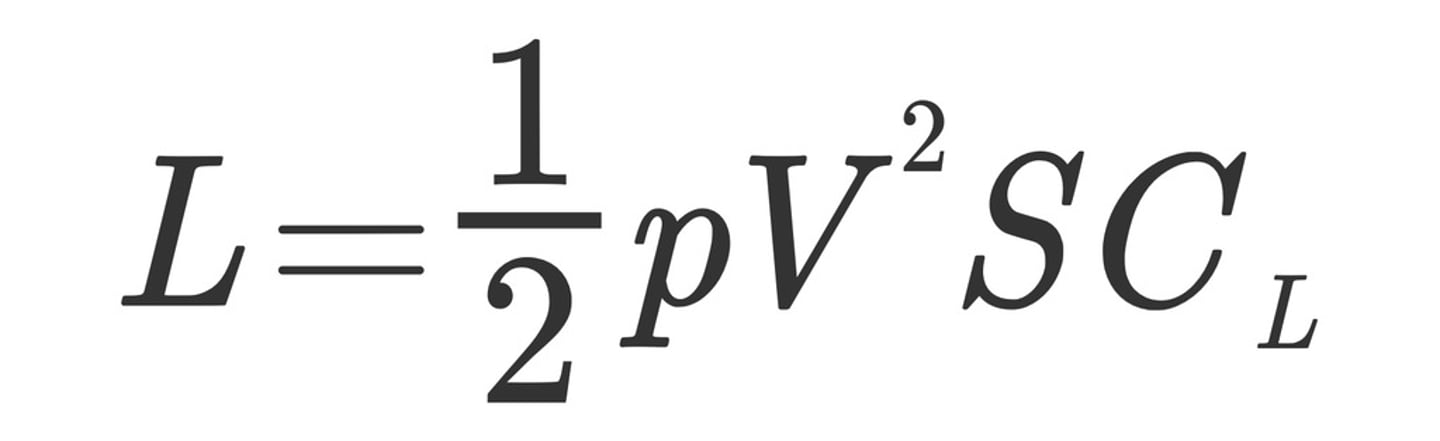
d) True airspeed (TAS), air density (p), airfoil surface area (S), airfoil angle of attack and camber
What happens to an aircraft's minimum airspeed as it burns off fuel?
a) Stall speed increases
b) Stall speed decreases
c) Stall speed remains constant
b) stall speed decreases:
"As airplane weight decreases stall speed decreases because the amount of lift required to maintain level flight decreases. When an airplane burns fuel or drops ordnance, stall speeds decrease. Carrier pilots often dump fuel before shipboard landings in order to reduce stall speed and approach speed."
Lift of an airfoil is always:
a) Perpendicular to drag
b) That component of AF that is perpendicular to relative wind
c) Perpendicular to flight path
d) All of the above
d) All of the above:
"Lift is the component of aerodynamic force acting perpendicular to the relative wind." It is also perpendicular to drag (same direction as RW) and flight path (equal in magnitude but opposite in direction of RW)
To maintain altitude lift must equal drag.
a) True
a) False
b) False:
Lift must equal weight
If an aircraft is operating at CLMAX AOA, the aircraft is stalled.
a) True
b) False
b) False:
"Any increase in angle of attack beyond CLmaxAOA causes a decrease in the coefficient of lift... a stall is a condition in flight in which an increase in AOA results in a decrease in CL"
What causes a stall?
a) A decrease in lift caused by an increase in AOA
b) An increase in lift caused by an increase in AOA
c) Excessive AOA
d) Both a and c
d) Both a and c:
"Any increase in angle of attack beyond CLmaxAOA causes a decrease in the coefficient of lift... a stall is a condition in flight in which an increase in AOA results in a decrease in CL"
How will placing tip tanks on the wings affect DP or Di?
a) Will not affect DP and decrease Di
b) Will not affect Di and decrease DP
c) Will increase DP and decrease Di
d) Will increase Di and not affect DP
c) Increase Dp but decrease Di:
"Another method to reduce induced drag is to install devices that impede the spanwise airflow around the wingtip. These devices include winglets, wingtip tanks, and missile rails." However, there will also be an increase in parasite drag due to the addition of wing tip tanks.
How does induced drag vary with velocity?
a) Directly with velocity squared
b) Inversely with velocity squared
c) Inversely with velocity
d) Directly with velocity cubed
b) "Induced drag varies inversely with velocity squared"
What are two types of parasite drag?
a) Form and interference
b) Induced and form
c) Interference and skin friction
d) Form and skin friction
d. Form and skin friction
How can one reduce friction drag?
a) Smooth the exposed surfaces of an airplane
b) Reduce the AOA and install wing devices
c) Friction can not be reduced
a) Smooth the exposed surfaces
"Friction drag can be reduced by smoothing the exposed surfaces of the airplane through painting, cleaning, waxing or polishing."
What is the definition of air density?
a) Atmospheric force per unit area
b) Mass of air particles per unit of volume
c) Mass of air particles times gravity
d) Mass of air particles times velocity of air particles squared
b) Mass of air particles per unit of volume
What is an example of an aircraft operating under equilibrium?
a) An aircraft making a turn while maintaining constant true airspeed (TAS) and altitude
b) An aircraft maintaining straight and level flight at a constant TAS
c) An aircraft pulling out of a dive at a constant TAS
d) An aircraft accelerating in straight and level flight due to an increase in thrust
b) SLUF: Straight and Level Unaccelerated Flight
"An airplane in straight and level flight at a constant velocity is acted upon by four forces: thrust, drag, lift and weight."
How does an increase in altitude affect static pressure?
a) Increases
b) No change
c) Decreases
c) Decreases
"As altitude increases, there is less air in the column above, so it weighs less. Thus atmospheric static pressure decreases with an increase in altitude."
What atmospheric conditions would provide the greatest air density?
a) Hot temperature, low static pressure, low humidity
b) Hot temperature, low static pressure, high humidity
c) Cold temperature, low static pressure, high humidity
d) Cold temperature, high static pressure, low humidity
d)
-Temperature and humidity are inversely related with density
-Pressure and density are directly related
Pitch is defined as the motion of the longitudinal axis about which axis?
a) Longitudinal
b) Lateral
c) Vertical
d) The horizon
b) lateral
"Movement of the longitudinal axis around the lateral axis is called pitch."
All motion or changes in an aircraft's attitude occurs about which position?
a) Aerodynamic center (AC)
b) Center of pressure (CP)
c) Center of gravity (CG)
d) The cockpit
c) Center of Gravity
"The center of gravity is the point at which all... forces and moments are measured."
All aircraft axes pass through the CG
What four airflow properties must remain constant on an airfoil to have a steady airflow?
a) Viscosity, temperature, pressure, density
b) Velocity, temperature, pressure, density
c) Lift, weight, thrust, drag
d) Friction, viscosity, density, lift
b) "Steady airflow exists if at every point in the airflow these four properties [static pressure, density, temperature, and velocity] remain constant over time."
What is the name of the angle between the chord line of an airfoil and the relative wind?
a) Angle of attack
b) Angle of incidence
c) Pitch angle
d) Slideslip angle
A. AOA"
"Angle of attack is the angle between the relative wind and the chordline of an airfoil."
What is the static pressure distribution about a positively cambered airfoil at zero angle of attack in level flight?
a) The static pressure distribution is equal over all portions of the airfoil
b) The static pressure distribution is less over the upper surface of the airfoil
c) The static pressure distribution is less over the lower surface of the airfoil
d) The static pressure over the upper surface is equal to atmospheric static pressure
B. Static pressure is less over the upper surface (dynamic pressure is higher)
"A positively cambered airfoil will have a positive CL at zero AOA, so the airfoil will produce lift at that point. To produce lift, the static pressure on the upper surface will be less than the static pressure on the lower surface. The lower static pressure on the upper surface will 'pull' the wing upward, creating a lifting force."
What is the cause of a stall if an aircraft rolls into a 60 degree angle of bank turn and pulls 3 g's at 200 knots?
a) Excessive angle of bank
b) Excessive g loading
c) Excessive airspeed
d) Excessive angle of attack
d) Excessive AOA:
"The only cause of a stall is excessive Angle of Attack"
According to the lift equation, in a slow speed situation such as landing, angle of attack will be:
a) Smaller than at cruising speed because we need less lift
b) Larger than at cruising speed in order to maintain the same lift at slower velocities
c) Dependent upon drag
d) None of the above
b) AOA will be higher
"As velocity decreases, angle of attack will need to increase to maintain the same lift."
Slower velocity at landing than at cruise
Drag is:
a) Parallel to the chord line
b) Parallel to the thrust vector
c) Perpendicular to the lift vector
d) Parallel to the centerline of the fuselage
c) Perpendicular to Lift
"Drag is the component of the aerodynamic force that is parallel to the relative wind, and acts in the same direction"
Lift is ALWAYS perpendicular to relative wind
Drag is not always parallel to thrust (i.e. in a climb/descent)
Airfoil efficiency at various angles of attack is expressed by the ratio of:
a) Lift to dynamic pressure
b) Lift to drag
c) Lift to weight
d) Lift to velocity
b) Lift to drag ratio represents efficiency of an airfoil
High induced drag is associated with low angles of attack.
a) True
b) False
b) False:
"Induced drag varies inversely with velocity, and directly with angle of attack."
Low AOA indicated high velocity
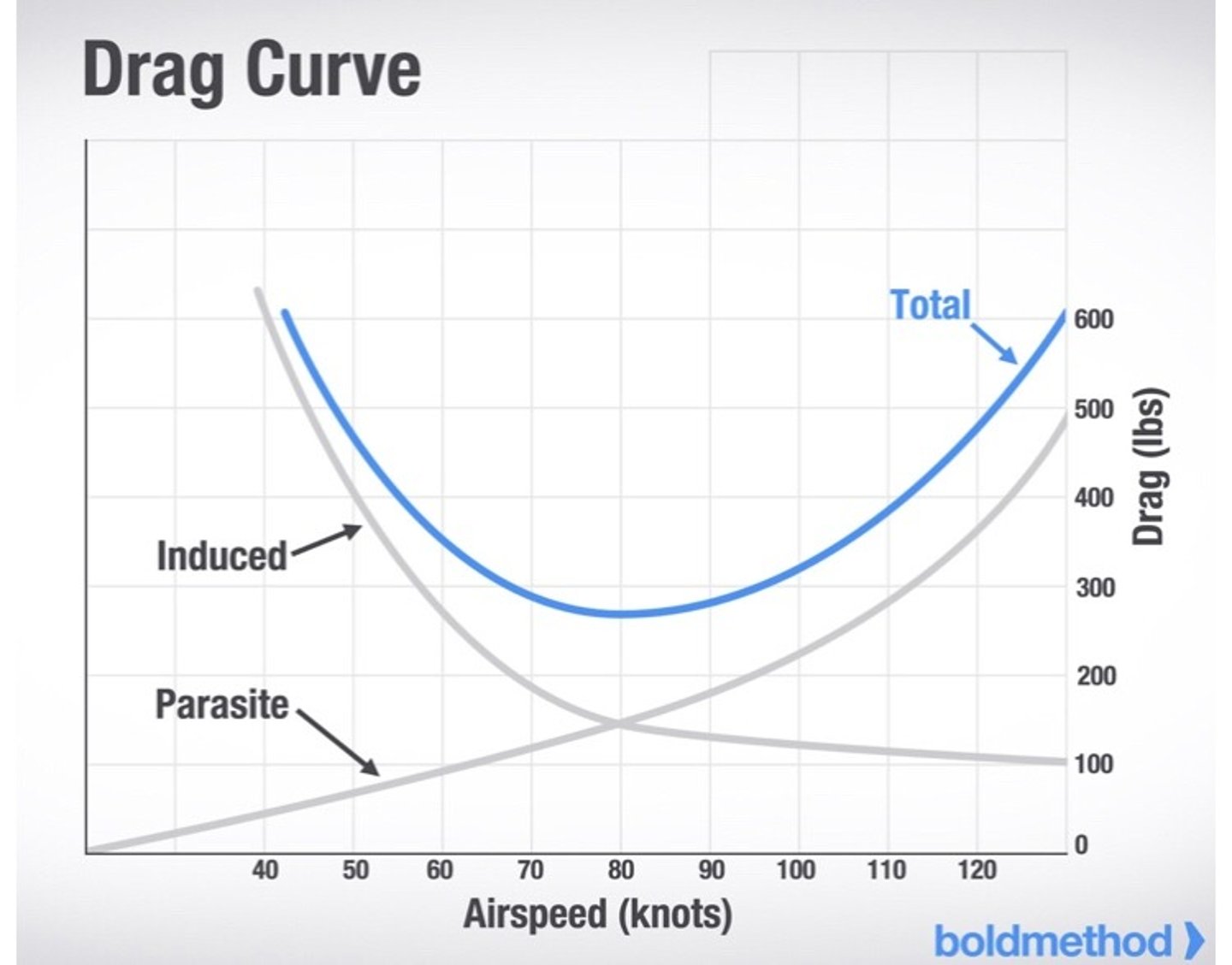
Parasite drag decreases with an increase in velocity.
a) True
b) False
b) False:
Parasite drag varies directly with velocity squared, so doubling the speed will result in four times as much parasite drag
L/D Maximum AOA is equivalent to all of the following statements except:
a) Minimum drag AOA
b) AOA where parasite drag equals induced drag
c) Maximum lift AOA
d) Wing's most efficient AOA
c) L/D Max AOA is the minimum drag produced but not necessarily the most amount of lift produced
What change in induced drag occurs as airfoil angle of attack increases in a stall?
a) Induced drag increases as lift decrease
b) Induced drag decreases as lift decreases
c) Induced drag remains constant as lift decreases
b) Di will decrease since the stall will result in decreased lift
In a stall, the excessive AOA will cause a decrease in lift. Induced drag is directly related to lift.
Wingtip vortices may instantly change the direction of the _____ that an aircraft experiences:
a) Crosswind
b) Headwind
c) Relative wind
d) None of the above
c) Relative wind
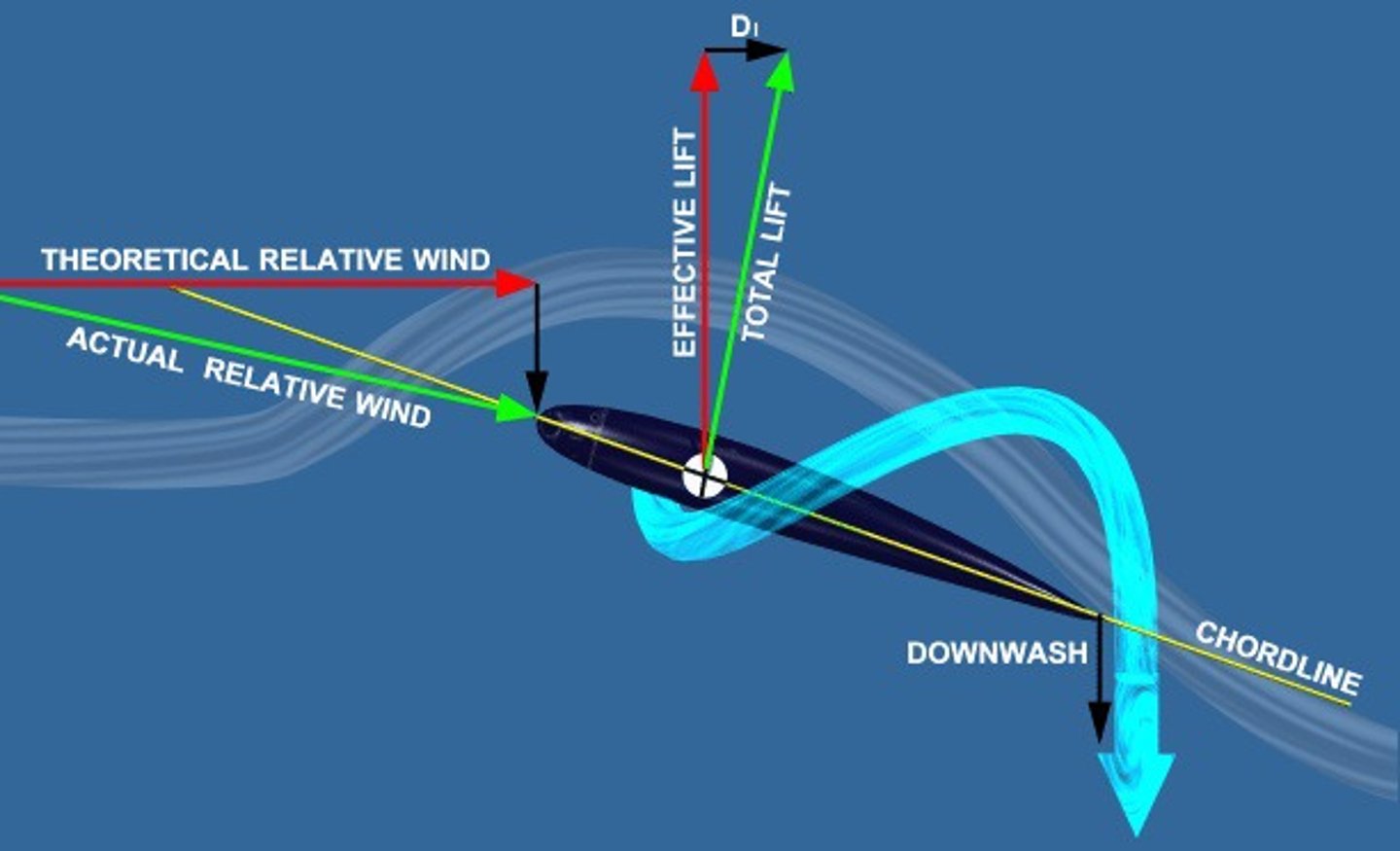
Induced drag, which produces wingtip vortices, angles the relative wind that an airfoil experiences down
In the region of reverse command, a higher throttle setting is required to maintain a slower airspeed.
a) True
b) False
a) True
What is a moment?
a) A push or pull exerted on a body
b) A force acting over a distance to produce rotation about an axis
c) Mass per unit of volume
d) A force acting toward the center of the Earth
b) A moment is created when a force is applied at some distance from an axis or fulcrum and tends to produce rotation about that point
Yaw is defined as the motion of the longitudinal axis about which axis?
a) Lateral axis
b) Longitudinal axis
c) Vertical Axis
d) Horizon
c)
What is indicated airspeed?
a) It is the actual aircraft velocity through an air mass
b) It is the result of correcting for errors in the instrument due to position or location
c) It is the result of correcting calibrated airspeed (CAS) for compressibility effects
d) It is the instrument indication for some given flight condition
d) "IAS is the instrument indication of the dynamic pressure the airplane is exposed to during flight."
What change in angle of attack is needed to maintain a constant amount of lift as aircraft TAS decreases?
a) An increase
b) A decrease
c) No change
d) It is not possible to maintain a constant amount of lift as TAS decreases
a) AOA must increase
As velocity decreases, CL must increase, therefore, AOA must increase
What is the single largest factor in increasing an aircraft's stall speed?
a) Increasing weight
b) Decreasing weight
c) Decreasing air density
d) Decreasing humidity
a) Increasing Weight
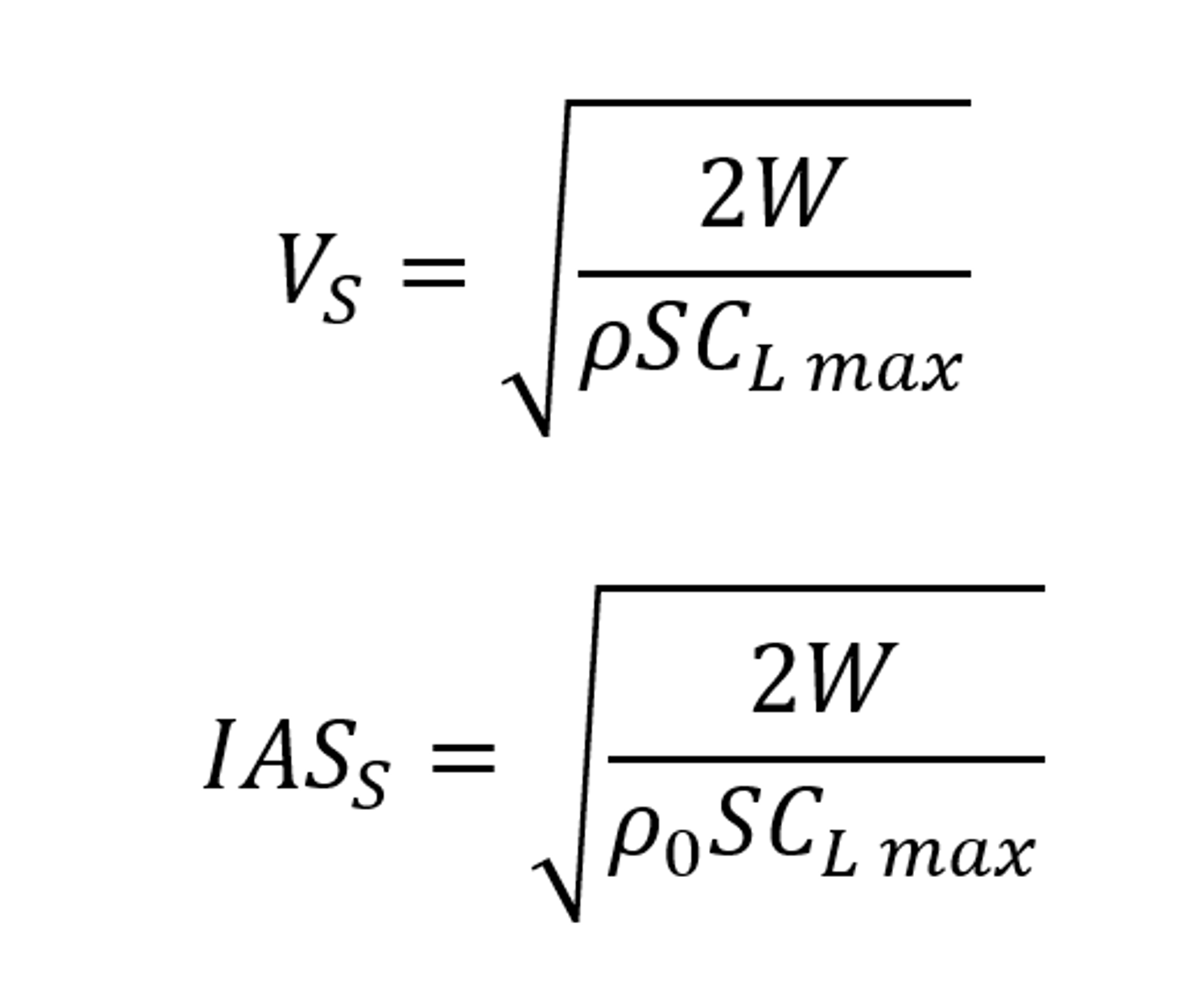
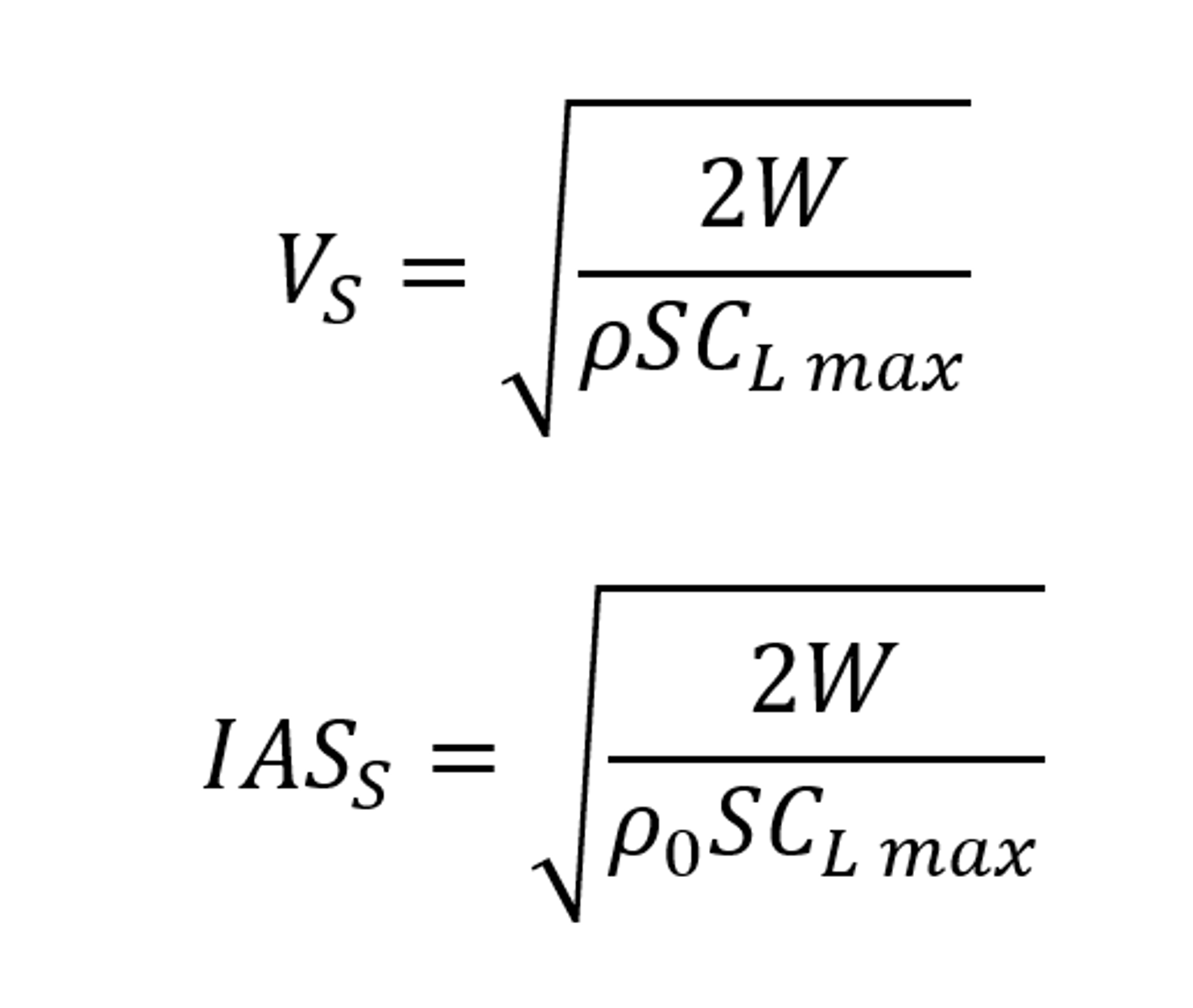
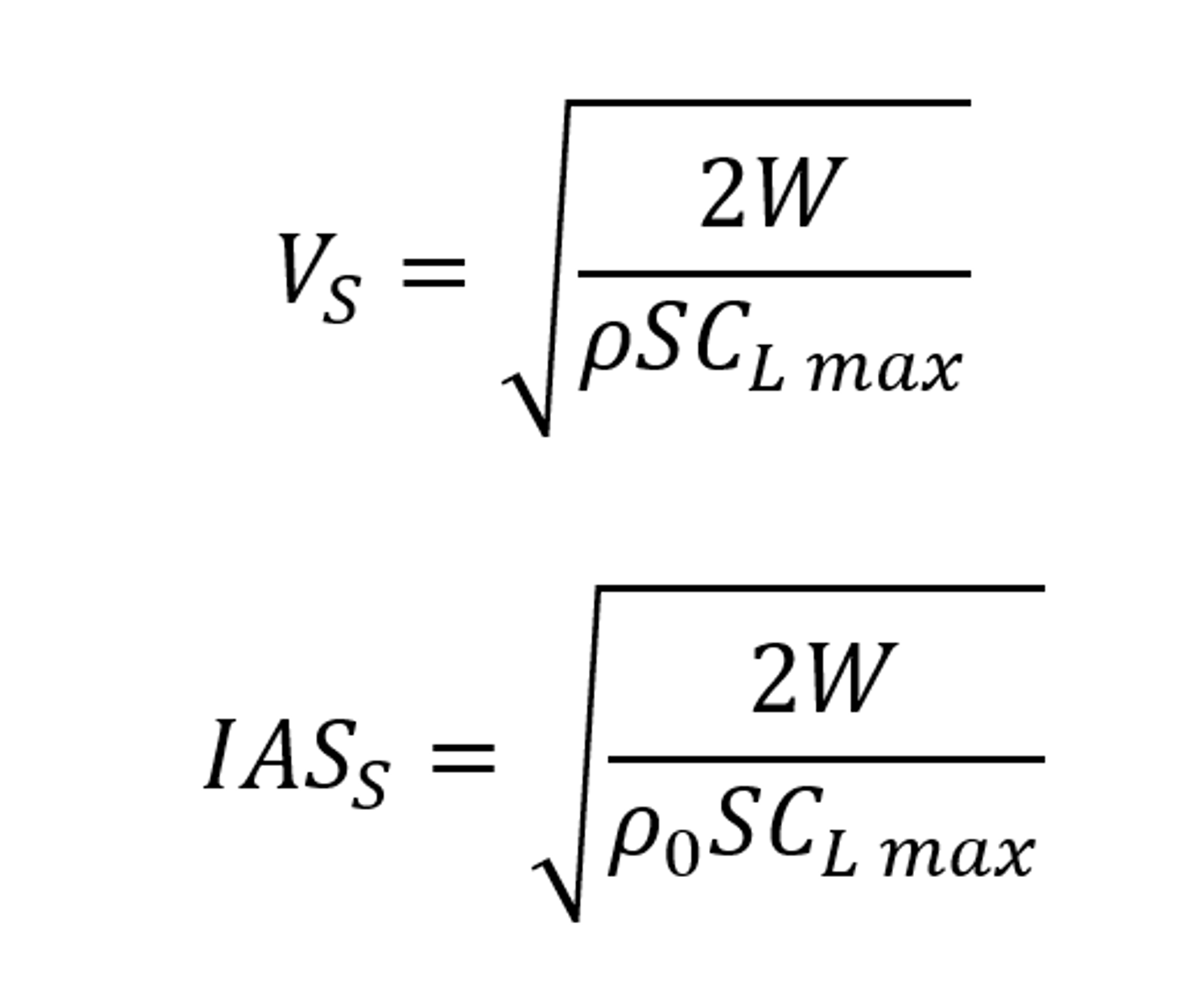
Weight is doubled in the stall speed equation, so it will produce a larger change in stall speed than any other factor
What two factors does the pilot control that affect the coefficient of lift?
a) Velocity and density
b) Velocity and angle of attack
c) Angle of attack and density
d) Angle of attack and camber
d) AOA and Camber:
CARVAC:
Compressibility
Aspect Ratio
Viscosity
AOA
Camber
Which of the following, when doubled, will cause the greatest increase in lift?
a) Velocity
b) Coefficient of lift
c) Density
d) Area
a) Velocity since it is squared in the lift equation
At zero degrees angle of attack and positive velocity, a symmetrical airfoil will produce:
a) Lift, but less than a positively cambered airfoil
b) No form drag
c) No induced drag
d) No net aerodynamic force
c) no induced drag
Still produces parasite drag (because it is at a positive velocity), but the airfoil will produce no lift, therefore, no Induced Drag
If you are in equilibrium flight, then you are in trimmed flight.
a) True
b) False
a) True
Trimmed flight occurs when the sum of all moments about the CG are = 0
What will the result of an increase in the dynamic pressure within a closed system, according to Bernoulli's equation?
a) A decrease in static pressure
b) An increase in total pressure
c) An increase in potential energy per unit volume
d) A decrease in total energy per unit volume
a) A decrease in static pressure since total pressure must remain equal
What two forces are considered aerodynamic forces?
a) Lift and Weight
b) Drag and Thrust
c) Lift and Drag
d) Weight and Thrust
c) Lift and Drag
Stall speed is the minimum _____ required to maintain level flight at CLMAX AOA.
a) Indicated airspeed
b) Calibrated airspeed
c) True airspeed
d) Equivalent airspeed
c) True airspeed
TAS is the actual velocity at which an aircraft moves through an air mass
When flying at the velocity for L / D maximum in straight and level flight:
a) Induced drag exceeds parasite drag
b) Parasite drag exceeds induced drag
c) Parasite drag equals induced drag
d) Induced drag and parasite drag will vary on the type of airplane
c) At L/D max AOA, Di = Dp
How does an increase in angle of attack affect the dynamic pressure and static pressure on the upper surface of an airfoil?
a) The dynamic pressure decreases
b) The static pressure increases
c) The dynamic pressure increases and the static pressure will decrease
d) The dynamic pressure remains constant
c) Dynamic increases and static decreases
As AOA increases, the cross-sectional area on the upper surface decreases..... velocity (dynamic pressure) must increase and pressure (static pressure) must decreases
What is a boundary layer?
a) The airflow layer which is perpendicular to the aircraft's flight path
b) The airflow layer which demonstrates no retardation due to the airfoil's surface
c) The airflow layer which is parallel to the relative wind
d) The airflow layer which shows local airflow retardation caused by viscosity
d)
Using flaps _____ the stalling AOA.
a) Increases
b) Decrease
c) Does not change
b) Stalling AOA decreases
As weight increases:
a) Stall speed decreases and IAS increases
b) Stall speed increases and IAS decreases
c) Stall speed increases and IAS increases
d) Stall speed decreases and IAS decreases
c) both true and indicated stall speed increase
As altitude increases:
a) True stall speed remains constant and indicated stall speed increases
b) True stall speed increases and indicated stall speed remains constant
c) True stall speed increases and indicated stall speed increases
d) True tall speed remains constant and indicated stall speed decreases
b) True stall speed will increase but indicated stall speed will remain constant because we assume sea level density
If an aircraft flying at L/Dmax AOA changes its velocity, total drag will:
a) Increase
b) Remain the same
c) Decrease
a) Increase:
Any movement away from L/D max AOA will produce an increase in total drag
If true air speed is corrected for the movement of the air mass, one gets:
a) Calibrated air speed
b) Equivalent air speed
c) Ground speed
d) Indicated air speed
c) Ground speed: correcting for wind
Power-on stall speed will be _____ than power-off stall speed.
a) More
b) Less
c) The same
b) less than power-off since the vertical component of thrust in a power-on stall will offset part of the weight
The primary purpose of flaps is to _____ takeoff and landing speeds by _____ stall speed.
a) Increase; reduce
b) Increase; increase
c) Reduce; reduce
d) Reduce; increase
c) reduce; reduce
Flaps increase the camber of an airfoil and increase the value of CLmax. Based on the stall equation, if we increase CLmax, stall speed decreases. Since takeoff and landing speeds are based on stall speed, if stall speed decreases, both takeoff and landing speeds will decrease
What kind of airfoil has a mean camber line that is coincident (the same as) with the chord line?
a) A positively cambered airfoil
b) A negatively cambered airfoil
c) A symmetrical airfoil
d) A non-symmetrical airfoil
c) Symmetric:
Camber is based on the maximum distance between the MCL and chordline. Since a symmetric airfoil has no camber, the MCL is the same as the chordline
Which of the following is true regarding Max Endurance?
a) Velocity and AOA are the same as L/D Max AOA and velocity
b) Velocity is greater than and AOA is less than L/D Max AOA and velocity
c) Velocity is less than and AOA is greater than L/D Max AOA and velocity
d) Velocity and AOA are less than L/D Max AOA and velocity?
c) Velocity is less than and AOA is greater than L/D Max AOA and velocity
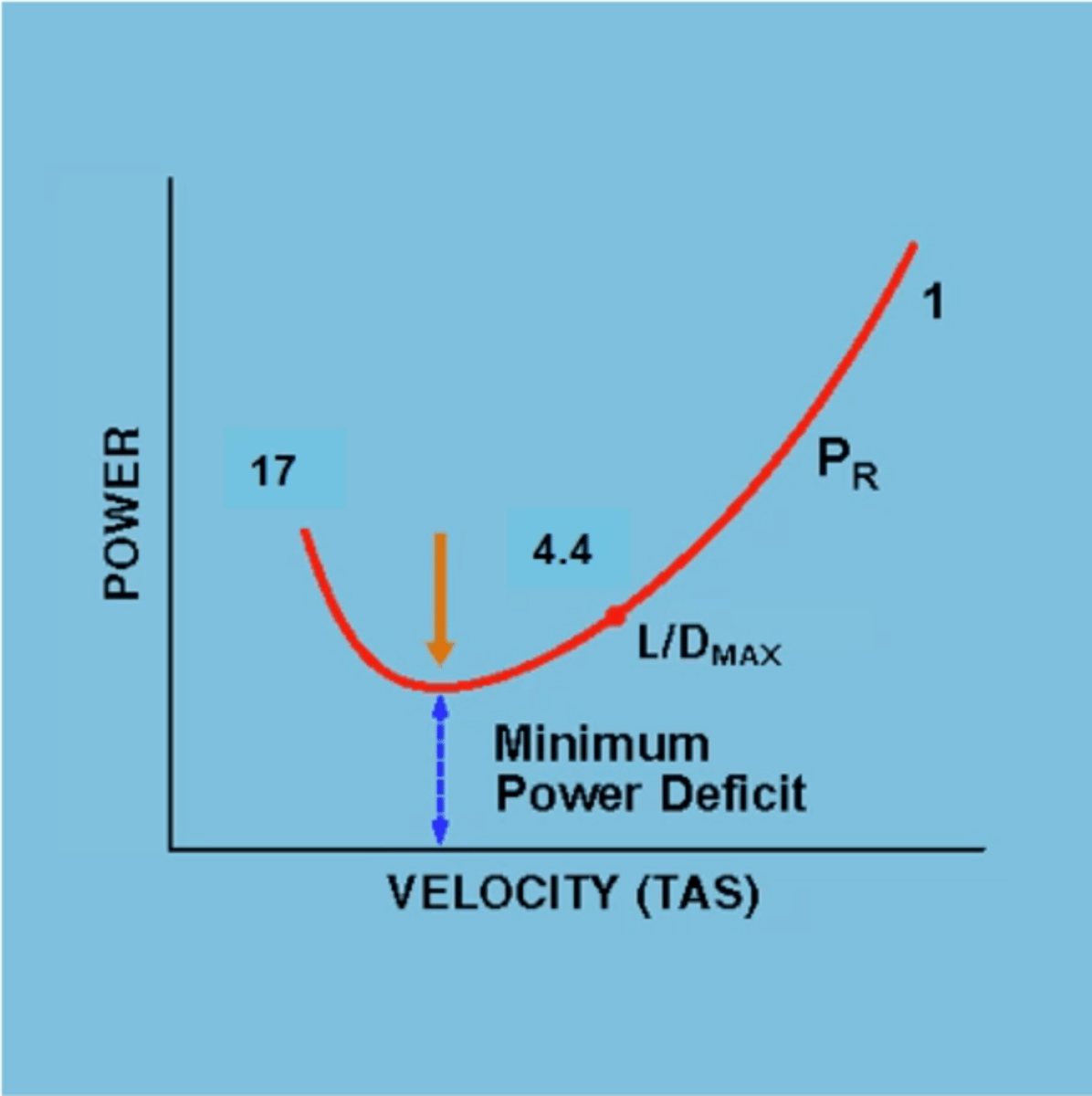
What happens to maximum range and maximum endurance as altitude decreases?
a) Altitude has no effect on maximum range or endurance
b) Both maximum range and endurance increase
c) Both maximum range and endurance decrease
b) Both maximum range and endurance will decrease
Which climb profile is needed to clear a high obstacle at the end of a runway?
a) Max Angle of Climb
b) Max Rate of Climb
a) Max Angle of Climb
While flying over the middle of the Atlantic Ocean, both of your engines flameout. What glide profile must you fly?
a) Maximum Glide Range
b) Maximum Glide Endurance
b) Maximum Glide Endurance since there is no runway within glide range
A plane that is _______ while landing causes the most severe wake turbulence?
a) Light, fast, and clean
b) Heavy, slow, and clean
c) Light, fast, and dirty (flaps extended)
d) Heavy, slow, and dirty
b) Heavy, slow, and clean
______ is the maximum load factor that an airplane can withstand without structural failure.
a) Limit Load Factor
b) G-Load Factor
c) Ultimate Load Factor
d) Over-G Load Factor
c) Ultimate Load Factor
A _______ is caused by insufficient rudder in the direction of the turn, and the corrective action is to apply __________.
a) skid; rudder opposite the direction of the turn
b) slip; ailerons opposite the direction of the turn
c) skid; ailerons in the same direction of the turn
d) slip; rudder in the same direction of the turn
d) Slip; rudder in the direction of the desired turn (step on the ball)
In a skid, turn radius _______ while turn rate _______.
a) increases; increases
b) increases; decreases
c) decreases; decreases
d) decreases; increases
d) decreases; increases
Slipstream Swirl and P-factor are strongest during __________ conditions.
a) low lift, low AOA, high power
b) high lift, high AOA, low power
c) high lift, high AOA, high power
d) high lift, low AOA, low power
c) high lift, high AOA, high power
Wind shear can cause a sudden change in ________ airspeed?
a) True
b) Indicated
c) Calibrated
d) Equivalent
b) Indicated
In relation to the plane ahead, a pilot should takeoff ____________ and land __________?
a) before the rotation point; before the touchdown point
b) after the rotation point; before the touchdown point
c) before the rotation point; after the touchdown point
d) after the rotation point; after the touchdown point
c) before the rotation point; after the touchdown point
After an aircraft enters a spin, autorotation is maintained because.....
a) the down-going wing is more stalled than the up-going wing.
b) the up-going wing is more stalled than the down-going wing.
c) both wings are equally stalled.
d) the tail of the aircraft is stalled.
a) the down-going wing is more stalled than the up-going wing.
At the boundary layer, _______ flow produces more friction but adheres to a surface better than _______, which separates more easily but produces less friction.
a) laminar; turbulent
b) turbulent; laminar
c) interference; turbulent
d) turbulent; leakage
b) turbulent; laminar
If an airplane takes off with a tailwind; takeoff distance will _______, true airspeed will _______, and ground speed will _________.
a) increase, increase, increase
b) increase, remain the same, increase
c) decrease, decrease, decrease
d) decrease, increase, decrease
b) increase, remain the same increase
-Takeoff with tailwind increases takeoff distance because it will take extra distance to overcome that wind (essentially starting with a negative velocity over the wing)
-Wind DOES NOT affect true airspeed
-Groundspeed = TAS + Tailwind or TAS - Headwind
In a climb, if the PCL is suddenly advanced, the T-6B will tend to yaw ________ because of the _________ tendency because ________.
a) to the left; p-factor; the upgoing blade on the left side produces more thrust
b) to the right; p-factor; the downgoing blade on the left side produces more thrust
c) to the left; p-factor; the upgoing blade on the left side produces less thrust
d) to the right; p-factor; the upgoing blade on the left side produces less thrust
c) to the left; p-factor; the upgoing blade on the left side produces less thrust
Gaining the most altitude in a given amount of time is ______.
a) based on amount of excess thrust available
b) used for obstacle clearance
c) Max Angle of Climb
d) Max Rate of Climb
d) Max Rate of Climb
When flying at maximum endurance airspeed, increasing AOA to maintain level flight will result in ______.
a) higher airspeed requiring less power
b) higher airspeed requiring more power
c) slower airspeed requiring less power
d) slower airspeed requiring more power
d) slower airspeed requiring more power
Operating in the region of reverse command requires a higher power setting for a slower airspeed