Concept 2.2: An element's properties depend on the structure of its atoms
 Call Kai
 Learn
Learn Practice Test
 Spaced Repetition
 Match
Match Flashcards
 Knowt Play
1/16

Name | Mastery | Learn | Test | Matching | Spaced | Call with Kai | Chat |
|---|
No analytics yet
Send a link to your students to track their progress
17 Terms
Atom
The smallest unit of matter that still retains the properties of an element
Subatomic particles
The particles that compose atoms, including:
Neutrons (no electrical charge)
Protons (positive electrical charge)
Electrons (negative electrical charge)
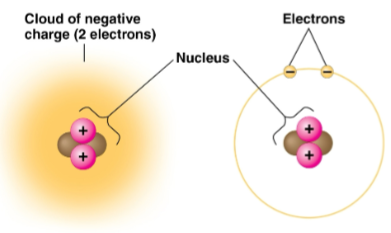
Atomic nucleus
The center of an atom formed by neutrons and protons surrounded by a “cloud” of negative charge by electrons
Daltons
The unit of mass when measuring subatomic particles like neutrons and protons; electron masses are so small that they are ignored when calculating atomic masses
Atomic number
The number of protons in an atom’s nucleus
Mass number
The sum of the masses of the protons and neutrons in the nucleus
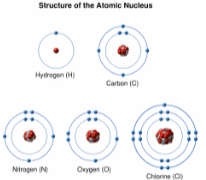
Atomic mass
The atom’s total mass which is usually approximated by the mass number
Isotopes
Two atoms of an element that differ in the number of neutrons (neutral particles)
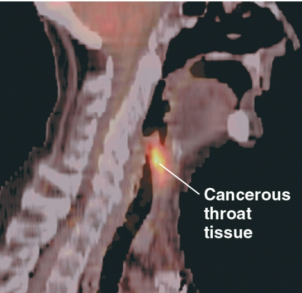
Radioactive isotopes
Isotopes that decay spontaneously and give off particles and energy; they are often used as diagnostic tools in medicine for metabolic function and internal imaging
Half-life
The rate of decay for an isotope to turn into another more stable isotope; can vary from seconds or days to billions of years
Radiometric dating
Measurement of the ratio of different isotopes in a material to calculate how many half-lives have passed since formation
Energy
The capacity to cause change
Potential energy
The energy that matter possesses because of its location or structure; matter has a tendency to move to the lowest possible state of this
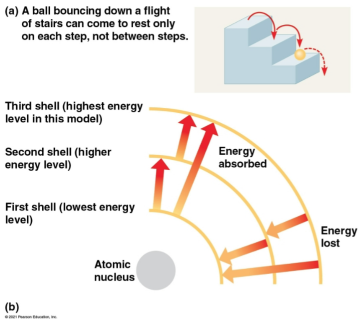
Electron shells
Where electrons are found with a different average distance and energy level at fixed distances due to differences in potential energy
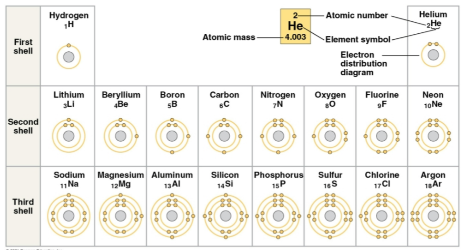
Chemical behavior
Defined by the distribution of electrons in electron shells shown by the periodic table of elements
The left-to-right sequence of elements in each row corresponds to additional electrons and protons
Valence electrons
Electrons in the outermost electron shell that determine an element’s chemical behavior; elements with a full shell of these are chemically inert
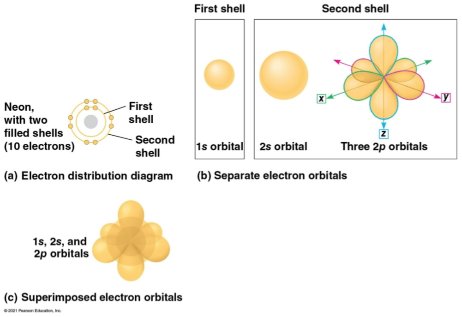
Electron orbital
The three-dimensional space where an electron is found 90% of the time; each electron shell consists of a specific number of these with no more than 2 electrons in each