Rxn's of Alkyl Halides: Nucleophilic Substitutions & Eliminations
 Call Kai
 Learn
Learn Practice Test
 Spaced Repetition
 Match
Match Flashcards
 Knowt Play
1/27

There's no tags or description
Looks like no tags are added yet.
Name | Mastery | Learn | Test | Matching | Spaced | Call with Kai | Chat |
|---|
No analytics yet
Send a link to your students to track their progress
28 Terms
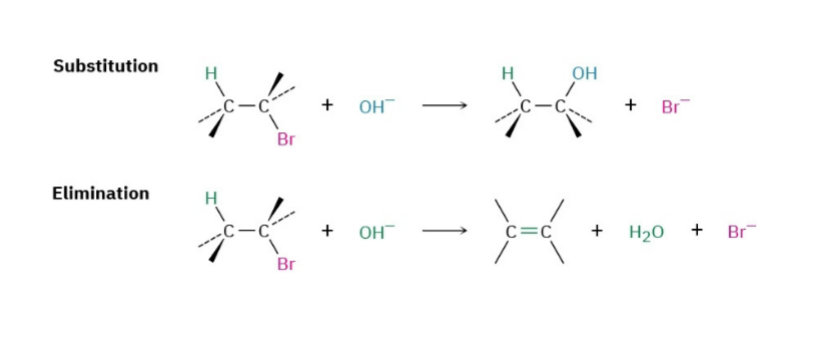
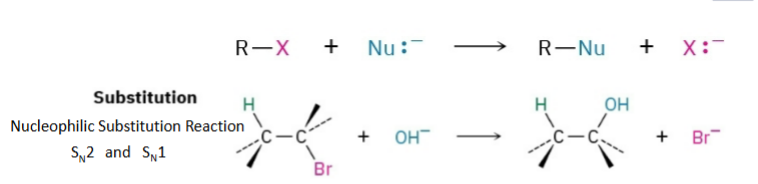
Substitution
Replace the halogen. Br leaves, OH takes its place.
Elimination
Removing: H and Br, creating a double bond: making an alkene, this is an elimination.

4 main reactions of Alkyl Halides
Substitution:
SN1
SN2
Elimination:
E1
E2
S stands for
Substitution: Something replaces the leaving group
E stands for
Elimination: Lose H and X, a double bond forms
N stands for
Nucleophilic: A nucleophile attacks
Nucleophile: electrons donor (has to have at least one lone pair and are more reactive when they have a negative charge).
EX:
OH-
CN-
I-
BR-
NH3
RO-
1 stands for
ONE molecule determines the rate (Unimolecular)
2 stands for
Two molecules determine the rate (Bimolecular)
SN2
(Substitution Nucleophilic Bimolecular) 1 Step reaction, everything happens at the same time: NEVER a carbocation, NEVER an intermediate, ONLY a transition state, one step.
Rate= k [Alkyl Halide] [Nucleophile]
Second Order Reaction, Doubling the concentration of either the alkyl halide substrate or the nucleophile will double the overall reaction rate.
![<p>(<strong>Substitution Nucleophilic Bimolecular</strong>) <u>1 Step reaction</u>, everything happens at the same time: NEVER a carbocation, NEVER an intermediate, <strong>ONLY </strong>a <u>transition state</u>, one step.</p><p><strong>Rate= k [Alkyl Halide] [Nucleophile]</strong></p><p>Second Order Reaction, <span>Doubling the concentration of either the alkyl halide substrate or the nucleophile will double the overall reaction rate.</span></p>](https://assets.knowt.com/user-attachments/4c6c0937-46a6-414d-ba13-d8f841e4d917.png)
Leaving Group
an atom or group of atoms that detaches from a organic molecule during a chemical reaction, taking a pair of electrons with it. It polarizes the carbon-halogen bond, making the attached carbon electron-poor (electrophilic) and susceptible to attack. The best leaving groups are very weak bases (the conjugate bases of strong acids).
Backside Attack
the specific pathway a nucleophile takes to bond with carbon during SPECIFICALLY ONLY an SN2 reaction. The nucleophile must attack from the back because it is forcing the leaving group out at the exact same time. The front side is blocked by the leaving group.
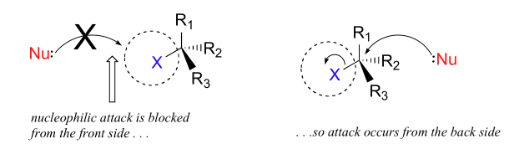
Inversion of Configuration (Walden Inversion)
the stereochemical flip that happens at a chiral carbon atom during an SN2 reaction. Because the nucleophile executes a backside attack, it bonds to the opposite side of the leaving group, forcing the other three attached groups to flip to the front. This motion acts exactly like an umbrella turning inside out in a heavy wind.
If the starting chiral center has an R configuration, the product will typically have an S configuration (and vice versa).
SN2 gives 100% inversion because the front pathway is totally blocked by the leaving group.
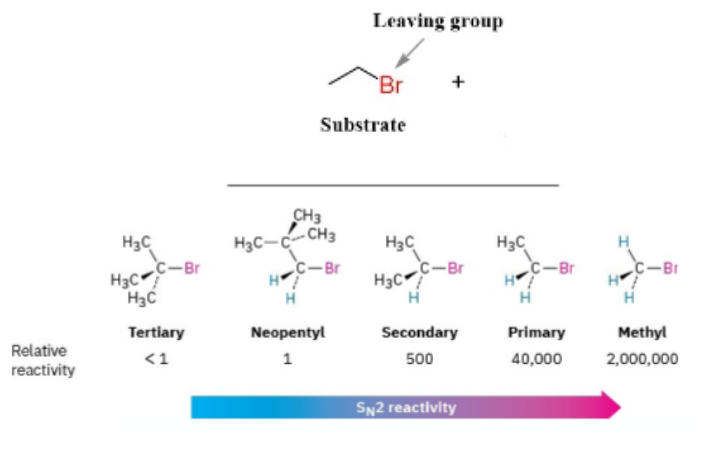
Substrate
the organic molecule undergoing the reaction (the alkyl halide containing the leaving group).
The less the degree of a Carbon, the easier it is to attack for SN2
How crowded is the carbon? Less crowded —> Easier attack
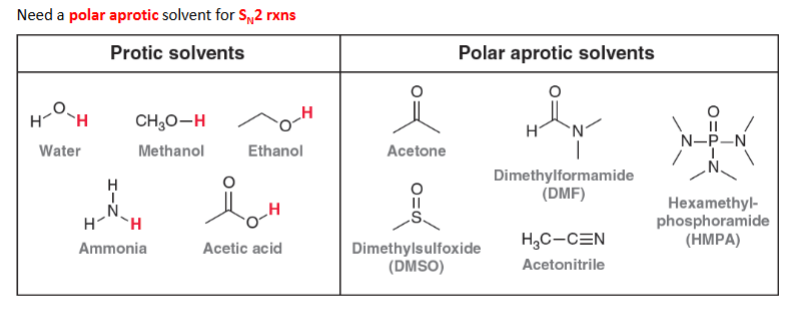
Solvents
2 Types:
Polar Protic Solvents
Polar Aprotic Solvents
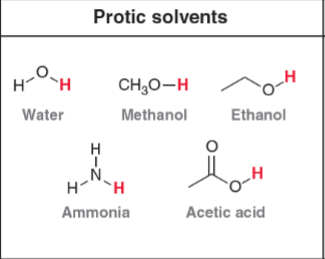
Polar Protic Solvents
Solvents that have a hydrogen atom directly bonded to an electronegative atom. EX: O-H or N-H. FavorsSN1 (and E1) by helping the leaving group fall off.
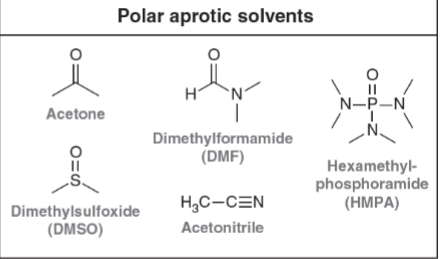
Polar Aprotic Solvents
Solvents that may have polar bonds but lack any O-H or N-H bonds. They cannot form hydrogen bonds. Favors SN2 (and E2)
SN1
(Substitution Nucleophilic Unimolecular) 2 step reaction
Step 1: Leaving group leaves, a carbocation forms (slow and rate determining step).
Step 2: Nucleophile attacks
Rate only depends on Alkyl Halide
Rate = k [RX]
For an SN1 reaction, the more substituents (alkyl groups) attached to the reacting carbon, the better and faster the reaction will be (opposite of SN2).
SN1 loves stable carbocations: 3 > 2 > 1.
![<p>(<strong>Substitution Nucleophilic Unimolecular</strong>) 2 step reaction</p><ul><li><p>Step 1: Leaving group leaves, a carbocation forms (slow and rate determining step).</p></li><li><p>Step 2: Nucleophile attacks</p></li></ul><p>Rate <strong>only </strong><u>depends </u>on <strong>Alkyl Halide</strong></p><p>Rate = k [RX]</p><ul><li><p>For an SN1 reaction, the <strong>more substituents</strong> (alkyl groups) attached to the reacting carbon, the <strong>better and faster</strong> the reaction will be (opposite of SN2).</p></li></ul><p>SN1 loves stable carbocations: 3 > 2 > 1.</p>](https://assets.knowt.com/user-attachments/daeb3a91-00e3-4345-a934-7dda0853462b.png)
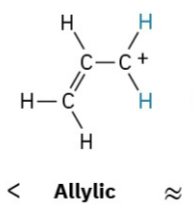
Allylic Position
A carbon atom directly attached to a carbon-carbon double bond C=C-C. These are very stable.
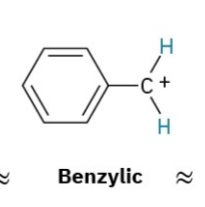
Benzylic Position
A carbon atom directly attached to a benzene ring (aromatic ring): Benzene Ring-C. Very stable.
Racemization
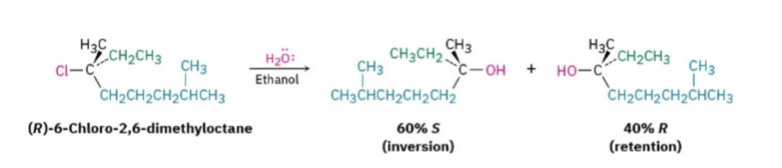
(retention) is the process where a single, optically active enantiomer (a molecule that is 100% left-handed or 100% right-handed) converts into a 50/50 mixture of both mirror images.
This 50/50 mix is called a racemic mixture, and it is optically inactive because the two opposite shapes cancel each other out.
You cannot invert like in SN2, where you can switch between R and S configs. In SN1, you will have some R, some S.
SN2 & SN1 Differences Summary
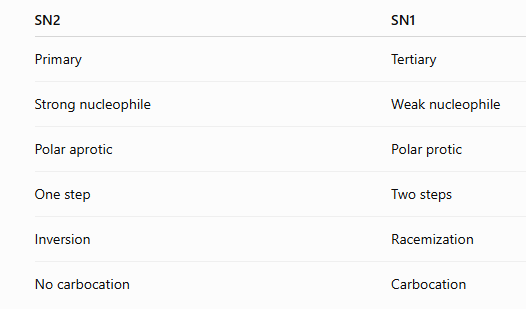
see image
Elimination
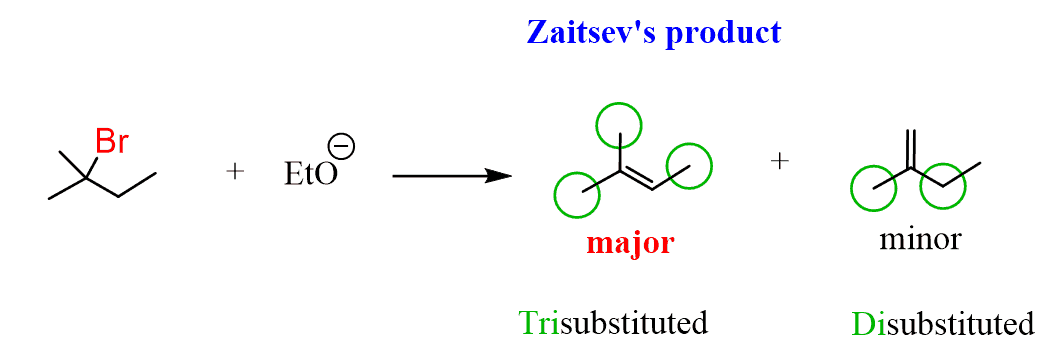
Instead of replacing Br, we remove H and Br to make an alkene (C=C)
Zaitsev’s Rule
When removing a hydrogen and a halogen to form an alkene, the major product will be the most highly substituted alkene.
The rich get richer: The carbon that already has fewer hydrogens attached to it is the one that loses the hydrogen.
come back to this
E2
One step reaction, only transition states, no intermediates, everything happens together:
Base removes H
Br leaves
Double bond forms
All at once.
Second order reaction. Rate = k [alkyl halide] [Base]
You NEED a strong base for an E2 reaction. In an E2 reaction, the leaving group does not fall off on its own. The base cannot afford to wait. It must be aggressive enough to force its way in and pull off a proton (hydrogen) to kick-start the elimination.
![<p>One step reaction, only transition states, no intermediates, everything happens together:</p><ul><li><p>Base removes H</p></li><li><p>Br leaves</p></li><li><p>Double bond forms</p></li></ul><p>All at once.</p><p>Second order reaction. Rate = k [alkyl halide] [Base]</p><p>You NEED a strong base for an E2 reaction. In an E2 reaction, the leaving group does not fall off on its own. The base cannot afford to wait. It must be aggressive enough to force its way in and pull off a proton (hydrogen) to kick-start the elimination.</p>](https://assets.knowt.com/user-attachments/a42a4878-afa8-4b54-ab54-516c4de2d371.png)
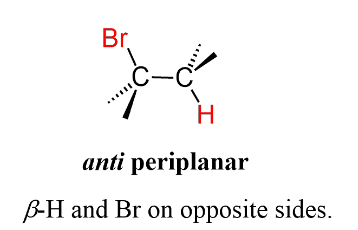
Anti-periplanar
Specific to E2 reactions. In an E2 reaction, three things happen at the same time:
The base grabs a hydrogen (H).
The leaving group (Br, Cl, etc.) leaves.
A double bond forms.
H and Br must be opposite each other AND in the same plane. Is there a hydrogen directly opposite of the leaving group? if yes, E2 can happen.
E1
Two step reaction:
Step 1: Leaving group leaves, Carbocation forms
Step 2: Base removes H, double bond forms
Rate = k [Alkyl Halide]
First order overall. Because the base only participates in the second (fast) step, adding more base or changing the base concentration will have zero effect on how fast the reaction goes.
![<p>Two step reaction:</p><ul><li><p>Step 1: Leaving group leaves, Carbocation forms</p></li><li><p>Step 2: Base removes H, double bond forms</p></li></ul><p>Rate = k [Alkyl Halide]</p><p>First order overall. Because the base only participates in the second (fast) step, adding more base or changing the base concentration will have <strong>zero effect</strong> on how fast the reaction goes.</p>](https://assets.knowt.com/user-attachments/22ab57f7-98b3-4024-9850-3afaec9dd950.png)
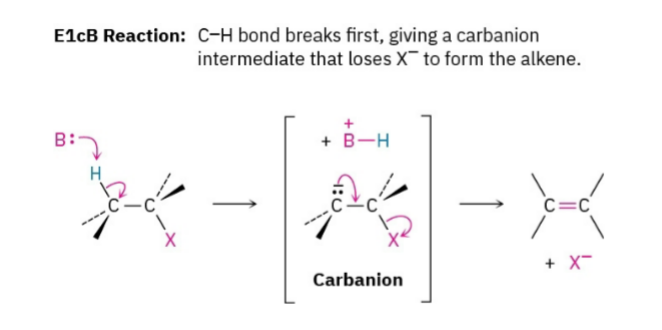
E1cB
Elimination Unimolecular conjugate Base. Think of it as the mirror-image opposite of an E1 reaction. In a normal E1 reaction, the leaving group falls off first. In E1cB, the hydrogen is ripped off first.
Step 1: The Base Grabs a Hydrogen (Fast)
A strong base pulls a hydrogen (β-hydrogen) off the molecule.
Instead of forming a double bond right away, the electrons stay on the carbon, forming a negatively charged carbon intermediate called a carbanion (the conjugate base of the substrate).
Step 2: The Leaving Group gets Kicked Out (Slow)
The lone pair of electrons on the negative carbon drops down to make a double bond, which finally pushes the bad leaving group out. Because this step is slow, it determines the reaction rate.
This is a less common elimination pathway. It usually occurs when the leaving group is two carbons away from a carbonyl, allowing a stabilized carbanion to form before the leaving group departs.
E1cB = Hydrogen gets taken first (forms a negative carbon) → leaving group leaves.
Substitution vs Elimination
see image. Substitutions and Eliminations can happen at the same time.