Comprehensive Guide to Spinal Cord Injuries: Types, Symptoms, and Rehabilitation
 Call Kai
 Learn
Learn Practice Test
 Spaced Repetition
 Match
Match Flashcards
 Knowt Play
1/35

There's no tags or description
Looks like no tags are added yet.
Name | Mastery | Learn | Test | Matching | Spaced | Call with Kai | Chat |
|---|
No analytics yet
Send a link to your students to track their progress
36 Terms
What is the difference between traumatic and nontraumatic spinal cord injuries?
Traumatic injuries are caused by gross injury to the spinal column, while nontraumatic injuries are usually due to disease processes such as infections or tumors.
What does paraplegia refer to?
refers to injury or damage to the thoracic, lumbar, or sacral spinal cord that causes lower extremity weakness or paralysis.
What is tetraplegia?
a term that replaces quadriplegia, referring to injury to the cervical spinal cord resulting in upper and lower extremity weakness or paralysis.
What does the ASIA Impairment Scale A indicate?
AIS A indicates complete spinal cord injury with no preserved function in S4-S5.
What is the significance of the zone of partial preservation?
refers to slight motor or sensory function remaining in complete spinal cord injury cases, but not enough to impact overall function.
What are the symptoms of Anterior Cord Syndrome?
Symptoms include loss of motor function below the level of injury, bilateral loss of pain, temperature, and tactile sensation, while proprioception and light touch remain intact.
What characterizes Central Cord Syndrome?
characterized by weakness in the upper extremities greater than in the lower extremities, possible flaccid upper extremities, and loss of pain and temperature sensation.
What is Brown-Sequard Syndrome?
damage to one lateral half of the spinal cord, causing ipsilateral loss of motor control and proprioception, and contralateral loss of pain and temperature sensation.
What is Cauda Equina Syndrome?
involves damage to nerve roots, leading to loss of function below the level of injury, areflexive bowel and bladder function, and low back pain.
What is Transverse Myelitis?
is an autoimmune disorder that attacks the spinal cord with rapid onset, leading to varying levels of functional impact and potential for recovery.
What are common mental manifestations of SCI/D?
include depression, fatigue, and complications from co-morbid traumatic brain injury (TBI).
What are common cardiovascular complications associated with SCI/D?
complications include orthostatic hypotension and decreased average blood pressure.
What types of adaptive equipment are used in SCI/D treatment?
includes custom manual wheelchairs, power chairs, tilt-in-space chairs, and daily use items like catheters and reachers.
What role do occupational therapists (OTPs) play in SCI/D intervention?
OTPs educate and train clients to use adaptive equipment, modify tasks for independence, and provide training in bladder and bowel programs.
What is the purpose of positioning in SCI/D treatment?
aims to prevent pressure injuries, contractures, pain, and to promote stability, movement, and circulation.
What is the focus of therapeutic exercise (Therex) in SCI/D rehabilitation?
Therex focuses on stretching and building endurance, often in collaboration with physical therapists to create a comprehensive plan.
What are common symptoms related to bladder and bowel function in SCI/D?
Common symptoms include neurogenic bladder, loss of voluntary voiding, and bowel dysfunction.
What is the impact of respiratory complications in cervical SCI?
Respiratory complications in cervical SCI can occur due to loss of communication with the phrenic nerve, affecting diaphragmatic breathing.
What is the significance of educating clients on self-advocacy in SCI/D?
Educating clients on self-advocacy empowers them to take charge of their care and participate actively in rehabilitation.
What is the classification of spinal cord injuries?
Spinal cord injuries are classified as complete or incomplete, based on the presence of sensory and motor function below the level of injury.
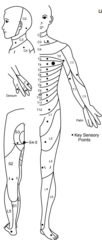
What is the role of adaptive equipment in daily living activities for SCI/D patients?
Adaptive equipment assists SCI/D patients in performing daily living activities independently and safely.
What are the common complications associated with SCI/D?
Common complications include skin breakdown, spasticity, pain, and difficulties with temperature regulation.
C1-4
Some head/neck control. Inc at C3/4. C4 has shoulder shrug and some diaphragm. No cough.
Goals for C1-4
Direct care, drive power chair, do pressure relief, use technology to control computer.
C5
Above + shoulder, biceps for elbow flex, and can supinate.
Goals for C5
Above + Use AE to feed self, use stylus and tray to use tech, direct bladder/bowel routine.
C6
Above + Lats, serratus, wrist ext, and can pronate. Start to use tenodesis grasp.
Goals for C6
Mod I self-care and feed, Min A bladder/bowel prog, Ind t/f, Ind com mobil.
C7
Above + wrist flexors and triceps.
Goals for C7
Above + Mod I bowel/bladder prog, Mod I IADLs and health mng.
C8-T1
C8 - str and precision of fingers + finger flex; T1 - intrinsic hand muscls.
Goals for C8-T1
Mod I for ADLs/IADLs.
T2-T12
Inc trunk/core str w/each level.
Goals for T2-T12
Use standing frame + Prev, return to office jobs.
L1 and below
L2 - hip flexion; L3 - knee ext; L4 - ankle dorsiflex; L5 - big toe ext; S1 - ankle plantarflex.
Goals for L1 and below
Mod I for ADLs/IADLs, manage spasms, ambulation possible L3 and below.