Lecture 2: EMG and Force
 Call Kai
 Learn
Learn Practice Test
 Spaced Repetition
 Match
Match Flashcards
 Knowt Play
1/65

There's no tags or description
Looks like no tags are added yet.
Name | Mastery | Learn | Test | Matching | Spaced | Call with Kai | Chat |
|---|
No analytics yet
Send a link to your students to track their progress
66 Terms
What is EMG?
EMG (electromyography) measures the electrical activity of a muscle using electrodes placed over the muscle.
What does EMG amplitude tell us, and how is it related to force?
Greater EMG amplitude = greater electrical muscle activity → generally greater muscle force production.
What are the main components of an EMG setup?
2 electrodes detect the muscle's electrical signal, a grounding electrode reduces electrical interference, and an amplifier strengthens the small signal for measurement.
What is the grounding electrode?
The grounding electrode is placed somewhere with little/no muscle electrical activity. It can therefore detect some of the background electrical interference that is affecting the body
What is biofeedback?
Electrodes are placed over a muscle with an activation problem to measure its electrical activity. The EMG information is then shown/communicated back to the patient, allowing them to see how much they are activating the muscle and practice increasing activation.
How is EMG used in prosthetic control?
placing electrodes over the intact portion of the muscle and the arm can pick up the acitivty to produce different motion in the prosthetic.
What are wearable EMGs?
Embedding the electrodes in the clothing to measure the amount of electrical activity going on.
What is the structure of the muscle?
Skeletal muscle → fascicle (A bundle of muscle fibers (cells) grouped together.) → muscle fiber → myofibril → sarcomere

What is the cell membrane of a muscle fiber called?
The sarcolemma.
What is a myofibril?
A long, contractile structure inside a muscle fiber that is made up of repeating sarcomeres.
What is a sarcomere?
The repeating functional unit of a myofibril that generates muscle force.
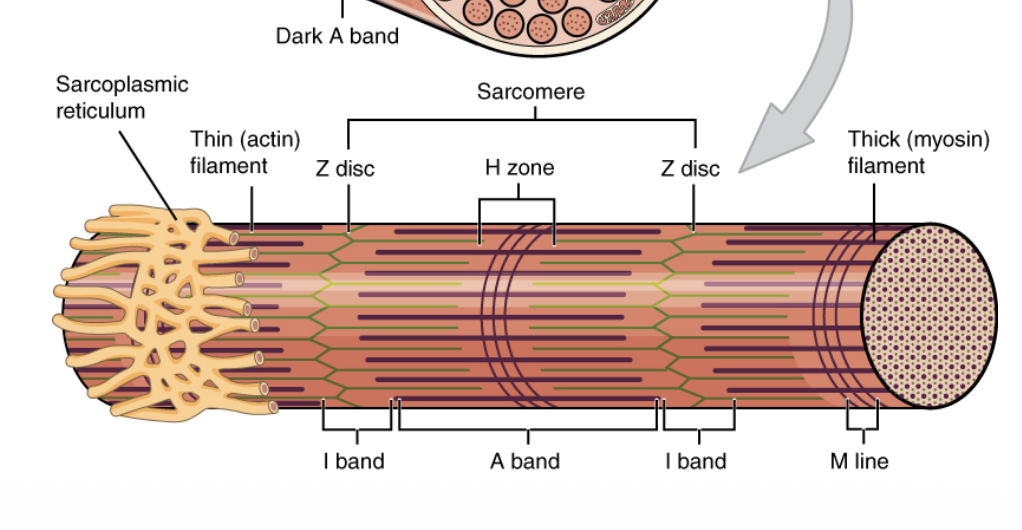
What is the sarcoplasmic reticulum (SR)?
A membrane network that surrounds the myofibrils and stores/releases Ca²⁺ needed for muscle contraction.
What is excitation contraction coupling?
AP arrived at the neuromuscular junction from the alpha motor neuron
ACh is released and binds to receptors and opens sodium ion channels leading to an AP in the sarcolemma
AP travels down the T tubules
Depolarization of the SR causes the release of calcium
Ca²⁺ binds troponin → tropomyosin moves → myosin binds actin → actin slides → contraction
What does EMG measure and how does it detect muscle activity?
EMG measures the electrical activity of muscle by detecting the wave of depolarization travelling along the sarcolemma. Electrodes act like antennae, picking up the electrical signals produced by active muscle fibers.
What does an EMG signal actually represent?
An EMG records the sum of motor unit action potentials from many active muscle fibers. Because many motor units are active at once, their signals overlap, creating an interference pattern with many spikes.
What does EMG amplitude tell us?
EMG amplitude generally reflects the degree of muscle activity.
→ More active/recruited muscle fibers → larger EMG amplitude
Does EMG measure electrical activity equally across the whole muscle? Why or why not?
No. The signal gets weaker with distance from the electrode. Fibers closer to the electrode produce a stronger signal, while fibers farther away produce a weaker signal.
🧠 Think: Like a radio signal — the farther you are from the station, the weaker the signal.
Why is EMG voltage somewhat arbitrary?
The recorded voltage depends on electrode placement and the location of active muscle fibers relative to the electrode. Therefore, the same muscle activity can produce different EMG voltages depending on where the electrode is placed.
How I force regulated in the muscle?
Muscle force is regulated in two main ways:
Recruiting more muscle fibers → through motor units
Increasing the force produced by individual muscle fibers → through rate coding
How is muscle force measured vs. muscle electrical activity?
Force → measured at the effector (muscle)
Muscle electrical activity → measured using EMG
What is a motor unit (MU)?
A single α-motoneuron + all the muscle fibers it innervates.
How are muscle fibers organized into motor units?
Each muscle fiber is controlled by one α-motoneuron, but one α-motoneuron can control many different muscle fibers.
→ 1 muscle fiber = 1 α-MN
→ 1 α-MN = many muscle fibers
What is the innervation ratio?
The number of muscle fibers controlled by a single α-motoneuron.
Example:
1 α-MN → 10 muscle fibers
→ Innervation ratio = 10:1
What does the all-or-none principle mean for a motor unit?
When an α-motoneuron fires an action potential, all muscle fibers within that motor unit are activated together.
→ α-MN fires → ALL fibers in its MU activate
What is the size principle of motor unit recruitment?
Motor units are recruited in order from small → large.
→ Small MUs recruited first
→ Large MUs recruited later
What makes a motor unit "small" or "large"?
The number of muscle fibers it contains.
Small MU → fewer muscle fibers → lower force
Large MU → more muscle fibers → greater force
This relates to the innervation ratio.
What muscle fiber types are associated with small vs. large motor units?
Small/early MUs → Type I (slow-twitch)
→ Lower force
→ Fatigue resistant
Large/later MUs → Type II (fast-twitch)
→ Greater force
→ Fatigue more quickly
How does motor unit recruitment affect EMG as muscle force increases?
As force increases, more motor units are recruited, so there is more electrical activity detected by the EMG.
→ ↑ Force → ↑ MU recruitment → ↑ EMG amplitude
Why might EMG amplitude increase disproportionately as force increases?
Larger motor units tend to be more superficial, meaning their muscle fibers are closer to the EMG electrodes. Their electrical signals are therefore picked up more strongly.
→ Recruit larger MUs → fibers closer to electrode → disproportionately ↑ EMG signal

Why doesn't EMG amplitude necessarily increase proportionally with muscle force?
Although force and motor unit recruitment might initially increase fairly steadily, electrode distance affects the EMG signal. When larger, more superficial MUs are recruited, their electrical activity is detected much more strongly than deeper MUs.
→ Force ↑ steadily
→ EMG ↑ disproportionately/exponentially
How does the distribution of motor units within a muscle affect EMG?
If small MUs are deeper and larger MUs are more superficial, then increasing force eventually recruits the larger superficial MUs. Because they are closer to the electrode, they produce a stronger EMG signal relative to their force contribution.
What is rate coding?
Grading the force produced by a muscle fiber/MU by changing the frequency (rate) of its action potentials.
→ ↑ AP frequency → ↑ force
How does increasing the rate of action potentials increase force?
A second AP can occur before Ca²⁺ from the previous contraction has been fully removed. The remaining Ca²⁺ combines with the newly released Ca²⁺ → greater force (wave summation).
→ ↑ AP frequency → ↑ leftover Ca²⁺ → ↑ Ca²⁺ available → ↑ force
Why can force continue after the action potential has ended?
The AP is very brief, but Ca²⁺ remains in the cytoplasm and continues allowing cross-bridge cycling. Ca²⁺ must then be reabsorbed into the SR, so the contraction lasts longer than the AP.
What happens to force as AP frequency continues to increase?
Force summates and increases as AP frequency increases because more Ca²⁺ remains available between contractions. Eventually, the muscle reaches maximum Ca²⁺ release, so force cannot increase further → maximal/tetanic force

.
What happens to EMG amplitude when rate coding increases?
EMG amplitude increases because action potentials occur more frequently and their electrical signals superimpose/overlap.
→ ↑ AP frequency → ↑ electrical activity → ↑ EMG amplitude
Is the increase in EMG proportional to the increase in muscle force throughout rate coding?
No. As rate coding increases, EMG amplitude continues to increase, but the amount of force gained per increase in EMG decreases.

How does force production change at early vs. later stages of rate coding?
Early rate coding: Small ↑ in EMG → large ↑ in force
Later rate coding: Same ↑ in EMG → smaller ↑ in force
→ Force increase per unit of EMG diminishes at higher frequencies.
Why does the force–EMG relationship become less proportional at higher firing frequencies?
At lower frequencies, increasing AP frequency causes large increases in force because more Ca²⁺ accumulates between contractions. At higher frequencies, the muscle is approaching maximal Ca²⁺ availability/force, so additional increases in frequency produce smaller increases in force.
What does the force vs. rate-coding relationship look like?
It has a sigmoid (S-shaped) relationship:
Low frequency:
Small ↑ rate → large ↑ force
High frequency:
Same ↑ rate → smaller ↑ force → approaching maximum force
How does the body increase muscle force as contraction intensity increases?
It uses two mechanisms:
MU recruitment → activates more motor units
Rate coding → increases the firing frequency of already-active motor units
What is the typical order of MU recruitment and rate coding as force increases?
MU recruitment occurs first, followed by rate coding at higher force levels.
→ Start increasing force → recruit small MUs first
→ Continue increasing force → recruit larger MUs
→ Once most/all MUs are recruited → increase their firing rates (rate coding)
What does MVC/MVF mean?
MVC = Maximum Voluntary Contraction
MVF = Maximum Voluntary Force
They refer to the maximum force a person can voluntarily produce.
What does a "break" or change in slope on a force graph indicate?
It can indicate a change in the mechanism being used to increase force.
Break at lower forces → likely transition related to MU recruitment
Break at higher forces → likely transition to rate coding
Can we directly measure the force produced by a muscle?
Yes, but direct measurement is invasive, so it is generally not used in humans.
How do we measure muscle force in humans?
We measure it indirectly at the effector level rather than directly measuring the force inside the muscle.
What factors affect the relationship between muscle force and the force measured at the effector?
Because we're measuring force farther downstream, we have to consider:
1. Muscle fiber mechanics → what happens within individual muscle fibers
→ contraction, activation, fiber length, shortening velocity, force produced
2. Whole-muscle mechanics → how all the muscle fibers work together
→ number of fibers active, fiber arrangement, muscle length, direction of pull
3. Joint & load mechanics → how muscle force is transferred into movement
→ joint angle, moment arm, external load/weight, limb position
Can the force of movement be determined directly from EMG?
Not directly. EMG measures electrical muscle activity, not force. The relationship between EMG and measured force is affected by muscle, whole-muscle, joint, and load mechanics.
Fibre mechanics: What is the muscle length-tension relationship?
The amount of force a muscle can produce depends on its length. There is an optimal muscle/sarcomere length where the muscle can produce the most force.
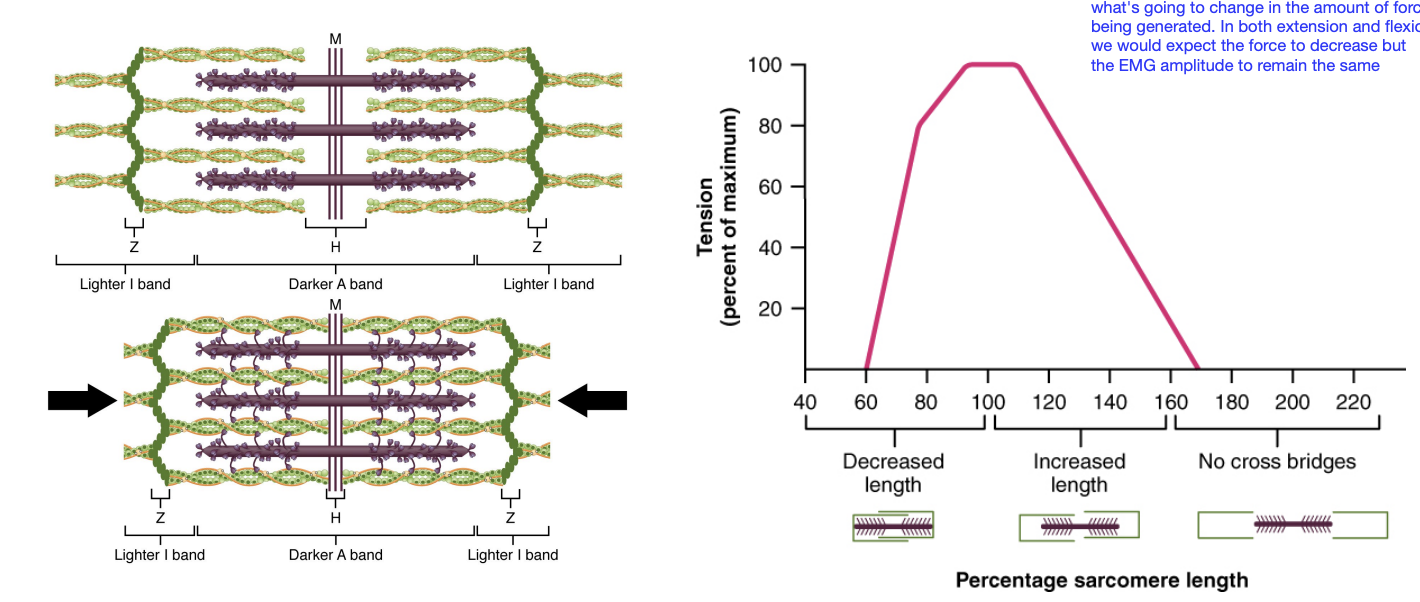
Why does a muscle produce the most force at its optimal length?
At the optimal length, there is the ideal amount of overlap between actin and myosin, allowing the greatest number of effective cross-bridges to form and generate force.
KEY ID: Optimal length → optimal actin-myosin overlap → maximum force
What happens to force when a muscle is too short or too long?
Force decreases because actin-myosin overlap is no longer optimal:
Too short → too much overlap/interference
Too long → too little overlap → fewer cross-bridges
KEY ID: Too short OR too long → ↓ force
Can EMG activity stay the same while muscle force changes?
Yes. EMG reflects the muscle's electrical/neural activation, while force also depends on muscle fiber mechanics, including muscle length and actin-myosin overlap. Therefore, the same EMG activation can produce different amounts of force at different muscle lengths.
How do fiber mechanics affect the EMG-force relationship?
Even if EMG amplitude remains the same, the force produced can change because the muscle fibers are at different lengths, which changes actin-myosin overlap and cross-bridge force production.
KEY ID: Same EMG → potentially different force depending on muscle length/fiber mechanics.
What makes up total muscle force?
Total muscle force = active force + passive force
Active force → produced by the sarcomeres/cross-bridges
Passive force → produced by the muscle's elastic structures
KEY ID: Total force = Active + Passive
What produces passive force in a muscle?
Passive force comes from connective tissue and titin, which have elastic properties. They act somewhat like a spring: when the muscle is lengthened, they resist the stretch and produce passive force.
-> (epimysium, perimysium, endomysium — shown in the diagram)
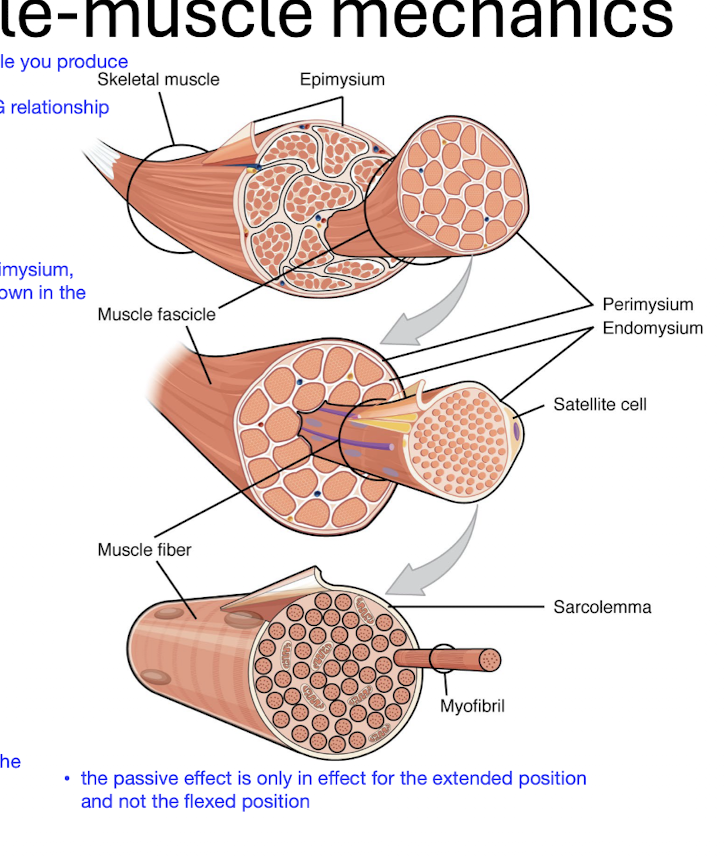
When does passive force become important?
Passive force becomes important when the muscle is lengthened/extended. As the muscle is stretched, the connective tissue and titin become more stretched and produce increasing passive force. It is much less important in the shorter/flexed position.
KEY ID: Extended/lengthened → ↑ passive force
Flexed/shortened → little passive force

Why doesn't passive force appear on an EMG?
Passive force comes from elastic structures, not electrical activation of the muscle. Therefore, it produces no EMG signal. This can affect the EMG-force relationship because measured force can increase without a corresponding increase in EMG.
KEY ID: Passive force → no electrical activity → no EMG signal
How is muscle force converted into joint moment (torque)?
Muscle force × muscle moment arm = joint moment (torque). The moment arm is the perpendicular distance from the joint axis to the muscle’s line of force.
What happens to the muscle moment arm as joint angle changes?
The moment arm changes with joint angle, so the same muscle force can produce different amounts of joint torque at different angles.
Why can changing the moment arm skew the force-EMG relationship?
EMG reflects muscle activation, but joint torque also depends on the moment arm. Therefore, the same EMG/muscle activation can produce different joint torque at different joint angles.
Why doesn't greater biceps brachii (BR) torque necessarily mean greater force at the hand?
Joint torque depends on the moment arm, while the actual muscle force also depends on sarcomere length and passive force. Therefore, a greater BR moment arm at a larger joint angle can produce more torque without necessarily producing more force at the hand.
What is co-contraction?
Simultaneous activation of agonist and antagonist muscles around a joint to help stabilize the joint.
Why does antagonist activity occur during a muscle contraction?
Antagonist muscles become active to stabilize the joint and control unwanted movement.

How does antagonist activity affect the force measured at the hand?
Antagonist activity generates a moment opposite to the agonist moment → reduces the net joint moment → decreases the force measured at the hand.
When do you see the most co-contraction?
Co-contraction is greatest when the joint is unstable, because more antagonist activity is needed to stabilize it.
Muscle vs Effector force: contraction-type, velocity
???????