antr 350 digestion
 Call Kai
 Learn
Learn Practice Test
 Spaced Repetition
 Match
Match Flashcards
 Knowt Play
1/42

There's no tags or description
Looks like no tags are added yet.
Name | Mastery | Learn | Test | Matching | Spaced | Call with Kai | Chat |
|---|
No analytics yet
Send a link to your students to track their progress
43 Terms
Masseter muscle
Muscle of mastication that elevates and protracts the mandible to close the jaw.
Temporalis muscle
Muscle of mastication that elevates and retracts the mandible.
Medial pterygoid muscle
Muscle of mastication that elevates and protracts the mandible for side-to-side grinding.
Lateral pterygoid muscle
Muscle of mastication that depresses and protracts the mandible to open the jaw.
CN V3 (mandibular nerve)
innervates muscles of mastication
accessory muscles of mastication
buccinator and orbicularis oris
CN XII hypoglossal nerve
innervates intrinsic and extrinsic tongue muscles
right upper quadrant organs
liver, gallbladder, duodenum, head of pancreas, right kidney and adrenal, hepatic flexure of colon, part of ascending and transverse colon
left upper quadrant organs
stomach, spleen, left lobe of liver, body of pancreas, left kidney and adrenal, splenic flexure of colon, part of transverse and descending colon
right lower quadrant organs
cecum, appendix, right ovary and tube, right ureter, right spermatic cord
left lower quadrant organs
sigmoid colon, descending colon, left ureter, left ovary and tube, left spermatic cord
oral vestibule
space between teeth and cheeks
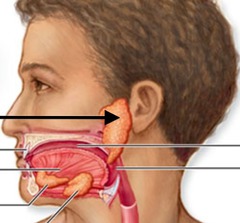
Parotid gland
Largest salivary gland, located anterior to the ear; secretes serous saliva.
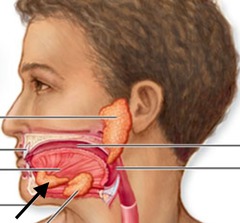
Sublingual gland
Smallest major salivary gland, located under the tongue; secretes mostly mucus.
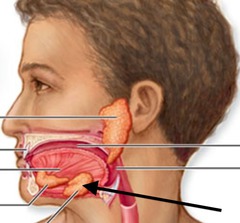
Submandibular gland
Salivary gland located beneath the mandible; secretes mixed serous and mucous fluid.
what kind of teeth do kids not have
premolars
CN VII facial nerve
innervates anterior 2/3 of tongue, sublingual and submandibular glands
CN IX glossopharyngeal nerve
innervates posterior 1/3 of tongue, pharynx, and parotid gland
posterior 1/3 of tongue innervation
CN IX (glossopharyngeal)
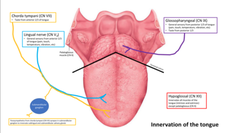
anterior 2/3 of tongue innervation
pain - mandibular division of trigeminal nerve (CN V3)
taste - facial nerve (CN VII)
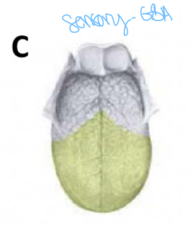
pharynx innervation
vagus nerve (CN X)
parietal peritoneum
lines the abdominal cavity; somatic afferent neurons
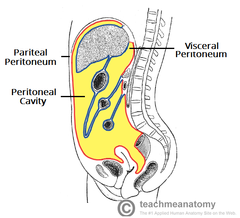
visceral peritoneum
covers abdominal organs; visceral afferent neurons
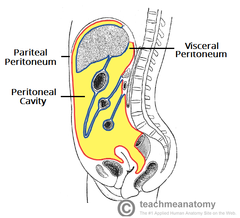
peritoneal cavity
potential space between the parietal and visceral peritoneum
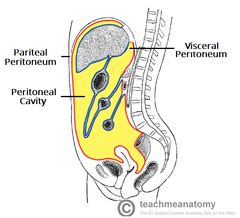
mesentery
double layer of peritoneum; suspend organs within abdominal cavity
peritoneal ligament
double layer of peritoneum that connects an organ with another organ or to the abdominal wall
greater omentum
greater curvature of stomach to transverse colon
lesser omentum
attaches stomach to liver
falciform ligament
attaches liver to anterior abdominal wall
transverse mesocolon
mesentery attached to the transverse colon
coronary ligament
attaches liver to diaphragm
what does the lesser omentum divide into
hepatogastric ligament and hepatoduodenal ligament
mesentery proper
attaches the small intestine to the posterior abdominal wall
what is the peritoneal cavity divided into?
greater and lesser sacs
intraperitoneal organs
completely surrounded by visceral peritoneum
retroperitoneal organs
organs outside the peritoneum
retroperitoneal space
space between the abdominal cavity and the posterior abdominal wall
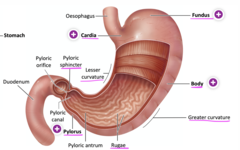
stomach components
cardia, fundus, body, pylorus
cecum
first part of the large intestine
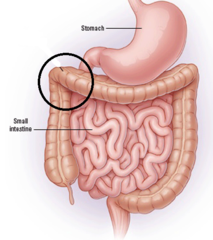
right flexure/hepatic flexure
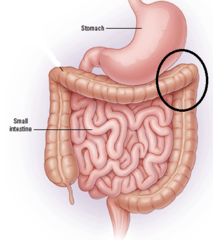
left flexure/splenic flexure
early appendicitis pain
poorly localized around the umbilicus, Mcburney's point
liver lobes
right, left, caudate, quadrate