Atoms
 Call Kai
 Learn
Learn Practice Test
 Spaced Repetition
 Match
Match Flashcards
 Knowt Play
1/14

There's no tags or description
Looks like no tags are added yet.
Name | Mastery | Learn | Test | Matching | Spaced | Call with Kai | Chat |
|---|
No analytics yet
Send a link to your students to track their progress
15 Terms
what are subatomic particles and their properties
protons: mass(kg) has same mass as neutron; positive charge; has a atomic mass of 1,
neutrons: same mass(kg) as protons; has no charge; has mass(amu) of 1
electrons: mass(kg) is very small in comparison to protons/electrons; has a negative charge;
side note: alike charges repel each other, opposite charges attract
whats the atomic mass unit
atomic mass unit (amu): simplified is
1 proton= 1amu
1 neutron= 1 amu
1 electron= 0 amu
what are isotopes
isotopes are atoms with the same number of protons but diff number of neutrons
not all atoms of the same element have an equal number of neutrons.
what determines a mass number and what happens regarding protons:neutrons ratio when protons increase in elements
mass number is determined by protons+neutrons
as the atomic # of elements increase the rise of excess neutrons increase as well, making it so protons is no longer = to neutrons
why do larger atomic # elements have excess neutrons compared to protons
because the more protons there are the more they’ll repel eachother, so an increase in neutrons would distance the protons enough so that they do not repel as much
what are the two ways you write out the isotope of an element?
with the mass# on top left corner of element and atomic # on bottom left
or the element with the mass # across from it

what is atomic mass
it is the average mass of the isotope weighted based on isotope abundance
since not all isotopes exist in the same amount
how do you find the average mass of isotopes (formula wise”)
ex. 1 isotope of Boron: B-10 (this is the mass of all isotopes in boron since theres only 1)
2 isotopes of Boron: B-10 (75%), B-11 (25%)= .75 (10 amu) + .25 (11amu) = 10.25 (this would be the avg mass of boron/ the atomic mass
are all atoms ions, and what makes an ion
no, all ions are atoms but not all atoms are ions.
atoms are always neutral (meaning they have zero charge because # of protons = # of neutrons.
unless they lose or gain electrons, making them an ion with a charge
what are the different charges of an ion, and why are they created through loss/gain of electrons
cations: ions with a positive charge
anion: ions with negative charge
because an atom cannot change the amount of protons it has or else it will change the element in its entirety (atomic #)
what is the notation for an negative ion or positive
it will be the element symbol with the number of loss/gained electrons in the top right corner along with the + or - symbol infront of the number.

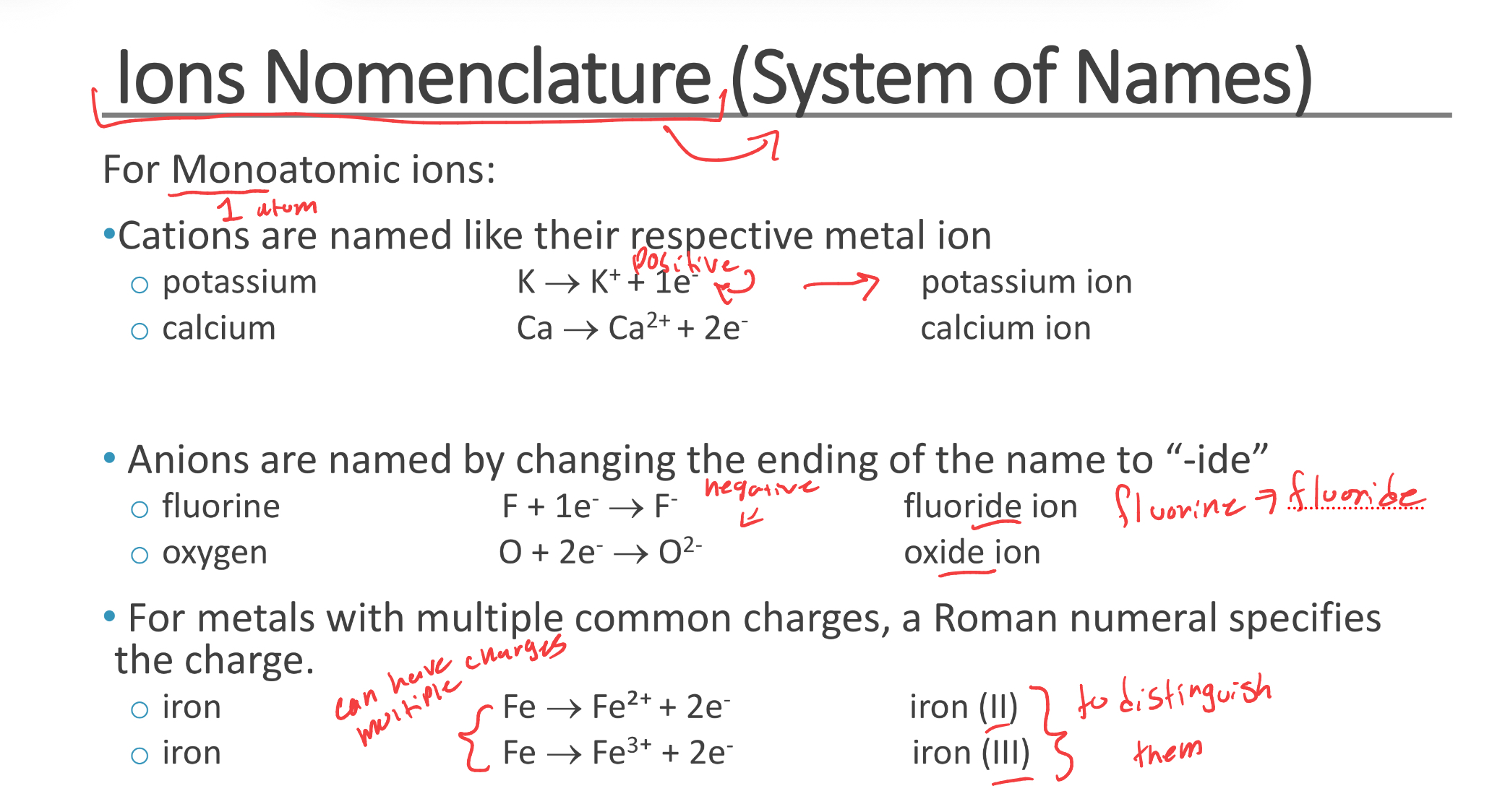
what are ions nomenclature (system of names)
For monoatomic ions (1 atom)-
cations have “-ion” at the end of their element
ex. potassium: K → K+ + 1e- = K —> Potassium ion.
Anions have “ -ide” at the end of their element, along with ion.
ex. fluorine: F + e-1 = F- —> fluoride ion
for metals with multiple charges, roman numerals are used.
ex. iron: Fe→ Fe²+ + 2e- —> iron (II)
iron: Fe → Fe ³+ + 2e- —> iron (III)
what are compounds
they are combinations of elements,
smallest part of an element is an atom; smallest part of a compound is a molecule; molecules are made of atoms
what is significant about molecules in compounds
all molecules in a compound are identical (if I take a piece of a compound from 2 separate corners they should be the same.)
Each molecule has the same number and type of atoms
since compounds have identical atoms, what does that mean regarding the mass ratio
since atoms are the same we can identify the mass ratio by the exact amount of atoms present.