Chemical Basis for Drug Action
 Call Kai
 Learn
Learn Practice Test
 Spaced Repetition
 Match
Match Flashcards
 Knowt Play
1/68

There's no tags or description
Looks like no tags are added yet.
Name | Mastery | Learn | Test | Matching | Spaced | Call with Kai | Chat |
|---|
No analytics yet
Send a link to your students to track their progress
69 Terms
drug
a chemical substance of known structure, other than an essential dietary ingredient, which, administered to a living organism, produces a biological effect
organic
drugs are usually _____ compounds
drug target
a molecule in the body that is intrinsically associated with a particular disease process and that could be addressed by a drug to produce a desired therapeutic effect
proteins (enzyme, receptor, channel) and nucleic acids (DNA or RNA)
drug targets are usually _____
paul ehrlich
who said the famous quote: “the drug will not work unless it is bound”
drug-target complex
a drug binds to its target to form a _____
conformation
the drug-target complex changes the _____ of the target
drug and a free target
the drug-target complex has a lower energy than the sum of a _____
covalent and non-covalent
what are the 2 types of forces used to bond molecules?
alkylation, acylation, phosphorylation, and rearrangement
what are the examples of covalent bonds?
ionic bonds (electrostatic interactions), dipole interactions, van der walls’ interactions, and additional aromatic interactions
what are the examples of non-covalent bonds?
chemical
covalent bonds are a type of _____ reaction
molecular
non-covalent bonds are a type of _____ interaction
covalent bond
a chemical bond that involves the sharing of electron pairs between atoms
octet rule
states that all atoms in a molecule are required to have 8 valence electrons to become stable
tetrahedron: attached to 4 things with single bonds
what geometric form does an sp3 C take?
trigonal planar: one double bond and 2 single bonds
what geometric form does an sp2 C take?
linear: one triple bond and one single bond
what geometric form does an sp C take?
covalent
only a small number of drugs act by forming _____ bonds with their biological target
reversed
covalent bonds cannot be _____
the duration of action may be too long, the specificity of the drug may be low → prolonged adverse effects, high reactivity
what are the problems that come with creating a covalent bond?
acylation
a type of covalent bond where a drug add an alkyl group (CnH2n+1-) to its target
cancer
alkylation is used in _____ treatment
nitrogen mustards
1st alykylating agents used medically, as well as the 1st modern cancer chemotherapies
alkylation
what covalent process is this image an example of?

acylation
a type of covalent bond where a drug adds an acyl group (RCO-) to its target. the drug molecules contains an ester, lactone, amide, and carbamate and the target molecule presents a nucleophilic atom (N, S, O)
beta lactam antibiotics (penicillins, cephalosporins)
what type of medication uses acylation?
acylation
what covalent process is this image an example of?

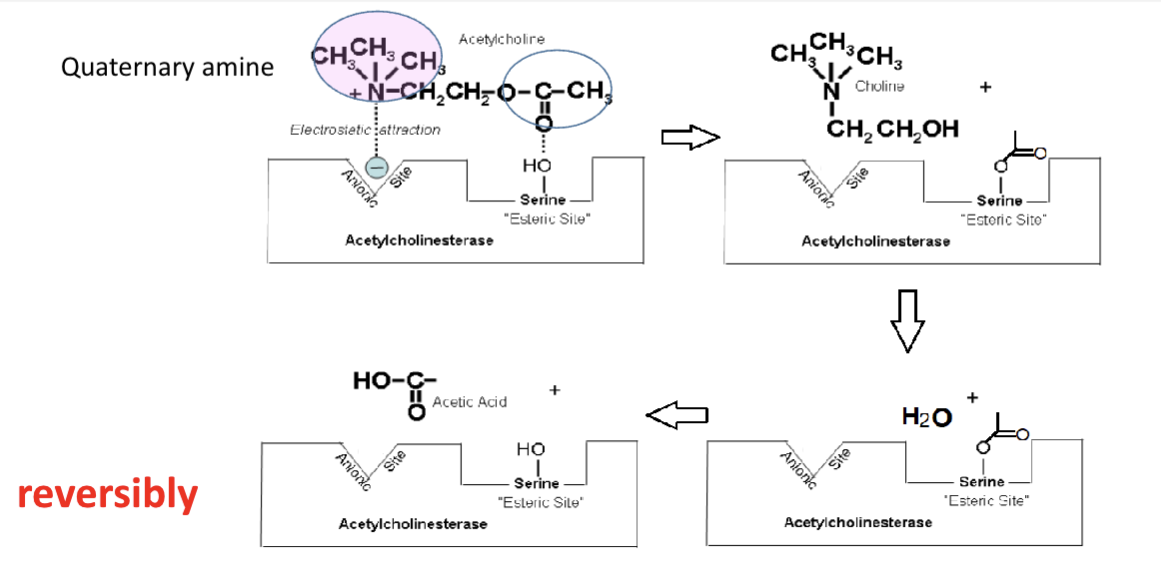
acetylcholinesterase
an enzyme that catalyzes the hydrolysis of acetylcholine
acetylcholinesterase inhibitors
what is this image showing?
phosphorylation
a type of covalent bond in which a drug adds a phosphate group to its target
organophosphates
phosphorylation uses _____ to attach to esteric site
irreversible and very toxic
phoasphorylate acetylcholinsterase is _____
phosphorylation
which covalent group creates products that are used primarily as insecticides?
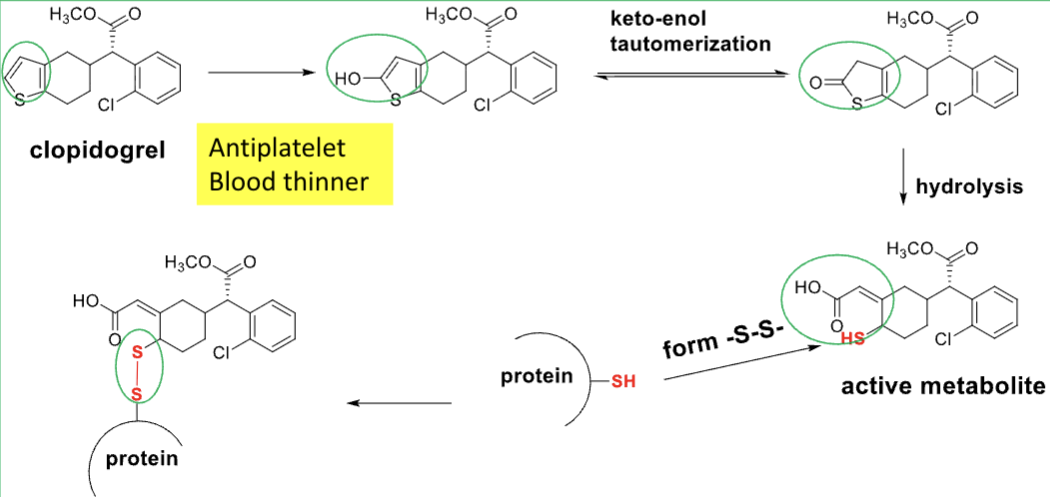
rearrangement reactions
a type of covalent bond that usually occurs during when the drug is metabolized
rearrangement reactions
what covalent process is this image an example of?
non-covalent bonds
what type of bond makes up 93% of bonds?
weak
the bond energy of covalent bonds is _____
distance
the strength of a non-covalent bond is inversely proportional to the _____ between the functional group on the drug and a complementary functional group on the biological target
ionic bonds (electrostatic interactions)
bond that occurs between ionized acidic and basic functional groups or ionized acidic (-) and quaternary ammonium (+) functional groups
ionic bonds
which non-covalent bonds are the strongest?
an acid exists in the form of A-
pKa < pH means:
[A-] (conjugate base)
if pKa < pH then an acid exists in the form of:
[HA] (acid)
if pKa > pH then an acid exists in the form of:
pKa - pH = log10[HA]/[A-]
what is the equation used to figure out the concentration of acid or conjugate base?
[BH]+ (conjugate acid)
if pKa > pH, then a base exists in the form of _____
[B] (base)
if pKa < pH, a base exists in the form of _____
pKa - pH = log10[BH]+/[B]
what is the equation used to figure out the concentration of base or conjugate acid?
dipole interactions
a type of covalent interaction in which electronegativity drives the bond between atoms
electronegativity
a chemical property that defines the tendency of an atom to attract a shared pair of electrons towards itself
dipoles
term that refers to the separation of positive charge and negative charge within a system
the bigger the dipole moment
the greater the difference of electronegativity values of the atoms, _____
F, O, Cl, N, Br
rank the following from most electronegative to least: Cl, N, Br, O, F
ion-dipole (full charge ion)
_____ have higher energy than dipole-dipole interactions
hydrogen bond
a special dipole-dipole interaction between a partially positively charged hydrogen atom attached to a highly electronegative atom (F, O, N), and another partially negatively charged atom (F, O, N)
strongly electronegative (F, O, N) and posses a localized lone pair of electrons
hydrogen bond acceptors usually are:
strongly electronegative atoms with a hydrogen atom attached
hydrogen bond donors usually are:
van der waals’ interactions
a non-covalent interaction between any atoms or molecules caused by temporary dipoles due to uneven or unsymmetrical electronic distribution, or induced dipole
weak
are van der waals’ interactions strong or weak?
aromatic interactions
occur when aromatic rings stack (one from drug, one from target)
cation-aromatic ring interactions
occurs when a cation (positive ion) from a drug molecule binds to an aromatic group from the target protein
chelation
a type of bonding of ions and molecules to metal ions (metal ion binds to ligand at 2 or more points)
calcium
what compound can cause issues with medications that use chelation?
covalent bonding, electrostatic interactions, hydrogen bonding, dipole-dipole interactions, and van der waal’s interactions
rank the following bonds/interactions in order of strength: hydrogen bonding, covalent bonding, dipole-dipole interactions, electrostatic interactions, and van der waals’ interactions
target
a drug must bind to its _____ to produce a therapeutic effect
covalent
only a small number of drugs act by forming _____ bonds with their biological target
non-covalent
most drugs bind to their targets using _____ bonds
distance
the strength of a non-covalent bond is inversely proportional to the _____ between the functional group on the drug and a complementary functional group on the biological target
covalent, non-covalent
bond energy = _____ > _____