Ch. 7 Phases
 Call Kai
 Learn
Learn Practice Test
 Spaced Repetition
 Match
Match Flashcards
 Knowt Play
1/5

There's no tags or description
Looks like no tags are added yet.
Name | Mastery | Learn | Test | Matching | Spaced | Call with Kai | Chat |
|---|
No analytics yet
Send a link to your students to track their progress
6 Terms
Physical Changes
Matter can undergo physical changes as well as chemical changes. Melting, freezing, and boiling are all examples of physical changes. A key property of a physical change is that no intramolecular bonds are made or broken: a physical change affects only the intermolecular forces between molecules or atoms. For example, ice melting to become liquid does not change the molecules of H2O into something else, melting reflects the disruption of the attractive interactions between molecules.
stopped on page 144
get the stuff from from page 144 to 150
Phase Diagrams
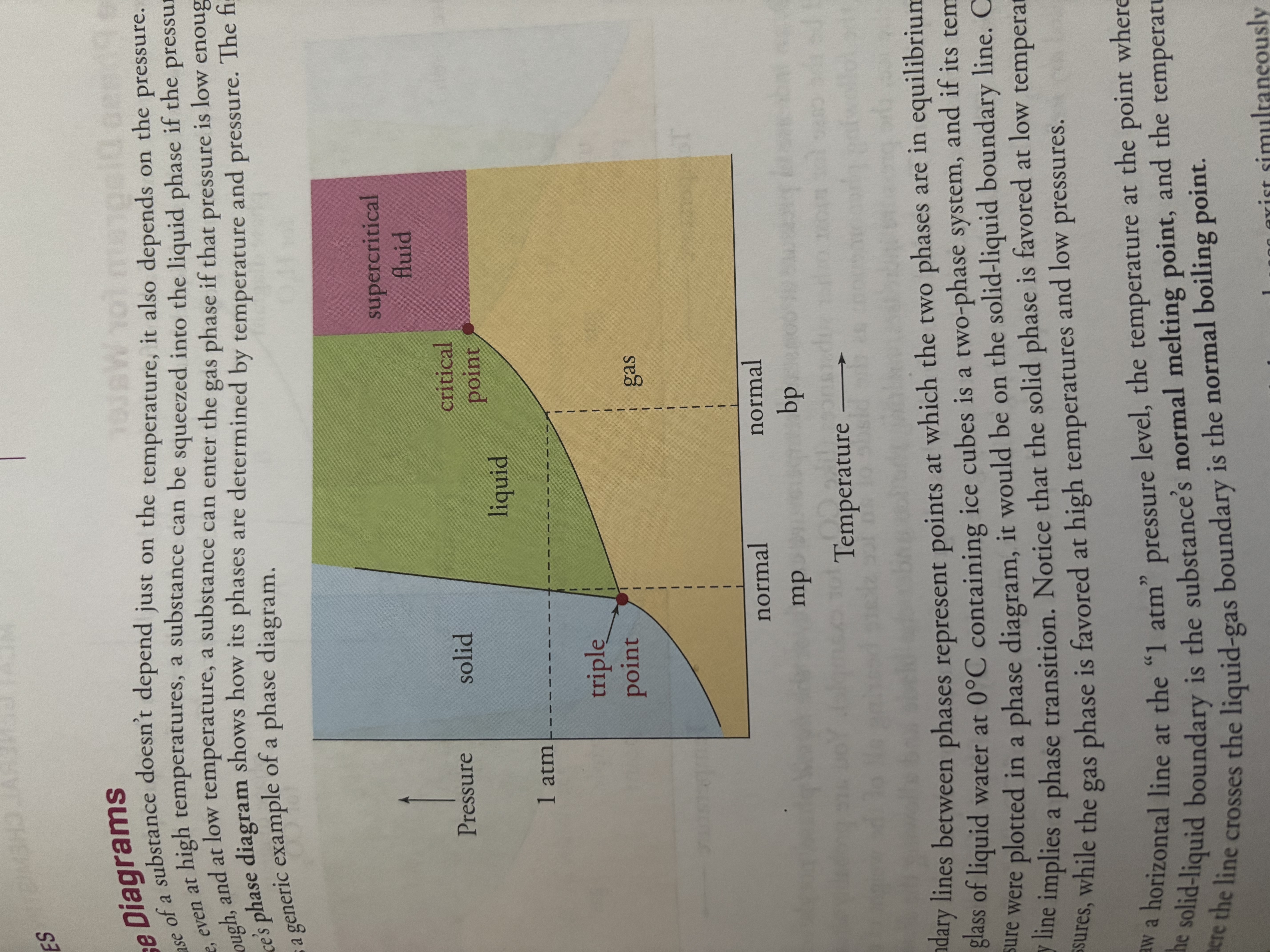
The phase of a substance doesn’t depend just on temperature, it also depends on the pressure. For example, even at high temperatures, a substance an be squeezed into the liquid phase if the pressure is high enough, and at low temperature, a substance can enter the gas phase if that pressure is low enough. A substance’s phase diagram shows how its phases are determined by temperature and pressure. The figure below is a generic example of a phase diagram.
Y axis: Pressure
X axis: Temperature
Increasing the pressure of a fluid compresses gases into a smaller volume (which is why more pressure increasing the pressure changes the fluid from a gas to a liquid)
The boundary lines between phases represent points at which the two phases are in equilibrium. For example, a glass of liquid water at 0 C containing ice cubes is a two-phase system, and if its temperature and pressure were plotted in a phase diagram, it would be on the solid-liquid boundary line. Crossing a boundary line implies a phase transition. Notice that the solid phase is favored at lower temperatures and high pressures, while the gas phase is favored at high temperatures and low pressures.
If we draw a horizontal line at the “1 atm” pressure level, the temperature at the point where this line crosses the solid-liquid boundary is the substance’s normal melting point, and the temperature at the point where the line crosses the liquid-gas boundary is the normal boiling point.
The triple point is the temperature and pressure at which all three phases exist simultaneously in equilibrium. and therefore, all phase changes are happening simultaneously.
The critical point marks the end of the liquid-gas phase boundary. Beyond this point, the substance displays properties of both a liquid (such as a high density) and a gas (such as a low viscocity). If a substance is in this state-where the liquid and gas phases are no longer distinct- it’s called a supercritical fluid, and no amount of increased pressure can force the substance back into its liquid phase.
The term "supercritical fluid" is a scientific compound phrase derived from Latin origins that literally translates to a fluid that is "above (super) the turning point.
The Phase Diagram For Water
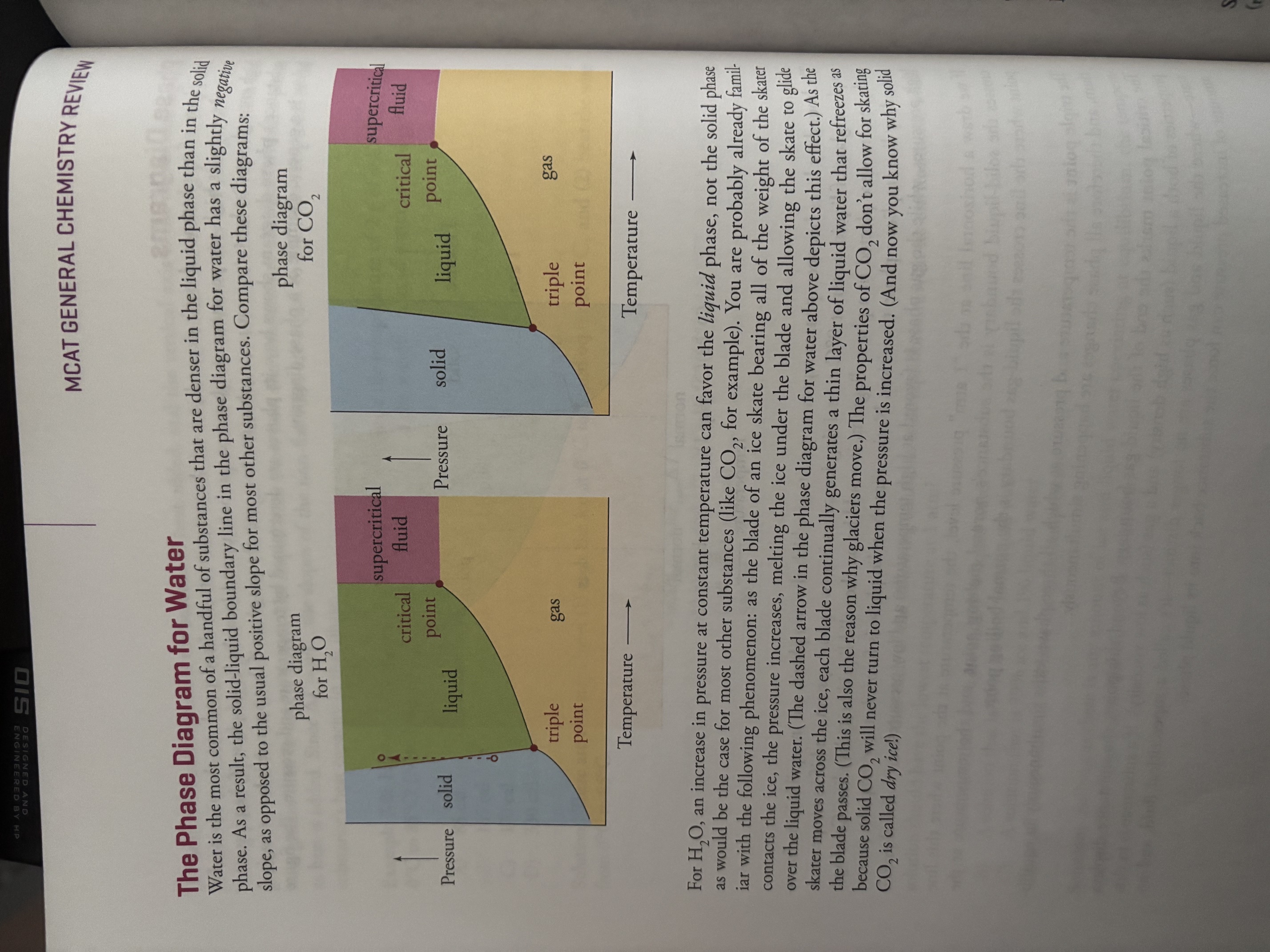
Water is the most common of a handful of substances that are denser in the liquid phase than in the solid phase. As a result, the solid liquid boundary line in the phase diagram for water has a slightly negative slope, as opposed to the usual positive slope for most other substances. Compare these diagrams:
look at the picture of the diagrams attached to this flashcard.
For H2O, an increase in pressure at constant temperature can favor the liquid phase, not the solid phase as would be the case for most other substances (like CO2, for example). You are probably already familiar with the following phenomenon: as the blade of an ice skate bearing all of the weight of the skater contacts the ice, the pressure increases, melting the ice under the blade and allowing the skate to glide over the liquid water. (The dashed arrow in the phase diagram for water above depicts this effect). As the skater moves across the ice, each blade continually generates a tin layer of liquid water that refreezes as the blade passes. (This is also the reason why glaciers move.) The properties of CO2 don’t allow for skating because solid Co2 will never turn to liquid when the pressure is increased. (And now you now why the solid CO2 is called dry ice!)
d
d
d
d