šŸ  Natural Behavior + Housing

0.0(0)
Studied by 0 people
call kaiCall Kai
learnLearn
examPractice Test
spaced repetitionSpaced Repetition
heart puzzleMatch
flashcardsFlashcards
GameKnowt Play
Card Sorting

1/21

encourage image

There's no tags or description

Looks like no tags are added yet.

Last updated 3:59 AM on 4/1/26
Name
Mastery
Learn
Test
Matching
Spaced
Call with Kai

No analytics yet

Send a link to your students to track their progress

22 Terms

1
New cards

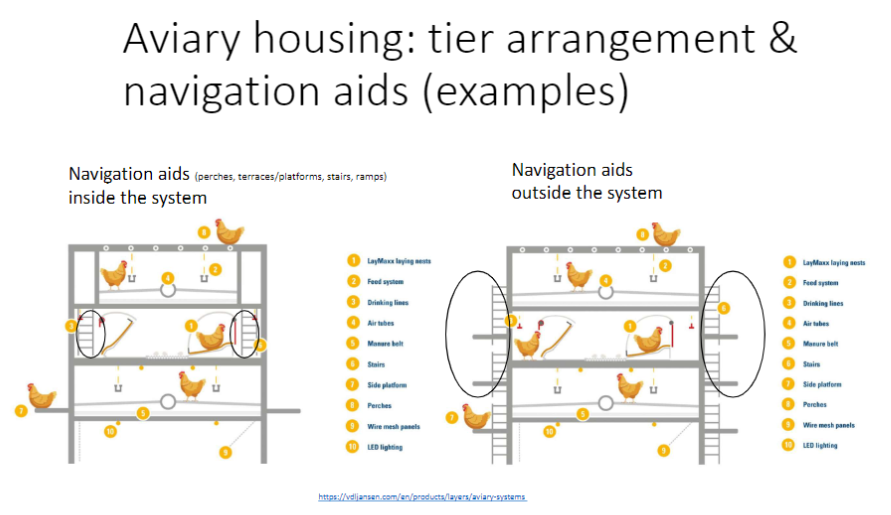
Aviary Housing – Tier Arrangement & Navigation Aids

Tier 1
ā€ƒGround floor

Navigation Aids – Inside the System
ā€ƒPerches, terraces/platforms, stairs, ramps

Navigation Aids – Outside the System
ā€ƒExternal structures that help birds access tiers safely
<p><strong>Tier 1</strong><br>ā€ƒGround floor</p><p><strong>Navigation Aids – Inside the System</strong><br>ā€ƒ<strong>Perches</strong>, <strong>terraces/platforms</strong>, <strong>stairs</strong>, <strong>ramps</strong></p><p><strong>Navigation Aids – Outside the System</strong><br>ā€ƒExternal structures that help birds <strong>access tiers safely</strong></p>
2
New cards

Downward Movement in the Air – Hens

Flight Capacity
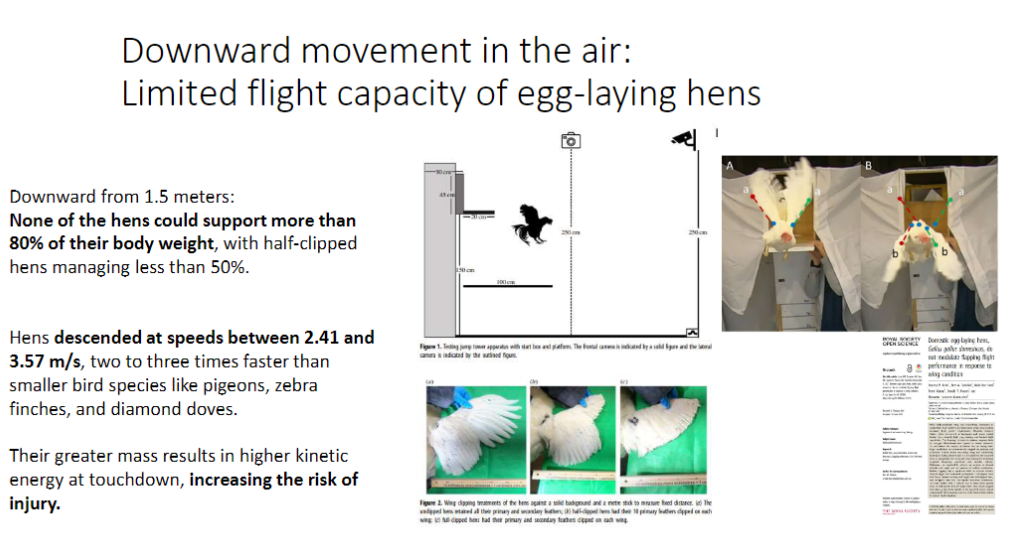
ā€ƒEgg-laying hens have limited flight ability

From 1.5 meters
ā€ƒNone could support > 80% of body weight
ā€ƒHalf-clipped hens managed < 50% body weight

Descent Speed
ā€ƒ2.41–3.57 m/s, 2–3Ɨ faster than smaller birds (pigeons, zebra finches, diamond doves)

Key Point
ā€ƒGreater mass → higher kinetic energy at landing → increased injury risk
<p><strong>Flight Capacity</strong><br>ā€ƒEgg-laying hens have <strong>limited flight ability</strong></p><p><strong>From 1.5 meters</strong><br>ā€ƒNone could support &gt; <strong>80% of body weight</strong><br>ā€ƒ<strong>Half-clipped hens</strong> managed &lt; <strong>50% body weight</strong></p><p><strong>Descent Speed</strong><br>ā€ƒ<strong>2.41–3.57 m/s</strong>, 2–3Ɨ faster than <strong>smaller birds</strong> (pigeons, zebra finches, diamond doves)</p><p><strong>Key Point</strong><br>ā€ƒGreater <strong>mass</strong> → higher <strong>kinetic energy at landing</strong> → <strong>increased injury risk</strong></p>
3
New cards

Perching & Roosting

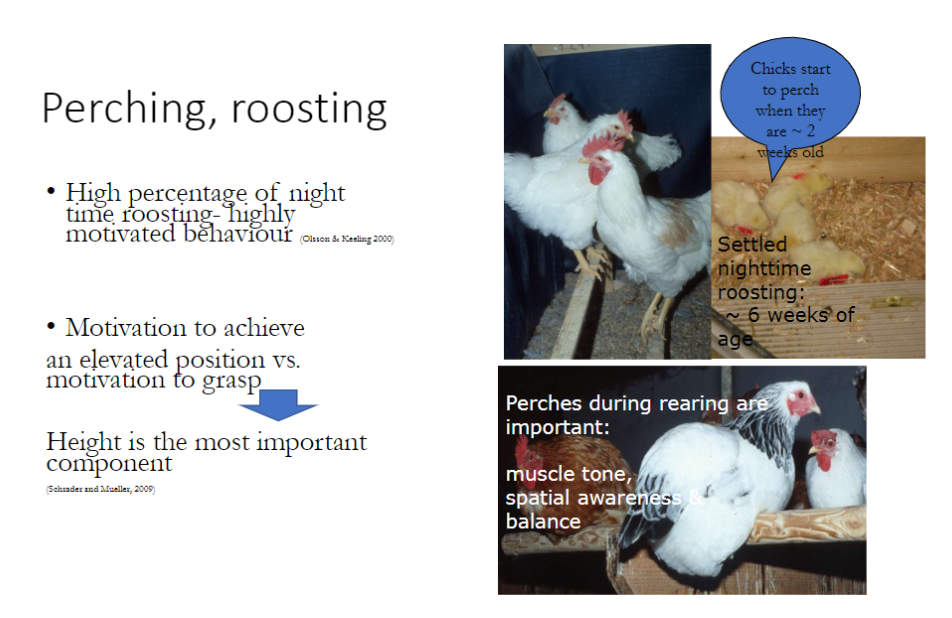
Motivation
ā€ƒHigh nighttime roosting indicates a strongly motivated natural behaviour
ā€ƒBirds prioritize height over grip when choosing perches

Development
ā€ƒChicks start perching at ~ 2 weeks old
ā€ƒSettled nighttime roosting occurs at ~ 6 weeks of age

Importance of Perches During Rearing
ā€ƒSupports muscle tone, spatial awareness, and balance

Key Point
ā€ƒProviding perches early is essential for normal development and expression of natural behaviours
<p><strong>Motivation</strong><br>ā€ƒHigh <strong>nighttime roosting</strong> indicates a <strong>strongly motivated natural behaviour</strong><br>ā€ƒBirds prioritize <strong>height</strong> over grip when choosing perches</p><p><strong>Development</strong><br>ā€ƒ<strong>Chicks</strong> start perching at ~ <strong>2 weeks old</strong><br>ā€ƒ<strong>Settled nighttime roosting</strong> occurs at ~ <strong>6 weeks of age</strong></p><p><strong>Importance of Perches During Rearing</strong><br>ā€ƒSupports <strong>muscle tone</strong>, <strong>spatial awareness</strong>, and <strong>balance</strong></p><p><strong>Key Point</strong><br>ā€ƒProviding perches early is essential for <strong>normal development and expression of natural behaviours</strong></p>
4
New cards

Perching & Roosting – Behaviour and Design

Natural Behaviour
ā€ƒHens roost at night for protection against predators
ā€ƒHighly motivated: hens work to access perches at night
ā€ƒUp to 100% use perches at night, some use during the day

Perch Design
ā€ƒCritical for keel bone and foot pad integrity

Key Point
ā€ƒNighttime perching is a strong natural behaviour, and perch design affects welfare and skeletal health
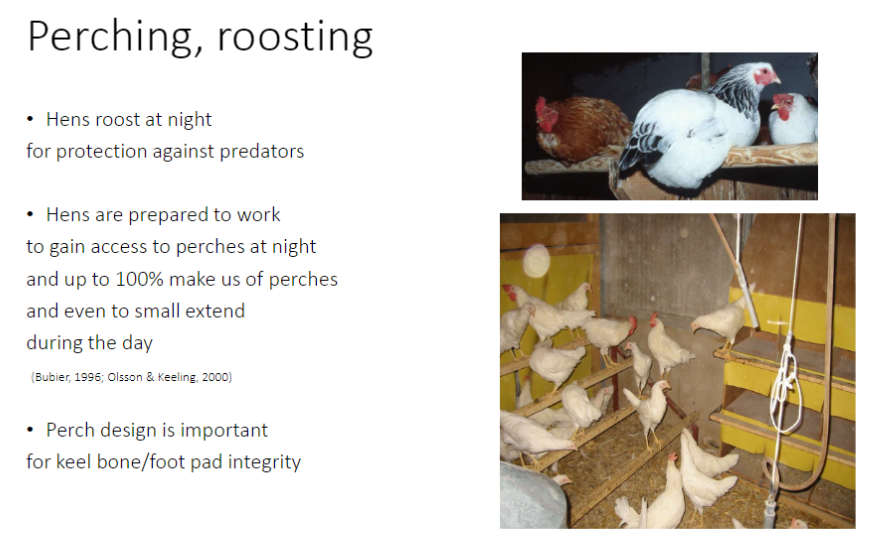
<p><strong>Natural Behaviour</strong><br>ā€ƒHens <strong>roost at night</strong> for <strong>protection against predators</strong><br>ā€ƒHighly motivated: hens <strong>work to access perches</strong> at night<br>ā€ƒUp to <strong>100% use perches at night</strong>, some use during the day</p><p><strong>Perch Design</strong><br>ā€ƒCritical for <strong>keel bone</strong> and <strong>foot pad integrity</strong></p><p><strong>Key Point</strong><br>ā€ƒNighttime perching is a strong natural behaviour, and perch design affects <strong>welfare and skeletal health</strong></p>
5
New cards

Balance & Vision in Birds

Testing
ā€ƒBirds tested with obstructed sight to exclude visual compensation for body equilibrium

Perch Trials
ā€ƒMechanic perch velocities: 0.16, 0.24, 0.34 m/s
ā€ƒTested with different perch diameters

Key Point
ā€ƒBalance in birds relies on multiple sensory inputs, not just vision
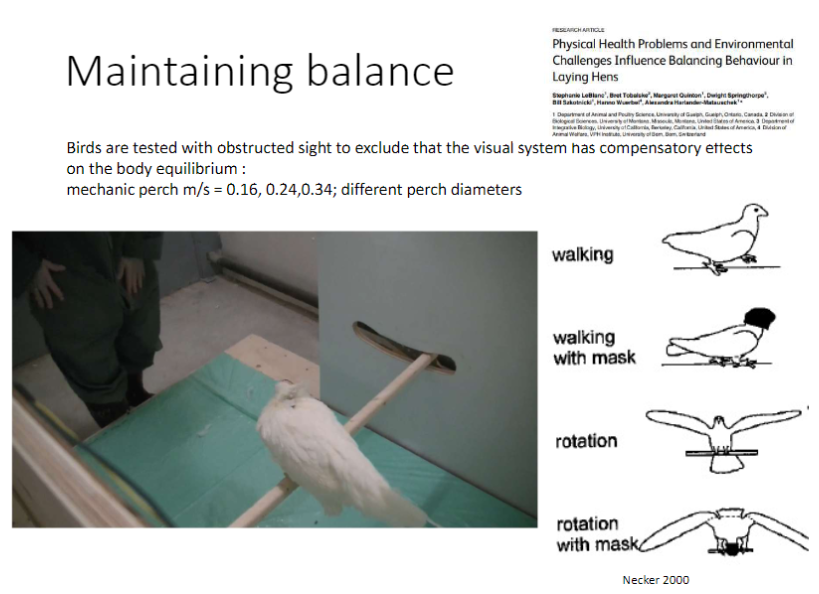
<p><strong>Testing</strong><br>ā€ƒBirds tested with <strong>obstructed sight</strong> to exclude <strong>visual compensation</strong> for body equilibrium</p><p><strong>Perch Trials</strong><br>ā€ƒMechanic perch velocities: <strong>0.16, 0.24, 0.34 m/s</strong><br>ā€ƒTested with <strong>different perch diameters</strong></p><p><strong>Key Point</strong><br>ā€ƒBalance in birds relies on multiple sensory inputs, not just vision</p>
6
New cards

Locomotion & Navigation in Laying Hens

Overview
ā€ƒLaying hens and pullets are bipedal birds with limited flight ability
ā€ƒEffective navigation in multi-tiered aviary systems depends on: experience, strain, health, and feather condition

Ramp Design
ā€ƒRamps angled ≤ 45° between tiers allow easier navigation
ā€ƒSteeper ramps create movement challenges

Perch Placement
ā€ƒBirds struggle with diagonal perches > 45°
ā€ƒDifficulty also occurs with vertical or horizontal perches when spacing > 75–80 cm

Grasping Ability
ā€ƒSurface friction of ramps, platforms, and perches affects stability and balance

Key Point
ā€ƒWell-designed ramps, perches, and platforms are essential for safe and efficient movement in aviaries
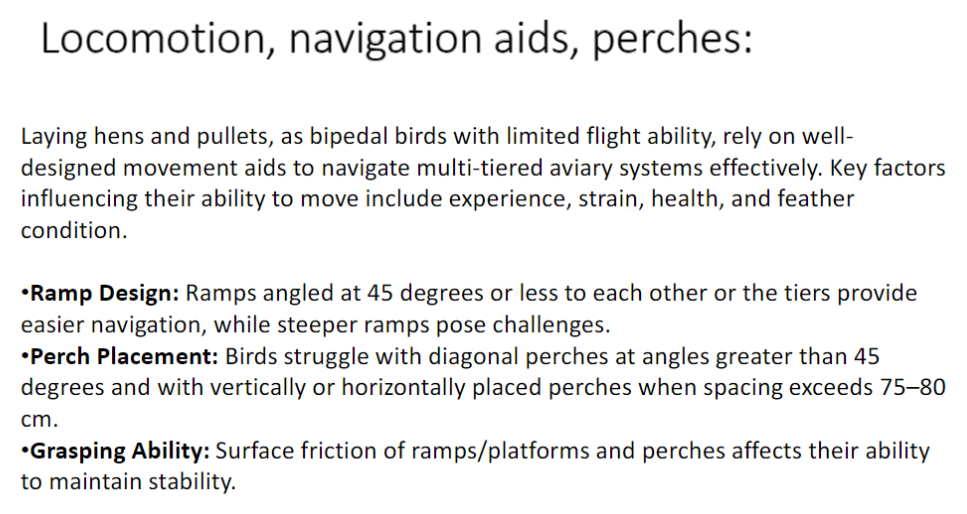
<p><strong>Overview</strong><br>ā€ƒLaying hens and pullets are <strong>bipedal birds with limited flight ability</strong><br>ā€ƒEffective navigation in <strong>multi-tiered aviary systems</strong> depends on: <strong>experience, strain, health, and feather condition</strong></p><p><strong>Ramp Design</strong><br>ā€ƒRamps angled <strong>≤ 45°</strong> between tiers allow <strong>easier navigation</strong><br>ā€ƒSteeper ramps create <strong>movement challenges</strong></p><p><strong>Perch Placement</strong><br>ā€ƒBirds struggle with <strong>diagonal perches &gt; 45°</strong><br>ā€ƒDifficulty also occurs with <strong>vertical or horizontal perches</strong> when spacing <strong>&gt; 75–80 cm</strong></p><p><strong>Grasping Ability</strong><br>ā€ƒ<strong>Surface friction</strong> of ramps, platforms, and perches affects <strong>stability and balance</strong></p><p><strong>Key Point</strong><br>ā€ƒWell-designed <strong>ramps, perches, and platforms</strong> are essential for safe and efficient movement in aviaries</p>
7
New cards

Binocular and Monocular Sleep

Definition
ā€ƒBinocular sleep – both eyes closed simultaneously
ā€ƒMonocular sleep – one eye closed while the other remains open

Function
ā€ƒMonocular sleep allows vigilance against predators while resting
ā€ƒBinocular sleep is used when the bird feels safe and protected

Key Point
ā€ƒBirds alternate between monocular and binocular sleep to balance rest and predator awareness
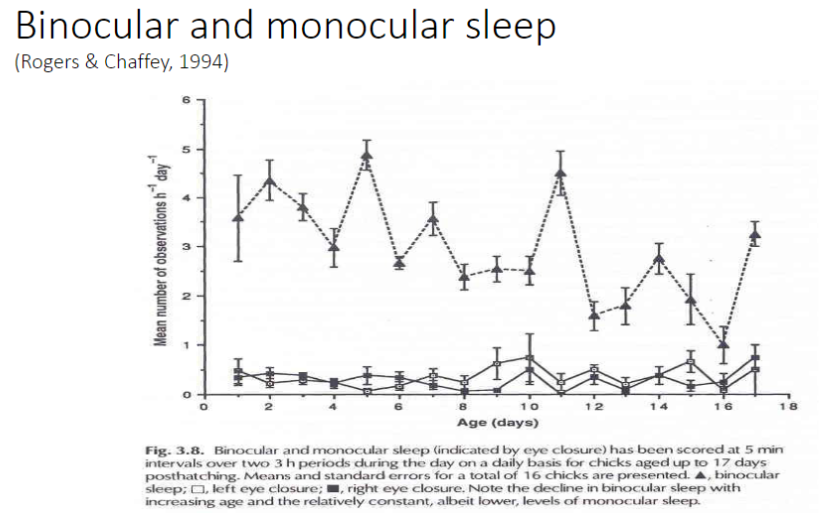
<p><strong>Definition</strong><br>ā€ƒ<strong>Binocular sleep</strong> – both eyes closed simultaneously<br>ā€ƒ<strong>Monocular sleep</strong> – one eye closed while the other remains open</p><p><strong>Function</strong><br>ā€ƒ<strong>Monocular sleep</strong> allows <strong>vigilance against predators</strong> while resting<br>ā€ƒ<strong>Binocular sleep</strong> is used when the bird feels <strong>safe and protected</strong></p><p><strong>Key Point</strong><br>ā€ƒBirds alternate between <strong>monocular and binocular sleep</strong> to balance <strong>rest and predator awareness</strong></p>
8
New cards

Comfort / Self-Maintenance Behaviour

Definition
ā€ƒComfort behaviours – actions birds perform to maintain their body condition and relieve stress

Examples
ā€ƒPreening – cleaning and aligning feathers with the beak; spreads oil from the uropygial gland
ā€ƒHead / Body Stretching – stretches muscles and joints
ā€ƒWing-Flapping – loosens muscles and stimulates circulation
ā€ƒHead / Tail Shaking – removes debris or water
ā€ƒFeather Raising – adjusts feather position for comfort
ā€ƒDustbathing – removes parasites and excess oil

Key Observations
ā€ƒBirds perform these behaviours seldom in cramped conditions
ā€ƒWhen space is restricted, they show rebound behaviour – performing the actions for longer periods when space is available
ā€ƒFrequent, short preening bouts often occur after a mild stressor or during frustration
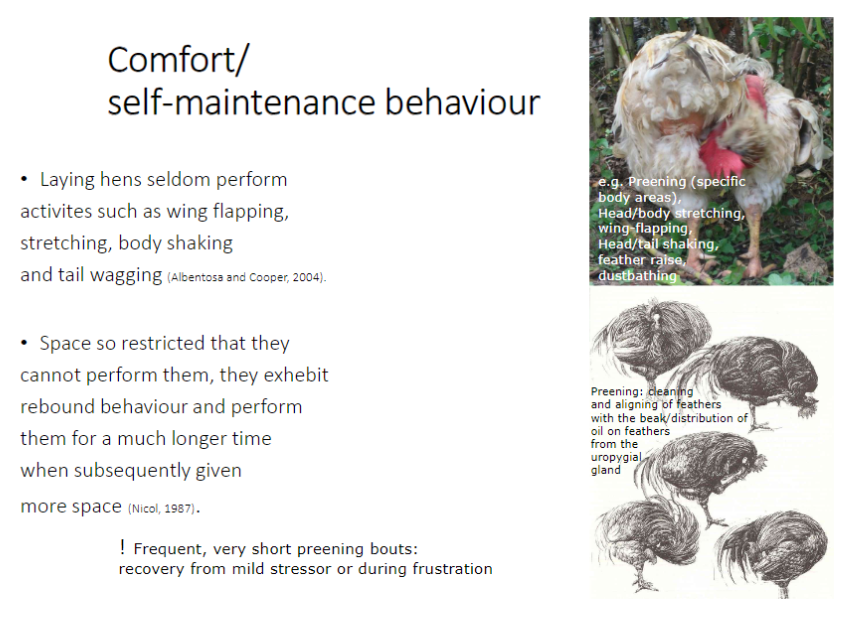
<p><strong>Definition</strong><br>ā€ƒ<strong>Comfort behaviours</strong> – actions birds perform to maintain their body condition and relieve stress</p><p><strong>Examples</strong><br>ā€ƒ<strong>Preening</strong> – cleaning and aligning feathers with the beak; spreads oil from the <strong>uropygial gland</strong><br>ā€ƒ<strong>Head / Body Stretching</strong> – stretches muscles and joints<br>ā€ƒ<strong>Wing-Flapping</strong> – loosens muscles and stimulates circulation<br>ā€ƒ<strong>Head / Tail Shaking</strong> – removes debris or water<br>ā€ƒ<strong>Feather Raising</strong> – adjusts feather position for comfort<br>ā€ƒ<strong>Dustbathing</strong> – removes parasites and excess oil</p><p><strong>Key Observations</strong><br>ā€ƒBirds perform these behaviours <strong>seldom in cramped conditions</strong><br>ā€ƒWhen space is restricted, they show <strong>rebound behaviour</strong> – performing the actions for <strong>longer periods</strong> when space is available<br>ā€ƒ<strong>Frequent, short preening bouts</strong> often occur after a <strong>mild stressor</strong> or during <strong>frustration</strong></p>
9
New cards

Space for Behavioural Expression

Personal Space
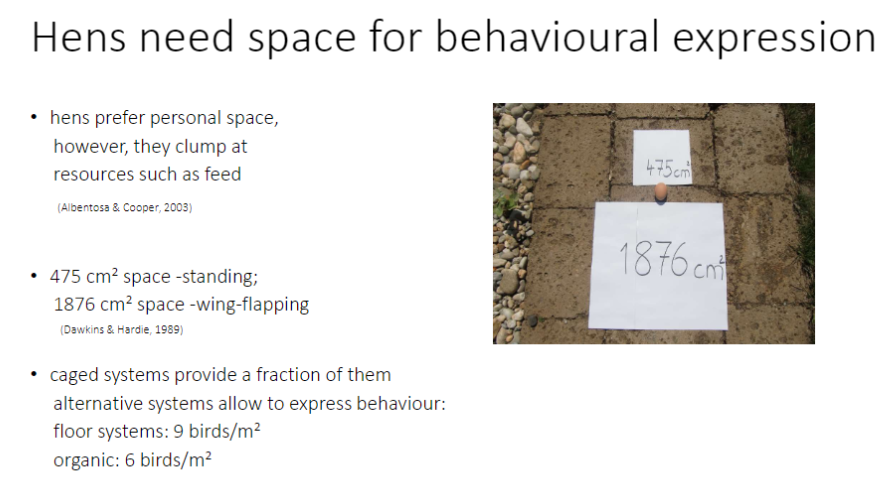
ā€ƒHens prefer personal space but will clump around resources such as feed

Space Requirements
ā€ƒStanding: ~475 cm² per hen
ā€ƒWing-Flapping: ~1876 cm² per hen
ā€ƒCaged systems provide much less than required
ā€ƒAlternative systems allow better expression:
ā€ƒā€ƒFloor systems: 9 birds/m²
ā€ƒā€ƒOrganic systems: 6 birds/m²

<p><strong>Personal Space</strong><br>ā€ƒ<strong>Hens prefer personal space</strong> but will <strong>clump around resources</strong> such as feed</p><p><strong>Space Requirements</strong><br>ā€ƒ<strong>Standing:</strong> ~475 cm² per hen<br>ā€ƒ<strong>Wing-Flapping:</strong> ~1876 cm² per hen<br>ā€ƒ<strong>Caged systems</strong> provide <strong>much less than required</strong><br>ā€ƒ<strong>Alternative systems</strong> allow better expression:<br>ā€ƒā€ƒ<strong>Floor systems:</strong> 9 birds/m²<br>ā€ƒā€ƒ<strong>Organic systems:</strong> 6 birds/m²</p>
10
New cards

Dustbathing

Behaviour
ā€ƒHen lays down and tosses loose substrate onto back and wings
ā€ƒRubs substrate into feathers and shakes it out
ā€ƒOften performed with preening

Functions
ā€ƒImproves feather condition
ā€ƒDistributes lipids and removes skin parasites

Substrate Preference
ā€ƒPeat or sand preferred over sawdust or straw
ā€ƒLonger dustbaths with all elements performed in peat or sand

Frequency & Social Aspect
ā€ƒOccurs ~every 2 days
ā€ƒCan be performed simultaneously in groups

Key Point
ā€ƒDustbathing is a natural maintenance behaviour essential for feather health and welfare
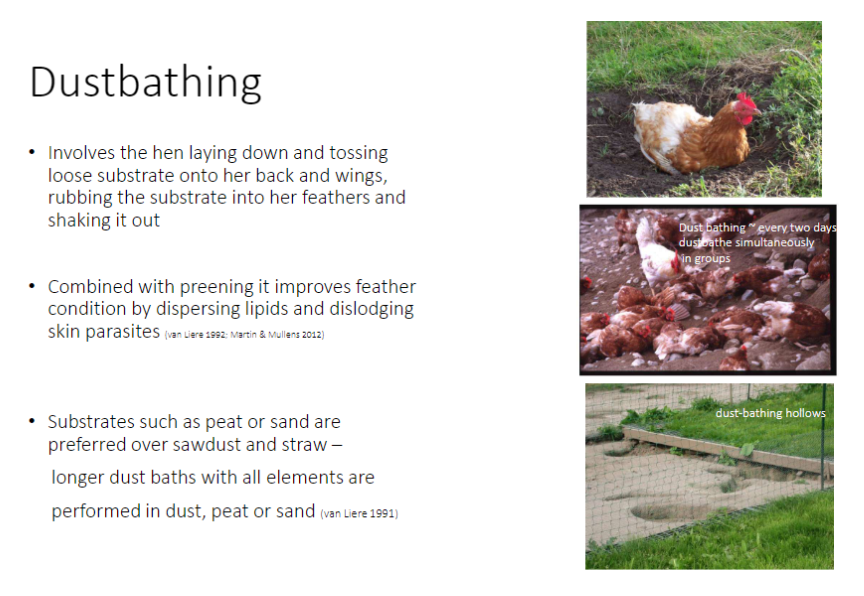
<p><strong>Behaviour</strong><br>ā€ƒHen <strong>lays down</strong> and <strong>tosses loose substrate</strong> onto back and wings<br>ā€ƒ<strong>Rubs substrate into feathers</strong> and <strong>shakes it out</strong><br>ā€ƒOften <strong>performed with preening</strong></p><p><strong>Functions</strong><br>ā€ƒImproves <strong>feather condition</strong><br>ā€ƒDistributes <strong>lipids</strong> and removes <strong>skin parasites</strong></p><p><strong>Substrate Preference</strong><br>ā€ƒ<strong>Peat or sand</strong> preferred over sawdust or straw<br>ā€ƒLonger dustbaths with all elements performed in <strong>peat or sand</strong></p><p><strong>Frequency &amp; Social Aspect</strong><br>ā€ƒOccurs <strong>~every 2 days</strong><br>ā€ƒCan be performed <strong>simultaneously in groups</strong></p><p><strong>Key Point</strong><br>ā€ƒDustbathing is a <strong>natural maintenance behaviour essential for feather health and welfare</strong></p>
11
New cards

Sham-Dustbathing

Definition
ā€ƒOccurs when hens perform dustbathing sequences without suitable substrate

Motivation & Reward
ā€ƒNot rewarding – hens remain motivated to dustbathe
ā€ƒGiven proper litter after deprivation, hens spend a long time dustbathing

Occurrence
ā€ƒSimilar overall dustbathing in furnished cages and floor systems
ā€ƒIn cages, most dustbathing is sham-dustbathing due to lack of litter

Key Point
ā€ƒSham-dustbathing demonstrates hens’ strong motivation for natural substrate and welfare needs
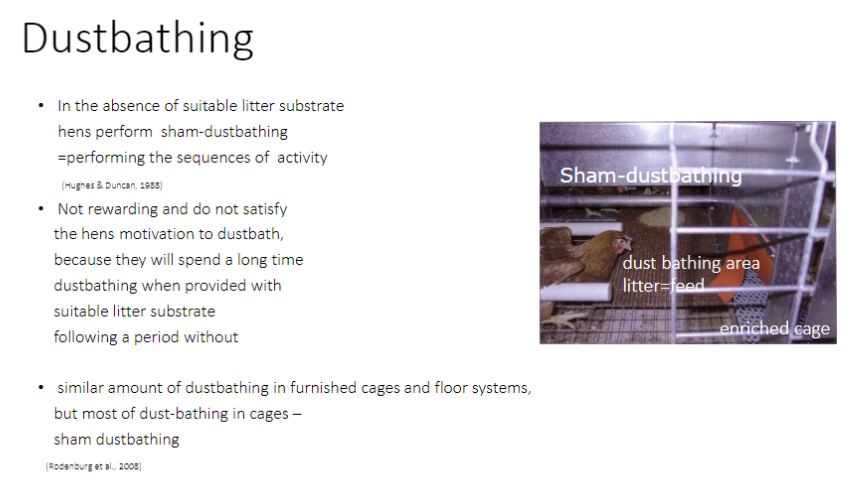
<p><strong>Definition</strong><br>ā€ƒOccurs when <strong>hens perform dustbathing sequences</strong> without <strong>suitable substrate</strong></p><p><strong>Motivation &amp; Reward</strong><br>ā€ƒ<strong>Not rewarding</strong> – hens remain motivated to dustbathe<br>ā€ƒGiven proper litter after deprivation, <strong>hens spend a long time dustbathing</strong></p><p><strong>Occurrence</strong><br>ā€ƒSimilar overall dustbathing in <strong>furnished cages</strong> and <strong>floor systems</strong><br>ā€ƒIn cages, <strong>most dustbathing is sham-dustbathing</strong> due to lack of litter</p><p><strong>Key Point</strong><br>ā€ƒ<strong>Sham-dustbathing demonstrates hens’ strong motivation</strong> for natural substrate and welfare needs</p>
12
New cards

Behaviour Across Housing Systems

Cage Systems (Conventional/Enriched)

Non-Cage Systems (Single-/Multi-Tier)

Key Point
ā€ƒHousing system strongly affects hens’ ability to perform natural behaviours, impacting welfare and motivation
<p><strong>Cage Systems (Conventional/Enriched)</strong></p><p><strong>Non-Cage Systems (Single-/Multi-Tier)</strong></p><p><strong>Key Point</strong><br>ā€ƒ<strong>Housing system strongly affects hens’ ability to perform natural behaviours</strong>, impacting welfare and motivation</p>
13
New cards

Furnished/Enriched Cages – Laying Hens

Structure
ā€ƒWire enclosure with extra space and elements: perches, nestbox (enclosed nest area), litter area, extra height

Group Sizes
ā€ƒSmall group: 10–12 birds
ā€ƒMedium group: 15–30 birds
ā€ƒLarge group: ~60 birds
ā€ƒReference: LayWel 2009

Feeding & Drinking
ā€ƒFood trough: 12 cm per hen
ā€ƒPerches: 15 cm per hen
ā€ƒNest box: 750 cm² per hen; Desired: 800 cm²
ā€ƒCage minimum area: no cage less than 2000 cm²
ā€ƒCage height: 45 cm; Desired: 60 cm
ā€ƒAt least 2 nipple/cup drinkers per cage

Litter Area
ā€ƒAllows scratching and pecking

Additional Notes
ā€ƒClaw-shortening devices exist
ā€ƒ550 cm² per hen in conventional cages – EU banned

Key Point
ā€ƒFurnished/enriched cages provide space, perches, nest area, and litter to support natural behaviors while meeting size and resource standards
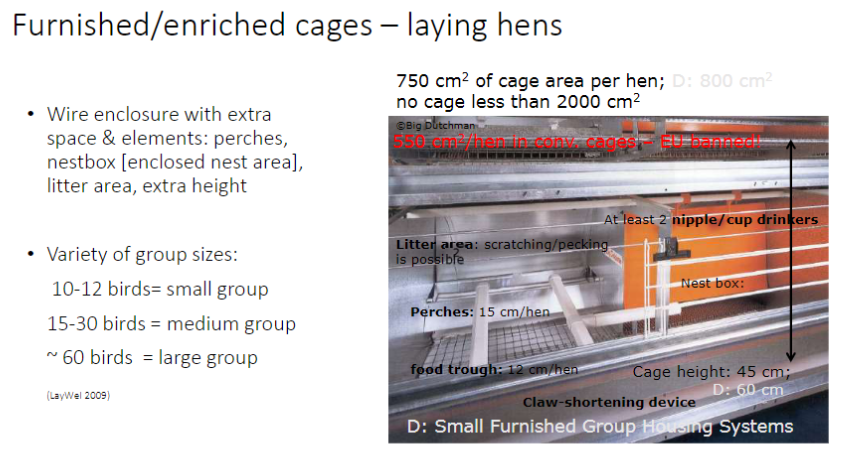
<p><strong>Structure</strong><br>ā€ƒ<strong>Wire enclosure</strong> with extra <strong>space</strong> and <strong>elements</strong>: <strong>perches</strong>, <strong>nestbox</strong> (enclosed nest area), <strong>litter area</strong>, extra <strong>height</strong></p><p><strong>Group Sizes</strong><br>ā€ƒ<strong>Small group:</strong> 10–12 birds<br>ā€ƒ<strong>Medium group:</strong> 15–30 birds<br>ā€ƒ<strong>Large group:</strong> ~60 birds<br>ā€ƒReference: <strong>LayWel 2009</strong></p><p><strong>Feeding &amp; Drinking</strong><br>ā€ƒ<strong>Food trough:</strong> 12 cm per hen<br>ā€ƒ<strong>Perches:</strong> 15 cm per hen<br>ā€ƒ<strong>Nest box:</strong> 750 cm² per hen; Desired: 800 cm²<br>ā€ƒ<strong>Cage minimum area:</strong> no cage less than 2000 cm²<br>ā€ƒ<strong>Cage height:</strong> 45 cm; Desired: 60 cm<br>ā€ƒAt least <strong>2 nipple/cup drinkers</strong> per cage</p><p><strong>Litter Area</strong><br>ā€ƒAllows <strong>scratching and pecking</strong></p><p><strong>Additional Notes</strong><br>ā€ƒ<strong>Claw-shortening devices</strong> exist<br>ā€ƒ550 cm² per hen in conventional cages – <strong>EU banned</strong></p><p><strong>Key Point</strong><br>ā€ƒFurnished/enriched cages provide <strong>space, perches, nest area, and litter</strong> to support <strong>natural behaviors</strong> while meeting <strong>size and resource standards</strong></p>
14
New cards

Non-Cage Systems – Laying Hens

System Types
ā€ƒSingle-level systems
ā€ƒMulti-level systems (aviary systems)

Space
ā€ƒMore space per bird: 1,111 cm² compared to 750–550 cm² in conventional cages

Features
ā€ƒPerches, nests, and large scratching areas (litter)

Group Sizes
ā€ƒLarge groups, e.g., 5,000–30,000 birds

Key Point
ā€ƒOn-cage systems provide more space and resources than conventional cages and support natural behaviors in large flocks
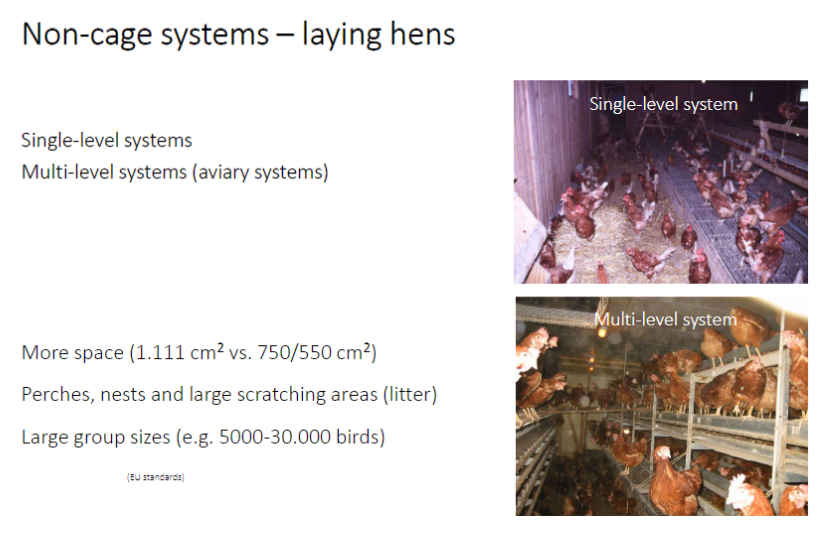
<p><strong>System Types</strong><br>ā€ƒ<strong>Single-level systems</strong><br>ā€ƒ<strong>Multi-level systems</strong> (aviary systems)</p><p><strong>Space</strong><br>ā€ƒMore <strong>space per bird</strong>: 1,111 cm² compared to 750–550 cm² in conventional cages</p><p><strong>Features</strong><br>ā€ƒ<strong>Perches</strong>, <strong>nests</strong>, and large <strong>scratching areas</strong> (litter)</p><p><strong>Group Sizes</strong><br>ā€ƒLarge groups, e.g., 5,000–30,000 birds</p><p><strong>Key Point</strong><br>ā€ƒOn-cage systems provide <strong>more space and resources</strong> than conventional cages and support <strong>natural behaviors</strong> in <strong>large flocks</strong></p>
15
New cards

Multi-Tier Systems – Aviary

Definition
ā€ƒMulti-tier system also called Aviary

Nest Boxes
ā€ƒCan be integrated or non-integrated

Flooring
ā€ƒSeveral levels of perforated floors with manure belts underneath

Feed & Water
ā€ƒFeeders and drinkers are distributed to provide equal access for all hens

Key Point
ā€ƒMulti-tier systems allow vertical space use while ensuring nesting, feeding, and drinking for all birds
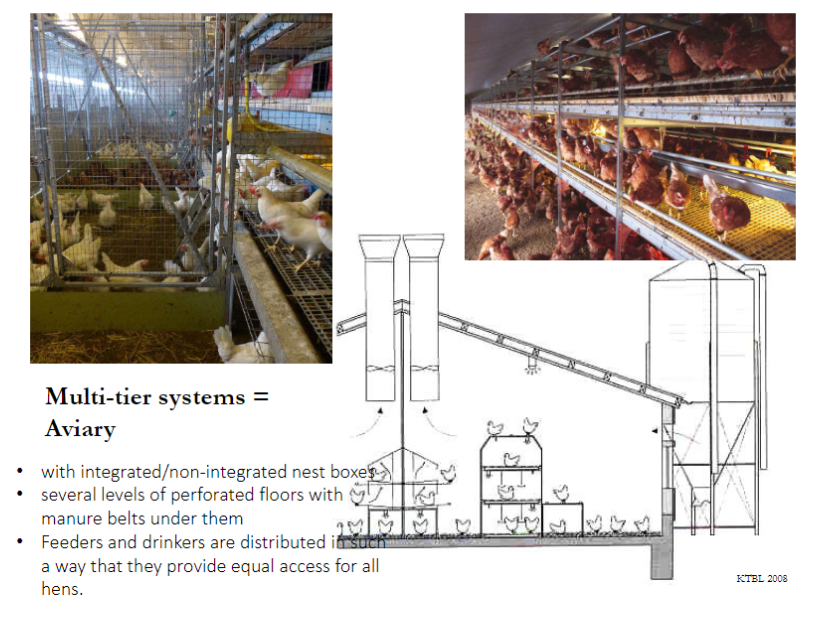
<p><strong>Definition</strong><br>ā€ƒ<strong>Multi-tier system</strong> also called <strong>Aviary</strong></p><p><strong>Nest Boxes</strong><br>ā€ƒCan be <strong>integrated</strong> or <strong>non-integrated</strong></p><p><strong>Flooring</strong><br>ā€ƒSeveral levels of <strong>perforated floors</strong> with <strong>manure belts</strong> underneath</p><p><strong>Feed &amp; Water</strong><br>ā€ƒ<strong>Feeders</strong> and <strong>drinkers</strong> are distributed to provide <strong>equal access</strong> for all hens</p><p><strong>Key Point</strong><br>ā€ƒMulti-tier systems allow <strong>vertical space use</strong> while ensuring <strong>nesting, feeding, and drinking</strong> for all birds</p>
16
New cards

Covered Verandas/Wintergarden – Laying Hens

Definition
ā€ƒArea near the house, indoors
ā€ƒCovered veranda is not counted as usable area

Outdoor Access
ā€ƒOpen run or free range

Flooring & Hygiene
ā€ƒConcrete floor, usually covered with litter
ā€ƒClimate similar to outside, except for rain
ā€ƒCovered with free-draining material to maintain good hygiene inside and outside the house

Access Points
ā€ƒPop holes allow hens to move between indoor and outdoor areas

Key Point
ā€ƒCovered verandas/wintergardens provide protected outdoor-like space while supporting hygiene and movement
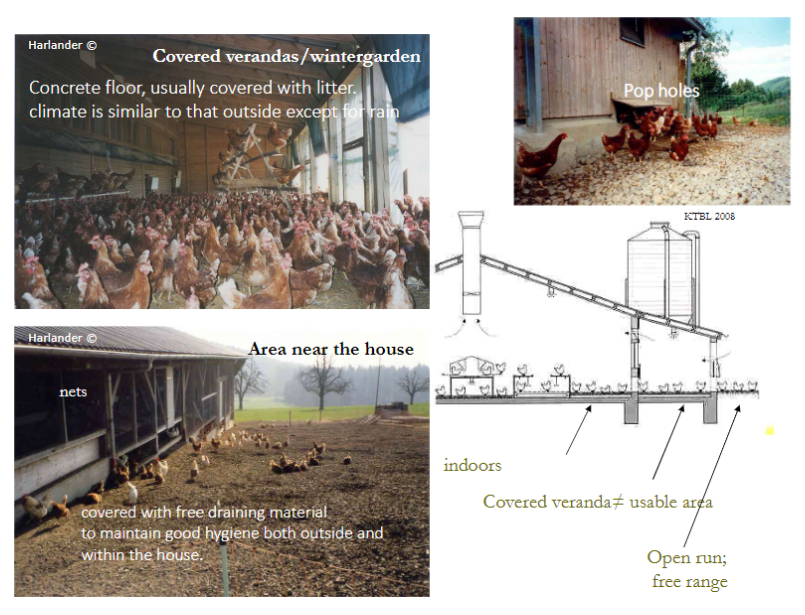
<p><strong>Definition</strong><br>ā€ƒArea near the <strong>house</strong>, indoors<br>ā€ƒ<strong>Covered veranda</strong> is <strong>not counted as usable area</strong></p><p><strong>Outdoor Access</strong><br>ā€ƒ<strong>Open run</strong> or <strong>free range</strong></p><p><strong>Flooring &amp; Hygiene</strong><br>ā€ƒ<strong>Concrete floor</strong>, usually covered with <strong>litter</strong><br>ā€ƒClimate similar to outside, except for <strong>rain</strong><br>ā€ƒCovered with <strong>free-draining material</strong> to maintain <strong>good hygiene</strong> inside and outside the house</p><p><strong>Access Points</strong><br>ā€ƒ<strong>Pop holes</strong> allow hens to move between indoor and outdoor areas</p><p><strong>Key Point</strong><br>ā€ƒCovered verandas/wintergardens provide <strong>protected outdoor-like space</strong> while supporting <strong>hygiene and movement</strong></p>
17
New cards

Canada’s Transition in Egg-Layer Housing

Enriched Colony Housing
ā€ƒAlso called enriched cages
ā€ƒCurrently houses 37% of hens

Alternative Systems
ā€ƒFree run (aviaries/single-tier), organic, and free-range farming are increasing
ā€ƒNow make up around 20% of hens nationwide

Key Point
ā€ƒCanada is shifting from conventional cages to enriched and alternative housing systems to improve hen welfare
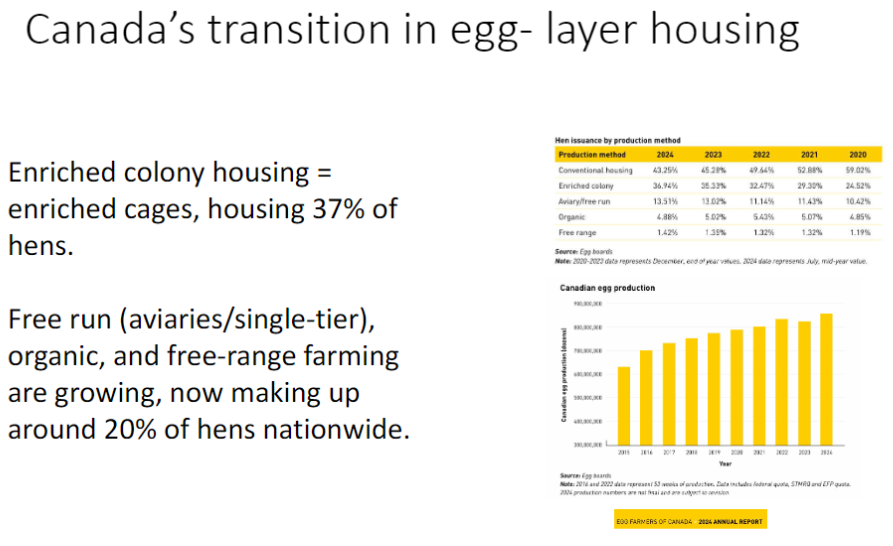
<p><strong>Enriched Colony Housing</strong><br>ā€ƒAlso called <strong>enriched cages</strong><br>ā€ƒCurrently houses <strong>37% of hens</strong></p><p><strong>Alternative Systems</strong><br>ā€ƒ<strong>Free run</strong> (aviaries/single-tier), <strong>organic</strong>, and <strong>free-range farming</strong> are increasing<br>ā€ƒNow make up around <strong>20% of hens nationwide</strong></p><p><strong>Key Point</strong><br>ā€ƒCanada is shifting from <strong>conventional cages</strong> to <strong>enriched and alternative housing systems</strong> to improve <strong>hen welfare</strong></p>
18
New cards

Welfare Potentials and Risks – Laying Hens

Welfare Potentials
ā€ƒHigh space allowance → general freedom of movement
ā€ƒEnvironmental stimulation → full repertoire of locomotion, body maintenance (sunbathing, dustbathing), exploration
ā€ƒAdditional nutritive and non-nutritive food → e.g., plants, insects, worms, little stones
ā€ƒHigh number of birds outside → lower risk of feather pecking
ā€ƒFresh air and UV-light → natural disinfection

Welfare Risks
ā€ƒDestruction of the run → mud, hygiene issues, weeks of regeneration
ā€ƒIntake of infectious agents
ā€ƒPredation → can be managed with suitable hybrids, fences dug into the ground, trees and shelter for aerial predators
ā€ƒLabour, area, and cost demands → higher egg prices are necessary

Key Point
ā€ƒOutdoor and enriched systems improve hen welfare but require careful management of hygiene, predators, and resources
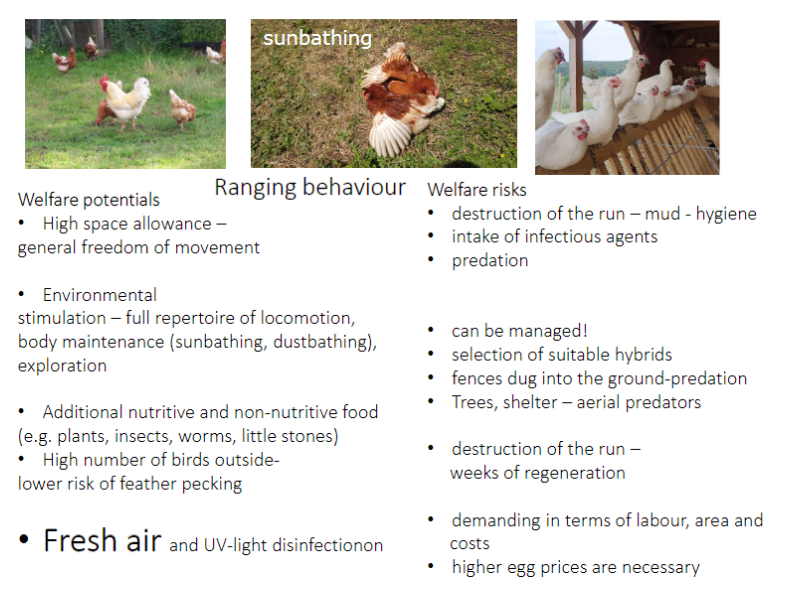
<p><strong>Welfare Potentials</strong><br>ā€ƒ<strong>High space allowance</strong> → general freedom of movement<br>ā€ƒ<strong>Environmental stimulation</strong> → full repertoire of locomotion, body maintenance (<strong>sunbathing, dustbathing</strong>), exploration<br>ā€ƒ<strong>Additional nutritive and non-nutritive food</strong> → e.g., plants, insects, worms, little stones<br>ā€ƒ<strong>High number of birds outside</strong> → lower risk of <strong>feather pecking</strong><br>ā€ƒ<strong>Fresh air and UV-light</strong> → natural <strong>disinfection</strong></p><p><strong>Welfare Risks</strong><br>ā€ƒ<strong>Destruction of the run</strong> → mud, hygiene issues, weeks of regeneration<br>ā€ƒ<strong>Intake of infectious agents</strong><br>ā€ƒ<strong>Predation</strong> → can be managed with suitable <strong>hybrids</strong>, <strong>fences dug into the ground</strong>, <strong>trees and shelter</strong> for aerial predators<br>ā€ƒ<strong>Labour, area, and cost demands</strong> → higher <strong>egg prices</strong> are necessary</p><p><strong>Key Point</strong><br>ā€ƒOutdoor and enriched systems improve <strong>hen welfare</strong> but require careful <strong>management of hygiene, predators, and resources</strong></p>
19
New cards

Laying Hens Prefer to Forage in Fresh Air

Observation
ā€ƒHens show a strong preference for foraging outdoors rather than staying inside

Benefits
ā€ƒAccess to fresh air, natural food sources (plants, insects, worms), and space for locomotion and body maintenance

Key Point
ā€ƒProviding outdoor access supports natural behaviors and improves welfare
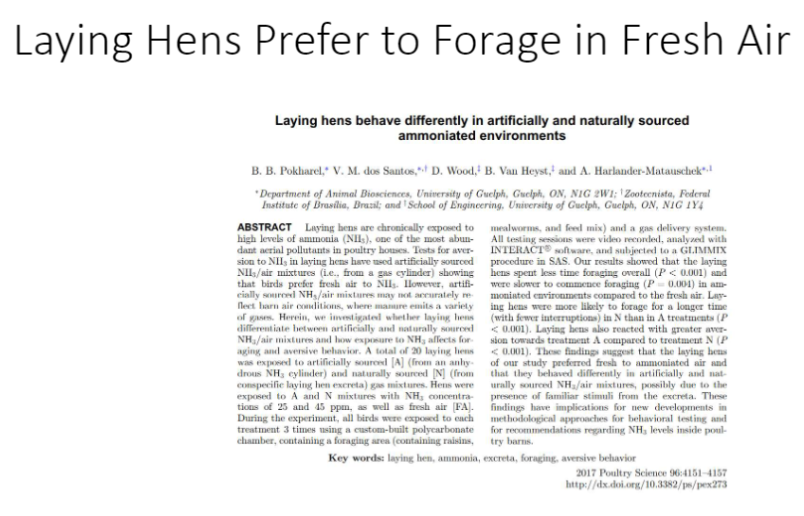
<p><strong>Observation</strong><br>ā€ƒHens show a strong preference for <strong>foraging outdoors</strong> rather than staying inside</p><p><strong>Benefits</strong><br>ā€ƒAccess to <strong>fresh air</strong>, natural <strong>food sources</strong> (plants, insects, worms), and space for <strong>locomotion and body maintenance</strong></p><p><strong>Key Point</strong><br>ā€ƒProviding <strong>outdoor access</strong> supports <strong>natural behaviors</strong> and improves <strong>welfare</strong></p>
20
New cards

Welfare Trade-Offs Among Housing Systems – Laying Hens

Conventional Cages
ā€ƒLimited space and movement
ā€ƒMinimal opportunity for natural behaviours like foraging, dustbathing, and perching

Enriched Cages
ā€ƒProvide more space and amenities: perch, nest box, scratching area
ā€ƒAllow some natural behaviours but still restricted compared to non-cage systems

Non-Cage Systems
ā€ƒGreater freedom of movement and access to perches, litter, and scratching areas
ā€ƒSupport a wider range of natural behaviours
ā€ƒRequire careful management to reduce injuries, disease, and feather pecking
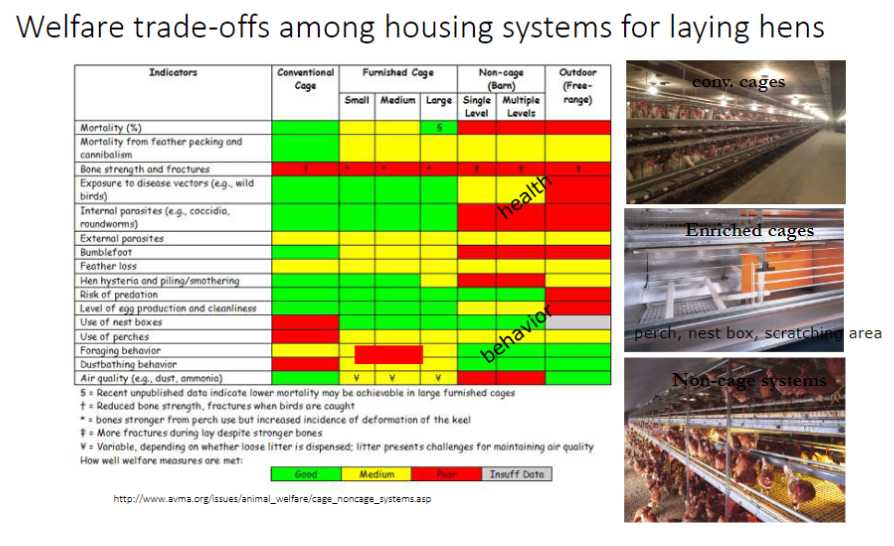
<p><strong>Conventional Cages</strong><br>ā€ƒLimited <strong>space</strong> and <strong>movement</strong><br>ā€ƒMinimal opportunity for <strong>natural behaviours</strong> like <strong>foraging, dustbathing, and perching</strong></p><p><strong>Enriched Cages</strong><br>ā€ƒProvide more <strong>space</strong> and amenities: <strong>perch, nest box, scratching area</strong><br>ā€ƒAllow some <strong>natural behaviours</strong> but still <strong>restricted compared to non-cage systems</strong></p><p><strong>Non-Cage Systems</strong><br>ā€ƒGreater <strong>freedom of movement</strong> and access to <strong>perches, litter, and scratching areas</strong><br>ā€ƒSupport a wider range of <strong>natural behaviours</strong><br>ā€ƒRequire careful management to reduce <strong>injuries, disease, and feather pecking</strong></p>
21
New cards

Mortality in Laying Hens – Cage vs. Non-Cage Systems

General Trend
ā€ƒMortality is generally higher in non-cage systems compared to furnished cages

Mortality Rates
ā€ƒCommercial indoor & free-range systems: 3–12%
ā€ƒFurnished cages: 2.8–5.4%
ā€ƒNon-cage systems: 8–9.4%

Management Impact
ā€ƒGood management practices can significantly reduce mortality in non-cage systems, e.g., from 22% to 6%

Key Point
ā€ƒFurnished cages have lower mortality than non-cage systems, but proper management can improve survival in aviary, floor, and free-range systems
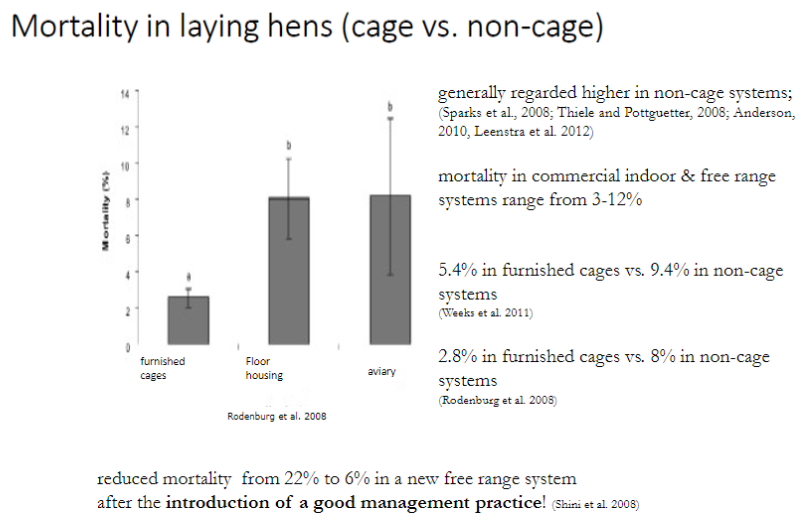
<p><strong>General Trend</strong><br>ā€ƒMortality is generally <strong>higher in non-cage systems</strong> compared to <strong>furnished cages</strong></p><p><strong>Mortality Rates</strong><br>ā€ƒ<strong>Commercial indoor &amp; free-range systems:</strong> 3–12%<br>ā€ƒ<strong>Furnished cages:</strong> 2.8–5.4%<br>ā€ƒ<strong>Non-cage systems:</strong> 8–9.4%</p><p><strong>Management Impact</strong><br>ā€ƒGood <strong>management practices</strong> can significantly reduce mortality in non-cage systems, e.g., from <strong>22% to 6%</strong></p><p><strong>Key Point</strong><br>ā€ƒ<strong>Furnished cages</strong> have lower mortality than non-cage systems, but proper <strong>management</strong> can improve survival in <strong>aviary, floor, and free-range systems</strong></p>
22
New cards

Mortality in Brown Layers – Cage vs. Floor Housed (Ontario)

Breeds Studied
ā€ƒHyline Brown 40%
ā€ƒISA Brown 50%
ā€ƒLohmann Brown 10%

Flock Sizes
ā€ƒCage-housed flocks: mean 15,194 hens (range 5,180–30,122)
ā€ƒFloor-housed flocks: mean 8,208 hens (range 1,992–15,065)

Key Point
ā€ƒCage-housed flocks tend to be larger, while floor-housed flocks are smaller, which may influence mortality and management practices
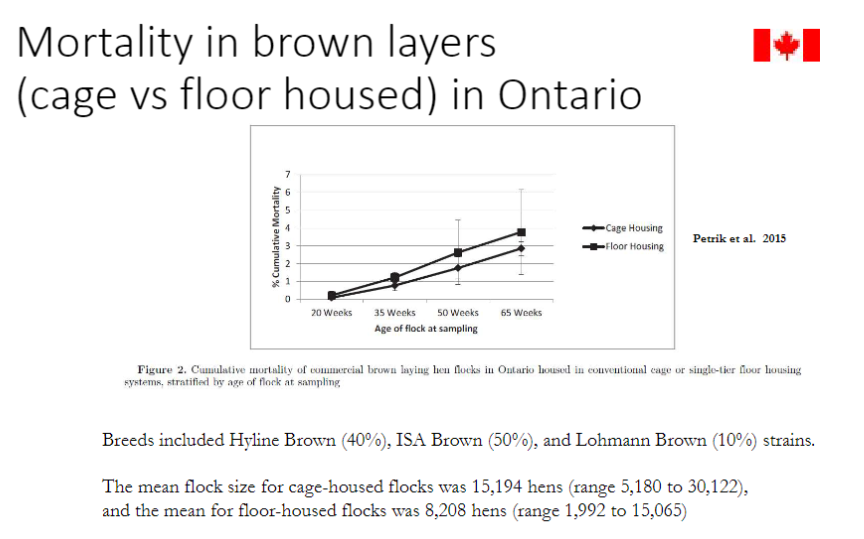
<p><strong>Breeds Studied</strong><br>ā€ƒ<strong>Hyline Brown</strong> 40%<br>ā€ƒ<strong>ISA Brown</strong> 50%<br>ā€ƒ<strong>Lohmann Brown</strong> 10%</p><p><strong>Flock Sizes</strong><br>ā€ƒ<strong>Cage-housed flocks:</strong> mean 15,194 hens (range 5,180–30,122)<br>ā€ƒ<strong>Floor-housed flocks:</strong> mean 8,208 hens (range 1,992–15,065)</p><p><strong>Key Point</strong><br>ā€ƒCage-housed flocks tend to be <strong>larger</strong>, while floor-housed flocks are <strong>smaller</strong>, which may influence <strong>mortality and management practices</strong></p>

Explore top notes

note
APHUG Unit 4 Summary
Updated 431d ago
0.0(0)
note
Vocabulary
Updated 1372d ago
0.0(0)
note
Conservation of Mass
Updated 1221d ago
0.0(0)
note
Chapter 12 - The Family
Updated 563d ago
0.0(0)
note
Chapter 9: Transitions
Updated 1022d ago
0.0(0)
note
Fluid Pressure
Updated 1264d ago
0.0(0)
note
APHUG Unit 4 Summary
Updated 431d ago
0.0(0)
note
Vocabulary
Updated 1372d ago
0.0(0)
note
Conservation of Mass
Updated 1221d ago
0.0(0)
note
Chapter 12 - The Family
Updated 563d ago
0.0(0)
note
Chapter 9: Transitions
Updated 1022d ago
0.0(0)
note
Fluid Pressure
Updated 1264d ago
0.0(0)

Explore top flashcards

flashcards
psych exam 5
58
Updated 699d ago
0.0(0)
flashcards
Chemistry Midterm #6
21
Updated 844d ago
0.0(0)
flashcards
HEAL 2600 Midterm **UPDATED**
117
Updated 470d ago
0.0(0)
flashcards
tale of 2 cities vocab 10-13
20
Updated 700d ago
0.0(0)
flashcards
Elements
30
Updated 415d ago
0.0(0)
flashcards
unit 1
62
Updated 1202d ago
0.0(0)
flashcards
psych exam 5
58
Updated 699d ago
0.0(0)
flashcards
Chemistry Midterm #6
21
Updated 844d ago
0.0(0)
flashcards
HEAL 2600 Midterm **UPDATED**
117
Updated 470d ago
0.0(0)
flashcards
tale of 2 cities vocab 10-13
20
Updated 700d ago
0.0(0)
flashcards
Elements
30
Updated 415d ago
0.0(0)
flashcards
unit 1
62
Updated 1202d ago
0.0(0)