PLCY 340 Final
 Studied by 0 people
 Call Kai
 Learn
Learn Practice Test
 Spaced Repetition
 Match
Match Flashcards
 Knowt Play
1/15

Earn XP
Description and Tags
Lectures 22-34
Name | Mastery | Learn | Test | Matching | Spaced |
|---|
No study sessions yet.
16 Terms
Harm Principle
individuals should be free to act in cases where their actions pose no significant risk of harm to others; it’s only aceptable for society to interfere with individual liberty/exercize power over an individual when it’s done to protect harm from coming to others (only interfere in other regarding sphere)
doesn’t include harming oneself
doesn’t apply to children/people who are deemed to not be in complete control of their own faculties
prevents tyranny of the majority(tendency of democracies to impose forms of conduct favored by the dominant majority, such as through sodomy laws, prhibitions on weed, etc)
spheres of action:
self-regarding (conscience [freeodom of religious belief, thought, and feeling], lifestyle [freedom of tastes], interactions with consenting adults)
other regarding (speech, motor vehicle operation, pollution)
Nudges
choice architecture: the organization of the context in which people make decisions; the design of choice situations affect the decisions individuals make
nudge: any aspect of the choice architecture that alter's people’s behavior in a predictable way without forbidding options or significantly changing their economic incentives
distinct from coercive policies (restrictions/mandates), taxes, and provision of information
two systems: automatic (gut instinct) and reflective (conscious thought) → nudges impact automatic by changing our immediate reactions
consistent with harm principle and more effective than providing information, but paternalistic and posibly manipulative
compare to: information (public education campaigns, warning labels), taxing items to disincentivize their purchase, SNAP specific soda purchasing ban
Orthodoxy
commitment to preserving/realizing traditional moral norms and favored economic arrangements on the grounds that they fulfill some ultimate truth (e.g., fulfill “natural law” or realize a particular religious doctrine
Philosophical Conservatism
loosely defined policitical philosophy holding that existing institutions ought to be conserved (oppositiong to sweeping reform, though conservation may involve/necessitate gradual reform)
Starting Points:
pessimistic about human nature: we are morally imperfect and therefore need to be civilized and constrained by society’s institutions and traditions (emphasis on moral education via family, school, religion, and skepticim of unrestrained freedom)
skepticism about human reason: societies are incredibly complex and human reason is limited; we shouldn’t think that philosophers and social scientists can use their rational capacities to construct ideal principles/policies/institutions (therefore, reform existing policies and don’t make large-scale change/overhaul institutions)
Themes:
order: societies need authoritative institutions to ensure order, a precondition of living well
freedom: to live in accordance with traditions and conceptions of the good life, but must be restrained b/c of imperfections of human nature
community: communities are necessary for good lives and transmission of moral education and tradition
property: ensures freedom and order, but also preserves ties to family and place
tradition: practices/traditions often have latent functions that aren’t immediately apparent to social scientists; changing them dramatically culd have major unintended consequences
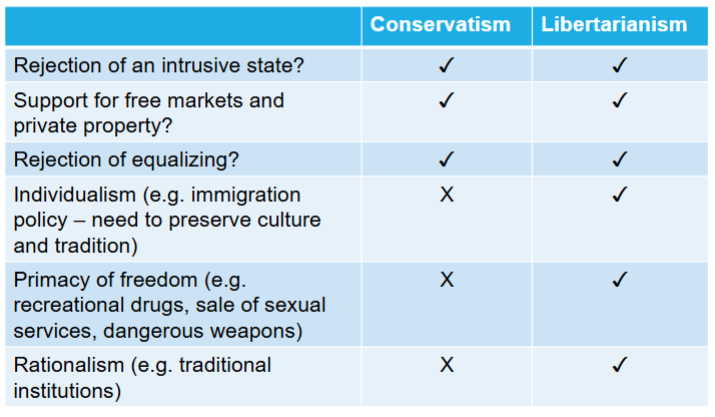
Conservatism vs. libertarianism
Open borders
the lifting of restrictions on people’s movement across national borders, with exceptions for public safety and public health
arguments in favor:
welfare
equality of opportunity (life prospects shouldn’t be determined by the country you’re born into because it’s morally arbitrary)
freedom (libertarian justification; borders are coercive state power)
Blake’s Three Arguments for Open Borders
Policy of exclusion may promote state’s ability to realize a just order, namely through the promotion of three goods:
Decolonization: the border functions as a site of resistance against external domination from other cultures via mass migration; exclusion protects the political domination of indigenous voices from foreign ones (mainly applies to border crossing by rich people)
Solidarity: given negative particularity, exclusion may promote solidarity, which undergirds trust in government and commitment to redistribution; high levels of immigration make a high trust society with lots of redistributin very difficult
positive particularity: people only flourish within particular communities, and they are right to promote the interests and values of group members over others
negative particularity: the prediction that people are morally flawed and limited in attention, and so are likely to limit their moral concern to the local group (basically, people are bad at solidarity with non-group members)
increased diversity has bnefits, but it is also accompanied by decreased amounts of trust, altruism, and social cooperations
Social Insurance: open borders allow people to favor jurisdictions that reward their present way of life, but this is unsustainable becuase you can’t have safety nets if the rich can move to areas with low taxes; exclusion enables states to opt for security for citizens, and security requires most people live and work in the jurisdiction from which they derive benefits
Just War Theory
war is morally permissable (perhaps even required) under certain conditions
Jus Ad Bellum: justice of resorting to war
just cause: national defense of one’s own state or ally, humanitarian intervention
legitimate authority
right intention (fuliflling the just cause, not monetary gain)
proportionality (relevant harms and benefits must be proportional to the wrongs it aims to address)
reasonable hope of success (prohibition of reckless waste of citizens’ lives and resources)
last resort (no non-military options left, like diplomacy or sanctions)
Jus In Bello: justice in war
discrimination (non-combatant immunity)
proportionality of means: the harms of the use of force must be proportional to the value of the strategic end; least harmful means must be chosen
Jus Post Bellum: justice after war
Wolfendale’s Proposal: principle of moral equality of noncombatants (all civilian lives matter equaly; would we carry out a planned strike if the civilians at risk of harm were our civilians?)
Discrimination
targeting noncombatants is impermissible; civilians and civilian infrastructure should not be deliberately targeted, even if they are in favor of the actions of their government/military, and steps should be taken to minimize civilian casulties
BUT: discrimination does not forbid all harms to citizens
Doctrine of Double Effect: it’s morally permissible to cause harm to innocent people if:
the harm is unintende, but merely a forseeable side effect
the intention of the action is to bring about a good result
there is no less harmful way to bring about the good result
the good result outweighs the harm
Proportionality
the harms of the use of force must be proportional to the value of the strategic end, and the least harmful feasible means must be chosen (even if this involves putting soldiers in greater danger)
what is the value of the military objective of a particular strike? what are the expected harms to civilians/civilian infrastructure? is the value of the military objectve propertionate to the harms to citizens? is there a less harmful way to achieve the military objective?
Principles of Research Ethics
Belmont Report: statement of ethical principles and guidelines to govern human subjects research; provide basis for federal regulations
practice: interventions designed solely to enhance wellbeing and have a reasonable expectation of success; research: activity designed to test a hypothesis, permit conclusions to be drawn, and thereby develop or contribute to generalizable knowledge
respect for persons: individuals should be treated as autonomous agents, and persons with diminshed autonomy are entitled to protection
informed consent
benifience: do no harm; maximize possible benefits and minimize possible harms
justice: justice in selection of subject, and justice in distribution of benefits and burdens of research
fair selection of research subjects
non-discrimination in selection of subjects of beneficial research
concern for social, racial, sexual, and cultural biases and how they impact opportunities for participation
prioritization of subjects on basis of ability to bear burdens of research
protection for vulnerable populations
justice in distribution of benefits and burdens of research
Informed Consent
individuals are entitled to decide whether to participate in research or not on the basis of their own values and preferences
information: information that is materially relevant to decision to enrol must be disclosed (risks, procedures, benefits, alternatives)
comprehension: subjects must understand relevant information
voluntariness: consent must be free of coercion and undue influence
Standard of Care
gvernment agencies may assign participants to an intervention only if it is not reasonably expected to be inferior with respect to the realization of target outcomes than the policy the pariticpant would otherwise get, the policy that the government has a DUTY to implement, that is the most effective policy which it has the authority and resources to sustainably implement
governments have duties of justice to realize “target outcomes” for residents, and therefore must implement policies that are
best proven (evidence based)
consistent with people’s rights
attainable and sustainable (given resources and target outcomes)
BPA policy
Policy Equipoise
indeterminancy between the intervention and control arm regarding the realization of target outcomes
government agencies may randomly assign participants to different policy interventions if they occupy a state of genuine equipoise regarding all arms of the study and the BPA policy
lotteries sanitize the decision-making process from the influence of reasons, and are permissible in the context of policy RCTs when decision-makers are in a state of equiposie (don’t know if intervention or control is better) or if they are in a state of indeterminancy over who should have access to the intervention arm
if intervention is scarce, government may randomly assign participants to it as long as they all have equally strong claims to the intervention and no person’s claim is left unmet longer than is necessary due to legitimate scarcity
Retributivism
criminals deserve to be punished
substantive argument for death penalty: lex talonis
criminal deserve to be punished
principle of lex talonis: an eye for an eye
implication: execute murderes
problem: what to do about torturers and rapists
Proportionality and commensurability (punishment)
proportionality: severity of punishment should be equivalent to severity of a crime — most severe punishment should be reserved for most severe crime
commensurability: punishments must be commensurable to crimes (can’t have fines from 1-100 for murder)
you can have proportionality without commensurability if, for example, you reserved the $100 fines for murderers, because you’re saving the most severe punishment for the most severe crime
if death is proportional to and commensurable with first degree murder, then capital punishment is morally permissible from a substantive perspective
substantive: is the death penalty inherently moral or immoral?
procedural: if it is morally permissible, then:
comparative: do the procedures that implement the death penalty treat one group worse than the other and is therefore unfair for that reason?
non-comparative: do the procedures that implement the death penalty treat people unfairly as individuals?