Week 7 Lesson 50: Eye Examination
 Call Kai
 Learn
Learn Practice Test
 Spaced Repetition
 Match
Match Flashcards
 Knowt Play
1/47

There's no tags or description
Looks like no tags are added yet.
Name | Mastery | Learn | Test | Matching | Spaced | Call with Kai | Chat |
|---|
No analytics yet
Send a link to your students to track their progress
48 Terms
What are the 4 tests of an ophthalmic examination?
Hands off
Hands on, lights on
Hands on, lights off
Additional tests
What does the first step of the ophthalmic examination, hands off, mean?
LOOKing for conformation, discharge, discomfort/pain, blink rate, blepharospasms, photophobia
What does the second step of the ophthalmic examination, hands on, light on, mean?
Maze test
Detailed “Look” at palpation, retropulsion, corneal reflectivity and several reflexes
What does the third step of a ophthalmic examination, hands on, lights off mean?
Darness and light source to test ref
What are some tests that are used for vision testing?
Menace responce
Visual tracking (Cotten wool drop, laster pointer)
Visual placing (maze test/obstacle course)
What test is a rudimentary assessment of vision manifested by blinking? If it’s absent, it may reflect an intra-ocular lesion, damage to visual neural pathways, facial nerve dysfunction, reduced mentation, or immaturity.
Menace response
At what does the menace response fully develop?
2-3 weeks
What test results in retraction of the globe and blinking on response to a bright light. The response of subcortical and may help to differentiate cortical blindness form disease of the eye, optic nerve or optic tract.
Dazzle reflex
What test assesses the integrity of the trigeminal nerve (Sensory), the facial nerve (motor), and neural connections in the brainstem? Assessed before sedation or regional anaesthesia.
Palpebral and corneal reflexes
What test assesses the integrity of the retina, subcortical visual pathways, efferent parasympathetic function of the oculomotor nerve and the iris constrictor muscle. Both the direct and consensual portion of this test should be assessed before sedation or use of mydriatics.
PLR
In what species is the consensial reflex is weak?
Horses
T/F: An intact PLR does not indicate vision because the reflex is subcortical.
True
What are the three basic ophthalmic test?
Schirmer tear test
Fluorescein
Tonometry
What are the four different types of ancillary diagnostic tests?
Mydriasis
Gonioscopy
Swabs, Scrapes, biopsy
ERG, Ultrasound, Scans
What test is performed to ensure that the eyes are producing enough tears to keep them moist?
Schirmer tear test
T/F: The STT should always be performed after any drops are placed on the eye or the eye is cleaned?
False
What test is touched to the upper fornix with a strip into each eye, which allows defects in the cornea to be spotted?
Fluorescein stain
What test is uses a tonometer to detect the pressure within the eye?
Intraocular pressure
What can be flushed to evaluate the external parts of the eye?
Nasolacrimal tear duct
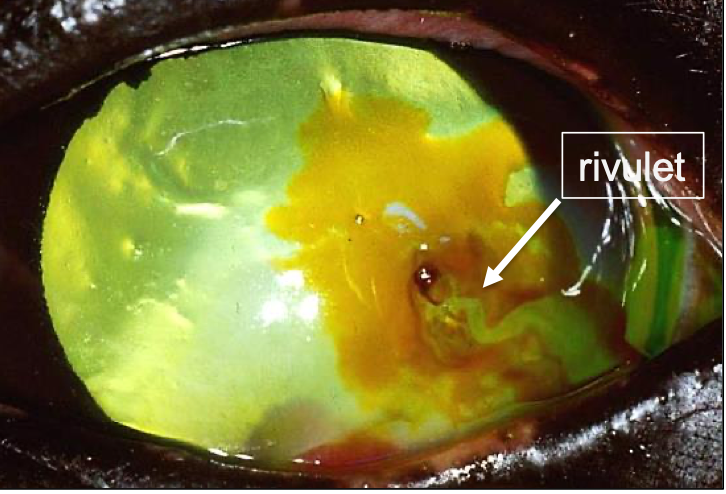
What test is used for eye perforations?
Seidel test

What test is used for a naso-lacrymal flush to test the external parts of the eye?
Jones test
What are the two types of tonometers are used to estimate the IOP?
Applanation or rebound
Depending on the type fo tonometer used, prior instillation of what may be required?
Topical anesthetic
T/F: Tonometry should be performed before dilation of the pupil.
True
A swab may also be used to obtain a sample of bacteria or fungi for what?
Culture
What does the direct and indirect ophthalmoscopic examination evaluate?
lens, vitreous, and ocular fundus
When shoudl direct and indirect ophthalmoscopic examination be performed?
After inducing mydrisis with tropicamide because without dilation they cannot be fully evaulated
What is the drug that used to dilate eyes for direct and indirect ophthalmoscopy?
Tropicamide
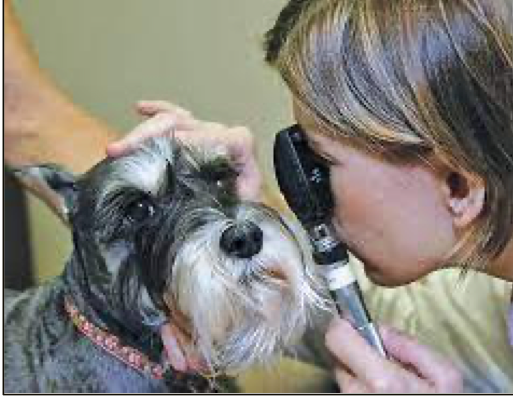
What type of ophthalmoscopy is this?
Direct
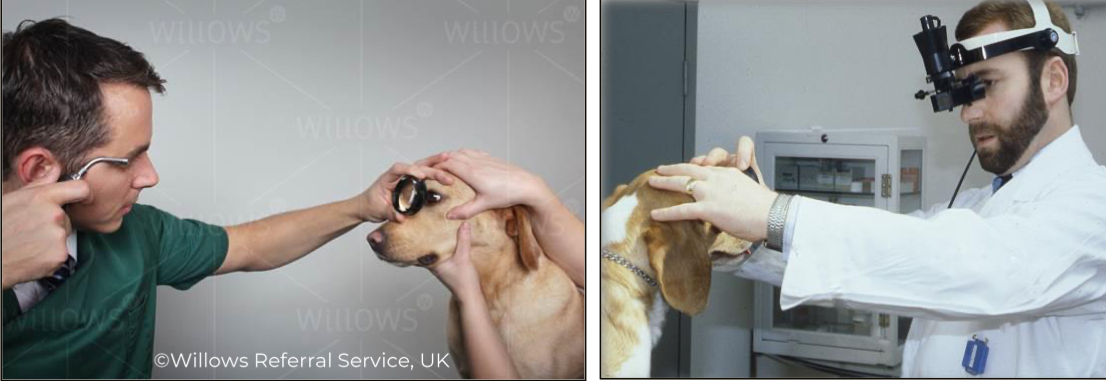
What type of ophthalmoscopy is this?
Indirect

What structure is indicated by the yellow and blue arrows?
Tapetal fundus
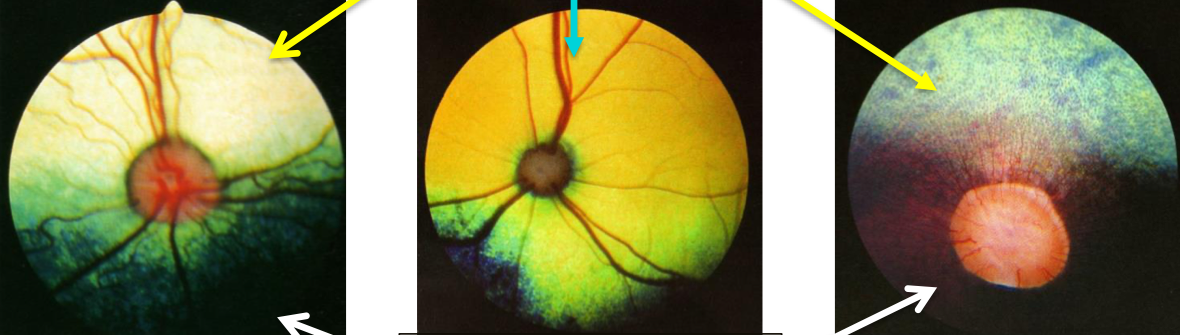
What structure is indicated by the white arrows?
Non-tapetal fundus
What is a special methods of examination, may require sedation or local, regional or general anesthesia depending on the species?
SLB
Ultrasound
ECG
What test evaluates the retinal ganglion cells and their axons? it is used to assess night blindness in horses when all other signs are normal.
Electroretinography
What test is used for measurement and visualization of the iridocorneal angle and drainage angle?
Gonoioscopy
T/F: Examinations should start from inward to outward and from anterior to posterior.
False
What are the reasons for an eye exam in a horse?
Routine neonatal
PPE
Trauma
Ocular discharge
Change in shape/size
How do you perform a thorough ophthalmic exam on a horse?
In the dark by turning the horse to the darkest corner of the stable for direct opthalmoscopy
What two nerve blocks are used to faciliate an ophthalmogogic exam?
Auriculopalpebral and supraorbital
What are the topical anesthesia that is used in horses to facilitate an opthalmologic exam?
Proparacaine drops
What condition is common issue in horses and should be checked using fluorscein?
Blocked tear ducts
What stain is used in mostly in large animals?
Rose bengal staining
In equine patients all red or painful eyes much be stained with what stains?
Fluorescien and rose bengal dyes
What may rapidly progress to an eye rupture in horses?
Corneal ulcers
What are bad when the cornea retains fluorescein stain?
Topical corticosteroids
What can be caused by a corneal ulcer or stromal abscess may be very difficult to control?
Uveitis
What are things to look for in a far off exam of livestock?
Is it uni or bi lateral
Discharge
Related to rest of body systems