Cardio: Exam 3 (Tsu)
 Call Kai
 Learn
Learn Practice Test
 Spaced Repetition
 Match
Match Flashcards
 Knowt Play
1/91

There's no tags or description
Looks like no tags are added yet.
Name | Mastery | Learn | Test | Matching | Spaced | Call with Kai | Chat |
|---|
No analytics yet
Send a link to your students to track their progress
92 Terms
Determine if the following statements describe Vtach or Vfib or both.
Torsades is a form of this rhythm.
This is the more life-threatening rhythm.
Can have a regular or irregular rhythm.
Usually occurs due to irritable ventricular foci.
Torsades is a form of this rhythm: Vtach
This is the more life-threatening rhythm: Vfib
Can have a regular or irregular rhythm: Vtach
Usually occurs due to irritable ventricular foci: Both
What are the possible causes of ventricular arrhytmias and cardiac arrest?
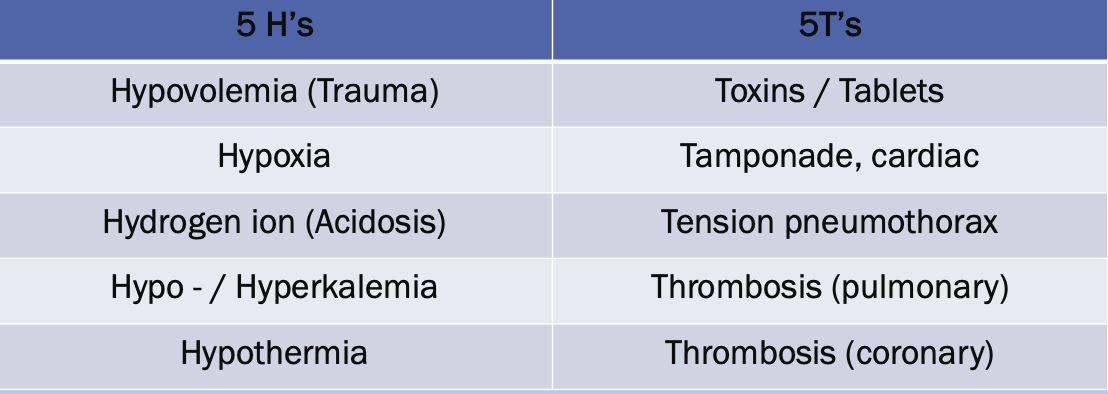
How do you manage the 5 T’s?
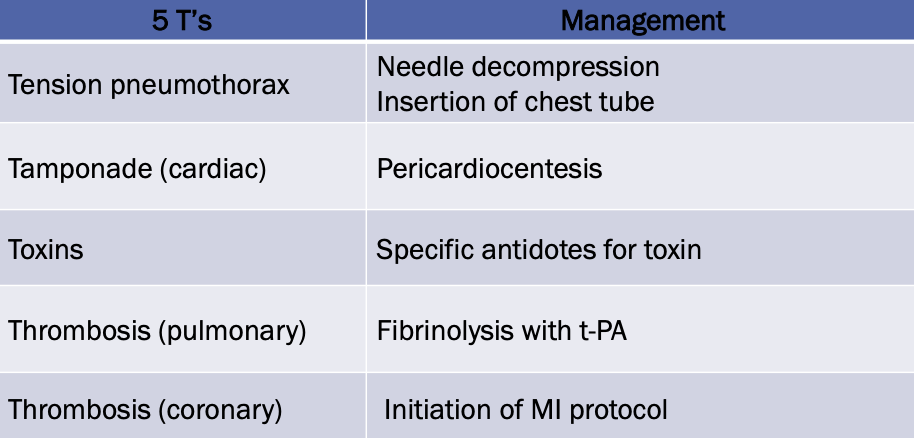
How do you manage the 5 H’s?
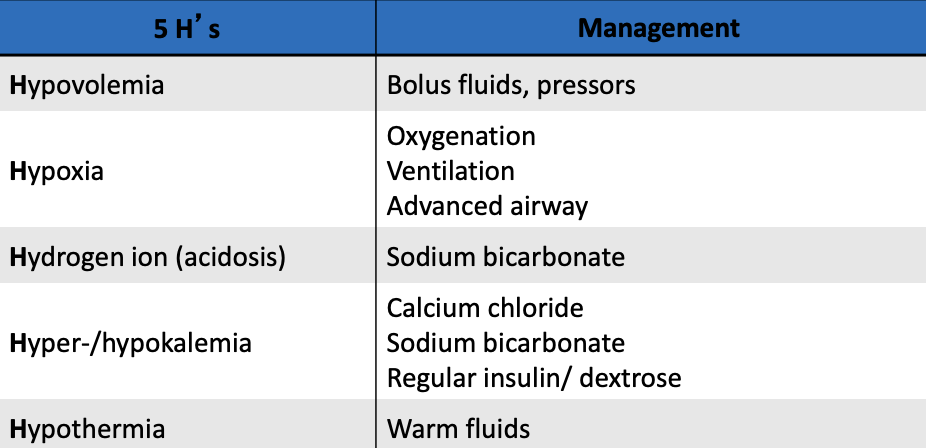
YU is a 56 year old female who is recovering in the hospital after hip surgery. Overnight, her cardiac rhythm changes from sinus tachycardia to ventricular tachycardia to asystole. Her BP is dropping to 70/50 mm Hg and she has no detectable pulses. What are the steps to treatment for YU?
A. Cpr, shock, cpr, meds
B. Cpr, meds, shock, cpr
C. Meds, cpr, meds
D. Cpr, meds, cpr
D:
Always start w/ CPR
Epinephrine ASAP
CPR 2 min
3. Which statement is accurate about YU? (Select all that apply)
A. If the patient has return of spontaneous circulation, targeted temperature management should be started
B. If the patient only has peripheral IV line, we should give higher doses of medications C. This rhythm could have been caused by acidosis, hypovolemia, or a pulmonary embolism
D. If the patient has a wide complex rhythm, we could use procainamide
A. If the patient has return of spontaneous circulation, targeted temperature management should be started
B. If the patient only has peripheral IV line, we should give higher doses of medications
Medication doses are the same for peripheral or central
C. This rhythm could have been caused by acidosis, hypovolemia, or a pulmonary embolism
D. If the patient has a wide complex rhythm, we could use procainamide
Procainamide is not indicated for asystole
4. Which of the following are steps in treating pulseless electrical activity? (Select all that apply)
A. Shock B. CPR C. Administer amiodarone D. Administer epinephrine E. Check pulses
A. Shock
B. CPR
C. Administer amiodarone
D. Administer epinephrine
E. Check pulses
Elevated levels of _ increases risk of seizures
Lidocaine
5. Which statement is accurate regarding bradycardia?
A. Intraosseous administration is preferred over intravenous administration
B. Atropine stimulates the beta-1 receptors in the myocardium
C. A pacemaker should be implanted if the heart rate is less than 60 bpm
D. Dopamine at intermediate (or medium) doses can be used if the patient is symptomatic
A. Intraosseous administration is preferred over intravenous administration
B. Atropine stimulates the beta-1 receptors in the myocardium
AchR antagonist
C. A pacemaker should be implanted if the heart rate is less than 60 bpm
Only use if symptomatic
D. Dopamine at intermediate (or medium) doses can be used if the patient is symptomatic
6. Which of the following is a reversible cause of cardiac arrest?
A. Pulmonary embolism B. Hyperglycemia C. Alkalosis D. Hypertension
A. Pulmonary embolism
7. Which statement is accurate regarding ventricular arrhythmias?
A. Pulseless electrical activity is a shockable cardiac arrest rhythm.
B. Chest compressions should be performed in cycles of 100 compressions and 2 breaths.
C. Procainamide and amiodarone can be used to treat wide-complex stable tachycardia. D. Adenosine should be infused over 1-2 minutes to avoid hypotension.
A. Pulseless electrical activity is a shockable cardiac arrest rhythm.
B. Chest compressions should be performed in cycles of 100 compressions and 2 breaths.
30 compressions, 2 breaths
C. Procainamide and amiodarone can be used to treat wide-complex stable tachycardia. D. Adenosine should be infused over 1-2 minutes to avoid hypotension.
Half-life <10 seconds → adminster as RAPID iv push
Which medication is used in pulseless electrical activity?
A. Epinephrine B. Amiodarone C. Sotalol D. Lidocaine
A:
Only Epinephrine is used for non-shockable rhythms
What medications are used for cardiac arrest?
Epinephrine
Amioadarone
Lidocaine
Vasopressin
Epinephrine Dosing: Cardiac Arrest
1mg Q 3-5 minutes
Amiodarone Dosing: Cardiac Arrest
300 mg bolus, then 150 mg
What are adjunctive ACLS medications and when are they used?
Magnesium → Torsades de Pointes
Sodium Bicarbonate → If acidosis
Thrombolytics → If concern for MI or pulmonary embolism
Lidocaine Dosing: Cardiac Arrest
1-1.5 mg/kg, then 0.5-0.75
Which statement is most accurate regarding medications used in ACLS? Correct the incorrect statements.
A. Epinephrine is used to decrease the fibrillation threshold
B. Vasopressin use is no longer recommended routinely
C. Amiodarone dosing is 1mg every 3-5 mins
D. Sodium bicarbonate should be given to all pts to prevent acidosis
A. Epinephrine is used to decrease the fibrillation threshold
Epinephrine is used to increase coronary and cerebral perfusion pressures, increases vasoconstriction
Amiodarone and Lidocaine are used to increase the fibrilation threshold
B. Vasopressin use is no longer recommended routinely
C. Amiodarone dosing is 1mg every 3-5 mins
Epinephrine dosing: 1mg q 3-5 min
Amiodarone dosing: 300 mg bolus, then 150 mg
D. Sodium bicarbonate should be given to all pts to prevent acidosis
Used as an adjunctive med if they ALREADY have acidosis, not used for prevention
All meds for cardiac arrest should be administered by _
Rapid IV push
Which statement is accurate? Correct the incorrect statements.
A. Endotracheal medication dosing is 1:1 with IV dosing
B. Intraosseous route is only indicated for certain ACLS medications
C. Targeted temperature management is indicated to preserve cardiac function
D. During targeted temperature management, patients are cooled for 5-7 days
E. Common complications of targeted temperature management include arrhythmias and infection
A. Endotracheal medication dosing is 1:1 with IV dosing
Intraosseous dosing: 1 (IV):1 (IO)
Endotracheal dosing is 1 (IV): 2-2.5 (Endotrecheal)
B. Intraosseous route is only indicated for certain ACLS medications
Endotracheal
Intraosseous can be used for all ACLS drugs
Intraosseous can be used for all ACLS drugs
C. Targeted temperature management is indicated to preserve cardiac function
Cerebral function
D. During targeted temperature management, patients are cooled for 5-7 days
12-24 hours
E. Common complications of targeted temperature management include arrhythmias and infection
What are A.E of targeted temperature management?
Arrhythmias
Electrolyte disorders
Hyperglycemia
Decreased drug clearance
Coagulation disorders
Infections
Shivering
What medications are used for bradycardia?
Atropine
Epinephrine
Dopamine
You are helping to manage a patient who is becoming bradycardic with a heart rate in the 40s. She is now hypotensive and is becoming slightly mentally altered with slurred speech.
How should we manage this patient? Why?
Which medication is first line for this patient?
If this medication is ineffective, what are the next steps?
Start medications since symptomatic
First line: Atropine 1 mg bous
Repeat Atropine, consider Epinephrine or Dopamine
What medications are used for stable tachycardia?
Adenosine
Procainamide
Amiodarone
Rapid IV administration of Amiodarone can cause _ and _
Hypotension
Bradycardia
You are on patient rounds when the team sees the patient develop the rhythm below, which is a wide complex ventricular tachycardia. The patient appears to be slightly agitated and restless. BP = 142/86, HR 120, RR 26. Should we treat this patient with medications? Provide rationale. Which of the following medications would be reasonable for this patient?
A. Dopamine
B. Magnesium
C. Atenolol
D. Procainamide
Yes, treat to further prevent progression into Vfib
A. Dopamine → Increases HR, used for bradycardia. Pt. has tachycardia
B. Magnesium → Used for prolonged QT/torsades de pointes
C. Atenolol → Used for narrow complex, pt. has wide complex
D. Procainamide
A 67 year old male is on the telemetry floor, and suddenly converts from sinus tachycardia to a wide complex ventricular tachycardia (VT). While he is hemodynamically stable, his VT is sustained and is polymorphic, and you notice his QTc interval is 550 msec. Which therapy would be the best choice for this pt?
A. Procainamide B. Adenosine C. Amiodarone D. Magnesium E. No therapy is needed
A. Procainamide
B. Adenosine
C. Amiodarone
D. Magnesium → D/T the patient prolonged QTc = torsades
E. No therapy is needed
2. What is accurate about meds used when the pt. has cardiac rhythm changes from sinus tachycardia to ventricular tachycardia to asystole. and BP is dropping to 70/50 mm Hg and she has no detectable pulses?
A. Only treat the patient if they are showing symptoms
B. Amiodarone will help lower fibrillation threshold
C. Atropine is the first medication that should be used
D. Epinephrine affects both beta and alpha receptors
A. Only treat the patient if they are showing symptoms
Treatment should begin immediately in asystole
B. Amiodarone will help lower fibrillation threshold
Increase
C. Atropine is the first medication that should be used
Atropine is indicated for bradycardia
D. Epinephrine affects both beta and alpha receptors
If stable tachycardia is emergent or non-emergent, you should:
Emergent: cardioversion or adenosine
Non-emergent: Monitor and consult cardiologist, consider medications
Determine whether each statement describes A fib (AF) or A flutter.
1. Originates from a single ectopic focus in atrium
2. Rhythm is described as “regularly irregular”
3. No discernable p waves
1. Originates from a single ectopic focus in atrium
Aflutter
2. Rhythm is described as “regularly irregular”
Aflutter
Afib - “irregularly irregular”
3. No discernable p waves
Afib
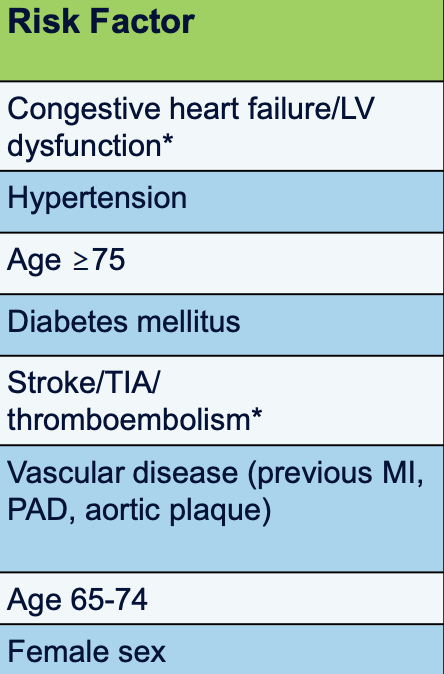
What is the CHA2DS2VASC Score?
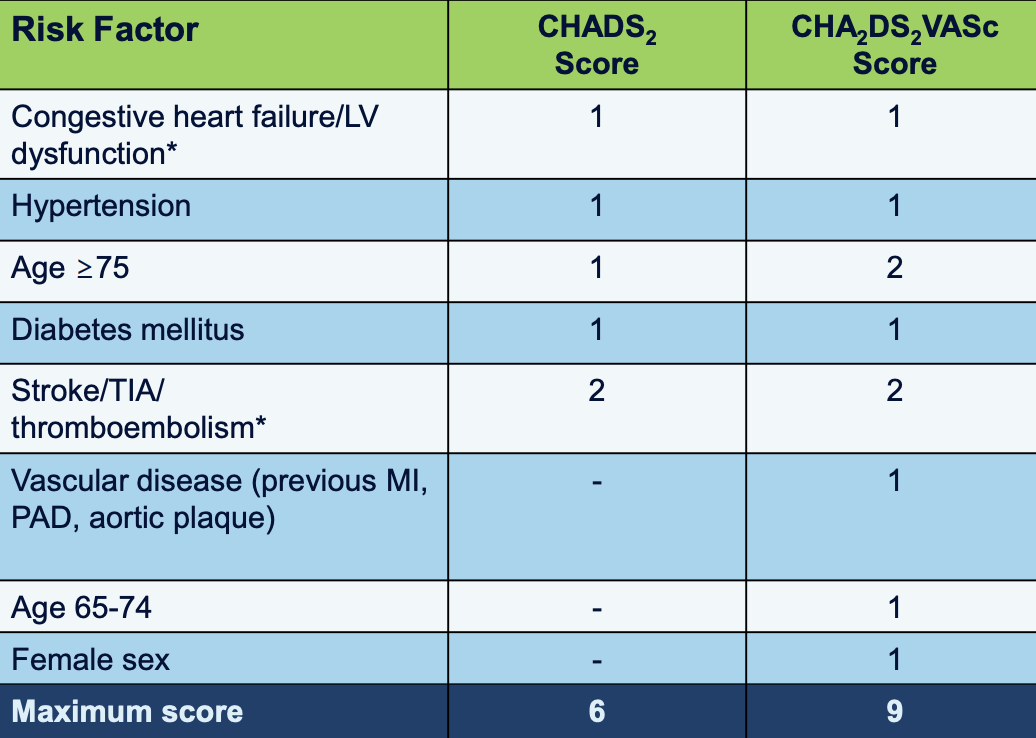
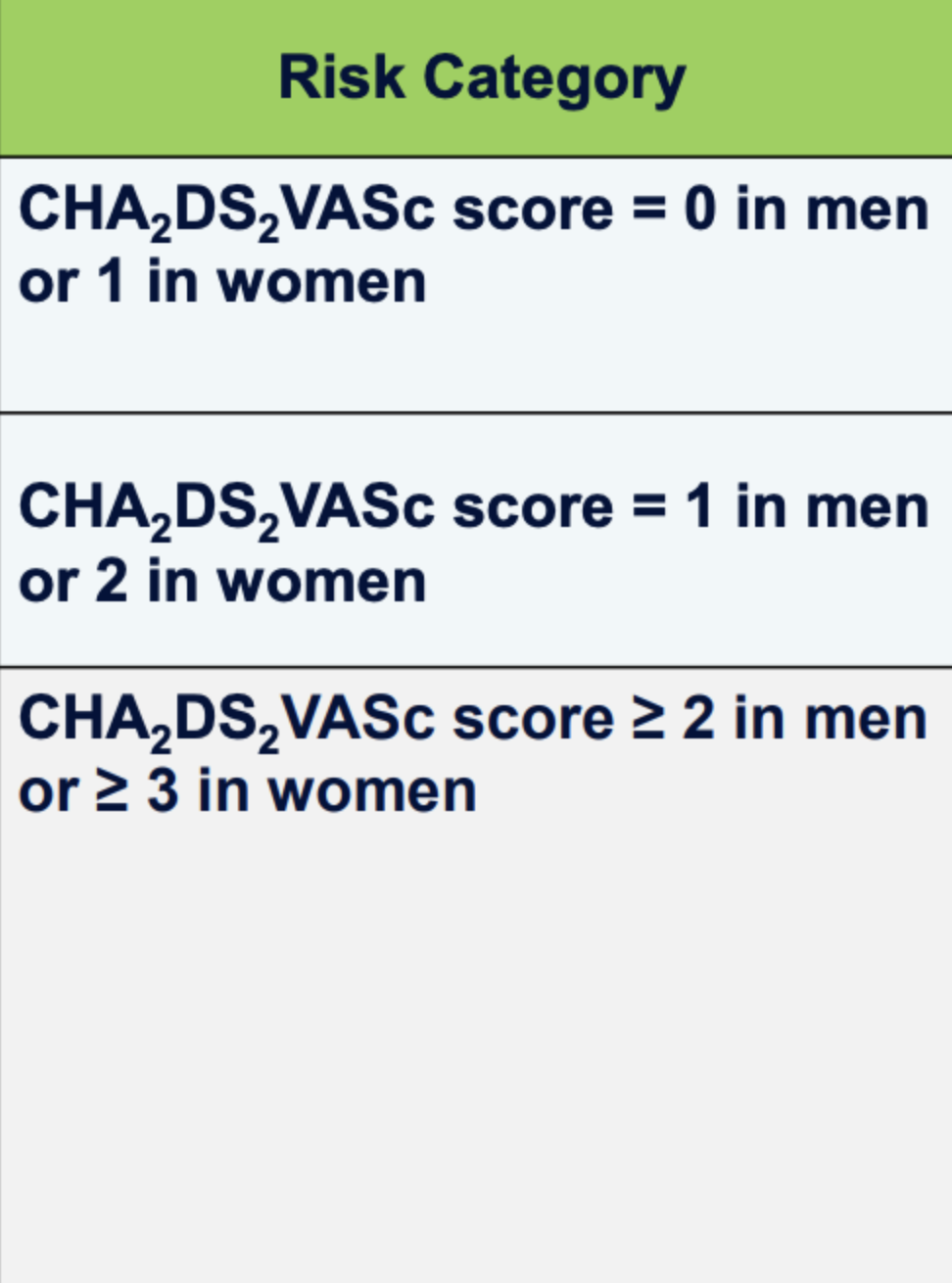
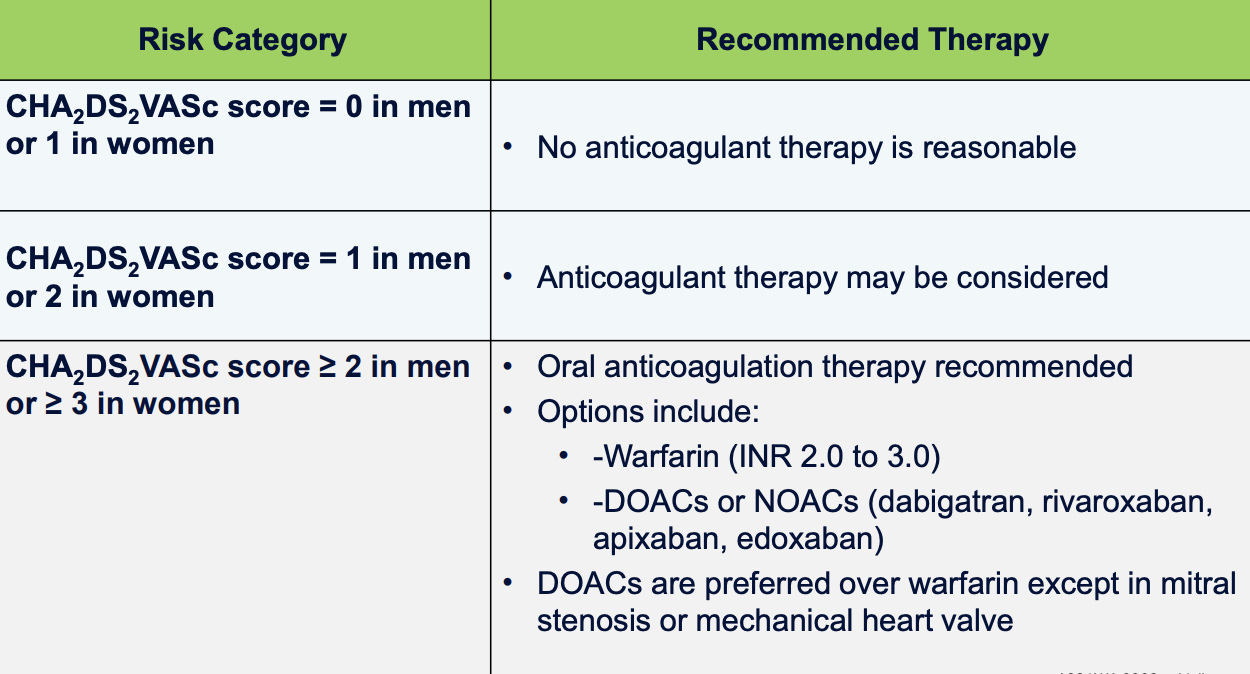
What are the antithrombotic therapy recommendations for the following risk categories?
RB is a 74 year old, 70kg female who presents to the hospital with new symptoms of cardioembolic stroke, and is diagnosed with new AF.
PMH: hypertension, hyperlipidemia, diabetes mellitus, myocardial infarction 2010, GI bleed 2012
SH: 1-2 glasses of wine/night, quit smoking 17 years ago
Vitals: BP 140/86 mmHg, HR 80 bpm, RR 20
Labs: Scr 0.8, AST/ALT WNL, electrolytes WNL, H/H 9.9/29.8, HgbA1c 7.2
Current medications: aspirin 81mg PO daily, carvedilol 12.5mg PO BID, simvastatin 40mg PO at bedtime, metformin 500mg PO BID
Assess RB’s risk of stroke. Determine if RB should be treated with anticoagulation.
RB’s stroke: 7 (Female (1), 74 (1), stroke (2), hypertension (1), MI (1), diabetes (1)
Yes, bc/ her CHADVASC score is >3
Which of the following is the best recommendation for anticoagulation for RB?
A. Increase aspirin to 325mg PO daily
B. Start warfarin 10mg PO daily, titrate to INR 2-3
C. Start rivaroxaban 15mg PO BID x 21 days, then 20mg daily
D. Start edoxaban 60mg PO daily and enoxaparin 70mg SC BID
E. Start apixaban 5mg PO BID
A. Increase aspirin to 325mg PO daily
Anticoags!
B. Start warfarin 10mg PO daily, titrate to INR 2-3
For VTE, do 10 mg for 2 doses then adjust after that - DO NOT DO DAILY WITH NO CHANGE.
Warfarin could be used but it’s just too high of a dose for the pt. → If it was 5mg, this could be a reasonable option
C. Start rivaroxaban 15mg PO BID x 21 days, then 20mg daily
Dosing for VTE
D. Start edoxaban 60mg PO daily and enoxaparin 70mg SC BID
Never do edoxaban and enoxaparin at the same time - double anticoags
E. Start apixaban 5mg PO BID
What drugs are for rate control?
BB
Non-DHP CCBs
Digoxin
What drugs are for AF w/ rapid ventricular response?
IV non-DHP CCBs
IV BBs
IV Digoxin
IV Amiodarone
What is used for AF w/ rapid ventricular response if the patient is hemodynamically unstable?
Cardioversion
TM is a 78 year old male who is presenting with fatigue, dizziness, and syncope. He is currently on metoprolol succinate 50mg daily succinate for rate control. His home BP log shows that his HRs are 80-90s, and his BP readings are 100-110s/60-70s. How should we adjust TM’s rate control therapy?
A. Increase metoprolol to goal HR 60-80
B. Decrease metoprolol, start diltiazem 120mg ER daily
C. Decrease metoprolol, start digoxin 0.125 mg daily
D. Discontinue metoprolol
A. Increase metoprolol to goal HR 60-80
Will worsen hypotension
B. Decrease metoprolol, start diltiazem 120mg ER daily
Dilitiazem decrease HR and B.P
C. Decrease metoprolol, start digoxin 0.125 mg daily
Digoxin will decrease H.R but NOT B.P → might also help w/ CO + H.F
D. Discontinue metoprolol
If D/C metoprolol → HR will go back up
Rate vs. Rhythm control strategy
Rhythm control strategy: Cardioversion then antiarrhythmic drugs to maintain NSR
Rate control strategy: Rate-control medications (BBs, Non-DHP CCBs, Digoxin)
What is the goal resting H.R?
<100-110 BPM
Warfarin (Comaudin) dosing
Dosing varies, usually 1-10 mg daily
Dabagitran (Pradaxa) dosing: AF and VTE
150 mg PO BID
Rivaroxaban (Xarelto) dosing: AF and VTE
AF: 20 mg PO daily
VTE: 15 mg PO BID x 3 weeks, then 20 mg PO daily
Apixaban (Eliquis) dosing: AF and VTE
AF: 5 mg PO BID
VTE: 10 mg PO BID x 1 week, then 5 mg PO BID
Edoxaban (Sayvasa) dosing: AF and VTE
AF and VTE: 60 mg PO daily
What are other AADs for pharmacological cardioversion?
Amiodarone
Dofetilide
Ibutilide (IV formulation only)
Flecainide
Propafenone
What are AADs for maintenance of normal sinus rhythm? Which one is the most effective?
Amiodarone (Cordarone, Pacerone) → Most effective
Dronedarone (Multaq
Dofetilide (Tikosyn)
Sotalol (Betapace AF)
Flecainide (Tambocor)
Propafenone (Rythmol)
WE is a 56 year old male who presents to the hospital with new AF with RVR. He states that his symptoms have been on-and-off for last week, and he came to the hospital since he is feeling more dizziness and nauseated. His BP is 88/58 mmHg and HR 132 bpm.
Is emergent cardioversion an option for WE?
Which echo modality should be used to visualize his left atrium?
Is elective cardioversion an option?
Based on his medical chart, you find his CHADS2-VASc score = 6. What recommendation do you have for his antithrombotic therapy (include dosing)?
Yes, hemodynamically unstable <90 BP but concern about duration of symptoms
TEE
Yes, can wait 3-4 weeks as outpatient. Need some other way to control his symptoms now. Would need anticoags for >3 weeks so no need for TEE
Needs long term full anticoagulation. (Options are Warfarin INR 2-3, Pradaxa 150mg BID, Xarelto 20mg daily, Eliquis 5 mg daily, or Sayvasa 60 mg)
Which statements are accurate regarding amiodarone therapy? Select all that apply.
A. It can cause renal fibrosis with prolonged use
B. Drug interactions occur with substrates of CYP 3A4 and PgP
C. PFTs and LFTs should be monitored at baseline
D. Amiodarone’s effects can persist for years
A. It can cause renal fibrosis with prolonged use
Pulmonary fibrosis
B. Drug interactions occur with substrates of CYP 3A4 and PgP
C. PFTs and LFTs should be monitored at baseline
D. Amiodarone’s effects can persist for years
Months
What is Dronedarone’s BBW?
Increased risk of death with decompensated HF or permanent AF
What monitoring does Sotalol require? What condition should it be avoided in?
Monitor:
Renal function
QT prolongation
Avoid in:
Systolic HF
What monitoring does Dofetilide require? What condition is at the highest risk for?
Renal function
QT interval
DDIs (Verapamil, HCTZ, cimetidine, ketoconazole, prochlorperazine, trimethoprim, any other drug that prolongs QT interval)
High risk for:
Torsades de Pointes
How often should Amiodarone’s baseline tests be monitored afterwards?
Thyroid function tests, EKG, liver function tests: Baseline and every 6 months
Baseline and PRN: Eye exam, pulmonary function tests
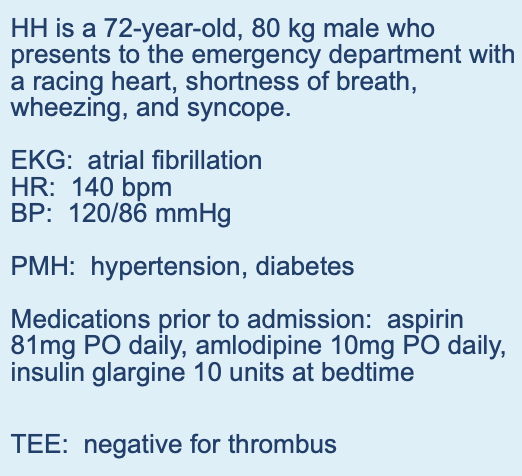
The medical team wants to start an anti-arrhythmic for the patient. Which antiarrhythmic would be the best choice for HH?
A. Amiodarone B. Sotalol C. Dronedarone D. Dofetilide E. Atenolol
C. Dronedarone
Do they have prior MI or significant heart disease? No → Look to the left chart!
Dofetilide → Choose when no options are available, requires so much monitoring (renal function, QT interval, DDIs)
Atenolol controls rate control → we need rhythm control for Afib
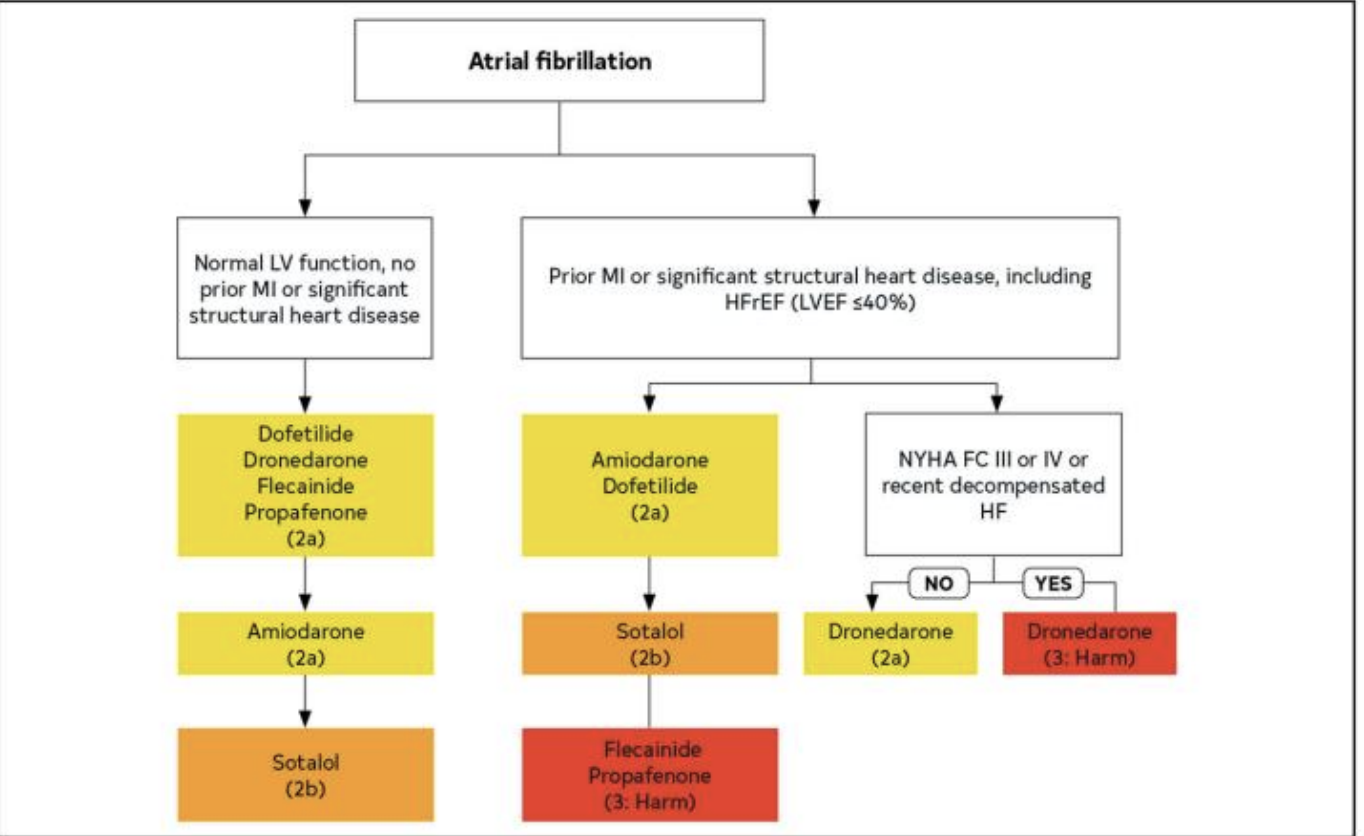
Which statement regarding AADs for maintenance of NSR is most accurate?
A. Sotalol and dronedarone are first-line options for HF patients
B. Flecainide and propafenone should not be used in structural heart disease
C. Amiodarone is the first-line AAD for pts with and without structural heart disease
D. Lidocaine is a second line option
Which statement regarding AADs for maintenance of NSR is most accurate?
A. Sotalol and dronedarone are first-line options for HF patients
Amiodarone and dofetilide are 1st line options for H.F pts
B. Flecainide and propafenone should not be used in structural heart disease
C. Amiodarone is the first-line AAD for pts with and without structural heart disease
For those with structural heart disease
D. Lidocaine is a second line option
Lidocaine is for ventricular arrhythmias NOT atrial arrhythmias
Which statement regarding Sotalol use for AF is most accurate?
A. It can be used for both pharmacological cardioversion and maintenance of NSR
B. Monitoring parameters include HR, BP, and LFTs
C. It can cause QT prolongation leading to TdP
D. Its main mechanism in AF is for rate control
A. It can be used for both pharmacological cardioversion and maintenance of NSR
Only maintenance of NSR, not pharmacological cardioversion
B. Monitoring parameters include HR, BP, and LFTs
Renal function & QT prolongation
C. It can cause QT prolongation leading to TdP
D. Its main mechanism in AF is for rate control
Rhythm control in Afib
What are catherer ablation indications?
If anti-arrhythmic medications are ineffective, contraindicated, or not tolerated
First-line in younger pts with few comorbidities to improve symptoms and prevent AF progression
Pulmonary vein isolation vs AV node ablation
Pulmonary vein isolation:
Can be curative for AF symptoms
Anticoagulation based on risk assessment
AV node ablation
Permanent pacemaker
AF persists → Continue anticoagulation
Which matches the medication to its corresponding adverse effect?
A. Amiodarone and renal dysfunction B. Dronedarone and pulmonary fibrosis C. Dofetilide and hepatitis D. Sotalol and QT prolongation
D
Digoxin (Lanoxin) Dosing
0.125-0.5 mg daily
Balloon valvulopasty is commonly used for _
Mitral stenosis
Balloon valvuloplasty requires pre-procedural _ to rule out thrombus formation
TEE
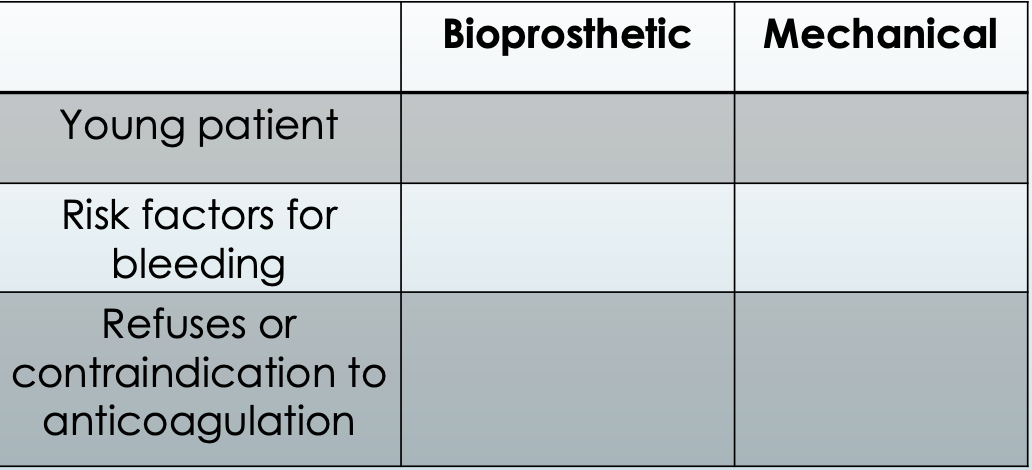
Young patient → Mechanical
Risk factors for bleeding → Bioprosthetic
Refuses/C/I to anticoag → Bioprosthetic
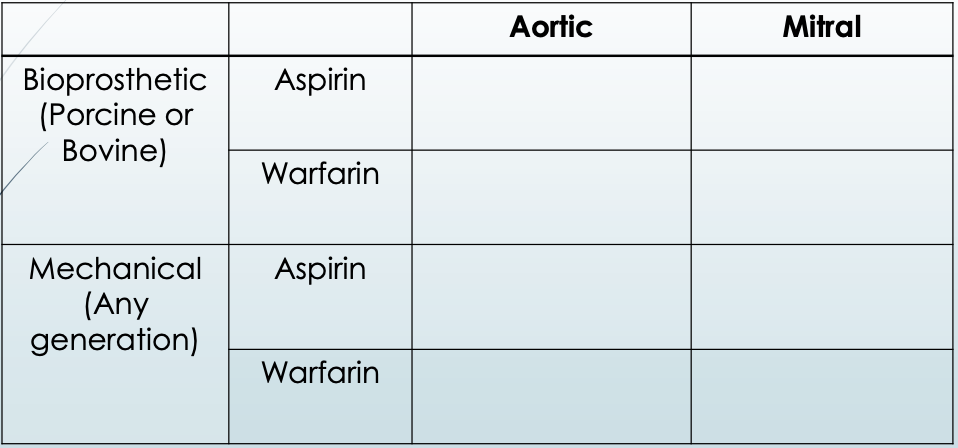
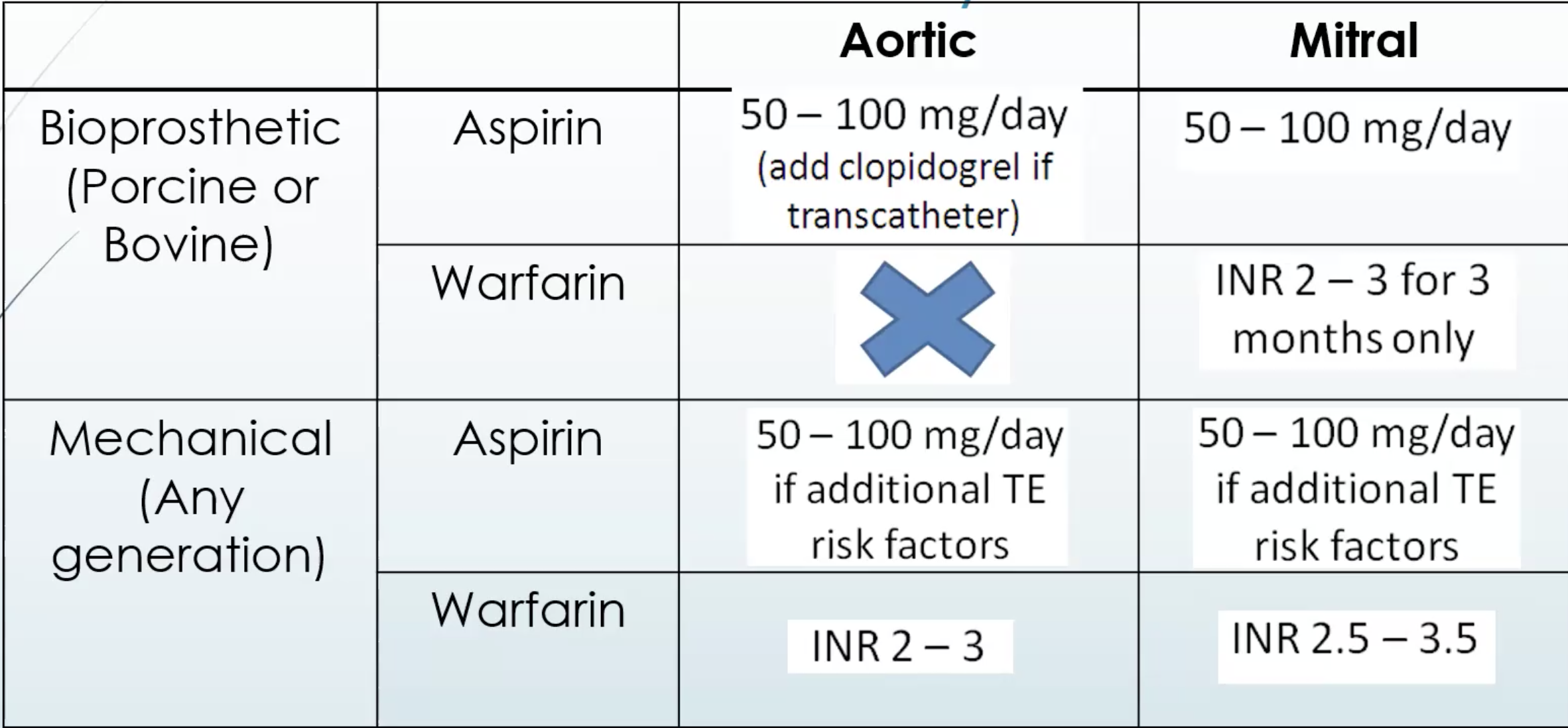
Which DOACs can be used in valvular disease? What is it contraindicated in?
Dabigatran
Rivaroxaban
Apixaban
Edoxaban
C/I w/ mechanical heart valves
A 30 year-old female requires mitral valve replacement for severe mitral valve prolapse. Which statement regarding valve replacement is most accurate for this patient?
A. A bioprosthetic valve will last longer than a prosthetic (mechanical) valve B. Her goal INR would be 2.5 – 3.5 if she received a prosthetic (mechanical) valve
C. A prosthetic/mechanical valve would be better if she would like to have children in the future
D. If she receives a bioprosthetic bovine valve, she should be on aspirin and clopidogrel therapy
A. A bioprosthetic valve will last longer than a prosthetic (mechanical) valve
B. Her goal INR would be 2.5 – 3.5 if she received a prosthetic (mechanical) valve
C. A prosthetic/mechanical valve would be better if she would like to have children in the future
Bioprosthetic
D. If she receives a bioprosthetic bovine valve, she should be on aspirin and clopidogrel therapy
Clopidogrel only if receiving transcatheter implantation, for bioprosthetic aortic valve
A 55 year-old male receives a mechanical mitral valve and mechanical aortic valve. His past medical history includes previous DVT and asthma. In addition to therapeutic heparin, which of the following anti-thrombotic regimens would be most appropriate?
A. Aspirin 81mg and warfarin to goal INR 2 - 3
B. Aspirin 81mg and warfarin to goal INR 2.5-3.5
C. Warfarin to goal INR 2 – 3
D. Warfarin to goal INR 2.5 – 3.5
B.
Mechanical Aortic Valve: Warfarin with INR 2 – 3 indefinitely
Mechanical Mitral Valve: Warfarin with INR 2.5 – 3.5 indefinitely
Bridge with IV UFH or SC LMWH if INR subtherapeutic
Add aspirin 50 – 100mg/day if additional risk factors for thromboembolism (atrial fibrillation, low EF, older age, history of TE)
A 78 year-old female presents with severe mitral stenosis. Her past medical history includes atrial fibrillation (stopped warfarin due to intracranial hemorrhage), HTN, and diabetes. Which of the following statements about this patient is most accurate?
A. Her mitral stenosis is likely due to rheumatic heart disease
B. A bioprosthetic valve will last >20 years in this pt
C. The best option for valve replacement would be a mechanical mitral valve
D. If the patient receives a bioprosthetic valve, she can use apixaban instead of warfarin
A
D. If the patient receives a bioprosthetic valve, she can use apixaban instead of warfarin
DOACs C/I in mechanical heart valves
A 75-year old patient has severe aortic stenosis, and is considering valve replacement. Which of the following statements is most accurate?
A. If she receives a valve by transcatheter procedure, she should be on warfarin and clopidogrel
B. She needs to be on warfarin whether she receives a mechanical or bioprosthetic valve
C. If she receives a mechanical valve, she will need to be on warfarin lifelong with a goal INR of 2-3
A. If she receives a valve by transcatheter procedure, she should be on warfarin and clopidogrel
Aspirin and clopidogrel
B. She needs to be on warfarin whether she receives a mechanical or bioprosthetic valve
Bioprosthetic aortic: No warfarin required
C. If she receives a mechanical valve, she will need to be on warfarin lifelong with a goal INR of 2-3
The goal of shock is to achieve and maintain a mean arterial pressure >_ mmHg
65
Which accurately describes shock due to massive blood loss after a trauma?
A. Cardiogenic B. Obstructive C. Hypovolemic D. Distributive
Describe what the etiologies of the other types of shocks.
A. Cardiogenic
H.F
Valve dysfunction
B. Obstructive
Pulmonary embolism
Tamponade
C. Hypovolemic
+ Fluid Loss
D. Distributive
Anaphylaxis
Sepsis
Epinephrine receptor activity and physiologic effect
A1, B1, B2 agonist
Vasoconstriction
Increased inotropic/chronotrophic activity
Norepinephrine (Levophed) receptor activity and physiologic effect
A1 agonist, secondarily B1 agonist
Vasoconstriction
Increased inotropic / chronotropic activity
Dopamine receptor activity and physiologic effect
D, B1, A1 agonist (depending on dosing)
Increased renal blood flow (low dose)
Increased inotropic/chronotropic activity (medium dose)
Vasoconstriction (high dose)
Phenylephrine (Neo-Synephrine) receptor activity and physiologic effect
A1 Agonist
Vasoconstriction
_ is used as an adjunctive agent to norepinephrine in sepsis (not as monotherapy_). Physiologic effect is _.
Vasopressin
Vasoconstriction
Which medication primarily increases BP by stimulating only α-receptors?
A. Norepinephrine B. Phenylephrine C. Epinephrine D. Dopamine
B.
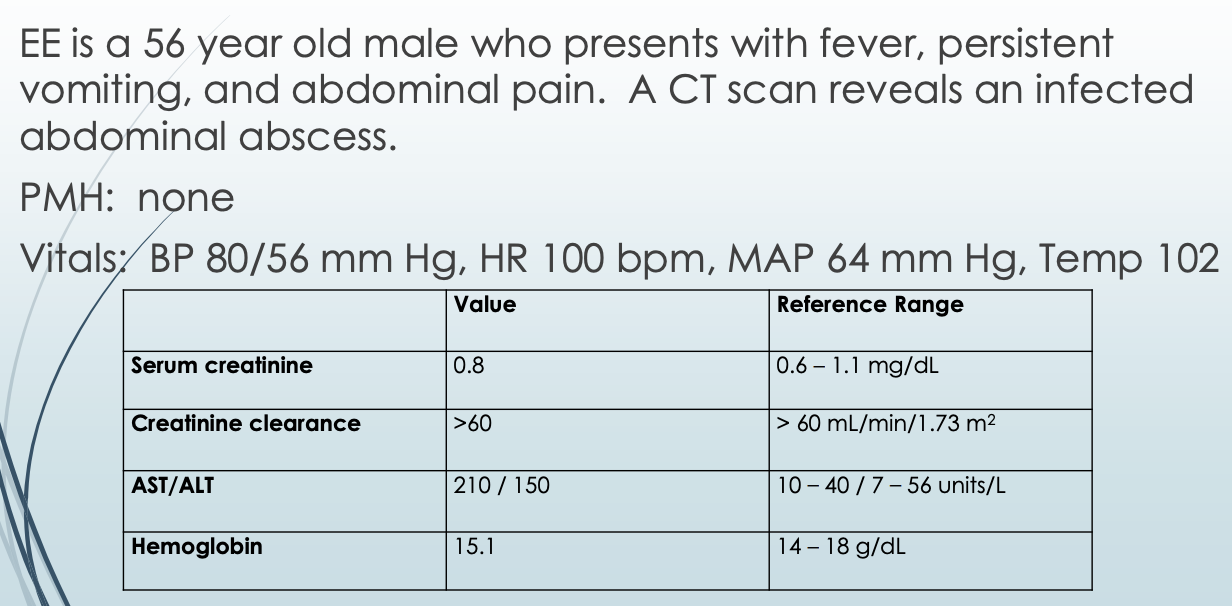
What findings determine that EE is in shock?
What type of shock is it?
What is the initial management for shock in EE?
If this initial management is not effective, what should be started next?
SBP <90 and MAP <65 mm Hg
Distributive shock (Infection → Sepsis)
IV fluid boluses
Vasopressor → Norepinephrine is vasopressor of choice in sepsis
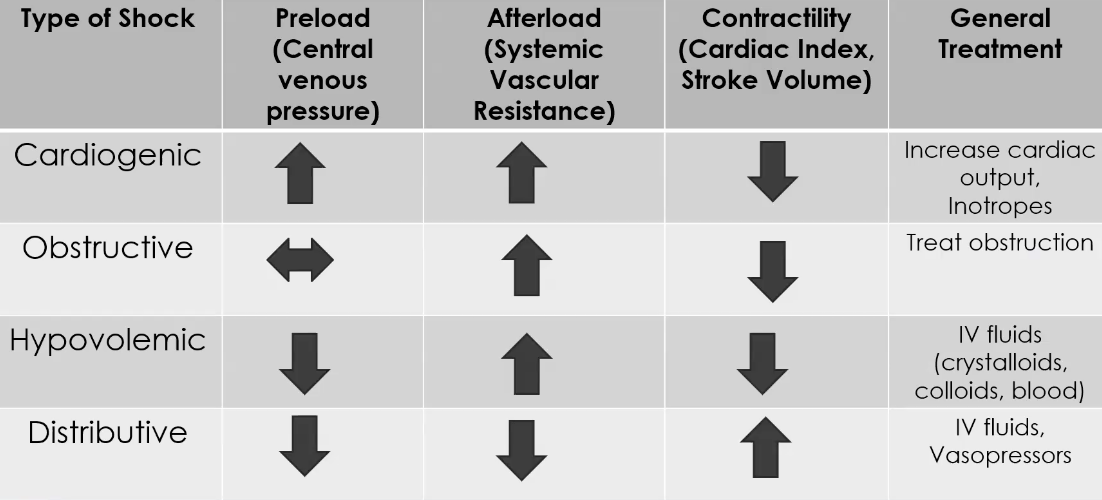
What is the general treatment for cardiogenic, obstructive, hypovolemic, distributive shock?
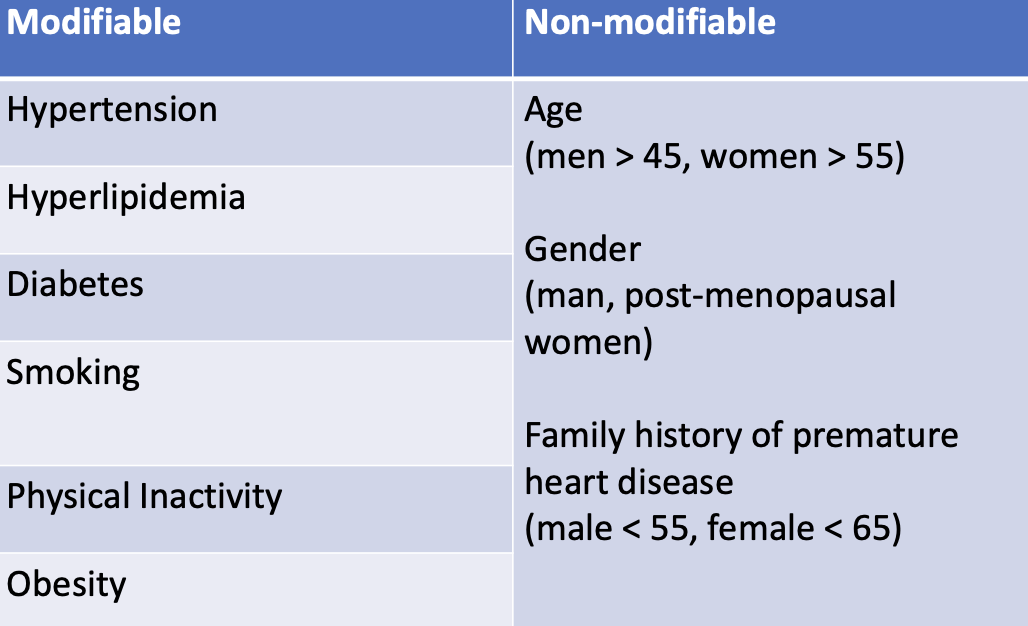
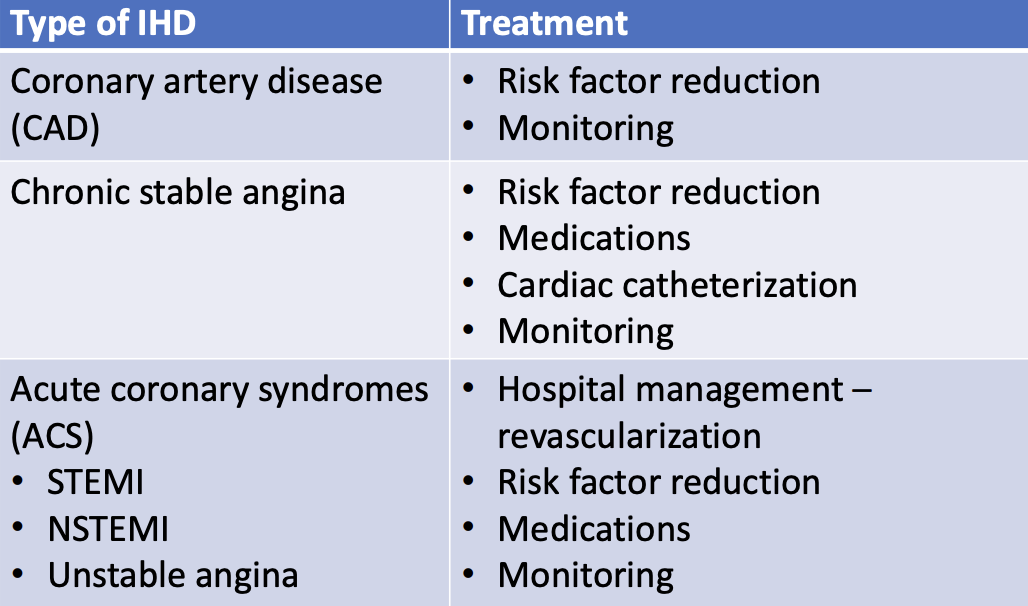
What are risk factors for ischemic heart disease?
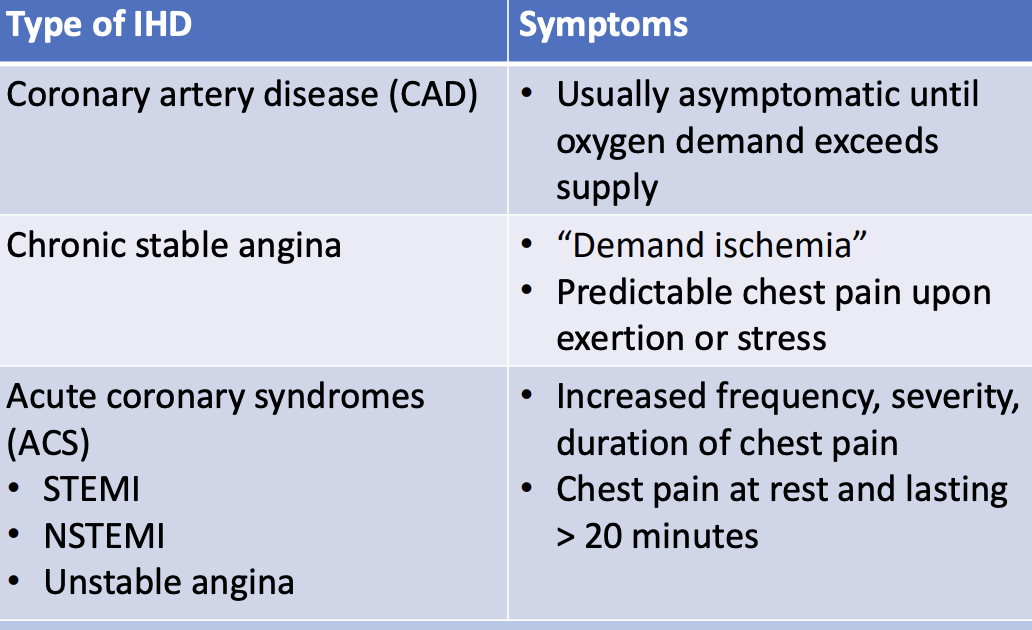
What are the symptoms of the following IHDs: CAD, Chronic stable angina, ACS
How should we manage the IHDs?
Which of the following statements is most accurate regarding CV testing procedures?
A. EKGs are a non-invasive test used to determine presence of arrhythmias and cardiac function
B. An exercise stress test with nuclear imaging is considered last line due to risk of radiation
C. A cardiac catheterization procedure is best way to visualize the coronary arteries D. A trans-thoracic echocardiogram is an invasive test used to determine cardiac structural abnormalities
A. EKGs are a non-invasive test used to determine presence of arrhythmias and cardiac function
Detects arrhythmias, conduction disturbances, myocardial ischemia
B. An exercise stress test with nuclear imaging is considered last line due to risk of radiation
Not last line. Usually done before aardiac catheterization.
Coronary artery calcium scoring has risks of radiation
C. A cardiac catheterization procedure is best way to visualize the coronary arteries
D. A trans-thoracic echocardiogram is an invasive test used to determine cardiac structural abnormalities
Non-invasive
Purpose of coronary artery calcium scoring
Determines presence and extent of coronary calcification
What medications are used for chronic stable angina? What are other treatment recommendations?
B-blockers
CCB
Nitrates
Ranolazine
Risk factor reduction
Aspirin 81 mg indefinitely (Clopidogrel if aspirin C/I)
Anti-anginals
Interventional
PCI
CABG
Which statement regarding chronic stable angina is most accurate?
A. It is caused by a partially occlusive thrombus
B. It can be exacerbated by severe anemia
C. All pts should receive a cardiac catheterization
D. The double product equation (used to determine MVO2 ) is DP = HR x CO
A. It is caused by a partially occlusive thrombus
Acute coronary syndrome
Angina is usually due to imbalance of oxygen demand and supply
B. It can be exacerbated by severe anemia
C. All pts should receive a cardiac catheterization
Invasive!
D. The double product equation (used to determine MVO2 ) is DP = HR x CO
DP = HR X SBP
What drug class if first choice for chronic prophylaxis?
B-Blockers
A 59 year old presents with new chest pain, and is diagnosed with chronic stable angina. Vitals: BP 148/92, HR 86, RR 18 Medications: aspirin 81mg daily, nitroglycerin 0.4mg SL PRN Which of the following is the most appropriate recommendation for this pt for prophylaxis of chest pain?
A. Lopressor 25mg BID
B. Inderal 10mg TID
C. Dilacor ER 120mg daily
D. Norvasc 50mg daily
A → Metoprolol, cardio-selective
We want BB
Want more cardio-selective
If C/I w/ BB → can use non-DHP CCBs
Long-acting nitrates indication
Monotherapy only if BB or CCB C/I or intolerable
Nitroglycerin SL (Nitrostat)
0.4mg SL PRN
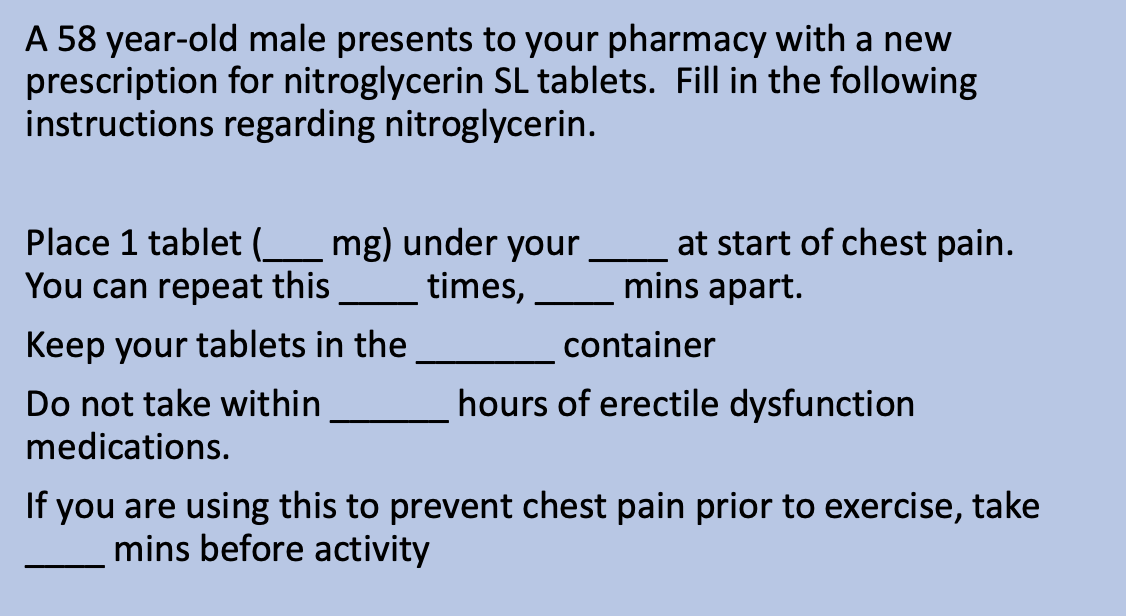
0.4 mg, under your tongue, 2 times, 5 mins apart
Original
24-48 hours
5-10 minutes
Avoid _ in prolonged QT interval