Alg. 2 Chapter 5
 Studied by 0 people
 Call with Kai
 Learn
Learn Practice Test
 Spaced Repetition
 Match
Match Flashcards
 Knowt Play
1/6

There's no tags or description
Looks like no tags are added yet.
Name | Mastery | Learn | Test | Matching | Spaced | Call with Kai |
|---|
No study sessions yet.
7 Terms
Complement
All possible outcomes that are not in the event.
Ex: The complement of rolling a 1 or a 2 on a number cube is rolling a 3, 4, 5, or 6.
Independent Event
When the outcome of one event does not affect the probability of a second event, the two events are independent.
Ex. The results of two rolls on a number cube are independent. Getting a 5 on the first roll does not change the probability of getting a 5 on the second roll.
Mutually Exclusive Events
When two events cannot happen at the same time, the events are mutually exclusive. If A and B are mutually exclusive events, then 𝘗(𝘈 𝘰𝘳 𝘉)=𝘗(A)+𝘗(𝘉).
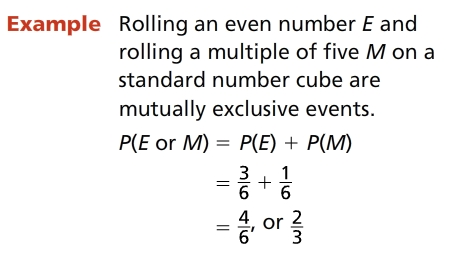
How does describing events as mutually exclusive or independent affect how you find probabilities?
Answer:

Conditional Probability
A conditional probability contains a condition that may limit the sample space for an event. The notation 𝘗(𝘉ǀ𝘈) is read “the probability of event B, given event A.” For any two events A and B in the sample space, 𝘗(𝘉ǀ𝘈)=𝘗(𝘈 𝘢𝘯𝘥 𝘉)𝘗(𝘈).
Dependent Events
When the outcome of one event affects the probability of a second event, the events are dependent events.
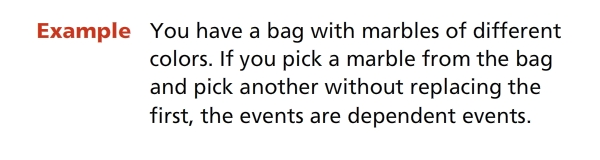
How are conditional probability and independence related in real-world experiments?
For any two events A and B, find 𝘗(𝘉|𝘈) and 𝘗(𝘉) and compare them. If they are equal, then events A and B are independent; if not, then A and B are dependent events.