Renal
 Call Kai
 Learn
Learn Practice Test
 Spaced Repetition
 Match
Match Flashcards
 Knowt Play
1/110

There's no tags or description
Looks like no tags are added yet.
Name | Mastery | Learn | Test | Matching | Spaced | Call with Kai | Chat |
|---|
No analytics yet
Send a link to your students to track their progress
111 Terms
What are the different body fluid compartments?
Extracellular fluid, plasma and intracellular fluid
Kidneys regulate blood vol and pressure via…(2)
water concentration and fluid vol
inorganic ion composition
The extracellular compartment has a greater ionic composition of…
Na+, Cl-, and HCO3
The intracellular compartment has a greater ionic composition of…
K+, Mg+, and Pi
osmolarity
how many solute particles that are dissolved per unit volume of water
Low osmolarity represents
a high water concentration
High osmolarity
a low water concentration
Diffusion
movement of molecules from one location to another as a result of their random thermal motion
osmosis
net diffusion of water across a selectively permeable membrane from a region of high water concentration
osmotic pressure
the pressure necessary to prevent solvent movement
works against osmosis
Tonicity is determined by the concentration of — of an extracellular solution relative to the intracellular environment of a cell. The solute concentrations may influence —
non-penetrating solutes; changes in cell volume
primary types of tonicity
isotonic
hypertonic
hypotonic
Hypertonic/Hyperosmotic
higher osmolarity than inside the cell
Hypotonic/Hypoosmotic
lower osmolarity than inside the cell
Water flows from — osmolarity to — osmolarity
lower; higher
Normal osmolarity inside a cell is…
~300 mOsm/L
Absorption
Movement of solute/water into the blood (Plasma)
Filtration
Movement of solute/water out of blood (Plasma)
What factors determine fluid movement across blood vessels?
starling forces

The arterial end of the capillary favors…
filtration
The venous end of the capillary favors…
absorption
The kidneys are — in location
Retroperitoneal
Hilum
inner concave part of the kidney
Bladder
storage organ for the formed urine
ANS innervation
Associated organs of urinary system
ureter
bladder
urethra
Micturition
the process of releasing the urine outside the body i.e. urination
General anatomy of kidney
outer cortex
inner medulla
General parts of nephron
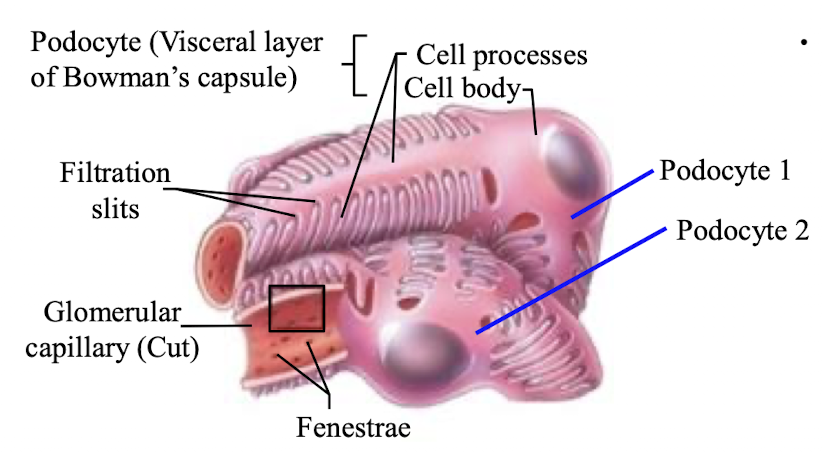
renal corpuscle
renal tubule
Renal corpuscle is comprised of…(2)
glomerulus
bowman’s capsule
Renal tubule is comprised of…(4)
proximal tubule
loop of henle (descending + ascending)
distal tubule
collecting duct
What is the filtering unit of the kidney?
renal corpuscle
What are the ultra specific structural features that make up the filtering unit?
afferent/efferent arteriole
glomerulus
podocytes
bowman’s space
proximal tubule
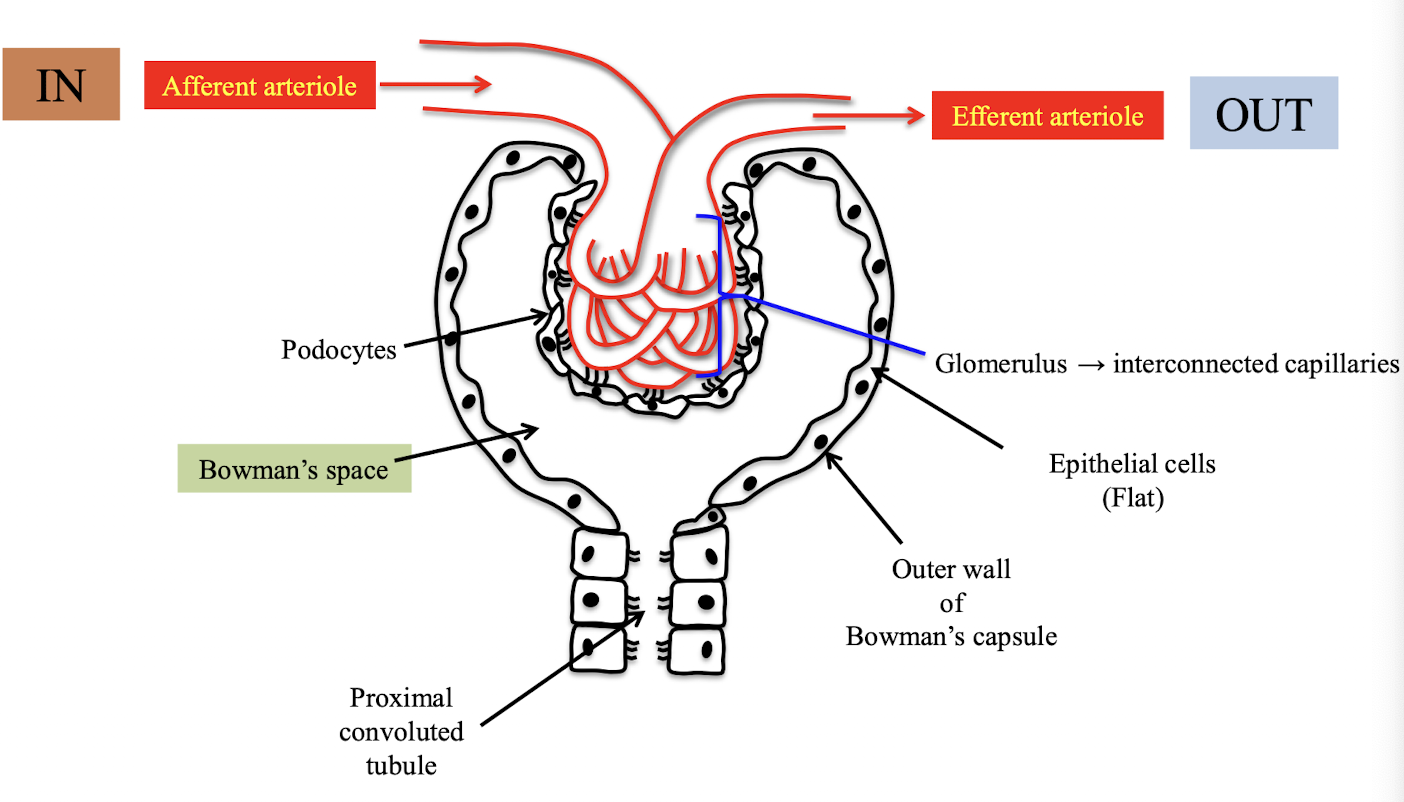
What is the functional significance of the glomerulus?
it’s where blood first undergoes filtration
Glomerular capillary is comprised of… (3)
Fenestrated endothelial layer
basement membrane
podocytes with filtration slits
Types of Nephrons; Where are they found?
Cortical and Juxtamedullary; In the cortex
Cortical nephron functions
Filtration, reabsorption, secretion
Juxtamedullary nephron functions
Filtration, reabsorption, secretion, regulate concentration of urine
What are the different capillaries that remain associated with nephrons?
glomerular
pertibular
vasa recta
Peritubular capillary
capillaries found around the proximal convoluted tubules → fuse to form renal vein
Vasa recta
capillaries that are found mostly associated with juxtamedullary nephrons in the medullary portion of the kidney
3 basic renal processes involved in urine formation
Filtration
Secretion
Reabsorption
What are the forces involved in the filtration of the plasma through the filtering unit?
Glomerular capillary blood pressure
Fluid pressure in Bowman’s space
Osmotic force due to protein in plasma
Large proteins/albumins are held back (via filtration) because (2)
pores are too small
pores and basement membrane repel (-) proteins
— and — are slits in podocytes that remain covered with fine semiporous membrane
Nephrins; Podocins
ultrafiltrate
the protein-free fluid formed as the plasma is filtered at the glomerulus
proteinuria
a condition where some of the proteins that are not supposed to pass through the filtration barrier show up in the filtrate and ultimately in the urine
Net glomerular filtration pressure is always…
positive
What factor would contribute to an increase in the glomerular filtration rate?
High blood pressure
What factor would contribute to a decrease in the glomerular filtration rate?
An increase in the protein concentration in the plasma would increase the protein content in the glomerular capillaries
Filtration fraction
~ 20 % of the plasma that enters into the glomerular capillaries is filtered nto Bowman’s space
Renal fraction
the proportion of blood plasma entering the kidneys that gets filtered into the kidney tubules
What is GFR?
Volume of fluid filtered from the glomerulus into the Bowman’s space per unit time
Factors influencing GFR (4)
net GF pressure
neural and endocrine control
permeability of corpuscular membrane
surface area available for filtration
What is autoregulation of GFR? How is it achieved?
Maintaining steady blood flow across GFR despite changes in MAP; via myogenic reflex
What is the juxtaglomerular apparatus (JGA)?
A specialized structure formed by the distal convoluted tubule and the glomerular afferent arteriole
Glucosuria
glucose appears in the urine
Proteins that play a role in reabsorption of glucose
SGLT
GLUT
Na+/K+/ATPase
transport maximum
all the SGLT proteins that transport glucose from the lumen to the peritubular capillaries are saturated and cannot transport any more glucose
renal threshold
beyond this point, glucose shows up in the urine because transport maximum has been reached
300 mg/100 mL
Diabetes mellitus
Capacity to reabsorb glucose is normal (normal SGLT), but filtered load is greatly increased and is beyond the threshold level to reabsorb glucose by the tubules
Renal glucosuria/ benign glucosuria
Genetic mutation of the Na+/glucose cotransporter (SGLT)
Steps for Urea processing by the renal tubules
Na is reabsorbed by active transport
electrochemical gradient drives anion reabsorption
water follows by osmosis (lumen > ecf)
urea will diffuse down its concentration gradient
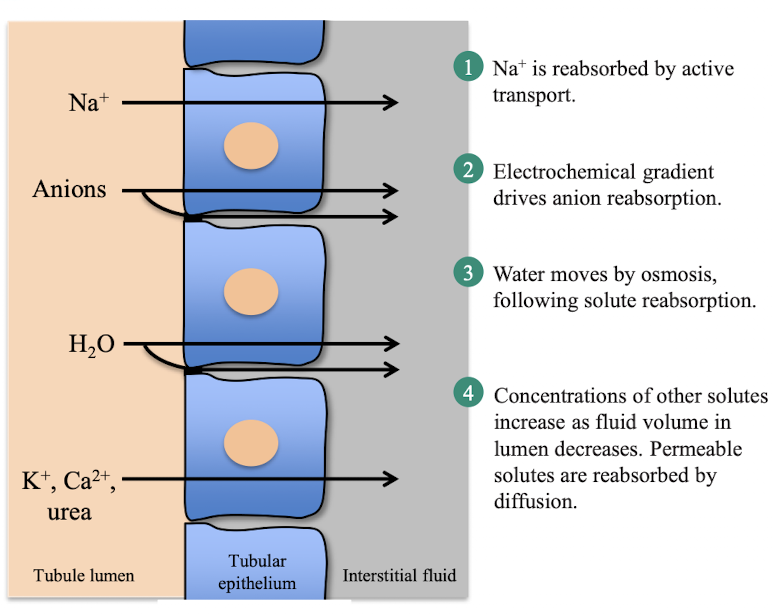
Urea reabsorption is dependent on…
water reabsorption
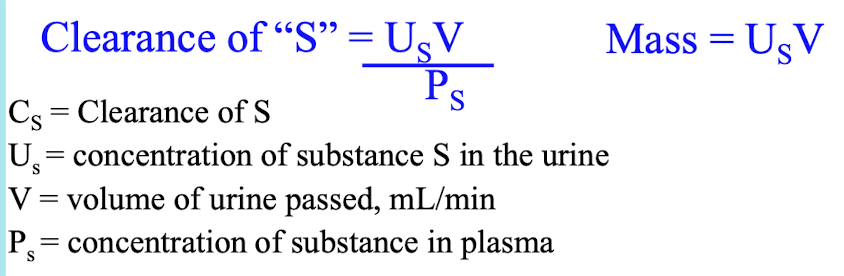
Renal clearance
measures the volume of plasma from which a substance is completely removed from the kidney per unit time
Formula for renal clearance
Inulin
Polysaccharide not found normally in the body used to measure clearance
Creatinine
Product of muscle metabolism; It’s clearance is used to measure GFR (slightly overestimated)
GFR is inversely proportional to the plasma concentration of the substance
If the clearance of substance X > GFR
X must undergo secretion
If the clearance of substance X < GFR
X must undergo reabsorption
Sources of input maintaining water balance
ingested liquid
water from oxidation of food
Sources of output maintaining water balance
insensible water loss
sweat
GI + urinary tract, menstrual flow
Water reabsorption is dependent on…
Na+ reabsorption
Which hormone regulates water reabsorption? Where?
Vasopressin/ADH on AQP2 (luminal side) in the collecting ducts
Water reabsorption occurs through the — portion of the loop of henle, while the — is impermeable to water
thin descending portion; ascending limb
Countercurrent multiplication
process in the Loop of Henle that uses fluid flow in opposite directions to build a salty concentration gradient
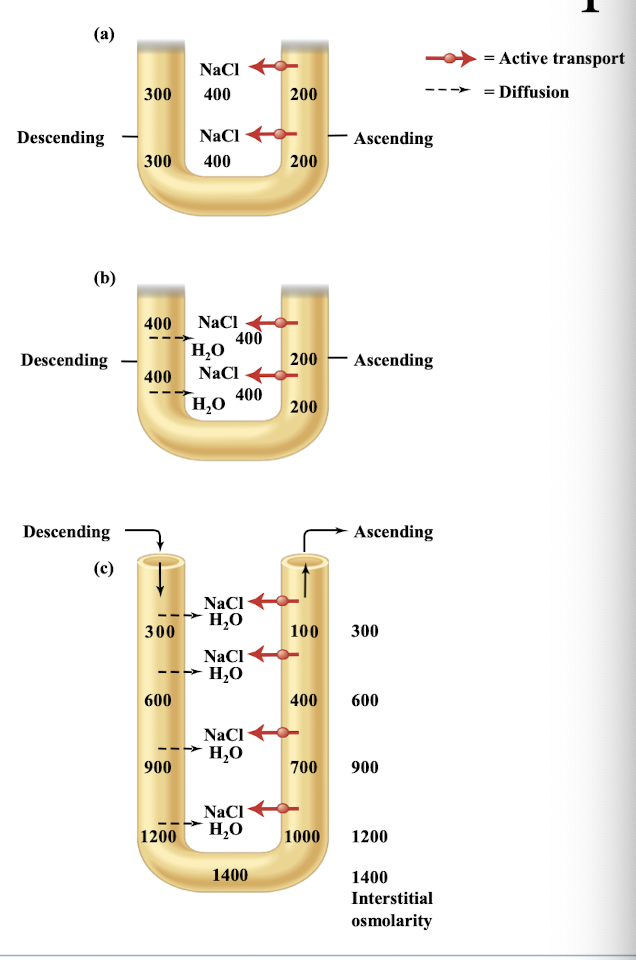
What does a long loop indicate about a species’ need to conserve water?
needs to conserve more water; hyperosmolar gradient is greater to conserve more water
Plasma osmolarity is mainly determined by measuring the plasma…
Na+
What cells make ADH?
Neurosecretory cells in the hypothalamus found in supraoptic nucleus (SON)
APQ 2,3,4 are found…
in the collecting ducts
AQPs on the — membranes are not regulated by ADH
basolateral
In the absence of ADH, what happens to collecting ducts?
They become almost impermeable to water, leading to water diuresis
Central diabetes insipidus
Failure to release the ADH from the posterior pituitary
Nephrogenic diabetes insipidus
ADH is secreted in a normal matter from the pituitary but the hormone does not function normally
ADH is present, body does not respond
When ADH is increased…
AQP-2 levels increase, water reabsorbed (pee less)
When ADH is decreased…
AQP-2 levels decrease, do not conserve water (pee more)
Water diuresis
Only excess water is excreted without excess solute in urine
Osmotic diuresis
Excess solute in urine is always associated with high levels of water excretion
Uncontrolled diabetes mellitus
— is never secreted into the renal tubules. It is excreted.
Sodium
In regards to low sodium levels, — cells are mechanoreceptors, secreting renin.
— cells are chemoreceptors, sensing NaCl load of the filtrate.
Juxtaglomerular; Macula densa
— stretch (Low circulating volume) stimulates renin release
Decreased
Atrial natriuretic peptide/ANP functions (3)
regulates GFR
inhibits Na+ reabsorption
inhibits aldosterone
ANP source
synthesized and secreted by cardiac atria
Baroreceptors location
Carotid sinus
aortic arch
major veins
intrarenal (JG cells of JGA)
Aldosterone source + trigger
steroid hormone secreted from the adrenal cortex triggered by low plasma volume associated with low sodium
Aldosterone site of action
Late distal tubule and cortical collecting duct
Renin
enzyme that acts as sensor for low NaCl conc in blood
Converts angiotensinogen to angiotensin I
What stimulates ANP secretion? (3)
Increased Na+ concentration
Increased blood volume
Atrial distension (!!!)
Aldosterone secretion is directly sensitive to the extracellular — level
K+
An increase in extracellular [K+] results in…
Stimulation of aldosterone production → More [K+] excreted in urine
What is a buffer?
compounds that can bind to H+ and form a hydrogen-buffer conjugate