Protein Synthesis
 Call Kai
 Learn
Learn Practice Test
 Spaced Repetition
 Match
Match Flashcards
 Knowt Play
1/3

Name | Mastery | Learn | Test | Matching | Spaced | Call with Kai | Chat |
|---|
No analytics yet
Send a link to your students to track their progress
4 Terms
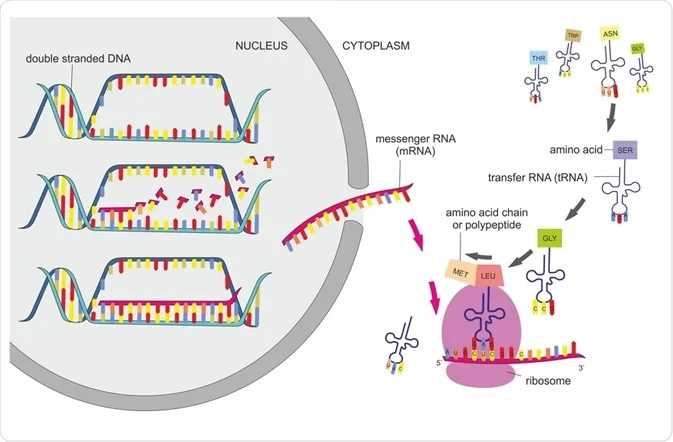
Basics of Translation & Protein Synthesis
DNA is a sequence of bases: acts as a chemical code for the amino acid sequence.
Every 3 bases encode 1 amino acid in the protein.
RNA transcript with a complement of the DNA code goes to a ribosome for translation into a protein.
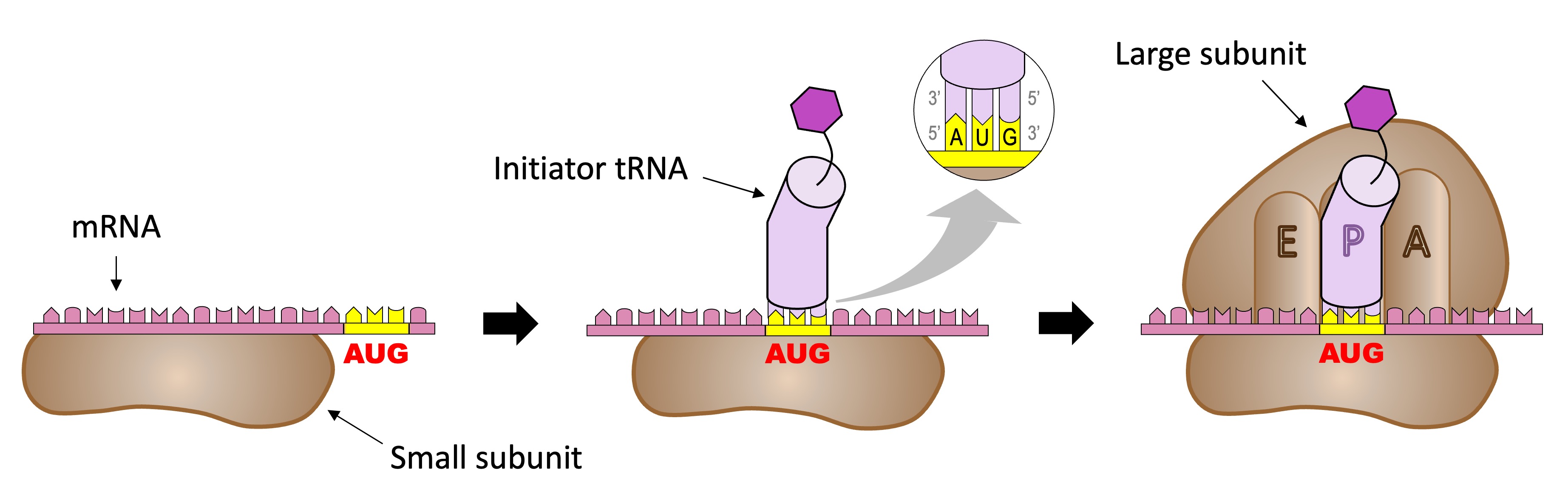
Initiation
The small ribosomal subunit binds to mRNA.
→ It “reads” (scans) the mRNA until it comes to a special codon (3-base codon) called the start codon (AUG).Each tRNA has a unique anticodon and floats in the cytoplasm.
→ tRNA with a complementary anticodon (UAC) binds to the start codon.The large ribosomal subunit binds, forming a complete ribosome.
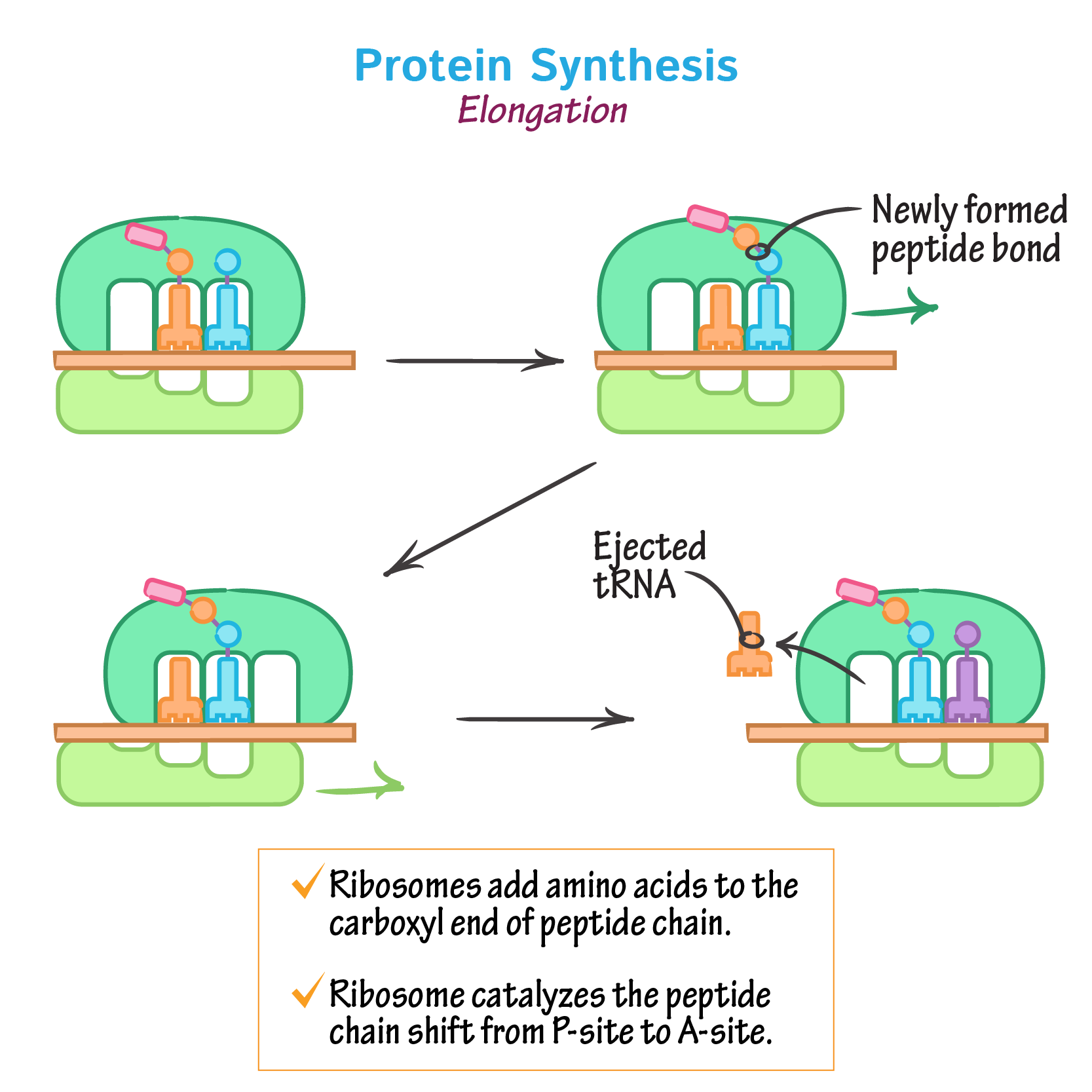
Elongation
tRNA carries a different amino acid based on its corresponding codon and binds to the A-site of the ribosome.
→ Ex: The tRNA with the anticodon UGG binds to the mRNA with the codon ACC, producing Threonine.On a complete ribosome, the tRNA #2 can bind at the A-site, codon to anticodon, after the tRNA #1 moves to the P-site.
The 1st amino acid binds to the 2nd amino acid on the tRNA #2 via dehydration synthesis to form a new peptide bond.
One codon is moved over, and the tRNA #1 exits the ribosome from the E-site, and tRNA #3 can now bind to the A-site.
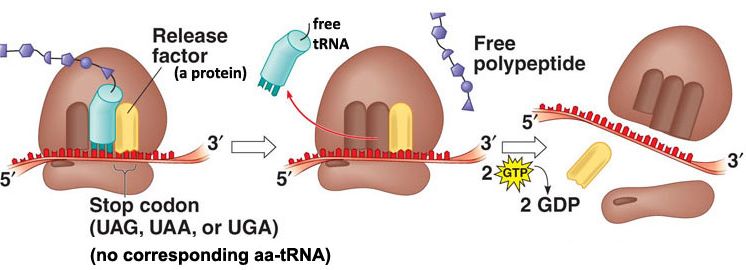
Termination
When a ribosome comes to one of three stop codons (UAA, UGA, UAG), the two ribosomal subunits will dissociate and fall off the mRNA.
→ A newly synthesized polypeptide is formed.Polysome: 1 mRNA, several ribosomes at once.
→ More efficient translation.