NRN11 - Exam 2 Seminar (Argumedo)
 Call Kai
 Learn
Learn Practice Test
 Spaced Repetition
 Match
Match Flashcards
 Knowt Play
1/16

There's no tags or description
Looks like no tags are added yet.
Name | Mastery | Learn | Test | Matching | Spaced | Call with Kai | Chat |
|---|
No analytics yet
Send a link to your students to track their progress
17 Terms
Define: Documentation
The written or electronic legal record of all pertinent interactions with a patient.
What is the purpose of documentation?
Legal Protection for Nurses
Communication Between Providers (what was and wasn’t done)
Record-Keeping (tests, labs, results, dx, procedures, med admin, etc)
Patient Safety
Risk Management & Quality Improvement
Identifies patterns and areas for improvement.
Why does documentation protect your license?
Proper documentation demonstrates you followed protocols, assessed appropiately, and intervened when needed.
Poor or falsified documentation, puts your license at very high risk and can result in:
Licensure Suspension/Revocation
Criminal Charges
Lawsuits & Damages
Report to the State Nursing Board!
Elaborate on common documentation practices.
If it wasn’t documented, it wasn’t done.
Document in Real Time—-do not use past terms, unless speaking about the past.
Document in Military Time
Tailor documentation to your unique patient.
Put patient statements in quotes.
Document OBJECTIVELY
DO NOT Document:
Opinion
Interpretation
Assumption
Judgments
Slang
Words Like: “good, apperas, maybe, most likely, do not guess [“maybe she was hungry?]; Use exact measurements, be specific!
If you document that something is wrong, what are you doing about it?
Record precautions, preventative measures, nursing responses to orders.
![<ul><li><p>If it wasn’t documented, it wasn’t done.</p></li><li><p>Document in Real Time—-do not use past terms, unless speaking about the past.</p></li><li><p>Document in Military Time</p></li><li><p>Tailor documentation to your unique patient.</p></li><li><p>Put patient statements in <span style="color: rgb(255, 0, 0);">quotes</span>.</p></li><li><p>Document <span style="color: rgb(255, 0, 0);">OBJECTIVELY</span></p></li><li><p><span style="color: rgb(255, 0, 0);"><strong>DO NOT Document:</strong></span></p><ul><li><p><span style="color: rgb(255, 0, 0);">Opinion</span></p></li><li><p><span style="color: rgb(255, 0, 0);">Interpretation</span></p></li><li><p><span style="color: rgb(255, 0, 0);">Assumption</span></p></li><li><p><span style="color: rgb(255, 0, 0);">Judgments</span></p></li><li><p><span style="color: rgb(255, 0, 0);">Slang</span></p></li><li><p><span style="color: rgb(255, 0, 0);"><strong>Words Like:</strong> “good, apperas, maybe, most likely, do not guess [“maybe she was hungry?]; <strong>Use exact measurements, be specific!</strong></span></p></li><li><p><span style="color: rgb(255, 0, 0);"><strong>If you document that something is wrong, <u>what are you doing about it?</u></strong></span></p><ul><li><p>Record precautions, preventative measures, nursing responses to orders.</p></li></ul></li></ul></li></ul><p></p><p></p><p></p>](https://assets.knowt.com/user-attachments/1987a71d-45de-468c-b112-af054716befc.jpg)
Legal & Ethical Consideration of Documentation:
Anything you document is legally subject to review in court proceedings or investigations.
Documentation can never truly be erased: corrections are permanent (struck through with initials) and electronic records are saved with changed history.
Chart access is logged.
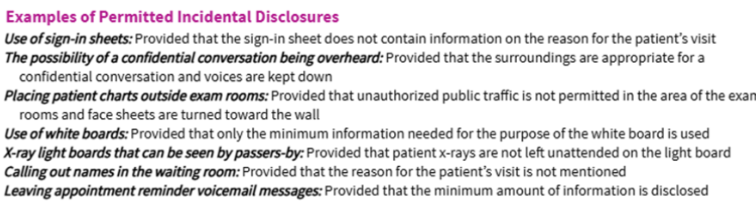
What are examples of permitted incidental exposures?
List the types of documenation.
SOAP Notes (Subjective, Objective, Assessment, Plan)
SBAR
DAR (Data, Action, Response)
Narrative Notes
PIE
Problem Oriented (focused on problem)
Focused Charting:
Goal
Therapies
A Problem
Need (Flowsheets)
EMAR (documents med admin, can make comments)
Documentation Types: Narrative
According to the textbook, narrative documentation must include (533):
Descriptions of Patient Observations
Statements that specify nursing care (including teaching and patient responses).
Statements that describe the patient's condition and progress (or lack thereof).
Patient Complaints
How the patient is coping or failing to cope.
Documentation Types: PIE (Problem, Intervention, Evaluation)
PIE documentation involves performing a “patient assessment at the beginning of each shift…patient problems identified in these assessments are numbered, documented in the progress notes, and worked up using the PIE format…resolved problems are dropped from daily documentation following the nurse’s review” (534).
Documentation Types: DAR (Focused)
A DAR (focused charting) involves a focus column “used to incorporate many aspects of a patient and patient care…the focus may be a patient strength, problem, or need” (534).
Documentation Types: CBE (Chart by Exception)
Charting by exception is a “shorthand method of documenting normal findings, based on standardized normals, standards of practice, and predetermined criteria for assessments and interventions; only significant findings or exceptions to the predefined norms are documented in detail” (535).
Abbreviations - Common
Approved for general use; used per facility policy.
Ex:
STD
OOB
SOB
CXR
PRN
Best Practice: Spell out when learning.
Abbreviations: Error Prone
Reccomend to be avoided but are NOT legally mandated by TJC.
Should be avoided at ALL COST and NEVER to be used when communicating medical information.
High risk for misinterpretation.
Ex:
U = Units
IU = International Units
Q.D = Daily
Q.O.D = Every Other Day
Abbreviations - Do Not Use List
Joiny Commission Mandatory List; LEGALLLY PROHIBITED
A DO NOT USE should NEVER be approved by a facility that is compliance with accrediting bodies.
Error Prone Orders: Verbal Orders (V.O) & Telephone Orders (T.O)

Incident Reports:
What is the purpose?
When do you file?
Purpose: Risk Management & Quality Improvement (NOT PUNISHMENT)
Helps organizations identify patterns, reoccurring problems, and training needs.
Prevent future incidents through staff education and system changes.
When to File: