IPS1: Dispensing - Part 1 - Introduction
 Call Kai
 Learn
Learn Practice Test
 Spaced Repetition
 Match
Match Flashcards
 Knowt Play
1/64

There's no tags or description
Looks like no tags are added yet.
Name | Mastery | Learn | Test | Matching | Spaced | Call with Kai | Chat |
|---|
No analytics yet
Send a link to your students to track their progress
65 Terms
Administrative Order No. 63 s. of 1989
Rules and Regulations to Implement Dispensing Requirements under the Generics Act of 1988 (RA 6675)
Dispensing
act validly-registered pharmacist of filling a prescription or a doctor's order on the patient's chart
George Urdang
the first person to study the prescription of today
prae + scribe
prescription is from two latin words which include
prae
meaning before
scribe
meaning I write
B
serves as the professional relationship among the physician, pharmacist and patient
a. patient record
b. prescription
c. health literatures
d. patient request
B
vehicle for communication from the prescriber to the pharmacist about the needs of the patient
a. patient record
b. prescription
c. health literatures
d. nurse record
Over-the-counter drugs
Are pharmaceutical products or drug preparations that can be dispensed even without the written order of a validly registered licensed physician, dentist or veterinarian, for the use of consumers for the prevention or symptomatic relief of minor or self-limiting ailments
OTC drugs
Biogesic for fever
Solmux for cough
Neozep for colds
Gaviscon for hyperacidity
Imodium for diarrhea
Prescription drugs
Ethical or Legend drugs
Are pharmaceutical products or drug preparations that are to be dispensed only upon written order of a validly registered physician, dentist or veterinarian for the management or treatment of a condition or disease
Prescription drugs
Lifezar for hypertension
Glumet for diabetes
Lipitor for hyperlipidemia
Colchicine for gout
Amoxil for bacterial infection
Dangerous drugs
pharmaceutical products referring to either prohibited or regulated drugs which require a special prescription form usually obtained from the Dangerous Drugs Boards.
List A drugs
include prohibited and regulated drugs
Prohibited drugs
opium and its active components and derivatives;
coca leaf and its derivatives;
hallucinogenic drugs;
other preparations containing physiological effects of a narcotic drug
Prohibited drugs examples
Morphine
Codeine
Fentanyl
Hydrocodone
Pethidine
Regulated drugs
sedative-hypnotics and drugs which contain a salt derivative of a salt of an isomer of amphetamine
Regulated drugs examples
Amphetamine
Chloral hydrate
Etchlorvynol
Pentothal
Methamphetamine
List B Drugs
drugs requiring strict precautions in their use;
the prescriber must write clearly “List B” after the Rx symbol but before the generic name.
List B drugs
Amiodarone
Clonazepam
Dexamethasone
Lithium carbonate
Warfarin
Type of Medication based on Prescription Requirements
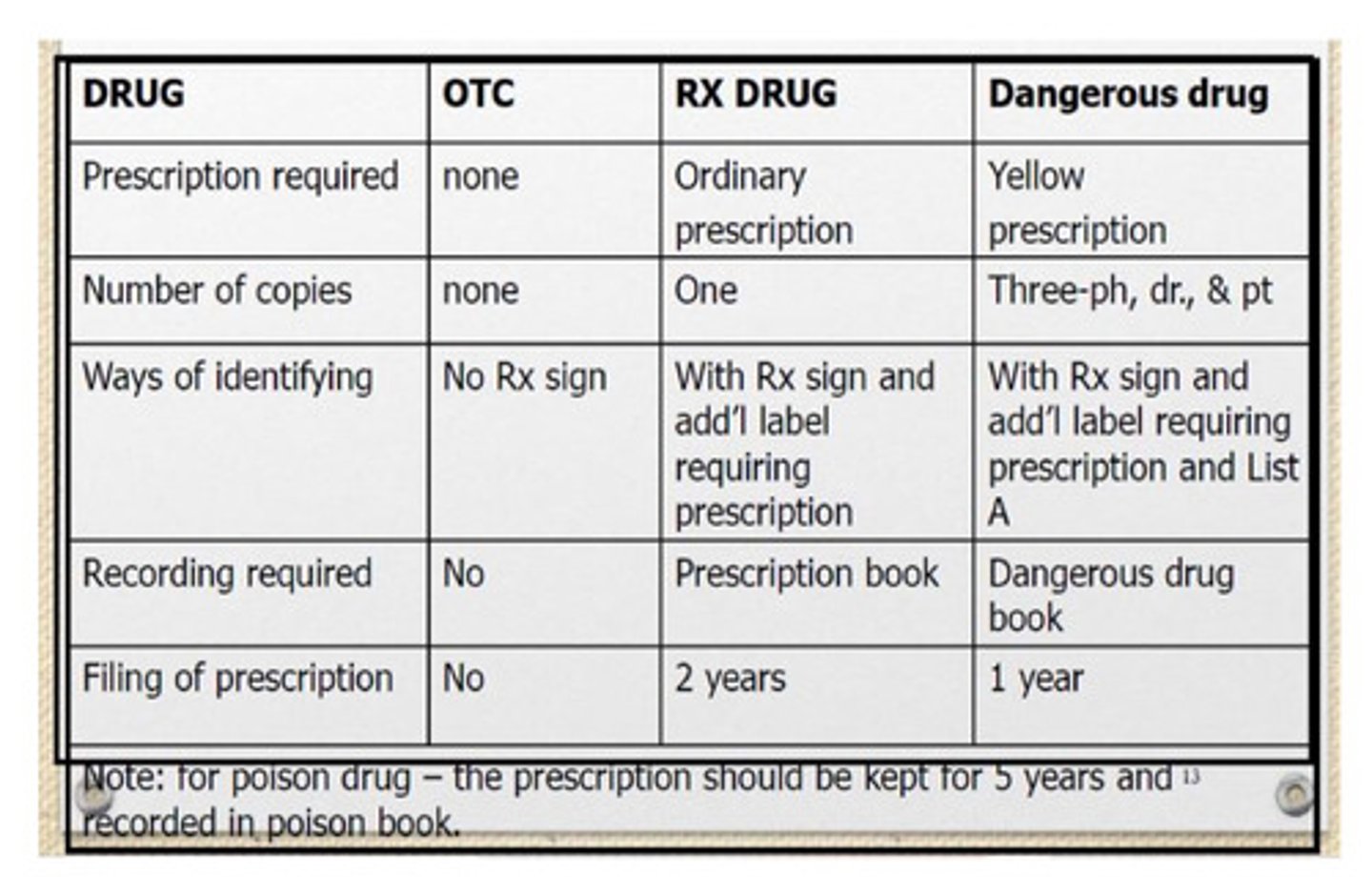
C
Requirement in prescribing list A drugs include
I. S2- license of physician
II. Form 1-72
III. Special DOH prescription form
IV. Recording system
a. I and II
b. I, II, III
c. I, II, IV
d. I, II, III, IV
D
Prohibited drugs except
a. Morphine
b. Pethidine
c. Hydrocodone
d. Etchlorvynol
C
Regulated drugs except
a. Amphetamine
b. Choral hydrate
c. Pethidine
d. Pentothal
C
Also known as shotgun prescription which contain more than two ingredients.
a. Compound prescription
b. Controlled prescription
c. Polypharmacal prescription
d. Simple prescription
Compounded prescription
Requires mixing of one or more ingredients including one or more active medicaments with one or more excipients, vehicles or other adjuncts to make the product.
Distinct portion of compounded prescription
Basis/Base
Adjuvant
Corrective or Corregent
Vehicle
Base
contains API, responsible for therapeutic action
Adjuvant
aids or assist the base
Corrective or corregent
qualifies the action of the base and adjuvant
Vehicle
dilutes the active ingredient
Partial filling of prescription
means dispensing less than the number of units prescribe
Shall be written on the face of prescription of partial filling
Date of partial filling
Quantity served and balance of unserved
Name and address of the drugstore
Magistral prescription
A prescription that is very often prescribed by the same doctor, of the same ingredients and compounded by the same pharmacist
Coded Rx
A prescription containing words or symbols to represent the name of drugs, it is also known as "blind prescription"
Generic dispensing
means dispensing the patient's/buyer's choice from among generic equivalents
Dispensing of controlled drugs
partial filling is not allowed
dispensing must be done by the pharmacist who shall affix his/her signature on the prescription filled
Physician's order or Medication Sheet
order for medications by an individual authorized to prescribe and are intended for use in the institutional setting
A
Dating of prescription is also a legal requirement.
a. True
b. False
A
Rechecking should be done at least 3-4 times
a. True
b. False
B
Prescription book shall be kept how many years after the last entry
a. 1 year
b. 2 years
c. 3 years
d. 5 years
D
Poison book shall be kept how many years after the last entry
a. 1 year
b. 2 years
c. 3 years
d. 5 years
A
Dangerous drugs book shall be kept how many years after the last entry
a. 1 year
b. 2 years
c. 3 years
d. 5 years
Label of Dispensed Medicines
Section 36 of RA 10918
A
Universally Accessible Cheaper and Quality Medicines Act of 2008
a. RA 9502
b. RA 9503
c. RA 6675
d. RA 7856
D
May cause drowsiness
a. antihistamines
b. sedative hypnotics
c. narcotics
d. all of these
D
Require "Do not drink alcohol" label except
a. disulfiram
b. metronidazole
c. chlorpropamide
d. tetracycline
D
Avoid sun exposure
I. Tetracyclines
II. Sulphonamides
III. Macrolides
IV. Thiazides
a. I, IV
b. I, II, III, IV
c. III, IV
d. I, II, IV
D
Best to be taken with food
a. Erythromycin
b. NSAIDS
c. Paracetamol
d. A and B only
e. A, B, and C
C
Taken on an empty stomach
a. tetracyclines
b. ampicillin
c. both a and b
d. none of these
D
Take with Plenty of Water
a. sulfonamides, expectorants
b. bulk laxatives, potassium supplements
c. chloral hydrate, antibiotic, theophylline
d. all of these
C
Should not be taken with milk and antacids except
a. tetracyclines
b. EC tablets
c. rifampin
C
Drugs that should be protected from light include
a. furosemide
b. sodium nitroprusside
c. both choices
d. none of the choices
Medication error
any preventable event that may cause or lead to inappropriate medication use or patient harm while the medication is in the control of the health care professional or patient, or consumer
by United States National Coordinating Council for Medication Error Reporting and Prevention
Medication error
reduction in the probability of treatment being timely and effective, or an increase in the risk of harm relating to medicines and prescribing compared with generally accepted practice
A
Errors occurs from mistakes made when planning action
I. Knowledge-based errors
II. Rule-based errors
III. Action-based errors or slips
IV. Memory-based errors or lapses
a. I and II
b. II and III
c. III, IV
d. I and IV
C
Errors occurs in the execution of appropriately planned action
I. Knowledge-based errors
II. Rule-based errors
III. Action-based errors or slips
IV. Memory-based errors or lapses
a. I and II
b. II and III
c. III, IV
d. I and IV
A
Giving Penicillin, without having established whether the patient is allergic
a. Knowledge-based error
b. Rule-based error
c. Slip
d. Lapse
B
Injecting diclofenac into the lateral thigh rather than the buttock.
a. Knowledge-based error
b. Rule-based error
c. Slip
d. Lapse
C
Picking up a bottle containing diazepam from the pharmacy shelf when intending to take one containing diltiazem.
a. Knowledge-based error
b. Rule-based error
c. Slip
d. Lapse
Technical Error
subset of action base error or slips
can be prevented by the use of checklists, fail-safe systems and computerized reminders
E
Putting the wrong amount of potassium chloride into an infusion bottle.
a. Knowledge-based error
b. Rule-based error
c. Slip
d. Lapse
e. Technical error
D
Giving penicillin, knowing the patient to be allergic, but forgetting.
a. Knowledge-based error
b. Rule-based error
c. Slip
d. Lapse
e. Technical error
Root Cause Analysis
Logical and systematic process used to identify critical underlying reasons for the occurrence of an adverse event or close call
Steps in RCA
a. Charter the team
b. Document and research
c. Identify root causes
d. Develop actions
e. Establish outcome measures