Book 13D - Free trade
 Call Kai
 Learn
Learn Practice Test
 Spaced Repetition
 Match
Match Flashcards
 Knowt Play
1/7

There's no tags or description
Looks like no tags are added yet.
Name | Mastery | Learn | Test | Matching | Spaced | Call with Kai | Chat |
|---|
No analytics yet
Send a link to your students to track their progress
8 Terms
Describe reasons for horizontal intra-trade
Trade in different varieties of the same end-product of the same industry
Reasons:
Differences in products and taste
EOS
Each country should specialise to take advantage of EOS and cater to minority tastes in other country by trading
Narrowing technological gaps
Countries start exporting similar products
Seasonality (Eg. Fruits)
Describe vertical intra-trade
Trade in components and finished products belonging to the same industry
Reasons: Theory of CA
Eg. Labour-intensive component produced in labour-abundant countries while skill-intensive component produced in capital-intensive countries
Draw free trade
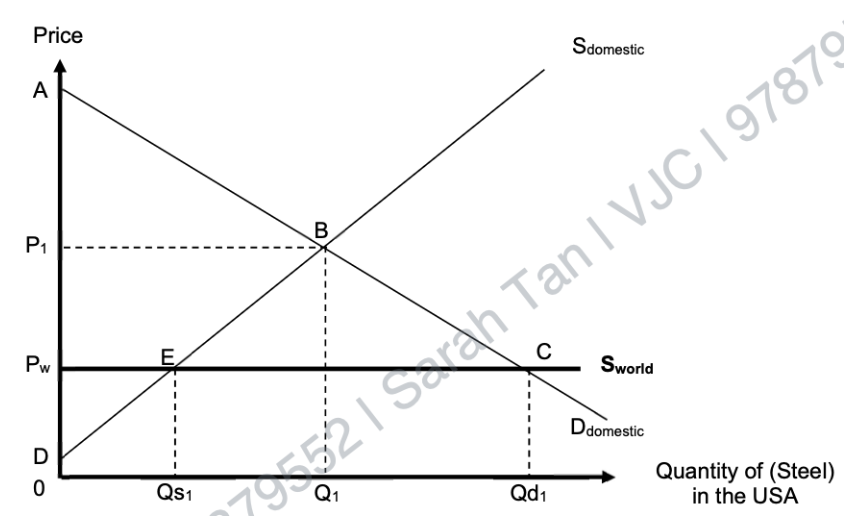
Describe free trade
Without international trade, a Country will only be able to depend on domestic production for consumption
The quantity transacted of (steel) is Q1 and the price is P1
Assuming that USA is a net importer, the world supply curve is drawn below the domestic price as other countries have comparative advantage and are able to produce (steel) at a lower cost and thus sell it at a lower price
The world supply is illustrated as a horizontal line, Sworld at Pw
It is perfectly price elastic because world economy is assumed to have almost infinite spare capacity to meet USA’s demand for (steel)
With free trade, consumers can now purchase the (steel) at Pw instead of P1
The lower prices will lead to a rise in quantity demanded from Q1 to Qd1.
However, if consumers are only willing to pay Pw, domestic producers will only be willing to produce up till Qs1 instead of Q1
This results in the domestic shortage of Qd1-Qs1 at Pw which is addressed by domestic consumers importing (steel) from the world market
Hence, the quantity transacted in the market is Qd1 where Qd1 is made up of both domestic production Qs1 and domestic imports (Qd1-Qs1)
Describe costs of free trade
Cost: Decrease PS and higher UN |
|
Define CA
(Def.): Mutually beneficial trade between countries is possible whenever one country has a comparative advantage in producing an item over another country -> it can produce a good at lower opportunity cost in terms of other goods sacrificed
Qns: Explain how benefits to the economy can arise from specialisation and exchange (trade) = THEORY OF CA
Qns: Explain why benefits from specialisation not always achieved = LIMITATIONS of CA
State assumptions of CA
Perfect competition
Perfect mobility of resources within the country
Imperfect mobility of resources between countries
Constant opportunity costs of production
No transport costs
No trade restrictions