alkanes
 Call Kai
 Learn
Learn Practice Test
 Spaced Repetition
 Match
Match Flashcards
 Knowt Play
1/15

There's no tags or description
Looks like no tags are added yet.
Name | Mastery | Learn | Test | Matching | Spaced | Call with Kai | Chat |
|---|
No analytics yet
Send a link to your students to track their progress
16 Terms
introduction
hydrocarbons → organic compounds that contain only two types of elements, carbon and hydrogen
alkanes form a homologous series of saturated hydrocarbons ⇒ no functional group
all carbon atoms present in alkanes are sp3 hybridised (C-H bonds)
general formula: CnH2n+2
cycloalkanes
are cyclic saturated hydrocarbons
a cyclic structure is formed when two terminal carbon atoms join together, and one hydrogen atom from each of these terminal carbon atoms are removed
general formula: CnH2n
are constitutional isomers of alkenes ⇒ same general formula with alkenes
nomenclature
straight chain alkanes
chemical names are formed by taking the
stem corresponding to the number of carbon atoms
ending with the suffix ‘-ane’
each successive member of the alkane family differs by a –CH2 (methylene) group ⇒ true when descending through each homologous series
cycloalkanes
ring structures are named with the word ‘cyclo’ attached to the front of the stem
branched chain alkanes
for alkanes with 4 carbon atoms onwards, there are different ways in which the carbon atoms can be connected to each other ⇒ branched chain alkanes
naming:
name the stem by counting the longest unbranched chain of carbon atoms in the main carbon skeleton ⇒ parent chain of the alkane
name the alkyl substituents (arranged in alphabetical order) as prefix to the name of the main carbon skeleton
the position of each substituent on the parent chain is denoted by a number → each carbon atom on the parent chain is numbered, starting from one end of the chain
start from the end that indicates the positions of the substituent groups by a set of smallest numbers possible
the number denoting the position of substitution is stated in front of the prefix for that particular substituent → hyphens are used to separate numbers from words
if there are multiple identical substituents, the numeric prefixes are added to the prefix → di-, tri-, tetra-
numeric prefixes do not affect the alphabetical order of the prefixes
hyphens are used to separate numbers from words, commas are used to separate numbers
alkyl substituents
are alkane derivatives with one less hydrogen atom from the parent alkane
have their names end in ‘-yl’
general formula: $CnH2n+1
isomerism
constitutional isomerism
alkanes with at least 4 C atoms exhibit chain isomerism
chain isomerism is the only form of constitutional isomerism that alkanes can exhibit since they have no functional groups
enantiomerism
longer-chain alkanes can exhibit chirality and enantiomerism
the smallest alkane is C7H16, 3-methylhexane
cis-trans isomerism
some cycloalkanes display cis-trans isomerism ⇒ ring structure restricts the free rotation of bonds in the ring
physical properties → boiling point
at room temperature:
C1 to C4: alkanes are gases
C5 to C17: alkanes are liquids
> C17: alkanes are solids
alkanes (non-polar molecules) have relatively low boiling and melting point as boiling or melting involves overcoming weak instantaneous dipole-induced dipole interactions that exist between the molecules
melting and boiling points increase with increasing Mr due to the larger electron cloud size, which results in greater polarisation of the electron cloud ⇒ stronger and more extensive instantaneous dipole – induced dipole attractions between alkane molecules. thus, more energy is needed to overcome these intermolecular forces of attraction for larger alkanes during melting and boiling
boiling point of a branched isomer is lower than that of its straight chain isomer. the greater the extent of branching, the lower the boiling point. Increased branching gives the molecule a
more spherical shape. this reduces the surface area of contact between molecules, leading to less extensive instantaneous dipole – induced dipole interactions between the molecules. thus, less energy required to overcome these intermolecular forces of attraction during boiling
physical properties → density
density of alkanes increases with increasing Mr ⇒ due to stronger and more extensive instantaneous dipole – induced dipole interactions which hold the molecules more closely together
all alkanes are less dense than water
physical properties → solubility
alkanes being non-polar are soluble in non-polar solvents (e.g. CCl4) and are insoluble in polar solvents (e.g. water)
liquid alkanes can act as non-polar solvents
reactivity of alkanes
relatively unreactive
due to the high bond energies of C–H and C–C bonds, a large amount of energy is required to break these bonds
alkanes are unreactive towards polar reagents (e.g. strong acids and bases, oxidising agents and reducing agents), as the C–H and C–C bonds in alkanes are non-polar due to the similarity in electronegativities between C and H atoms
can undergo combustion, and free-radical substitution reaction with halogens
combustion
combustion of alkanes is highly exothermic ⇒ important fuel
CxHy + (x + y/4) O2 → xCO2 + y/2 H2O
with abundant/excess supply of oxygen, products are CO2 and H2O
with limited supply of oxygen, products are C (soot) or CO and H2O
free-radical substitution reaction with halogens
reaction with chlorine or bromine does not occur in the dark → when exposed to uv light, substitution occurs, giving a mixture of products
general equation: CnH2n+2 + X2 → CnH2n+1X + HX
X is Cl or Br
reaction takes place via the free-radical substitution mechanism, which involves 3 stages: initiation, propagation and termination
name of mechanism:
free radical substitution
reagent and condition:
limited Cl2 (g), uv light and at room temperature
Br2 (l) or Br2 in CCl4 can be used
further substitution will give rise to a mixture of products
e.g.: free radical substitution of methane can give dichloromethane, trichloromethane and tetrachloromethane
mono-substituted alkane predominates if excess alkane is used
e.g.: in order to form $CH_3Cl$ as the major product of the reaction, the reaction can be controlled by starting the reaction with a large excess of $CH_4$

relative amount of mono-substituted isomeric products in a free radical substitution reaction
free radical substitution takes place randomly and a lack of control on the reaction is inevitable
coupled with the fact that the C–H bonds are of about the same energy, there is a high possibility of having a different hydrogen atom substituted such that isomeric mono-substituted products are obtained
assuming that all H-atoms are of the same reactivity and substitution is completely random
in reality, the assumption does not hold true ⇒ not all H atoms are of the same reactivity
H atoms may have different reactivity since radicals of different stability are formed when H atoms in different structural environments are abstracted during the reaction
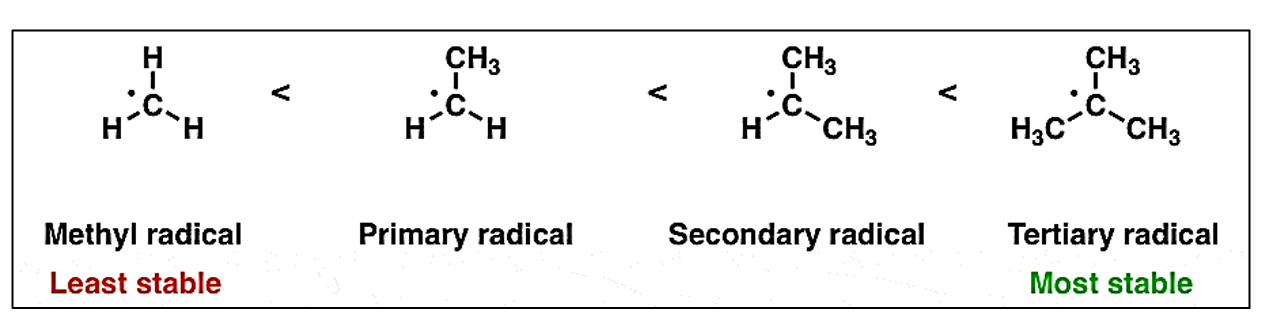
stability of radicals
reason: the tertiary radical has the greatest number of electron-donating alkyl groups which will stabilise the radical to a greatest extent ⇒ most likely to be formed
the more stable the radical, the faster it is formed → increases the proportion of the isomer formed from the more stable radical during the reaction
both factors affect the final composition of isomeric products formed
statistical factor → number of structurally different H atoms being substituted
relative reactivity of structurally different H atoms → relative rate of formation of the radical leading to each isomeric product
thermodynamic considerations for free radical substitution reactions
the trend in the calculated ΔH for the overall halogenation reaction corresponds to the trends observed for H–X and C–X bond energies ⇒ enthalpy changes become less
exothermic (or more endothermic) from F to Iorder of reactivity: F2 (most violent) >> Cl2 > Br2
fluorination of alkanes is highly exothermic, such that the reaction is too violent to be of practical use
iodoalkanes are not produced as the first propagation step is highly endothermic
due primarily to the weak H–I and C–I bonds formed → propagation step 1 is highly endothermic and energy released from propagation step 2 is insufficient to compensate for step 1 ⇒ overall ΔH for iodination is endothermic and energetically unfavourable

reduction (hydrogenation) of alkenes → preparation of alkanes
general equation: CnH2n + H2 → CnH2n+2
reagent and condition:
H2 (g) with Pt or Pd catalyst
H2 (g) with Ni catalyst
motor vehicle pollution
since air rather than pure oxygen is used, incomplete combustion occurs ⇒ unburnt hydrocarbons, carbon monoxide and oxides of nitrogen are produced
greenhouse gases
includes gases such as carbon dioxide, methane, nitrous oxide and water vapour ⇒ absorb some of the infrared radiation, retain the energy and warm the earth’s surface (greenhouse effect)
causes global warming and leads to drastic shifts in weather
carbon monoxide
produced as a result of incomplete combustion in the car engine
CO is odourless and highly toxic
combines with haemoglobin in blood more effectively than oxygen, preventing haemoglobin from carrying oxygen to body cells
may affect mental alertness and can lead to death if inhaled extensively
oxides of nitrogen
under the high temperature in the car engine, oxides of nitrogen are formed:
O2 + N2 → 2NO
2NO + O2 → 2NO2
NO and NO2 combine with water to form HNO3 and HNO2which contribute to acid rain formation ⇒ negative impact on soil, trees, buildings and aquatic lives
NO2 acts as a catalyst in the conversion of SO2 to SO3 which then dissolves in water to give dilute H2SO4 → SO2 is the main contributor to acid rain
SO2 (g) + NO2 (g) → SO3 (g) + NO (g)
NO (g) + 1⁄2 O2 (g) → NO2 (g)
NO2 also contributes to the formation of photochemical smog and in the formation of ground level ozone → ozone in smog is dangerous to health
unburnt hydrocarbons
some hydrocarbons do not undergo combustion and end up in the exhaust gases.
a mixture of unburnt hydrocarbons and nitrogen dioxide contributes to photochemical smog that is corrosive and irritating to the respiratory tract
lead (II) bromide
formed from combustion of tetraethyllead(IV) (TEL), an additive to
petrolTEL was being replaced by unleaded petrol starting in the US in the mid-1970s because of lead’s neurotoxicity and damaging effect on catalytic converters
solutions to the pollution problems
use unleaded petrol
catalytic converters cannot work with leaded petrol as lead poisons the catalyst → when a heterogenous catalyst is “poisoned”, the surface of the catalyst is no longer available
to catalyse the substrate
use catalytic converters
catalytic converters are fitted onto car exhausts to remove pollutant gases before they reach the atmosphere
catalyst used: ceramic honeycomb coated with precious metals such as platinum, palladium and rhodium
in the converter,
2NO + 2CO → N2 + 2CO2 (redox processes)
2CO + O2 → 2CO2
CxHy + (x + y/4) O2 → x CO2 +y/2 H2O
as a result, the exhaust gases from a car with a catalytic converter contain simply a mixture of nitrogen, carbon dioxide and water
