Week 3: Responsibility
 Call Kai
 Learn
Learn Practice Test
 Spaced Repetition
 Match
Match Flashcards
 Knowt Play
1/24

There's no tags or description
Looks like no tags are added yet.
Name | Mastery | Learn | Test | Matching | Spaced | Call with Kai | Chat |
|---|
No analytics yet
Send a link to your students to track their progress
25 Terms
Responsibility (recap)
Conduct fulfilling stakeholder responsibilities and serving stakeholder value optimisation.
Three approaches to responsible management
1) Instrumental: responsibility as a tool for profit — must integrate stakeholder demands to survive
2) Political: responsibility as engagement with society
3) Ethical: the management-society relationship is embedded in an ethical framework.
Carroll's CSR Pyramid
Four levels, bottom to top:
1) Economic (be profitable)
2) Legal (obey the law)
3) Ethical (do what's right, even beyond the law)
4) Discretionary/Philanthropic (voluntary good citizenship).

Agency problem
A conflict arising when managers (who control the company) don't act in the best interest of shareholders (who own it) — a separation of ownership and control.
Fiduciary duty
A manager's obligation to act in the best interests of shareholders and not waste their invested capital on value-reducing actions.
Shareholder theory (Friedman)
The business's only social responsibility is profit, earned through open and fair competition.
Executive philanthropy spends shareholders' money without their consent, so helping other stakeholders is only justified if it increases profit.
Stakeholder theory (Freeman)
Stakeholders are any group or individual who can affect or is affected by the business; all stakeholders are intrinsically valuable, and managing them well means finding win-win solutions.
Shareholder model vs stakeholder model of the firm
Shareholder model: inputs flow in from various groups, but value flows out only to shareholders.
Stakeholder model: the firm sits at the centre of a network, exchanging value with every stakeholder group. (Donaldson & Preston, 1995)
Uber case — the core tension
Stakeholder theory says drivers' legitimate stakes (fair pay, autonomy) can't be overridden by customer and investor interests alone — yet Uber has often prioritised the latter.
Uber case — why balance matters
Ignoring driver interests can backfire (e.g. drivers gaming or sabotaging the app), showing that balancing stakeholder interests can also protect the company's own interests.
Grand challenges / wicked problems
Global-scale problems with three defining features (Ferraro et al.):
1) Complex (many interacting causes)
2) Uncertain (hard to predict how they evolve)
3) Evaluative (people disagree on what "success" looks like).
Governance structures (3 sectors)
Public sector (governmental, non-profit, public goods)
Civil society (non-governmental, non-profit, public goods)
Private sector (non-governmental, for-profit, private goods) — plus "club goods" in between (e.g. cinema, satellite TV).
Partnership portfolio mapping
A tool for analysing a company's cross-sector partnerships across 5 dimensions:
1) Size
2) Diversity
3) Density (ties between partners)
4) Dynamics (change over time)
5) Portfolio map (the full picture).
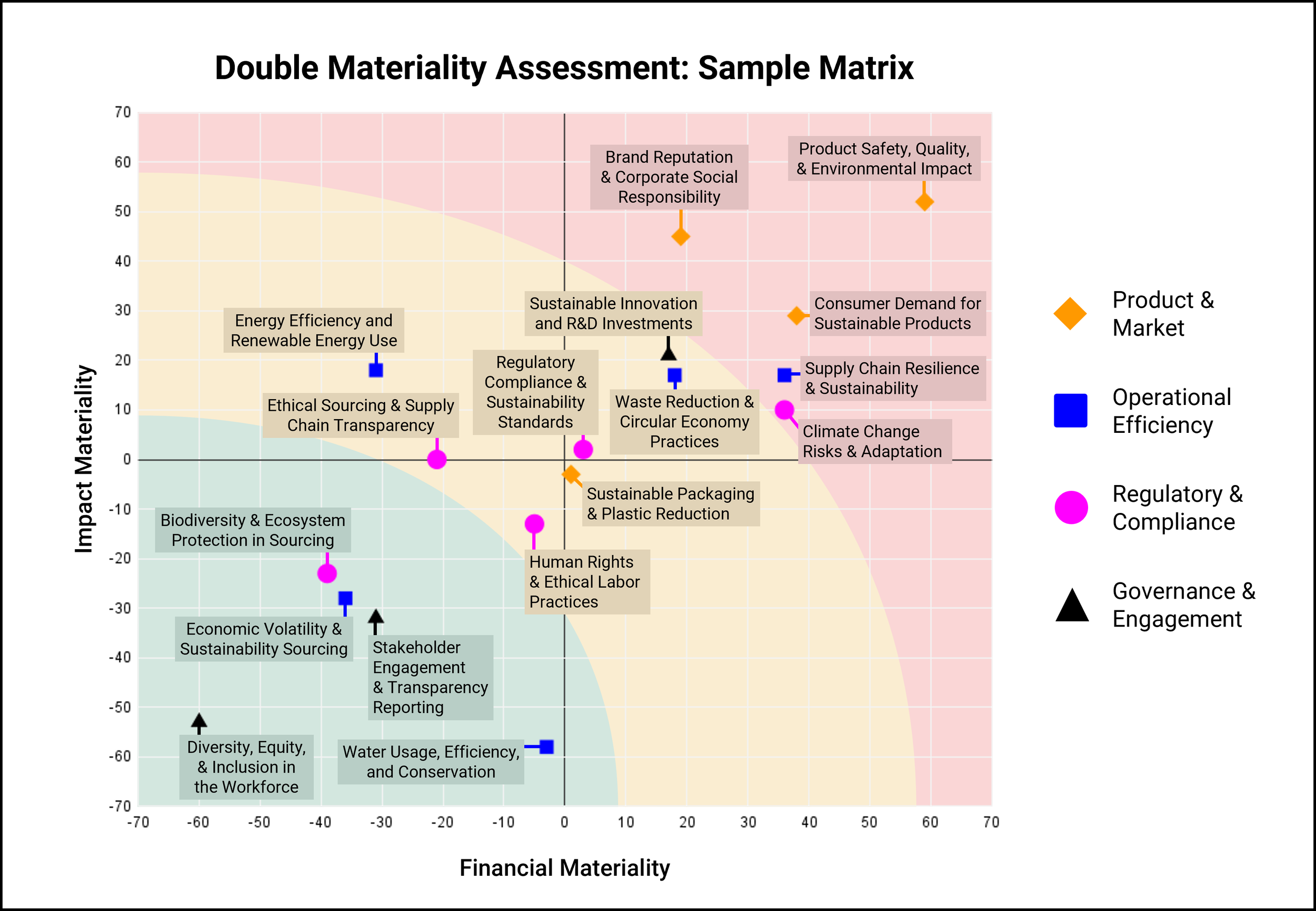
Materiality (in a CSR context)
How important a specific issue is, both to the company and to its stakeholders — the basis for deciding what to prioritise.
Materiality matrix
A chart plotting issues by importance-to-stakeholders against importance-to-company, used to decide what to focus on and report.
Responsibility and profitability (meta-analysis)
A meta-analysis of 251 studies found only a small positive overall correlation (~0.13) between CSR and financial performance — strongest for observer perceptions and philanthropic donations.
CSR → Reputation → Financial performance
Responsible activities (especially philanthropy, if properly communicated) build reputation; a strong reputation then improves financial performance through willing stakeholders, price premiums, and investor confidence.
CSR → Innovation pathway
Closer stakeholder relationships and internal learning from CSR activities can fuel innovation, better product differentiation, and ultimately higher profits.
Why the business case for CSR may not always hold
Newer research shows the CSR-profit link isn't guaranteed: ESG ratings vary wildly between agencies, and some studies even find lower expected returns for "green" stocks than "brown" ones.
Externality
A cost or benefit to a third party caused by an economic activity, not reflected in that activity's price (e.g. pollution costs left out of a product's price).
True price
A product's normal retail price plus its true social and environmental costs, calculated using damage costs and/or abatement costs.
GRI (Global Reporting Initiative)
A widely used voluntary standard for companies to publicly report their impacts on the economy, environment, and people.
CSRD (Corporate Sustainability Reporting Directive)
An EU law requiring certain companies to report on their sustainability impacts and how sustainability affects their business.
ESRS (European Sustainability Reporting Standards)
The detailed standards that establish exactly what and how companies must report under the CSRD.
Double materiality
Reporting both how sustainability issues affect the company financially, AND how the company's own activities affect people and the environment — required under CSRD.