Food animal midterm 1
 Call Kai
 Learn
Learn Practice Test
 Spaced Repetition
 Match
Match Flashcards
 Knowt Play
1/141

There's no tags or description
Looks like no tags are added yet.
Name | Mastery | Learn | Test | Matching | Spaced | Call with Kai | Chat |
|---|
No analytics yet
Send a link to your students to track their progress
142 Terms
What is dental attrition? What are the two general causes of dental attrition?
accelerated dental ear
poor pasture with sandy soil
dietary factors like Ca/P imbalances, fluoride tox, acids and enzymes
What are three bacteria that cause tooth root abscesses in small ruminants?
anaerobes
trueperella pyogenes
actinomyces spp.
Why would animals with excessive salivation potentially need fluids?
To treat dehydration and metabolic acidosis due to loss of alkaline saliva
What is the causative agent of wooden tongue disease? Anaerobic or aerobic? Gram negative or positive? How is it introduced?
Actinobacillus lignieresii
aerobic gram negative rod
tissue injuries like with fibrous feed.
Which tends to be more painful, Wooden tongue or lumpy jaw?
wooden tongue
What would you use to treat wooden tongue? Prognosis?
oxytetracycline, TMS, florphenicol, etc. Can use with NaI (IV)
good to excellent
What is the causative agent of lumpy jaw? What are the characterisitics of the bacteria? How is it introduced?
Actinomyces bovis
gram positive anaerobic filamentous rod.
abrasive feed or erupting teeth
How would you treat lumpy jaw? Prognosis?
10-20% sodium iodide IV (same as wooden tongue)
Penicillin G, oxytetracycline or florfenicol.
can give remission but guarded long term
Five ddx for vesicular/oral diseases in cattle?
BVDV
malignant catarrhal fever
vesicular stomatitis
foot and mouth
bovine papular stomatitis
BVDV can cause oral erosions. What is another lesion we can see that is very common?
linear esophageal erosions
_________________ signs include cloudy eyes and lymphadenopathy, and resp signs, and oral erosions.
malignant catarrhal fever
________________ : horses can get this**. Rhabdovirus. Cattle and pigs too. Reportable. High morbidity with low mortality and slow recovery. Big economic impact bc looks like FMD. Treat with supportive care.
Vesicular stomatitis
What family of viruses is FMD? Vesicular stomatitis?
picornavirus
rhabdovirus
________________ : parapox virus seen in young and naive calves where you see a 2-4mm hyperaemic lesions in nose and mouth. Most are asymptomatic. Zoonotic. Very common
Bovine papular stomatitis
______________: reoviridae (orbivirus) transmitted through the arthropod Culicoides variipennis. Have had some in BC through vector and wind borne intros.Causes oral lesions in ruminants. See facial edema, cyanotic tongue.
Bluetongue disease
What are two diseases that cause oral lesions in small ruminants?
Contagious ecthyma (orf—> parapox virus)
Bluetongue disease
Describe the two types of rumen contractions and how often they occur?
Primary contractions occur 1/minute where there is a mixing function, moving digesta from rumen to reticulum and there to omasum. Allows for cud regurgitation.
Secondary contractions occur 1 every 2 min where the rumen contracts to move things caudal. This allows for eructation as the cardia relaxes.
What are 5 causes of free gas bloat?
grain overload causing increased gas production
esophageal obstruction
vagal nerve or cardia dysfunction
hypocalcemia
postural (lateral or dorsal recumbency)
How would you treat free gas bloat?
try passing a tube and if that doesn’t get through then do a left side trochar.
What are two general causes of frothy bloat?
lush legumes (alfalfa, clover, winter wheat)
grain bloat from fine particle size
Three ways to prevent frothy bloat?
feed ionophores
limiting access to feed
drench with oil
At what pH of the rumen is considered acidotic?
<5.4 for acute
How would you treat acute ruminal acidosis?
If free gas, pass orogastric tube and give MgO or sodium bicarb which is less gentle
If frothy, give poloxalene, DSS or mineral oil
What are two of the most common sequelae of acute ruminal acidosis?
laminitis
liver abscesses
What causes subacute rumen acidosis? When do you see it? What is a big issue with it?
excessive carbs in diet or low roughage
adapted feedlot animals or lactating dairy cows in first 150d
It tends to be a herd problem where the rumen paplillae are damaged and clump decreasing feed efficiency and intake. They tend to have low milk fat and production.
When is the rumen considered alkalotic? Two main causes?
pH>7
animals off feed with continued saliva production, urea tox (urea fed as a protein source in large amounts)
What are the two main causes of peritonitis in cows?
traumatic reticuloperitonitis (hardware)
perforated abomasa ulcers
What are three clinical signs of peritonitis?
abdominal discomfort (failed withers pinch)
poor to absent rumen contractions
dramatic decrease in milk production
note: may see fever and systemic signs
What can an ultrasound and abdominocentesis show if there is peritonitis?
fluid and fibrin
When are animals at highest risk for hardware disease?
parturition
How would you treat hardware disease (5)? Prognosis?
magnet
antibiotics (Penicillin or oxytet)
NSAIDs (meloxicam or flunixin)
confinement
hay diet
Good if it responds in 3-4d but if they need surgery then very poor.
What are 4 times that you commonly see abomasal ulcers?
early PP
high carb diets
sequelae to LDA (due to delayed gastric emptying lowering the pH)
sequelae to absomasal lymphoma
What are the 4 types of abomasal ulcers? How would you treat them?
non-perforating erosive
non-perforating with severe blood loss
perforating with local peritonitis
perforating with diffuse peritonitis
similar to hardware except no NSAIDs
7 ddx for diarrhea in adult cows?
Salmonellosis
Winter dysentery
BVD
malignant catarrhal fever
hemorrhagic bowel syndrome
Johne’s
parasitic gastroenteritis
Which species of Salmonella is most common in cattle? Which subtype is cattle specific? Which subtype is most common?
Salmonella enterica
S. Dublin
S. Tymphimurium
How long do cattle shed salmonella?
weeks to months
What are the three categories that infected cattle with Salmonella can fall into?
non-clinical carriers
subclinical cases (intermittent fevers and low MP)
clinically ill with diarrhea
Does Salmonella infection alone cause disease? Where are outbreaks most commonly seen?
Not usually on its own but does when there is concurrent disease or triggers like feed changes, parturition, movement of young, etc
In calves of endemic farms
Describe the transmission of salmonella?
fecal oral
can be trans-placental
in milk for up to 4w after parturition
What are the 4 clinical syndromes of salmonellosis in cattle? Who gets it?
septicemia (new born calves)
Acute enteritis (calves 2-6w, cows post stress)
Subacute enteritis in adult cattle
abortion due to bacteria infecting fetus or the endotoxemia causing the CL to lyse
Describe the clinical signs of acute enteritis caused by salmonellosis?
Initial signs of endotoxemia include fever, dullness, anorexia, dehydration and diarrhea (fetid with blood and fibrin).
May present as pneumonia due to sepsis especially with S. Dublin.
Describe the pathophysiology of salmonellosis in cattle? What is often found at necropsy?
causes a maldigestive and secretory diarrhea. Salmonella is invasive and intracellular. Can be phagocytized and carried to lymphoid tissue. Strong inflammatory response with fibrin formation.
at necropsy, can see mucoid fibrinonecrotic enteritis localized over Peyer’s patches. Can also see oedematous mesenteric LN.
How do you diagnose salmonella?
can do 3-5 serial cultures or pcr on feces
How would you treat salmonellosis?
fluid therapy
NSAIDs
grass hay diet
antiobiotic if needed (TMS)
How is winter dysentry transmitted? High or low morbidity?CS?
fecal oral
high morbidity (near 100%) but rarely mortalities
Explosive outbreak of prjectile diarrhea that may have red blood flecks. Sometimes a cough.
What kind of virus is BVDV? Are most noncytopathic or cytopathic?
pestivirus
noncytopathic
BVDV invades epithelial tissue in what 3 areas? How is it transmitted?
GI, integumentary, resp system
basically all fluids and vertically too
What are the 3 outcomes for utero-acquired infections and what are the time lines for them?
persistently infected: 40-125d gestation. Cannot amount an immune response against the virus. Most are poor doers and get culled.
congenital defects (80-150d): most common is cerebellar hypoplasia
early embryonic death (<30d) and abortions (150d)
True or false:
If the dam is a PI, the calf will most likely be a PI
true
Which animals can get mucosal disease? How?
if persistently infected animals that were exposed to a NCP strain gets exposed to a CP strain that is similar, they can die very quickly with severe neutropenia and thrombocytopenia.
How can you diagnose BVDV?
necropsy findings
paired serology in acute cases
PCR for viral antigen
immunohistochemistry on fetuses or tissues (ear notch for PIs)
How would you prevent BVDV?
good sanitation
quarantine and vaccinate new animals
test for PIs and cull
vaccinate with MLV
What is the causative agent of malignant catarrhal fever? Main CS?
ovine herpes virus 2 where cows are dead end hosts
oral/esophageal erosians, bloody diarrhea, keratoconjunctivitis, etc. They will die.
Describe hemorrhagic bowel syndrome?
peracute disease often resulting in sudden death. Sporadic with unknown cause (maybe C. perfringens type A).
Pathology is sudden and extreme with extensive hemorrhage into the SI resulting in clood clots that obstruct intestine. See melena or frank blood. Can try to treat with surgery but prognosis is grave.
What is the causative agent of Johne’s disease? Pathogenesis? Do they shed?
mycobacterium paratuberculosis
ingested organism early in life. May be asymptomatic for years and then develop granulomatous enteritis causing a malabsorptive protein losing enteropathy. Usually fecal oral but has been isolated in milk.
often shed bacteria before showing disease
Describe CS of Johne’s?
intermittendt diarrhea and weight loss with profuse watery non-fetid diarrhea. Clinical pathology can show hypoalbuminemia and hypoproteinemia.
How do you diagnose Johne’s disease? Prevention?
fecal culture but that takes 6-8w for results
can do a fecal PCR
prevent fecal oral in young through sanitation and early separation of dam and calf. Test and cull.
__________________ (small ruminants, young calves) which causes severe anemia, hypoproteinemia and death through abomasa blood sucking. No diarrhea.
Haemonchus contortus
______________ is seen in cattle and causes destruction of abomasal mucosa leading to protein loss and maldigestion (similar one in small ruminants). Economic impact. Type one from heavy burden on pasture and occurs in first grazing season for animals. When they reemerge in the fall/spring, this is Type II. May have diarrhea.
Ostertagia ostertagi
_______________ parasite is seen in sheep and goats and causes abomasitis
Trichostrongylus axei
Which type of C. perfringens is more common in older feedlot cattle? Milk cows?
type D
type C
What are the three physiological classifications of neonatal scours?
secretory
osmotic overload
malabsorptive/osmotic diarrhea
What are three things that cause secretory diarrhea? Is there enterocyte damage? pH?
E. coli, salmonella, enterotoxins
no
alkaline fecal pH
What are two things that can cause osmotic overload diarrhea?
poor quality milk replacer and overeating
Malabsorptive diarrhea is caused by what 4 pathogens? Is there enterocyte damage? pH of feces?
rota, corona, crypto, salmonella spp.
acid fecal pH

What diagnostic test would you use for the following pathogens?
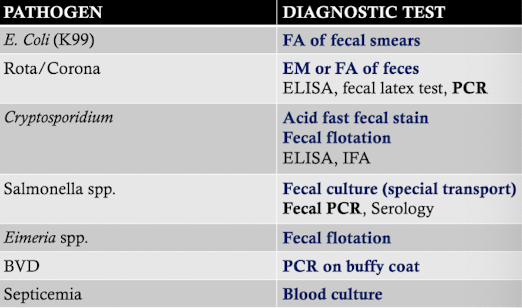
How would you treat neonatal scours?
fluid therapy*** to fix dehydration, acid/base and electrolyte abnormalities.
nutrition: whole milk is better when scouring. Smaller quantities more often. Better colostrum managment
NSAIDs
antimicrobials if septic
At what point should you IV fluids on a scouring calf rather than oral?
When >7% dehydrated when not suckling, in sternal or later recumbency.
When is coccidiosis more common? In what conditions?
In calves and lambs 3-4w to yearlings mostly after weaning or grouped housing. Incidence of clinical disease is low.
NOTE: ingested oocysts stimulate immunity.
When are you likely to see scours caused by E. coli? Rota and corona? Salmonella and crypto?
days 1-8
days 5-16 to 21
days 6 and onward. Not common in first week.

What causes displaced abomasums?
abomasal motility disorders like dietary modifications (rations high in protein and low in fibre) and metabolic disturbances (ketosis, hypocalcemia)
For an LDA, where would you hear a ping? What about RDA/RTA? Are they emergent?
9-13th rib and are clinically stable
10th-13th rib and need emergency surgery
Are LDAs or RDAs more common?
LDAs (85-95%)
What are the 4 approaches to surgical correction of LDAs/RDAs?
right flank omentopexy
right flank pylorpexy (don’t do this anymore as it makes the outflow obstruction worse
Right ventral paramedian abomasopexy
left flank abomasopexy (LDA only)
Which approach to an DA is being described?
incision in right paralumbar fossa. Find back of rumen and follow it to abomasum. Bring out needle (protected), pierce abomasum gas cap. Suction. Follow as air is taken out until it falls out. Swing abomasum over or retract omentum if you can’t reach. Want to pull until you see the pylorus. Take that omentum and suture to body wall. Do a running suture to hold it in place.
right flank omentopexy
Which surgical approach to a DA is being described?
not a standing procedure. Animal is in dorsal recumbency. This allows the abomasum to float up. Stomach area is usually dirty, clean carefully. Take gas off with needle and suture to body wall. And less layers to cut through.
right ventral paramedian abasopexy
Which surgical approach to a DA is being described?
need really long arms. Run suture lines into the abomasum before taking the gas off. Then deflate. Keep hold of suture lines as it sinks. Bring suture lines down the cow then pierce through body wall and grab form outside. Do that for both and tie them together.
left flank abomasopexy
What are 3 complications see in surgical repair of DAs?
breakdown of pexy before mature adhesion
incisional infection
outflow obstruction (pyloropexy)
Name and describe a non-surgical approach to a DA?
Abomasal Blind Tack: cow is cast and rolled into dorsal. 2 trochars inserted through the body wall and hopefully into the abomasum. Toggle pin/suture passed through the trochars to catch the abomasum and then tie together. Sutures are removed in 2-4w.
What are some complications associated with abomasal blind tack approach to DAs? (3)
incomplete decompression of the abomasum, abomasal fistula, may accidentally pexy something else.
True or false: you cannot see a right sided fluid wave in right torsed abomasum?
false: sometimes can ballot one
What electrlyte abnormalities are common in right torsed absomasums?
hypochloremia, hypokalemia, and metabolic acidosis
Why is parasite a must do for small ruminants?
Haemonchus**
Describe program A for parasite control? B? C?
treatment given to cows 3-4 and 8-12w after turnout. Calves treated 0,1,2 times on pasture depending on age and in fall (if kept). Cows and selected heifer calves at stabling. 40kg and bigger for heifers with this strategy.
bipolar blanket. Treat cows when they go out then treat when they come back in after. Try to do calves after 4w.
treat and go. Treat cows and calves mid season or in fall.
What are 4 types of wormers and what do they work for?
Avermectins (Ivermectin): Gets most helminths and external parasites but not tape.
Benzimidazoles and levamisoles: narrow spectrum and not externals.
Albendazoles: oral. Same as Benzs
Morantel tartrate: oral. Same as Benzs but not Buno or dictyocaulus
Should you worry about tape worms in small ruminants? How do you treat them?
Not that important
treat with Albendazole
What are 4 coccidiostats and what is the best option?
amprolium (hard on stomach)
decoquinate
monensin
Baycox— best choice
What can be used to treat crypto?
Halocur which decreases shedding but does not eliminate it
How would you treat lice in cattle?
1x treatment of avermectins or 2x if not ivermectin. Biting lice and chorioptic mange need pour ons. Treat everyone.
How would you treat for grubs, warblers and mites?
treat in fall with Avermectins
What is one treatment option for flies?
CyLence but is can only be used 3x a year (12w fly control total)
____________: those that have not been exposed to proper drugs. Want to increase the number of sensitive worms and decrease resistant worms. In small ruminants, to increase refugia then don’t deworm the entire flock. Keep some left untreated. Use fecal egg counts and FAMACHA (uses eye anemia as guide. High PCV have fewer worms) scores to determine who needs treated.
Refugia
What are the 3 steps to control neonatal scours?
reduce exposure: calve heifers first and separate, keep season short. Have good drainage and shelter, clean, dry, draft free area for calves only (creep space), isolate sick animals, make sure there is wintering, calving, and mothering spaces. Do not buy replacement. Change calving season if things are going really south.
increase immunity: enhance colostrum quality (reduce stress in cow and provide good quality), 4L in 4h (6L in 12h), colostrum alternatives (monoclonal antibodies, artificial, dairy), vaccinate cows (or calves if necessary), reduce stress by calf physical and social comfort.
Vaccination: There is E.coli and Rota/corona virus (2-3$/cow). None for crypto, coccidia. There is cow products to give but can vaccinate calves in emergency. Try to get two shots in them. 3m before worn off.
What are the 3 VFAs that are created in the rumen by microbes when digesting carbs?
butyrate
actetate
proprionate
Which VFAs contribute to milk fat? Where do they come from?
actetate and butyrate
fibre
Where does proprionate come from? What does it do?
cereals/starch
drives the liver with energy (glucose) where the glucose also turns into lactose for the milk.
How many kgs of dry matter do cows eat per day?
22kg
What are the two types of fibre and why are each important?
acid detergent fibre: it helps with structure but you can’t do much with it.
Neutral detergent fibre: gets broken down and used by the body.
Why is fibre physically important? What percentage of diet should be parts >1.5in?
fibre mats hold particles up for digestion in the ruminant
15-20% of dairy cattle forage should be >1.5in to prevent rumenal acidosis.
True or false: cows do not need high quality protein because microbes can reformulate them
true