3. Earth Processes info
 Call Kai
 Learn
Learn Practice Test
 Spaced Repetition
 Match
Match Flashcards
 Knowt Play
1/22

There's no tags or description
Looks like no tags are added yet.
Name | Mastery | Learn | Test | Matching | Spaced | Call with Kai | Chat |
|---|
No analytics yet
Send a link to your students to track their progress
23 Terms
Define litosphere and asthenosphere
Lithosphere = part of crust broken into giant tectonic plates
Asthenosphere = weak hot flowing zone at top of mantle
Oceanic vs Continental age
Continental = up to 4.5billions
Oceanic = < 200 million years old
Oceanic vs Continental material and density
Continental = granitic 2.6g/cm3
Oceanic = basaltic 3g/cm3
Oceanic vs Continental thickness
Continental = 70km
Oceanic = 5-10km
All evidence for plate movement
Apparent jigsaw fit of continents - SA and Africa
Fossil correlation - Mesosaurus SA and Africa
Rock and mountain correlation - Zircon dating so same rocks made in same time - Canada/Greenland and North Europe/Scandinavia
Palaeomagnetic correlation - alignment locks as plate cools showing evidence of seafloor spreading
Theories of plate movement from best to worst
Slab pull, ridge push + small bit convection currents
Convection currents
Expanding earth
Hydroplate
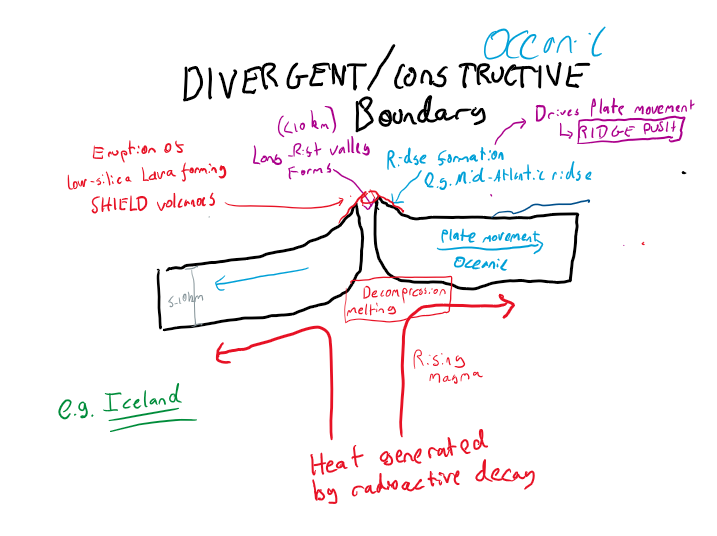
Explain divergent/constructive oceanic boundary - (faulting type, processes, landforms)
Normal faulting
Two oceanic plates move apart driving plate movement by ridge push
Long ocean ridge forms, shield volcanoes(low silica lava forming)
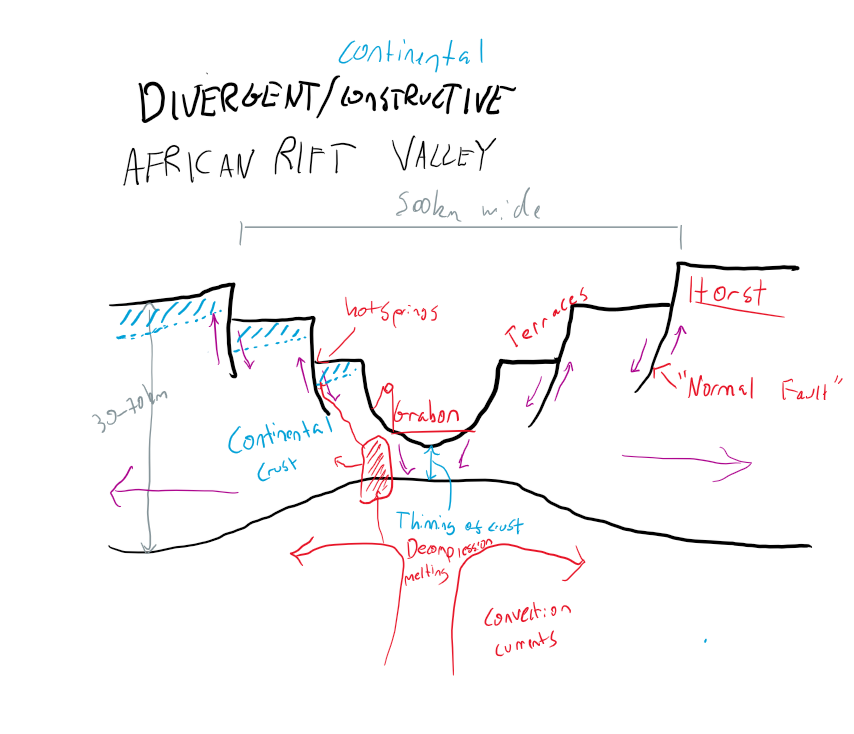
Explain divergent/constructive continental boundary - (faulting type, processes, landforms)
Normal faulting
Thinning of the crust in the middle creates graben(dip), terraces coming out from graben, fault scarps = vertical displacements of rock
Hot springs
Mostly shield volcanoes as oceanic magma but sometimes silica from continental makes stratovolcanoes
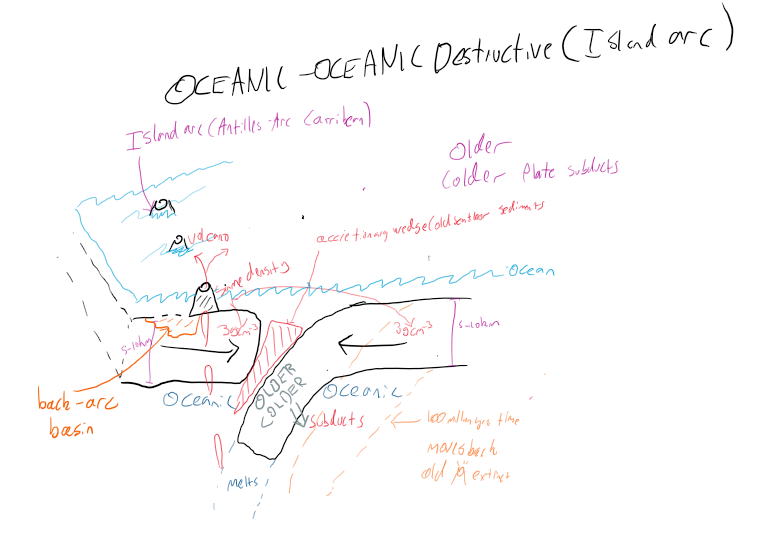
Explain ocean-ocean convergent/destructive boundary - (faulting type, processes, landforms)
Reverse faulting
Island arc and ocean trench, back arc basin, stratovolcanoes
older, colder oceanic plate subducts
Accretionary wedge forms between plates
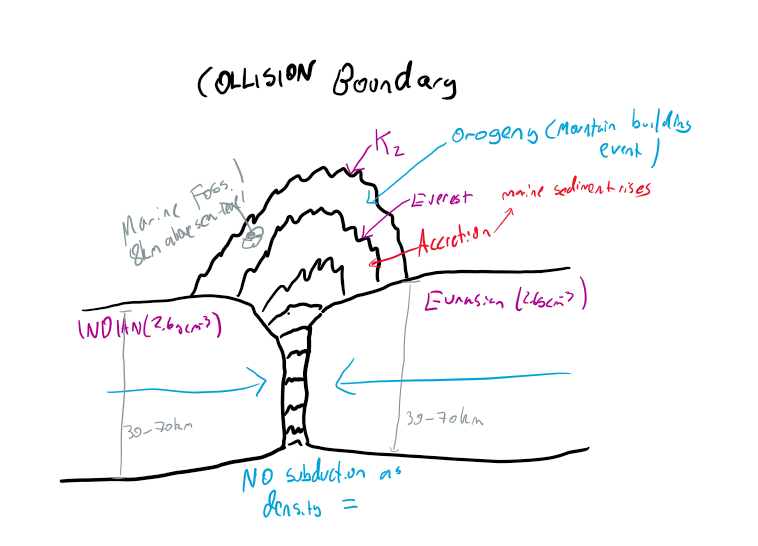
Explain continental-continenral convergent/collision - (faulting type, processes, landforms)
Reverse faulting
Fold mountains
Orogeny = mountain making effect
Accretion
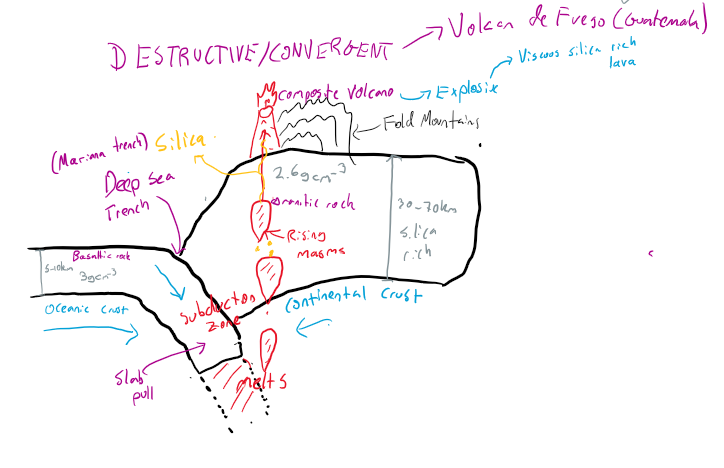
Explain Oceanic-Continental convergent/destructive - (faulting type, processes, landforms)
Reverse faulting
Oceanic plate subducts
Fold mountains, stratovolcanoes, trench
Drives process of slab pull
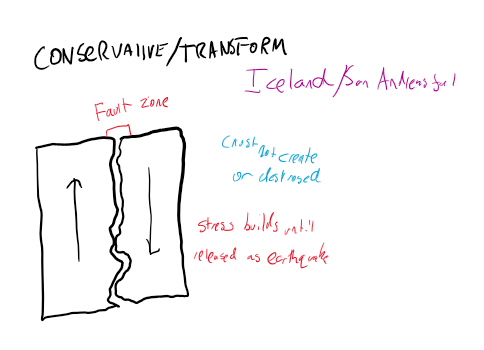
Conservative/transform plate boundary - (faulting type, processes, landforms)
Shear stress
Earthquakes
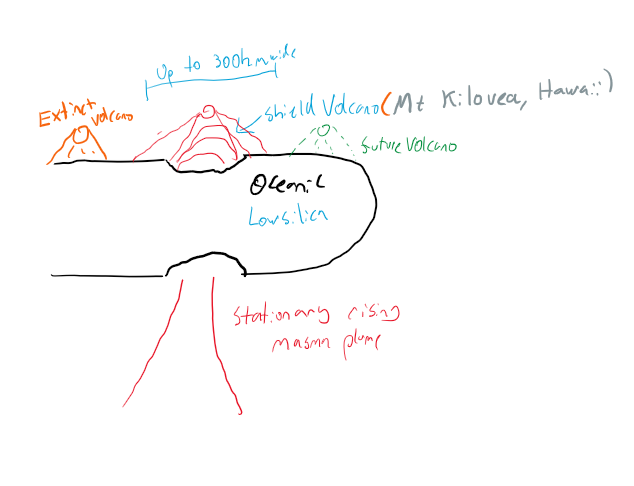
Oceanic hotspot - (faulting type, processes, landforms)
Island chain/shield volcano
Moving oceanic plate creates chain of islands over stationary rising magma plume
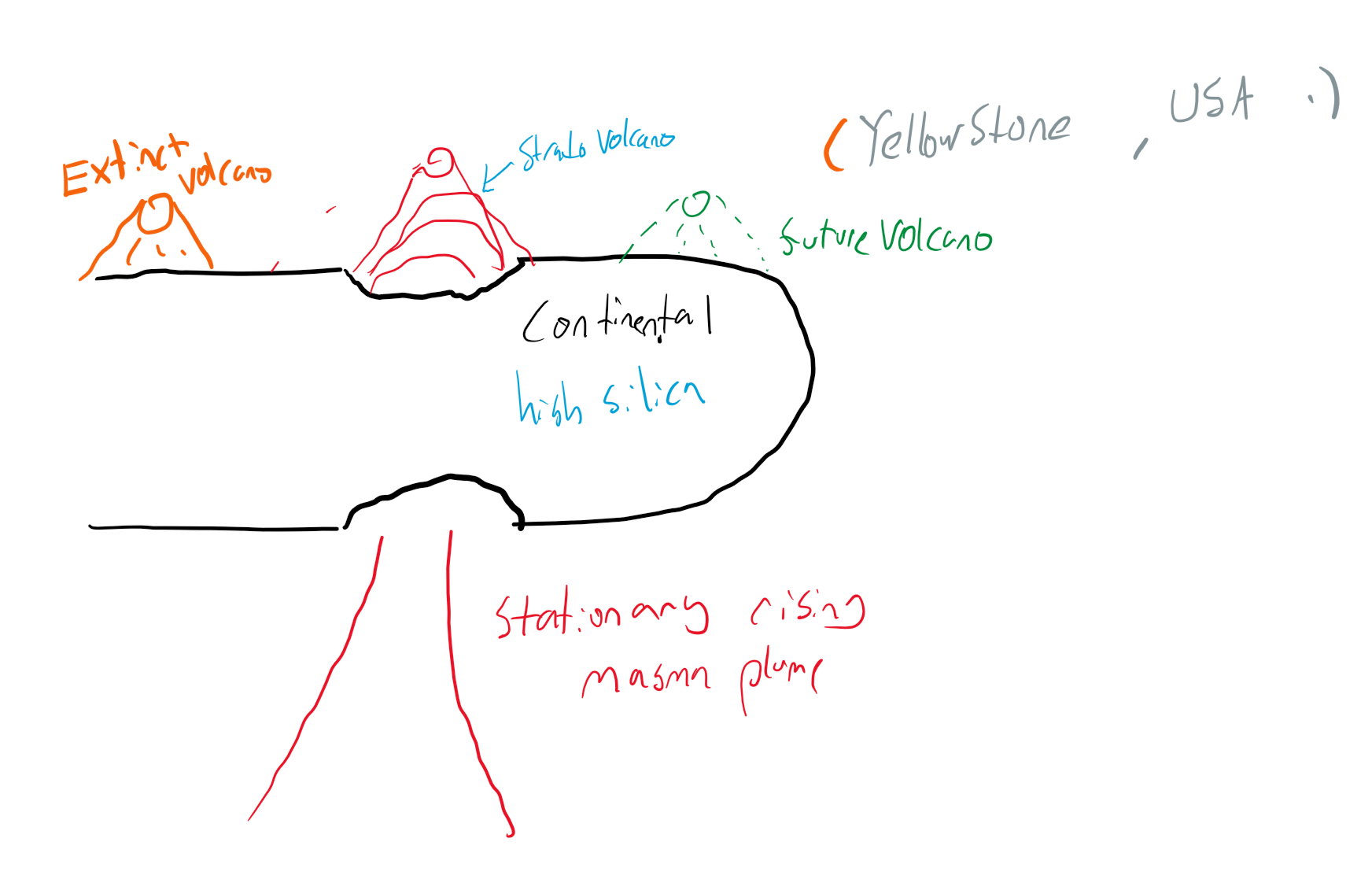
Continental hotspot -(faulting type, processes, landforms)
Strato/composite volcanoes
Name all tectonic forces, what they are and where they are
Confining stress - pressure from above
Compression - rocks pushed together - convergent
Tension - rocks pulled apart - divergent
Shear - rocks pushed past one another - shear
Explain how deformation changes with depth and speed of stress
Surface = all brittle deformation
Deep in mantle = all elastic deformation
Mid depth
Slow speeds = all elastic deformation
Mid speed = plastic deformation
Fast speed = brittle deformation
Name all 7 types of mass movement
Rock falls
Debris/mud flows
Rotational slides
Slides
Slumping
Heaves
Soil creep
Explain heaves/creeps
Slow, gradual process
Individual soil particles are moved down slope by wetting, freezing or heating
Soil creep can form terraces
Explain flows
Continuous flows that change shape of regolith
Regolith size is usually smaller - rocks/mud/fine silts
Mudflows = fast, wet flows of mud
Debris flows = fast flowing accumulations of water containing soil and rock fragments
Explain slides
Landslides of any material/regolith
Rotational slides(slumps) produce a series of steps/terraces
Occur when an entire mass of material moves along a slip plane
junction between two layers of rock
A fault line
Slide material generally tends to maintain shape
landslides
Loose rock/stones/soil moving down slope as shear stress is greater than shear strength
Slumps
Occur on weaker rocks and have a rotational slide along a slip plane
Explain falls
Occur on steep slopes
Often caused by weathering
Condition for mass movement to occur
Shear strength > shear stress
Exogenic vs endogenic factors affecting mass movement
Exogenic
Precipitation, weathering, human activity, land use change
Endogenic
Lithology, human activity, pore water pressure, weakening of cohesion, undercutting of slope, organic effect, road building(undercutting), excavation, deforestation, loading from houses