Cognitive Social Learning Theory (CSLT): Walter Mischel and Albert Bandura
 Call Kai
 Learn
Learn Practice Test
 Spaced Repetition
 Match
Match Flashcards
 Knowt Play
1/23

Earn XP
Description and Tags
Mischel: “Traits describe, but do not explain.”
Name | Mastery | Learn | Test | Matching | Spaced | Call with Kai | Chat |
|---|
No analytics yet
Send a link to your students to track their progress
24 Terms
Cognitive Social Learning Theory (CSLT)
Largely a cognitive model
Stresses the importance of both personality and the environment
Stresses the importance of mental representations of the world
Focuses, too, on the process of learning
Consistency Paradox
We intuitively see people as consistent, but research suggests that they are not!
The correlation between personality traits and behavior is only about .3 maximum (termed the Personality Coefficient)
Behavior is largely situation-specific
CSLT does not expect behavior to be consistent across situations, but depends on the reward/punishment it produces in that situation
Why do we believe in the consistency of traits?
Mischel argues that it is in the eye of the beholder
Self-fulfilling prophecy: Our belief in traits makes us see people similarly
We ARE the situation
Helps us see consistency
We see people in similar situations
Consistency is only expected…
If the same behavior is reinforced across environments
Learning history dictates when and how a person acts in a given situation
Or, if a person cannot discriminate between environments
Fits into Personality Theory because people who can discriminate between situations are well-adapted!
According to Mischel and Bandura
Traits are not causes, but merely summary labels for multiple behavioral observations
That is, TRAITS DO NOT EXPLAIN!
Situational Context for Behavior
Mischel and Wright (1988)
People hedge their statements with conditions with people they know well (Person does X when Y)
E.g., Grace will cry if she is too hot
E.g., Beatrice will hit back when she is teased
Hartshorne & May
Children were placed in different situations where they could lie, cheat, or steal
Correlation between behavior was only .3!
Called Personality Coefficient
Conclusion: Traits are not useful to a psychologist who wishes to describe an individual
Are you the same at a party and funeral?
“Cognitive Person Variables,” not Traits
Encoding Strategies
Competencies
Expectancies
Subjective Values
Self-Regulatory Systems
Encoding Strategies
Style of representing information, which is different between people
The environment influences behavior (of course!), but we all differentially interpret the environment because of:
Different learning histories
Different encoding strategies
Different competencies (how might someone who is blind interpret different situations?)
Prototypes
Much behaviorism research used a very clear stimulus to signify the “environment”
Say, 2,000Hz tones and 10,000Hz tones indicate a possible future punishment and reward, respectively
But what if the environment were less clear?
Say, a 6,000Hz tone
People, too, are difficult to easily categorize
Extrovert or introvert? It depends on how they interpret the world!
Competencies
Cognitive and behavioral competencies
Think about what types of competencies one needs to be a . . .
President
Orator
World’s Strongest Man or Woman Competitor
Stock Analyst
Professor
Expectancies
Behavior-Outcome
Will my behavior have an effect?
Will studying help me get an ‘A’ or does the professor “have it in for me”?
Self-Efficacy
Can I perform a desired behavior?
If I need to run a 5-minute mile to make the team, should I even try out?
Stimulus Outcome
What does the environment predict and how will that influence my behavior?
Does Amy’s yelling signify that she will soon slap me (RUN!!) or is this tantrum just for show?
Subjective Values
Are results desirable?
Do I even want to make the team?
Self-Regulatory Systems
Distraction, delay gratification
Self-Regulatory Systems and Plans
Helps us to overcome stimulus control (the influence of the environment)
Freedom from Distractibility
ADHD
Self-Appraisal
I ran a 5 minute mile. Am I happy, or should I have done better? Is it ok if I couldn’t run a 5-minute mile?
Delay of Gratification
The ability to defer present gratification for a more desirable, future goal
Studies with children (receive one marshmallow now or two later?)
Making the marshmallow visible (harder)
Talking about how good marshmallows taste (harder)
Providing distraction makes delay easier!
Even watching commercials about “yummy” Sugar Pops makes it easier to delay the reward!
By about age 5, children develop their own strategies
Covering up the marshmallow
Focusing on something different
The ability to delay gratification is termed ego strength
The opposite of impulsivity
Interestingly, ego strength is relatively stable starting at about age 5!
Social Learning Theory (SLT) - Albert Bandura
Agrees with Learning Theory that behavior can be influenced by direct reinforcement
Behavior need not spontaneously occur for learning to take place!
Need not get hit by a car to know that it’s bad!
Most human behavior is learned, intentionally or unintentionally, by modeling
Termed imitative learning, observational learning, or vicarious learning (interchangeable)
Modeling
Definition: Observing others’ behavior and then mimicking it
Can result in NEW behaviors
Can modify old behaviors
The Bobo Experiment
3-5 year old children saw adults kicking/punching an inflatable doll (“Bobo”)
Some ended there, others saw the adults get praised or punished . . .
Then observed children play with Bobo
Punished = less aggression; no other differences
80% of kids who saw adults rewarded/non-rewarded showed the aggressive behavior towards the Bobo!
Only 5% of kids who saw adults punished showed the aggressive behavior
So violence on TV doesn’t lead to aggression?
Well, not necessarily . . .
When given a future reward (juice and stickers), all the children beat Bobo exactly like the adults
Including those who saw the adults punished!
Punishment may temporarily suppress aggression, but the behaviors HAVE been learned
Difference between performance and learning
Moreover . . .
When rewarded/non-rewarded groups were allowed to play with the Bobo doll after 8 months, 40% of them still showed aggressive behavior towards the doll!
Types of Models Used in Bobo
Controller Models
Controlled access to highly desirable toys
Consumer Models
Received rewards for their behavior
Which would the kids imitate more?
The kids imitated the controller models more!
This finding falls in line with psychoanalytic research, which suggests that kids identify more with the father than the mother
But this is based on a very “traditional” view of families . . . Which is ever changing!
Increased % of working families and 1-parent families
Standards for Behavior
In a bowling task, children saw:
Adults reward themselves for only superior scores
For average scores and above
For all but the very worst scores
Children would self-reward themselves based on the models they observed!
However, if left to their own devices, the children would reward themselves for any behavior! (even the very worst scores!)
Models influence behavior in adulthood
Riding with a model who wears a seatbelt increases the likelihood that the passenger, too, will wear a seatbelt
Interestingly, it also affects other safety measures (locking one’s door)
Placing a placard at a stop sign with a person “buckled up” also increases use of a turn signal!
What is necessary to follow a model
One must attend to the model (observe them)
One must be able to remember what the model did
Complex sequences of behavior are less likely to be imitated
One must be able to perform the behavior themselves
No kidding!
One must WANT to perform the behavior
External reinforcement
Vicarious reinforcement
Self-reinforcement
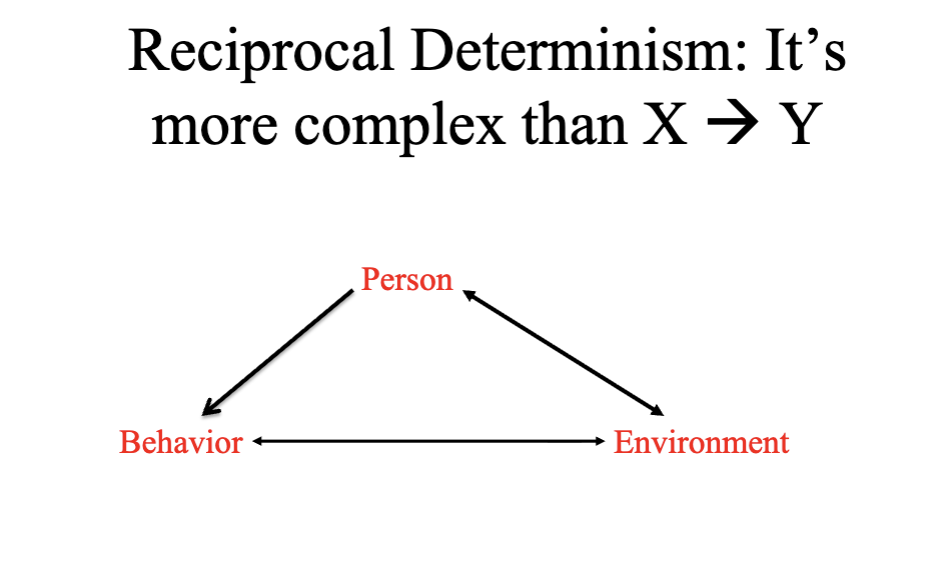
Therapy
Should be more interested in:
Learning
Modeling
Role-playing
Trial and error behavior
And less on talking!
Must increase self-efficacy
The belief “that one can organize and execute given courses of action required to deal with prospective situations” (Bandura, 1980)
By role-playing
By having the person take new skills to their own environment
“. . . Treatments that are most effective are built on the empowerment model. If you really want to help people, you provide them with competencies, build a strong self-belief, and create opportunities for them to exercise those competencies.”