Energy
 Call Kai
 Learn
Learn Practice Test
 Spaced Repetition
 Match
Match Flashcards
 Knowt Play
1/22

There's no tags or description
Looks like no tags are added yet.
Name | Mastery | Learn | Test | Matching | Spaced | Call with Kai | Chat |
|---|
No analytics yet
Send a link to your students to track their progress
23 Terms
free energy change
tells us whether that process will require energy or release energy—and if the latter is the case, how much energy it will make available to do useful work.
system
any part of the universe that we choose for study. It can be a single bacterial cell, a Petri dish containing nutrients and millions of cells, the whole laboratory in which this dish rests, or the entire Earth.
surroundings
Anything not defined as part of the system.
Isolated
Close
Open
organisms are open systems
they can exchange both energy (e.g., heat) and material (e.g., nutrients and excreted wastes) with their environments.
first law of thermodynamics
Stats energy can be converted from one form to another; but it is conserved in a closed system (and open system)
enthalpy
heat change
negative: energy released (heat loss)
positive: energy absorbed (heat gain)

reversible
always occur near a state of equilibrium
(1) it is the lowest energy state for the system
(2) the forward and reverse rates for the process are equal.
Irreversible
when systems are set up far from an equilibrium state. They then drive toward a state of equilibrium.
Entropy
is a measure of the disorder in a system.
solid to liquid to gas entropy increases
fewer moles to more moles entropy increases
The free energy change for a process at constant temperature and pressure is

-Delta G
free energy is available to do work
thermodynamically favorable (the reverse process is unfavorable)
spontaneous and exergonic
the reaction will happen without the need of help or energy. (System does not need the surrounding) this system does work on the surrounding
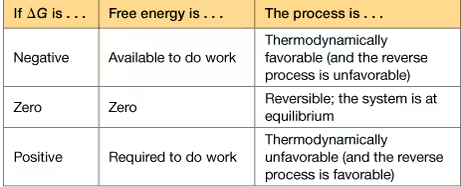
+Delta G
free energy is required to do work
thermodynamically unfavorable (the reverse process is favorable)
non-spontaneous and endergonic
reaction won’t happen unless help and energy is provided (surrounding acts on the system)

0 Delta G
free energy is r0
reversible the system is at equilibrium (forward = backward)
the system or the surroundings does not need to act upon each other
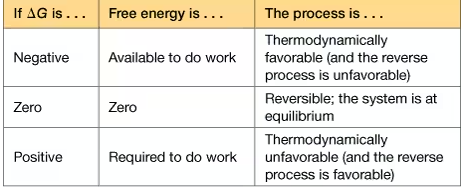
The thermodynamic favorability of a process does not determine its rate. A reaction may have a large negative free energy change but still proceed at a slow rate
true
catalyst
may increase the rate for some reactions
Q
It measures the relative ratio of products to reactants at any given, non-equilibrium moment in a metabolic pathway.

Q<K
forward reaction (formation of products)
Add more reactants or decrease products

Q>K
reverse reaction (formations of reactants)
decrease reactants or add more products

Q=K
system at equilibrium
forward and backward reactions
Total free energy
we use delta G knot as a reference point or chemical standard state

biochemical standard state

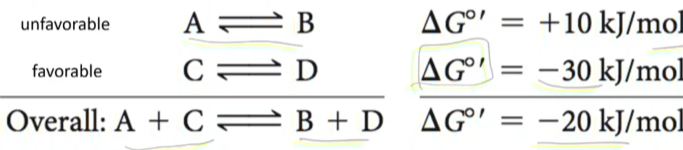
two ways to drive unfavorable reactions
Q<K are method used by manipulating the concentrations of products amount low or adding more reactants
second is coupling unfavorable reactions with favorable ones that release energy
Coupling reactions
coupling unfavorable reactions with favorable ones that release energy
used across so many different pathways in the cells such the formations of peptides, pumping, etc