Linguistics Final Quiz: Language Change
 Studied by 0 people
 Call Kai
 Learn
Learn Practice Test
 Spaced Repetition
 Match
Match Flashcards
 Knowt Play
1/40

There's no tags or description
Looks like no tags are added yet.
Name | Mastery | Learn | Test | Matching | Spaced |
|---|
No study sessions yet.
41 Terms
Synchronic Analysis
Studying the structure of a language at one point in time.
Diachronic Analysis
Studying how the structure of a language changes over time.
Historical Linguistics
branch of linguistics that investigates what kinds of language changes occur, why they occur, and how they spread.
Language Change
The natural development and modifications that occur in a language over time, affecting its . . .
phonology (patterns/organization of sounds)
morphology (how morphemes (affixes) form words)
syntax
and semantics
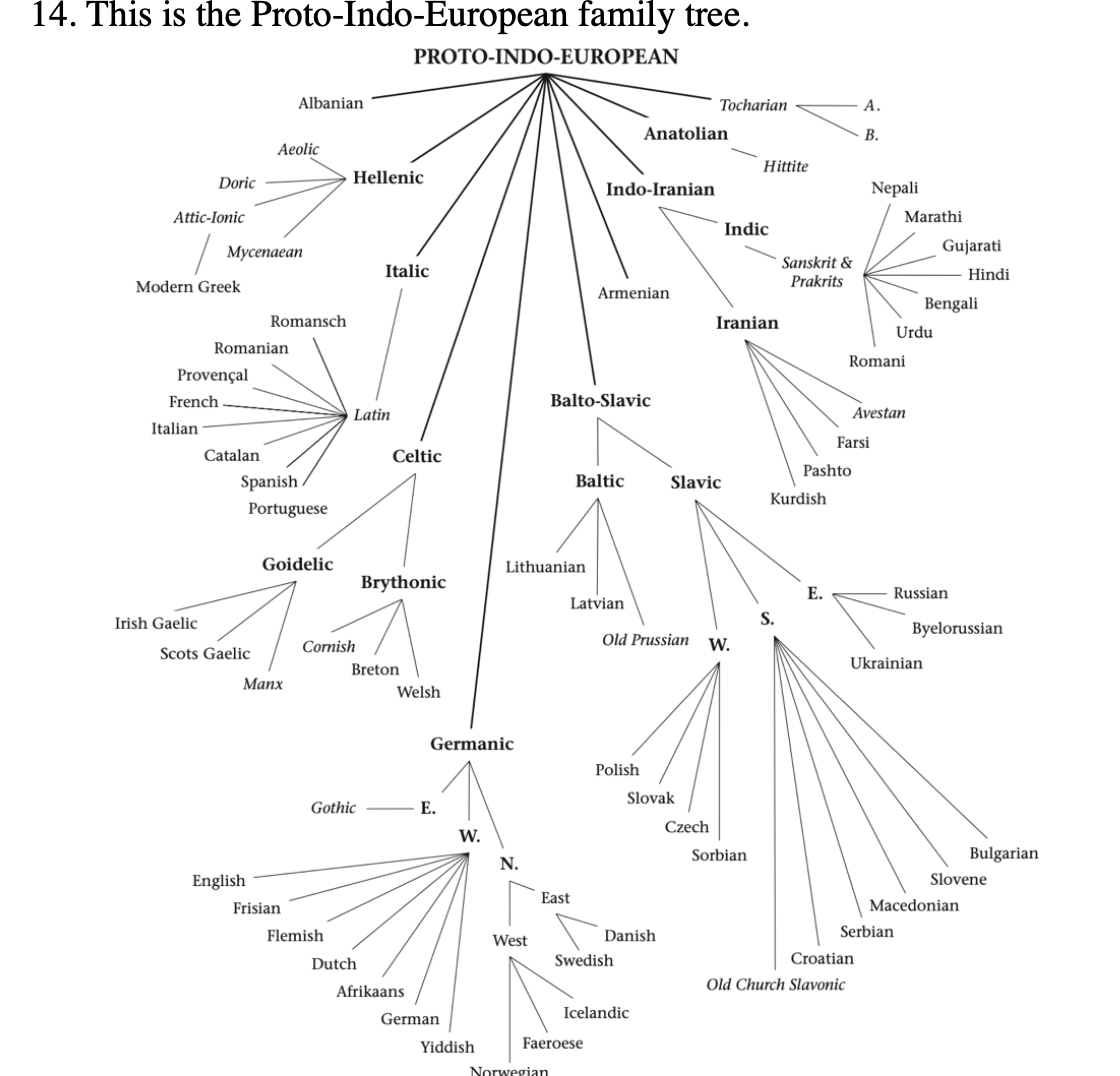
Protolanguage
the earlier common language that all the languages in a family descend.
ex: From that large language tree, the protolanguage is Proto-indo-European
Language Families
Groups of languages that share a common ancestor.
Sister Languages
Languages that share the same parent language.
Relatedness Hypothesis
Two languages may split from a single variety and then independently change, but still show systematic similarities.
Cognates
words with similar forms and meanings
Borrowing
Language adopts a word from another language (e.g., English empanadas).
reason for similarity across language
Onomatopoeia
Words that imitate sounds tend to resemble each other cross-linguistically.
reason for similarity across language.
Family Tree Model
Represents languages splitting from one protolanguage to parent languages into daughter languages.
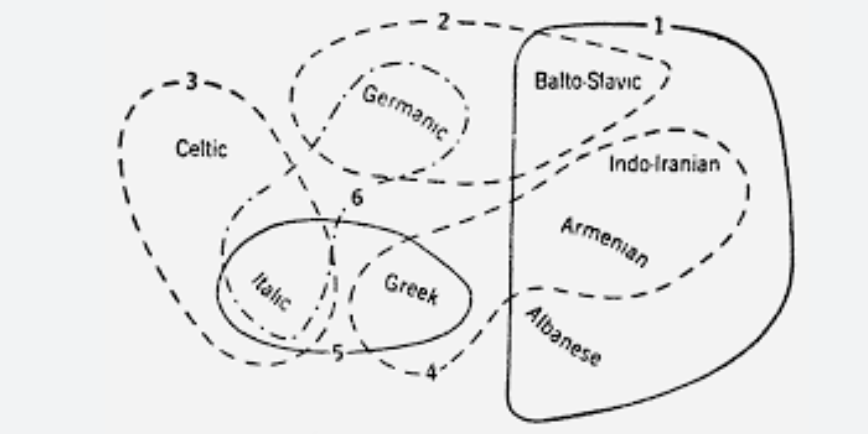
Wave Theory Model
represents the gradual spread of language - like ripples in water
Phonetic Change
change in pronunciation of an allophone in a language
ex: assimilation
Phonological Change
loss of a phoneme or a change in the distribution of allophones.
Regular Sound Change
change applies to every instance of the sound in its relevant context.
describes how consistent the sound change is.
/k/ → [tʃ] before /i/ for every word in that language
Conditioned Sound Change
a sound changes only when the sound is in a certain position, surrounded by specific other sounds, or within a particular syllable
/k/ → [tʃ] / __ {i, e} in just that instance of the rule
Unconditioned Sound Change
There is no special environment that triggers the change.
sound changes everywhere, no matter what comes before or after it = makes it regular
Assimilation
sound becomes more like a neighboring sound.
ex: The 'n' in "in-possible" becomes an 'm' because 'm' and 'p' are both bilabial, 't' in "want you" becomes a 'ch' sound
Dissimilation
sound becomes less like a neighboring sound.
ex: the tendency for the first /r/ to drop in words like "surprise" and "governor,"
Metathesis
Two sounds switch places.
Deletion
A sound is lost.
Insertion
A sound is added.
Diphthongization
A simple vowel becomes a diphthong.
Monophthongization
A diphthong becomes a simple vowel.
Raising
changes in the height of the tongue in the production of a vowel.
ex: The sound change [ʊ] (like good) to [u]
Lowering
A vowel moves to a lower tongue position.
ex: full vowel like the 'a' in "man" can be lowered to a schwa sound /ə/ in a compound word like "chairman"
Fronting
alterations in the frontness of the tongue in the production of vowels.
ex: Going from using [a] for a word like “calf” to [æ].
Backing
alterations in the backness of the tongue in the production of vowels.
Morphological Change
change in the morphological structure of a word, the introduction of new words, or the introduction of new morphological processes.
ex: Past tense of climb, used to be clomb, but now it’s climbed.
Back Formation
Creating a new base form by reanalyzing an existing word
(e.g., burglar → burgle)
Proportional Analogy
four-part proportion, such as A : B :: C : D, or A is to B as C is to D.
Semantic Extension
occur when a word takes on new appropriate contexts or referents.
Semantic Narrowing (Reduction)
A word’s meaning becomes more specific.
Semantic Elevation
A word gains a more positive meaning (e.g., knight shifting to an honorable title).
Semantic Degradation
A word gains a more negative meaning.
Comparative Reconstruction
systematic comparison of multiple related languages to hypothesize about the protolanguage they descended from
Internal Reconstruction
the analysis of data of a single language
Reasons for Language Change
loss of homogeneity due to geographical division
languages in contact with each other begin to show similarities (ex: through borrowing)
Reasons for Language Similarities
similarity in the apparatus we use to make sounds
ex: sounds [p] and [a] occur in most languages of the world because they are some of the most basic sounds a human can make
coincidentally hit upon similar ways of expressing the same meaning
ex: the Modern Greek word for eye is [mati], and the Malay word for eye is [mata].
The word is onomatopoetic (ex: words in
English, Arabic, and Mandarin for a clock ticking are [tɪktɑk], [tɪktɪk], and [tiʔtaʔ].
at one point, the two languages were the same language—but over time, the language split into two different varieties
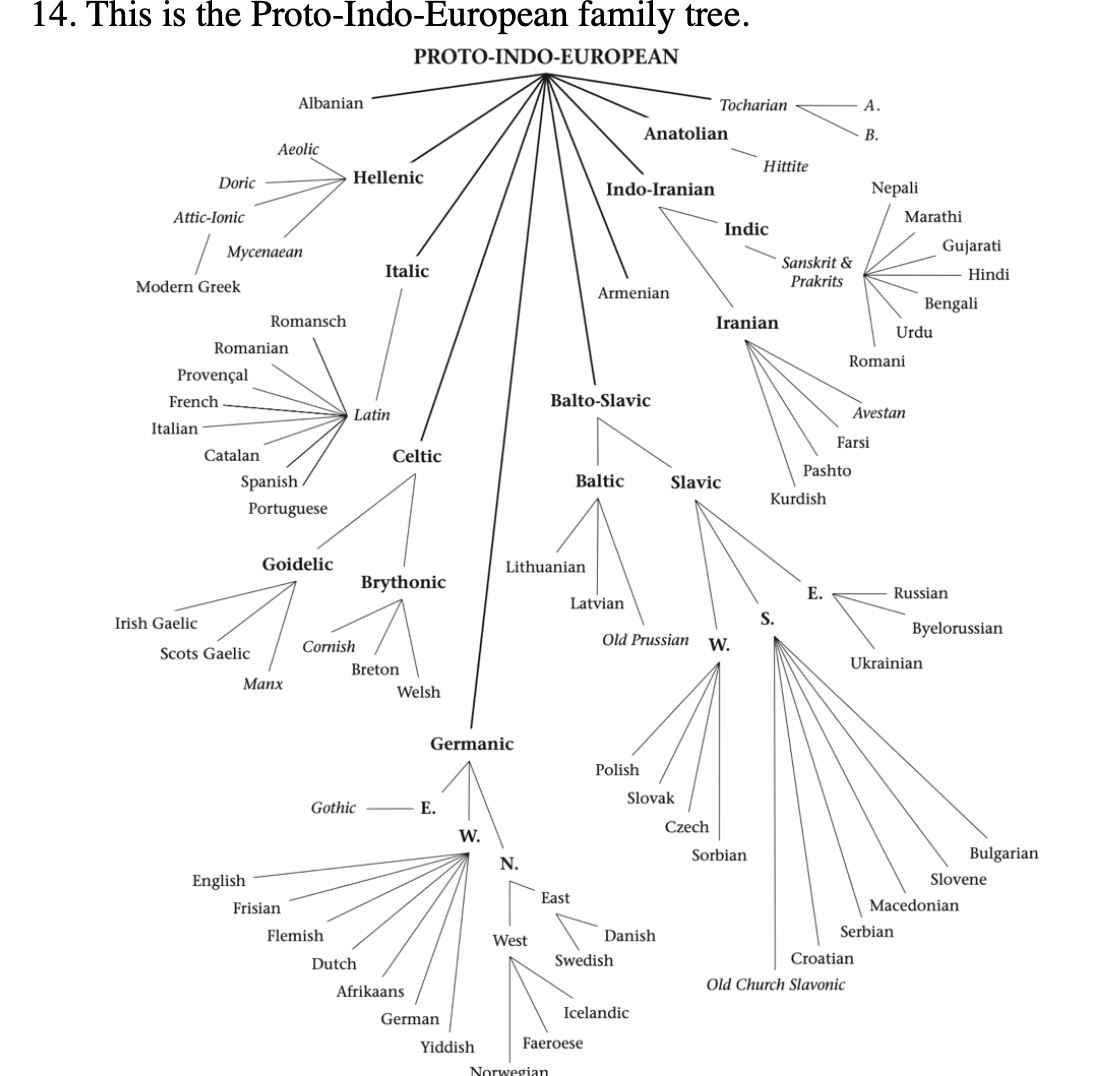
Mother/Parent language
the individual language’s most similar or nearest ancestor language.
that second main category in the language family tree
ex: Mother language of Farsi is Iranian