Organic Chemistry Substitution & Elimination (DAT)
 Call Kai
 Learn
Learn Practice Test
 Spaced Repetition
 Match
Match Flashcards
 Knowt Play
1/58

There's no tags or description
Looks like no tags are added yet.
Name | Mastery | Learn | Test | Matching | Spaced | Call with Kai | Chat |
|---|
No analytics yet
Send a link to your students to track their progress
59 Terms
Nucleophiles are electron-___
rich
Electrophiles are electron-___
poor
Nucleophiles ___ (accept/donate) electrons
donate
Electrophiles ___ (accept/donate) electrons
accept
Nucleophile strength ___ (increases/decreases) left to right across a row for both polar protic and polar aprotic solvents
decreases
I-, Cl-, Br-, HO-, HS-, and NC- are all examples of common
nucleophiles
H3C-CO-CH3, secondary LG, and tertiary carbocations are all examples of
electrophiles
___ ___ solvents form Hydrogen bonds
polar protic
___ ___ solvents cannot donate Hydrogen bonds
polar aprotic
For polar protic solvents, nucleophilicity increases ___ (up/down) a group
down
For polar aprotic solvents, nucleophilicity increases ___ (up/down) a group
up
Atoms that detach from the molecule, taking electrons
leaving groups
List three examples that are both nucleophiles and leaving groups
I-, Cl-, Br-
The best leaving groups are ___ ___
weak bases
The major, more substituted alkene product formed during an elimination reaction is called a ___ alkene
Zaitsev
You can produced the major, more substituted Zaitsev alkene through elimination with the following reagent(s)
H2SO4, heat
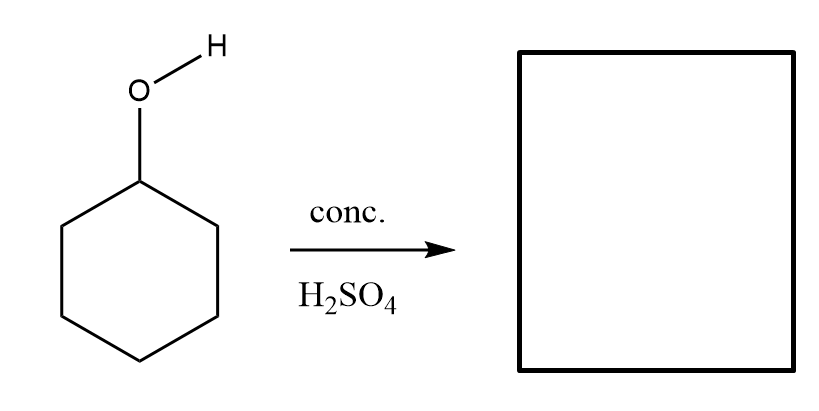
Draw the mechanism and name the product for the following reaction
but-2-ene
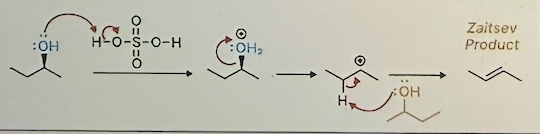
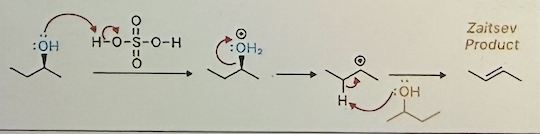
Is the following mechanism showing a dehydration or hydration reaction of an alcohol
dehydration
SN2 reactions are well known for their ___ ___
backside attack
SN2 reactions are ___ step(s)
one
In an SN2 reaction, stereochemistry ___ (is/is not) inverted
is
SN2 rate equation: rate =
k[nucleophile][substrate]
SN2 reactions are favored by ___ (strong/weak) nucleophiles
strong
SN2 reactions are favored by ___ (1/2/3) carbon substrate types
1
Common solvents for SN2 reactions include polar ___ solvents such as ___ and ___
aprotic
In SN___ and E___ reactions, the LG leaves once the nucleophile has attacked
2
SN1 reactions are ___ step(s)
two
SN1 reactions form a ___ mixture
racemic
SN1 reaction rate equation: rate =
k[substrate]
SN1 reactions are favored by ___ (strong/weak) nucleophiles
weak
SN1 reactions are favored by ___ (1/2/3) carbon substrate types
3
In SN___ and E___ reactions, the LG leaves on it’s own
1
In SN2, the rate determining step is the formation of the
carbocation
More stable carbocations allow SN1 reactions to happen ___ (faster/slower)
faster
Carbocation rearrangements only happen in what two reaction types
SN1 and E1
A hydride shift is the movement of a
hydrogen
E2 reactions are ___ step(s)
1
E2 reaction rate equation: rate =
k[base][substrate]
E2 reactions are favored by strong ___ ___
bulky bases
NaOEt and NaOMe are common bases for ___ reactions
E2
E2 reactions are favored by ___ (1/2/3) carbon substrate types
any
In an E2 reaction, the LG and attacking strong base must be ___
antiperiplanar
E1 reactions are ___ step(s)
2
E1 reaction rate equation: rate =
k[substrate]
E1 reactions are favored by ___ (strong/weak) bases
weak
H2O and ROH are common examples of bases that will undergo a(n) ___ reaction
E1
E1 reactions are favored by ___ (1/2/3) carbon substrate types
3
E1 reactions favor the ___ (heat/cold)
heat
The Zaitsev product is known as the ___ product
thermodynamic
The Hofmann product is known as the ___ product
kinetic
The thermodynamic product is the ___ substituted alkene
more
The thermodynamic product is favored by ___ bases
small
The kinetic product is the ___ substituted alkene
less
The kinetic product is favored by ___ bases
bulky
If the LG is primary, the only possible reactions are
SN2 and E2
If the LG is tertiary, the only possible reactions are
SN1, E1, and E2
If there is a bulky base, the reaction is
E2
If the solvent in polar protic, the only possible reactions are
SN1/E1
If heat is involved, the only possible reactions are
E1 and E2