Bipn 100 Part 1
 Call Kai
 Learn
Learn Practice Test
 Spaced Repetition
 Match
Match Flashcards
 Knowt Play
1/19

There's no tags or description
Looks like no tags are added yet.
Name | Mastery | Learn | Test | Matching | Spaced | Call with Kai | Chat |
|---|
No analytics yet
Send a link to your students to track their progress
20 Terms
Anatomy
the study of the structure of the body
Physiology
the study of the function of the body
Physiological mechanisms:
the molecular, cellular, and/or physical processes that underlie function
Mechanisms explain HOW things happen, NOT why
Which is the Physiological mechanism?
A) Heart rate increases when sympathetic neurons innervating the heart increase firing rate.
B) Heart rate increases during physical activity to provide the muscles with more oxygen
✔ Heart rate increases when sympathetic neurons innervating the heart increase firing rate.
✖ NOT: Heart rate increases during physical activity to provide the muscles with more oxygen
(Mechanisms explain HOW things happen, NOT why)
Levels of Organization (preview)

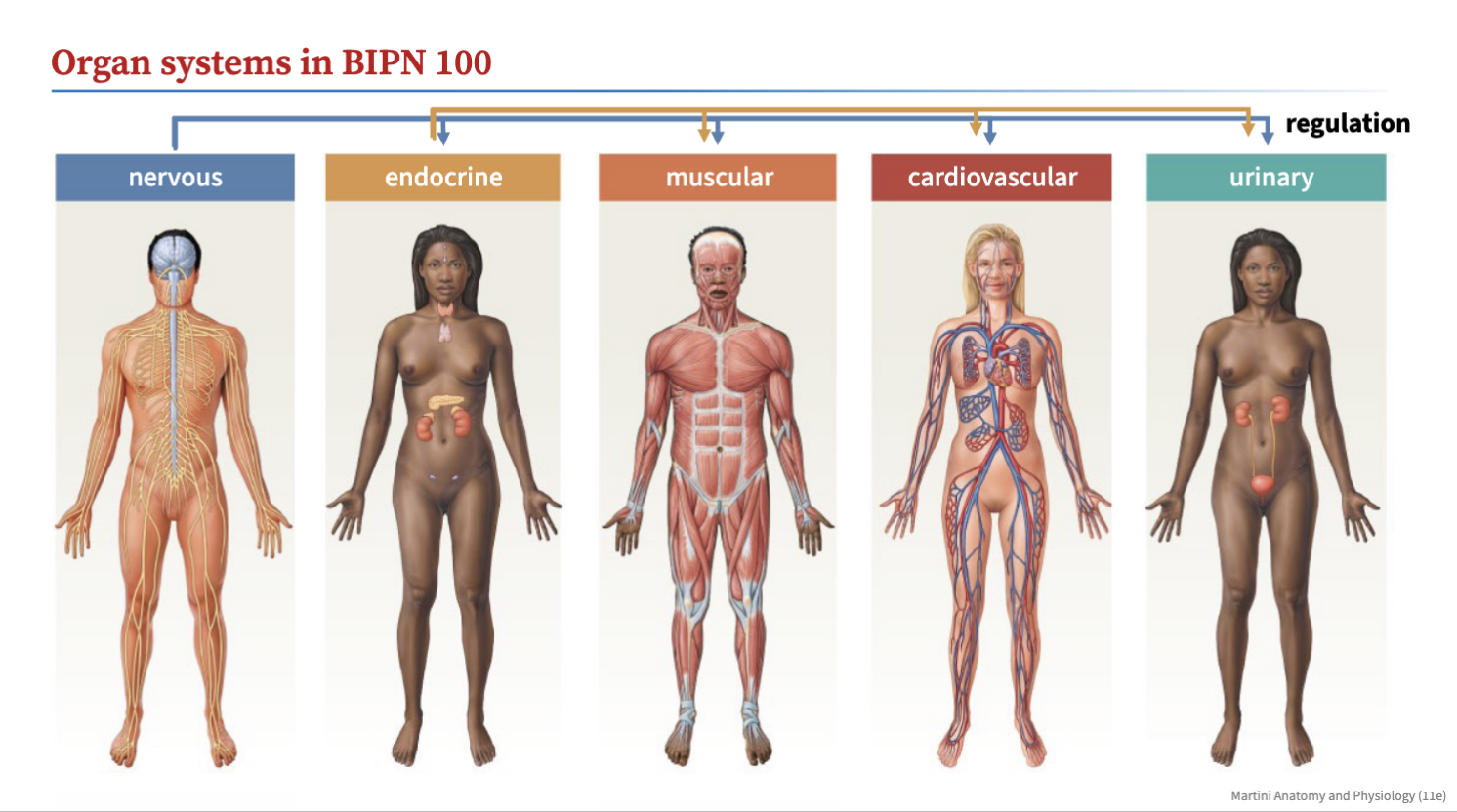
Organ systems in BIPN 100(preview)
They are all connected to each other: regulation
Homeostasis
maintaining a stable internal environment
achieved throough feedbackloops
Setpoint
ideal value or range that a living system tries to maintain for stable internal conditions
Pathology
condition/study of when a bio system deviates from its normal/helthy fucntioning, resulting in disease or injurty
What happens when teh body’s internal varibles deviate too far from its setpoint?
in response:
• Physiological mechanisms help to restore that variable.
• Failure to do so/to restore → can result in pathology.

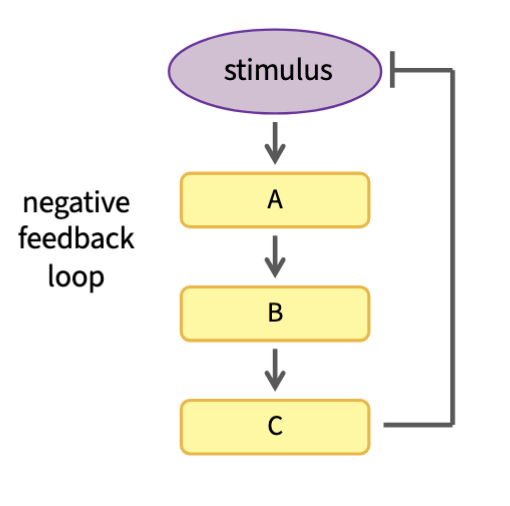
Label the parts of feedbackloops in the legend
top to bottom:
stimulus
component/action
activate/increase
inhibit/decrease
Negative Feedback Loops
Homeostasis is achieved through negative feedback loops
When the stimulus changes, the feedback loop acts AGAINST that change
There is an odd number of inhibition arrows (the one with the flat end)
Positive Feedback loops
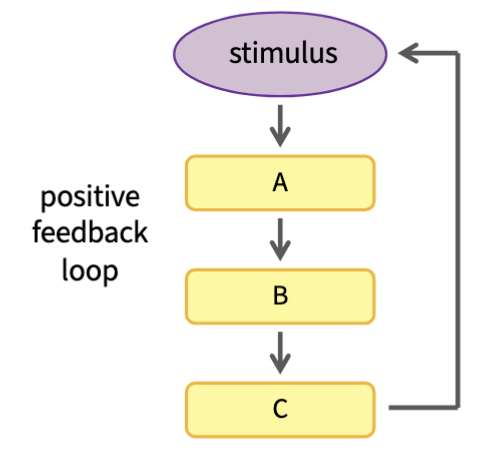
Amplification achieved through positive feedback loops (has activation arrow- the long one)
Brings the variable farther from the setpoint. Doesn’t promote homeostasis
When a stimulus changes, the feedback loop acts to BOOST that change
Even number of inhibition arrows or just none

Positive or Negative feedback loop?
Negative feedback loop
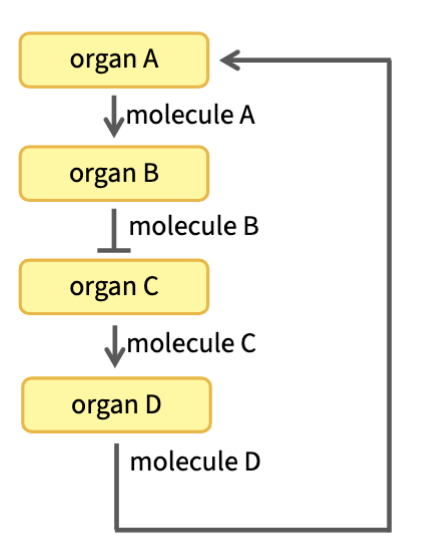
A tumor causes organ D to produce much more of molecule D compared to baseline. How will this affect the activity of organ C?
Increase or Decrease?
Decrease:
Bc issue is in organ D (acting more active than usual). Since D usually activates organ A, it is more active than organ B)
Since organ B increases and inhibits organ C, Organ C’s activity DECREASES
Organ D produces much more molecule D due to the tumor.
Molecule D points to organ A with an activating arrow, which increases organ A’s activity.
Organ A releases molecule A → increases the activity of organ B.
Organ B releases molecule B with an inhibitory bar targeting organ C, which decreases the activity of organ C.
To bring the variable back (after positive feedback), some event outside the loop is needed to stop the system from
spiraling out of control.
Childbirth example (don’t need to memorize)
Positive feedback loop with the inhibitor
Start at contraction in cycle
Stretch → oxytocin → contraction → more stretch. Each step makes the next step stronger, pushing the body away from setpoint.
The cycle can't shut itself off; an outside action must break it.
Giving birth is the outside event that stops the stretch and breaks the loop.

How does the body maintain homeostasis?
Through feedback loops
What is happening inside each arrow (in feedback loops)? What are the underlying mechanisms?
Inside each arrow of a feedback loop:
Sending the Message: An organ releases a chemical (like a hormone) to deliver instructions.
Receiving the Message: The next organ catches that chemical using special cell surface receivers.
Doing the Action: The chemical tells the receiving organ to turn ON (speed up) or turn OFF (slow down).
Midterm Concept:
Compare and contrast negative feedback and positive feedback loops in terms of their roles in the body. |
Midterm Concept: Categorize a feedback loop as negative or positive feedback, and predict the outcome when a component of the loop is perturbed.