Chapter 1: The Lifespan Perspective
 Call Kai
 Learn
Learn Practice Test
 Spaced Repetition
 Match
Match Flashcards
 Knowt Play
1/17

Earn XP
Description and Tags
Covering: The Lifespan Perspective, Developmental Debates, and Developmental Theories. Taught by Prof. Samantha Kyser.
Name | Mastery | Learn | Test | Matching | Spaced | Call with Kai | Chat |
|---|
No analytics yet
Send a link to your students to track their progress
18 Terms
What are the seven life stages, and what ages are included in each stage?
Birth/ Infancy: birth to 2 years
Early Childhood: 3-5 years
Middle/ Late Childhood: 6-12 years
Adolescence: 13 to 18 years
Early Adulthood: 19 to 29 years
Middle Adulthood: 30 to 60 years
Late Adulthood: 61+ years and older
What is the definition of Development?
The pattern of change that begins at conception and continues through the lifespan. Most development involves growth, although also includes decline brought on by aging and dying.
What is the definition of Lifespan Perspective?
Lifespan Perspective is a multidimensional approach to understanding human development that emphasizes the lifelong process of change throughout an individual's life. It involves growth, maintenance, and regulation, and is constructed by biological, sociocultural, and individual factors working together.
What is the definition of Biological Processes?
Produces change in an individual's physical body, including growth, hormonal changes, and genetic influences.
What is the definition of Cognitive Processes?
Change in thought patterns, perception, memory, and problem-solving abilities throughout an individual's development. (Thoughts, intelligence, and language)
What is the definition of Socio-emotional Processes?
Changes in an individual's emotions, personality, and social relationships. This includes how individuals connect with others, develop empathy, and respond to emotional experiences.
What are the different conceptions of age?
Chronological age: # of years elapsed since birth
Psychological age: One’s adaptive capabilities (mental & emotional)
Social age: Connectedness with others and the social roles we adopt
Biological age: The functioning of the body (vital organs) in relation to health and aging
What are the three patterns of aging?
Normal Aging: Psychological functioning peaks in early/middle adulthood, remains stable until the early 60s, then shows a modest decline through the early 80s.
Pathological Aging: Greater average decline as they age through the adult years; in old age, cognitive impairment and chronic disease impair daily functioning.
Successful Aging: Positive physical, cognitive, and socioemotional development is maintained longer.
Define the developmental debate “Nature vs. Nurture”:
Nature vs Nurture studies the extent to which your development is impacted by your biology (nature) vs your environment (nurture), including experiences and upbringing.
Define the developmental debate “Stages vs. Continuity”:
Stages vs Continuity studies the idea of development occurring in distinct/defined stages (ex. infancy → toddler) versus (slow) continuous gradual changes throughout life.
Define the developmental debate “Stability vs Change”:
Stability vs. Change examines whether individuals remain consistent in their behaviors and personality traits throughout life or undergo significant changes due to experiences and environmental factors.
Briefly define the 8 stages of Erikson’s Psychosocial Theory:
Erikson’s 8 stages of psychosocial development describe the social and emotional challenges faced at different stages/crises through life, including:
Trust vs. mistrust (infancy): Will you trust the world is good and safe?
Autonomy vs. shame/doubt (1-3 years): developing a sense of personal control and independence.
Initiative vs. guilt (3-6 years): asserting control and power over the environment - will your behavior be purposeful and responsible?
Industry vs. inferiority (6-12 years): coping with new social and academic demands, mastering knowledge and intellectual skills.
Identity vs. role confusion (12-18 years): exploring personal identity and sense of self. explore roles in a healthy way, find a positive path in life, and then develop a positive identity.
Intimacy vs. isolation (early adulthood): forming healthy friendships and intimate romantic relationships.
Generativity vs. stagnation (middle adulthood): creating or nurturing things that will outlast oneself. helping the next generation lead helpful lives.
Integrity vs. despair (late adulthood): reflecting on life and feeling a sense of fulfillment or regret.
⭐️ Erikson’s = 8 letters, 8 stages

Briefly describe Piaget’s Cognitive Theory and why he faced some criticism:
Piaget's Cognitive Theory outlines how children progress through four stages of cognitive development:
Sensorimotor (0-2 years): Infants learn through sensory experiences and motor actions, developing object permanence.
Pre-operational (2-7 years): Children begin to use symbols and language but lack concrete logic; egocentric thinking predominates.
Concrete operational (7-11 years): Logical thinking develops, allowing children to perform operations on concrete objects and understand conservation.
Formal operational (12 years and up): Abstract reasoning, problem-solving, hypothetical and deductive thinking emerge.
He faced criticism for underestimating children's cognitive abilities and not accounting for cultural differences in learning because he only studied his own children.
Define assimilation and accommodation relating to Piaget:
Assimilation refers to the process of incorporating new information into existing knowledge (cognitive schemas).
Accommodation is the process of adjusting our schemas to fit new information and events.
What is Vygotsky’s Sociocultural Cognitive Theory? Explain the Zone of Proximal Development:
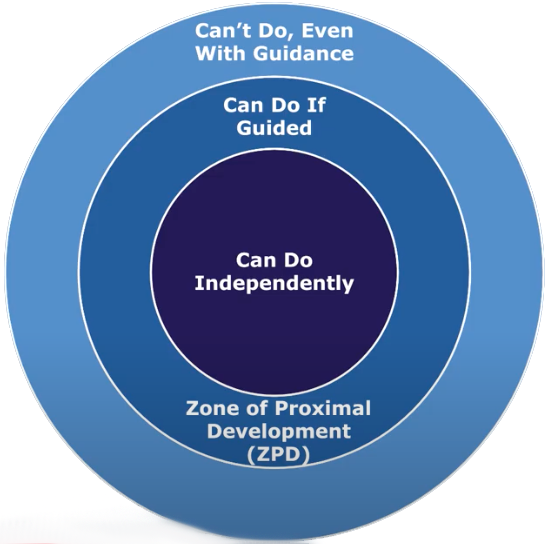
Vygotsky’s Sociocultural Cognitive Theory emphasizes that cognitive development is driven by social interaction, language, and cultural context.
Zone of Proximal Development (ZPD): The range between what a learner can do independently versus with guided support (scaffolding).
Define Skinner’s Behaviorist Theory:
Skinner's Behaviorist Theory says that behavior is learned through conditioning, primarily operant conditioning, in which rewards and punishments shape it. Positive reinforcement increases the likelihood that a behavior will be repeated, while punishment decreases it.