chapter 5 - chromatography
 Call Kai
 Learn
Learn Practice Test
 Spaced Repetition
 Match
Match Flashcards
 Knowt Play
1/24

There's no tags or description
Looks like no tags are added yet.
Name | Mastery | Learn | Test | Matching | Spaced | Call with Kai | Chat |
|---|
No analytics yet
Send a link to your students to track their progress
25 Terms
what is the mobile phase?
solvent
what is the stationary phase?
a solid
how does chromatography work?
it works to separate substances based on their interactions with a mobile and stationary phase
the more a substance interacts with the stationary phase…
the longer it will take to reach the bottom of the column/plate
this means, it will take longer to ‘elute’
what can chromatography use the different elution times of different substances for?
separate substances as they leave the column or plate at different times
identify substances using Rf values
what is the retention time?
in gas chromatography, it is the time taken for the substance to elute from the column (travel up the column)
what do different retention times show you?
large retention time: substance interacts strongly with the stationary phase
small retention time: substance interacts weakly with the stationary phase
what is thin-layer chromatography?
a type of chromatography used to identify and separate chemicals in a mixture
thin layer chromatography: setup the apparatus
use an aluminium TLC plate coated in silica or alumina
the substances to be separated or identified must be dissolved in organic solvent and dotted along the bottom of the TLC plate
the TLC plate is placed in a closed jar with a small amount of organic solvent inside
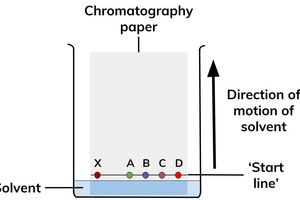
thin layer chromatography- run the experiment?
the jar is left and the organic solvent in the jar rises up the TLC plate and over the dots
the TLC plate is removed when the solvent front (top of the rising solvent on the plate) nears the top edge of the plate
we can now use this TLC plate to either identify or separate the components in the mixture
thin layer chromatography - evaluate the results?
the mobile phase is the organic solvent (typically apolar) and the stationary phase is the TLC plate (typically polar)
the more polar substances will interact more with the stationary phase and so will be found lower down the plate
the less polar substances will interact more with the mobile phase and so will rise with the solvent more quickly and will be found higher up the plate
how to identify substances from the TLC plate?
by calculating the Rf value
Rf = distance travelled by substance / distance travelled by solvent
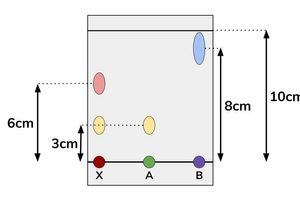
what do the Rf values depend on?
the solvent that they are measured in
the identification process is comparing the Rf value of the reference and tested substance
calculation of Rf- example?
we have a mixture and we suspect that it contains a particular component, e.g- propanol
since Rf values are relative to the conditions, we must only compare values measured under the same conditions
the best way to do this is to add a spot of the suspected component, e.g-propanol, to the same TLC plate as the mixture, and run them together - then we can see if the Rf values align
if the Rf values do align, there is significant evidence that the suspected component is in the mixture
why can some chemicals not be identified in TLC?
because they are not visible- these are called colourless chemicals
what are the different ways for locating colourless chemicals?
fluorescent dyes
iodine
fluorescent dyes?
fluorescent dyes are visible when UV light is shone on them
this allows us to see where the spot of the colourless chemical is and so we can calculate its Rf value
iodine?
iodine turns the colourless spots purple
this is another method that allows us to see where the spot of the colourless chemical is so that we can calculate its Rf value
what is another type of chromatography?
gas chromatography
gas chromatography: experimental set-up?
a column is packed with a solid
a mixture of the vaporised sample is passed through the column in an inert carrier gas under pressure at high temperature
the sample needs to be a gas, liquid or volatile solid to be carried through the column
the high temperature causes the sample to vaporise

gas chromatography: mobile and stationary phase?
the mobile phase is the inert carrier gas
the stationary phase is the solid in the column
the most volatile substances will elute from the column first as they will spend more time in the mobile phase

how does gas chromatography work?
liquid samples are vaporised and carried through the column by a carrier gas
the liquid sample will have a different retention time depending on whether it is more attracted to the carrier gas or the tubes of the column
the retention time is specific to a particular compound
what does a calibration curve allow you to do?
allows you to determine concentrations
first, you make up solutions of a known concentration, and then use the gas chromatography machine to find the peak integrals of the sample at different concentrations
you plot the peak integral against concentration, and this gives you a calibration curve
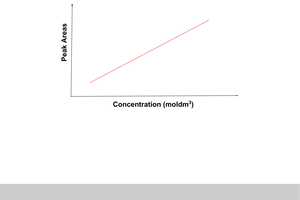
how to use a calibration curve?
carry out your experiment on a sample of unknown concentration
then, take the peak integral value and compare it with the curve
this gives the concentration of the sample
what is the retention time?
time taken for the substance to pass through the gas chromatography column
retention time can be used to identify a compound